
Your liver is the hardest working organ in your body. It filters toxins, processes nutrients, and helps you digest food without asking for a break. But when you pour alcohol into that system regularly, it starts to pay a heavy price. Many people think liver damage only happens after decades of heavy drinking, but the truth is much more urgent. The journey from a healthy liver to alcoholic liver disease can happen faster than you expect, and understanding the stages is your best defense.
We used to call this condition "alcoholic liver disease," but medical experts at the American Association for the Study of Liver Diseases (AASLD) updated the term to "alcohol-associated liver disease" (ALD) in 2019. Why the change? To reduce stigma. Alcohol causes the injury, not necessarily an addiction label. Whether you drink socially or heavily, the biological impact on your liver follows a predictable path. Knowing where you stand on that path can save your life.
The Silent Start: Hepatic Steatosis (Fatty Liver)
It all begins with fat. This first stage is called hepatic steatosis, also known as alcoholic fatty liver disease. When you consume more than four units of alcohol per day-about 32 grams of pure alcohol-your liver gets overwhelmed. Instead of processing the alcohol efficiently, it starts storing excess energy as fat droplets inside liver cells.
This isn't just a minor glitch. Studies show that 90% of people who drink heavily develop this condition. In fact, research published in the Journal of Hepatology found that fat accumulation can begin within just 72 hours of sustained heavy drinking. That’s three days. You don’t need years of abuse to start damaging your liver; you just need a few bad weeks.
The scary part? Most people feel fine. About 95% of patients with hepatic steatosis are completely asymptomatic. You might have slightly elevated liver enzymes (specifically, an AST-to-ALT ratio greater than 2), but you won’t feel sick. However, this stage is fully reversible. If you stop drinking entirely for 4 to 6 weeks, your liver can clear out the fat. A 2017 clinical trial showed that 85% of participants saw complete resolution of steatosis after six weeks of abstinence. It’s a clean slate if you take it.
| Stage | Time to Develop | Reversibility | Action Required |
|---|---|---|---|
| Hepatic Steatosis | 3-5 days of heavy drinking | Fully Reversible | Complete abstinence for 4-6 weeks |
| Mild Alcoholic Hepatitis | Years of chronic use | Potentially Reversible | Immediate cessation + medical care |
| Cirrhosis | 10+ years | Irreversible (but stabilizable) | Lifelong abstinence + management |
The Turning Point: Alcoholic Hepatitis
If you keep drinking past the fatty liver stage, inflammation sets in. This is alcoholic hepatitis (now often called alcohol-associated hepatitis or AH). About 30-35% of people with persistent fatty liver move to this stage. It’s no longer silent. Your liver is actively inflamed and cells are dying.
You might notice yellowing of the skin and eyes (jaundice), which appears in 85% of moderate-to-severe cases. You could feel extreme fatigue, lose your appetite, or develop swelling in your abdomen (ascites). Doctors use the Maddrey Discriminant Function (mDF) score to measure how bad it is. If your score is 32 or higher, it’s considered severe, carrying a 30-40% short-term mortality rate. That means nearly one in three people with severe AH die within a month without proper treatment.
Treatment usually involves corticosteroids like prednisolone to calm the inflammation. The STOPAH trial showed that steroids reduced 28-day mortality from 20.2% to 17.6%, though only about 40% of patients actually respond to the drug. The most critical factor remains stopping alcohol immediately. Mild cases (mDF <32) can sometimes reverse with abstinence alone, but severe cases require hospitalization and aggressive care.
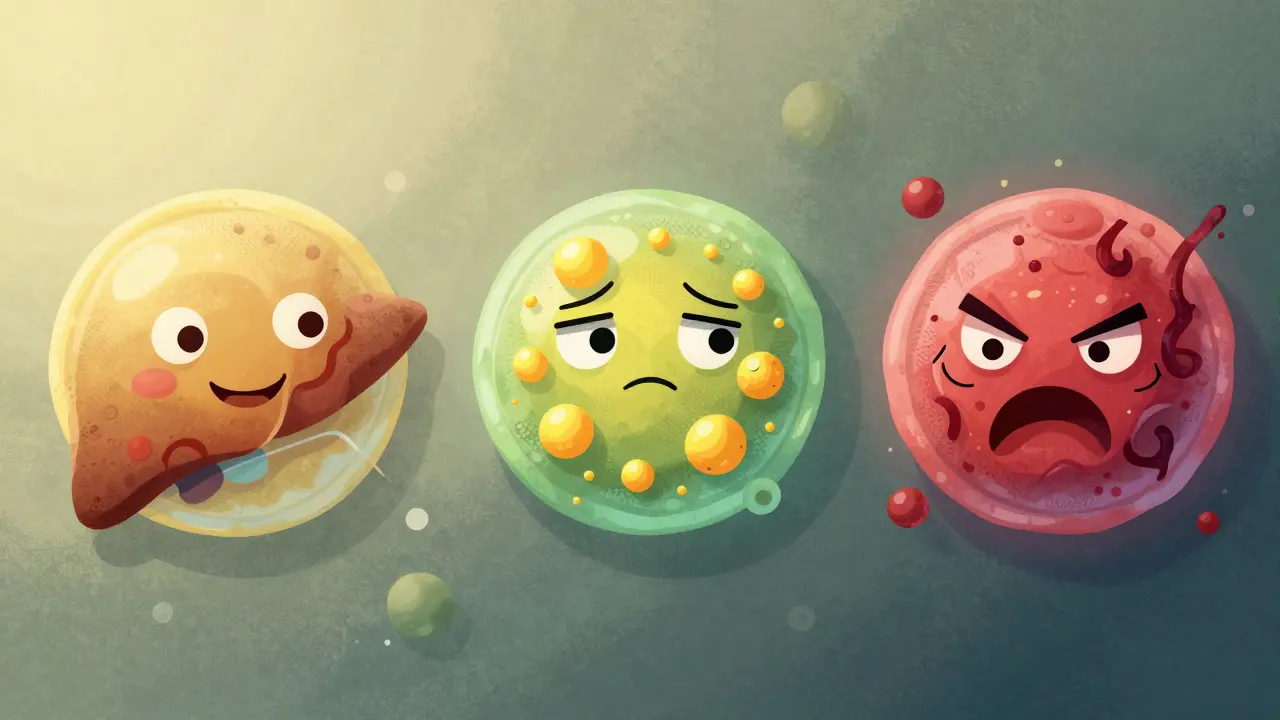
The Final Stage: Cirrhosis
When inflammation persists for years, scar tissue replaces healthy liver cells. This is cirrhosis. It develops in about 10-20% of chronic heavy drinkers. At this point, more than 75% of your normal liver architecture is gone, replaced by hard, non-functioning scar tissue. Doctors classify this as F4 fibrosis on the Metavir scale.
Cirrhosis is generally irreversible. You cannot un-scar a liver. However, that doesn’t mean you’re doomed. Complete alcohol abstinence can stabilize the condition in 50-60% of compensated cirrhosis cases. "Compensated" means your liver is still doing enough work to keep you alive, even if it’s damaged. With abstinence, your five-year survival rate jumps from 30% to 70-90%. Without it, median survival drops to less than two years.
Things get dangerous when cirrhosis becomes "decompensated." This means complications kick in:
- Variceal bleeding: Swollen veins in the esophagus burst. Propranolol medication can reduce this risk by 45%.
- Hepatic encephalopathy: Toxins build up in the brain, causing confusion. Lactulose helps clear these toxins, cutting recurrence by 50%.
- Ascites: Fluid builds up in the belly, requiring drainage and diuretics.
- Hepatocellular carcinoma: Liver cancer risk rises to 3-5% annually in cirrhotic patients.
If decompensation occurs, the five-year mortality rate hits 50% without a liver transplant. Transplantation is the only cure for end-stage disease, offering a 70-75% five-year survival rate post-surgery. Most centers require six months of documented sobriety before listing you, emphasizing that quitting is non-negotiable.
Who Is at Risk? Beyond Just Drinking
You might wonder why some people drink heavily for decades and stay healthy, while others crash quickly. It’s not just about volume. Several factors accelerate liver damage:
- Gender: Women are 2-3 times more likely to develop ALD at lower alcohol doses. They have less of the enzyme that breaks down alcohol and higher stomach absorption rates.
- Genetics: Variations in genes like PNPLA3 and TM6SF2 make some livers more prone to fat storage and scarring.
- Metabolic Syndrome: Obesity, diabetes, and high cholesterol compound the damage. Having NAFLD (non-alcoholic fatty liver disease) plus drinking accelerates fibrosis progression significantly.
- Viral Hepatitis: Co-infection with Hepatitis B or C multiplies the risk of rapid decline.
A 2023 study in JAMA Internal Medicine highlighted a worrying trend: ALD hospitalizations among adults aged 25-34 rose by 65% between 2010 and 2020, especially among women. Younger people are hitting the wall harder and faster.

Diagnosis and Detection
Catching ALD early saves lives. Since early stages are silent, regular check-ups matter. Blood tests looking at ALT and AST levels are standard. An AST-to-ALT ratio greater than 2 is a classic red flag for alcohol-related injury.
Historically, a liver biopsy was the gold standard for diagnosis. Today, non-invasive tools like transient elastography (FibroScan) detect significant fibrosis with 85-90% accuracy. It’s painless and quick. New biomarkers, like the ALive panel currently in Phase 3 trials, promise to detect early fibrosis with 89% accuracy without any needles.
Don’t wait for symptoms. By the time you see jaundice or feel abdominal pain, you’re likely in the hepatitis or cirrhosis stage. Early detection through blood work and imaging gives you the chance to reverse damage before it becomes permanent.
Recovery Is Possible
The narrative around liver disease is often grim, but recovery stories are powerful. Patient data from the British Liver Trust shows that individuals who achieved complete abstinence within six months of a fatty liver diagnosis reported full recovery in 80% of cases. One patient shared, "After my fatty liver diagnosis at 38, six months of abstinence and weight loss normalized my liver enzymes completely."
Conversely, delaying action has consequences. Those who waited over a year to quit had only a 35% reversal rate. And continuing to drink despite diagnoses leads to rapid decline: 32% of decompensated cirrhosis cases involved patients who continued drinking despite multiple hospitalizations.
Support matters. Integrated care combining hepatology and addiction medicine improves abstinence rates to 65% at one year, compared to 35% with liver specialists alone. You don’t have to do this alone. Counseling, support groups, and medications can help you stay sober long enough for your liver to heal.
How long does it take for alcohol to cause liver damage?
Fat accumulation (steatosis) can begin within 3-5 days of heavy drinking. Significant inflammation (hepatitis) typically develops after 5-10 years of chronic heavy use, but can occur sooner with binge drinking. Cirrhosis usually takes 10 or more years.
Is fatty liver from alcohol reversible?
Yes. Hepatic steatosis is fully reversible with complete alcohol abstinence for 4-6 weeks. Studies show 85% of people see complete resolution if they stop drinking during this window.
What are the symptoms of alcoholic hepatitis?
Common symptoms include jaundice (yellow skin/eyes), abdominal swelling (ascites), extreme fatigue, loss of appetite, and fever. Severe cases may involve confusion (encephalopathy) or bleeding.
Can you live a normal life with cirrhosis?
If caught early (compensated cirrhosis) and you remain strictly abstinent, yes. Survival rates improve dramatically, and many people live for decades. Decompensated cirrhosis requires intensive management and potentially a transplant.
Why do women develop liver disease faster than men?
Women have lower levels of alcohol dehydrogenase (the enzyme that breaks down alcohol) and absorb more alcohol into their bloodstream. This means they reach toxic liver concentrations with fewer drinks than men.