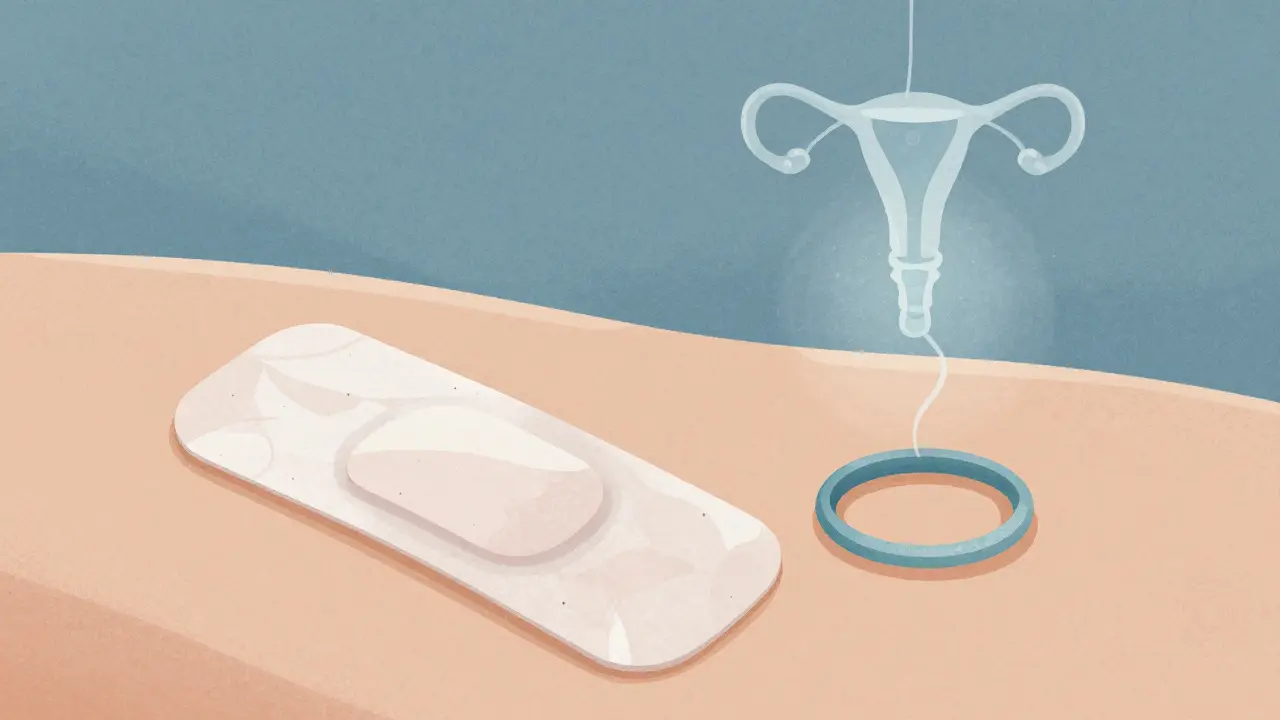
Choosing birth control feels like solving a puzzle where the pieces keep changing. You have the contraceptive patch, which sticks to your skin; the vaginal ring, which sits inside you; and the IUD, a tiny device placed in the uterus. Each promises protection, but they come with very different safety profiles, side effects, and levels of effort on your part.
If you are trying to decide between these three popular methods, you need more than just marketing slogans. You need to understand the real-world data on pregnancy rates, serious health risks like blood clots, and how each method affects your daily life. The gap between "perfect use" and "typical use" is where most people get tripped up, especially with short-acting methods like the patch and ring compared to long-acting devices like IUDs.
How They Work: Mechanism and Delivery
To understand the risks, you first have to understand what these devices are actually doing to your body. The contraceptive patch (such as Xulane® or Ortho Evra®) and the vaginal ring (NuvaRing®) are both combined hormonal contraceptives. This means they deliver two types of hormones: estrogen and progestin.
The patch delivers 150 mcg of norelgestromin and 35 mcg of ethinyl estradiol daily through your skin. You wear it for three weeks and take it off for one week. The vaginal ring releases 0.12 mg of etonogestrel and 0.015 mg of ethinyl estradiol daily. You insert it for three weeks and remove it for one week. Both methods work primarily by stopping ovulation-preventing your ovaries from releasing an egg.
In contrast, Intrauterine Devices (IUDs) work differently depending on the type. There are two main categories:
- Copper IUDs (Paragard®): These contain no hormones. Instead, they release copper ions that create a local inflammatory response toxic to sperm and eggs. It acts as a barrier and a spermicide inside the uterus.
- Hormonal IUDs (Mirena®, Liletta®, Kyleena®, Skyla®): These release levonorgestrel, a progestin hormone. They thicken cervical mucus to block sperm and thin the lining of the uterus. In many women, they also stop ovulation, though not always consistently in every cycle.
This distinction is crucial because estrogen-the hormone found in the patch and ring-is linked to specific cardiovascular risks that progestin-only and non-hormonal methods do not carry.
Efficacy: Typical Use vs. Perfect Use
You might think all these methods are equally effective if used correctly. While true in a lab setting, real life is messy. A 2022 review in JAMA Network Open by Keder et al. highlights a stark difference in failure rates based on how humans actually behave.
| Method | Typical Use Failure Rate | Primary Reason for Failure |
|---|---|---|
| Contraceptive Patch | ~9% (approx. 4.55 for short-acting combined) | Forgetting to change weekly, detachment |
| Vaginal Ring | ~7-9% (approx. 4.55 for short-acting combined) | Incorrect insertion/removal timing |
| IUD (Hormonal & Copper) | <1% (0.27) | Expulsion (rare), user error during insertion |
Short-acting methods like the patch and ring require active participation every single week or month. If you forget to swap the patch on Sunday, or leave the ring out for too long during your break, your protection drops significantly. IUDs are Long-Acting Reversible Contraceptives (LARCs). Once inserted, they work continuously for 3 to 12 years without any daily, weekly, or monthly action from you. This "set it and forget it" nature is why their failure rate is so low-human error is largely removed from the equation.
Safety Profile: Blood Clots and Cardiovascular Risk
This is where the safety differences become critical. The presence of estrogen in the patch and ring increases the risk of venous thromboembolism (VTE)-blood clots in the legs or lungs.
According to the 2022 JAMA review, estrogen-containing methods increase VTE risk from a baseline of 2-10 events per 10,000 woman-years to 7-10 events per 10,000 woman-years. While these numbers sound small, the relative risk is significant. Some studies suggest the patch may deliver higher peak levels of estrogen than oral pills, potentially posing a slightly higher clot risk, though this remains debated. The FDA has issued warnings regarding this potential.
Who should avoid the patch and ring entirely? If you fall into any of these categories, estrogen-based contraception is generally contraindicated:
- Women over 35 who smoke cigarettes.
- People with a history of migraines with aura.
- Those with uncontrolled hypertension (high blood pressure).
- Individuals with a personal history of blood clots or stroke.
IUDs bypass this risk entirely. Hormonal IUDs release progestin locally, resulting in minimal systemic absorption compared to the patch or ring. Copper IUDs are hormone-free. For women with cardiovascular risk factors, IUDs are often the safest choice, as recommended by the American College of Obstetricians and Gynecologists (ACOG).
Side Effects: What Your Body Will Feel
Safety isn't just about rare, serious events; it's also about quality of life. Side effects are the number one reason people switch methods.
The Patch: Skin irritation is common. About 42% of users report redness or itching at the application site. Additionally, because the patch delivers hormones continuously, some users experience breakthrough bleeding or spotting, especially in the first few months. Adhesion is another issue; humidity, swimming, or friction can cause the patch to detach. Studies show partial detachment occurs in about 2.8% of cycles, requiring a backup method.
The Vaginal Ring: Many users find the ring convenient, but 38% report vaginal discomfort or issues with expulsion during intercourse. Breakthrough bleeding is less common than with the patch, but withdrawal bleeding during the ring-free week can be heavier. One major advantage is steady hormone levels, which can mean fewer mood swings compared to the pill, but individual experiences vary wildly.
IUDs: The side effect profile splits sharply between copper and hormonal types.
- Copper IUD (Paragard): Expect heavier periods. Many users report longer duration, stronger cramps, and increased flow. For some, this is manageable; for others, it leads to anemia or discontinuation. However, it is excellent for those who want zero hormones.
- Hormonal IUDs (Mirena, etc.): Most users experience lighter periods. After 6-12 months, many stop having periods altogether (amenorrhea). Initially, irregular spotting is very common. Some users also report acne improvement or worsening, breast tenderness, or ovarian cysts (which are usually benign and resolve on their own).
Insertion, Maintenance, and Cost
Practical logistics matter just as much as biology. Can you handle the routine?
The patch requires weekly discipline. You must apply it to clean, dry skin on your abdomen, buttock, upper arm, or torso (not the breast). If it falls off for more than 24 hours, you need backup contraception. The cost ranges from $15 to $80 monthly without insurance.
The ring requires monthly insertion and removal. You learn to insert it yourself. It can be tricky for some due to body image concerns or physical difficulty, but most adapt quickly. Costs range from $0 to $200 monthly depending on insurance coverage.
IUDs require a clinical procedure. Insertion takes 5-10 minutes but can be painful, comparable to strong menstrual cramps. However, once in, you don't touch it again for years. Upfront costs are high ($0-$1,300), but because they last 3-12 years, they are far more cost-effective over time. If you have Medicaid or comprehensive private insurance under the ACA, the IUD is often free.
Which Method Is Right for You?
There is no single "best" method, only the best method for your specific health profile and lifestyle.
Choose the IUD if you want the highest efficacy, lowest maintenance, and have risk factors for blood clots. It is the gold standard for safety and convenience according to most experts, including Dr. Jen Gunter, OB/GYN. If you hate heavy periods, go hormonal. If you want no hormones, go copper, but prepare for heavier flows.
Choose the Vaginal Ring if you want hormonal benefits without daily pills, prefer a lower estrogen dose than the patch, and are comfortable with self-insertion. It is a good middle ground for those who cannot tolerate IUD insertion pain or desire immediate reversibility without a doctor's visit.
Choose the Patch if you struggle with remembering daily pills or inserting a ring, and you have no cardiovascular risk factors. Be aware that it is visible on your body, which may be a privacy concern for some. Ensure you have a plan for adhesion issues during hot weather or exercise.
Is the contraceptive patch safer than the pill?
The patch contains similar hormones to the pill but delivers them through the skin. Some studies suggest the patch may result in higher peak levels of estrogen, potentially increasing the risk of blood clots compared to low-dose oral contraceptives. However, for healthy, non-smoking women under 35, both are considered safe. The primary difference is convenience: the patch is weekly, while the pill is daily.
Can I switch from the ring to an IUD immediately?
Yes, but timing matters. To ensure continuous protection, your provider should insert the IUD during the first 5 days of your menstrual cycle or immediately after removing the ring if you are within the window of protection. If you switch mid-cycle, you may need to use backup contraception for 7 days. Always consult your healthcare provider for a personalized transition plan.
Do IUDs cause infertility?
No. IUDs are reversible contraceptives. Fertility returns quickly after removal. Studies show that women who use IUDs conceive at the same rates as those who use other forms of contraception after stopping. The myth that IUDs cause infertility stems from outdated associations with older models and infections, which are extremely rare with modern IUDs and sterile insertion techniques.
What are the signs of IUD expulsion?
Expulsion occurs when the IUD partially or completely leaves the uterus. Signs include sudden severe cramping, heavier bleeding than usual, inability to feel the IUD strings, or your partner feeling the hard plastic of the IUD during intercourse. If you suspect expulsion, use backup contraception and see your provider immediately for an ultrasound check.