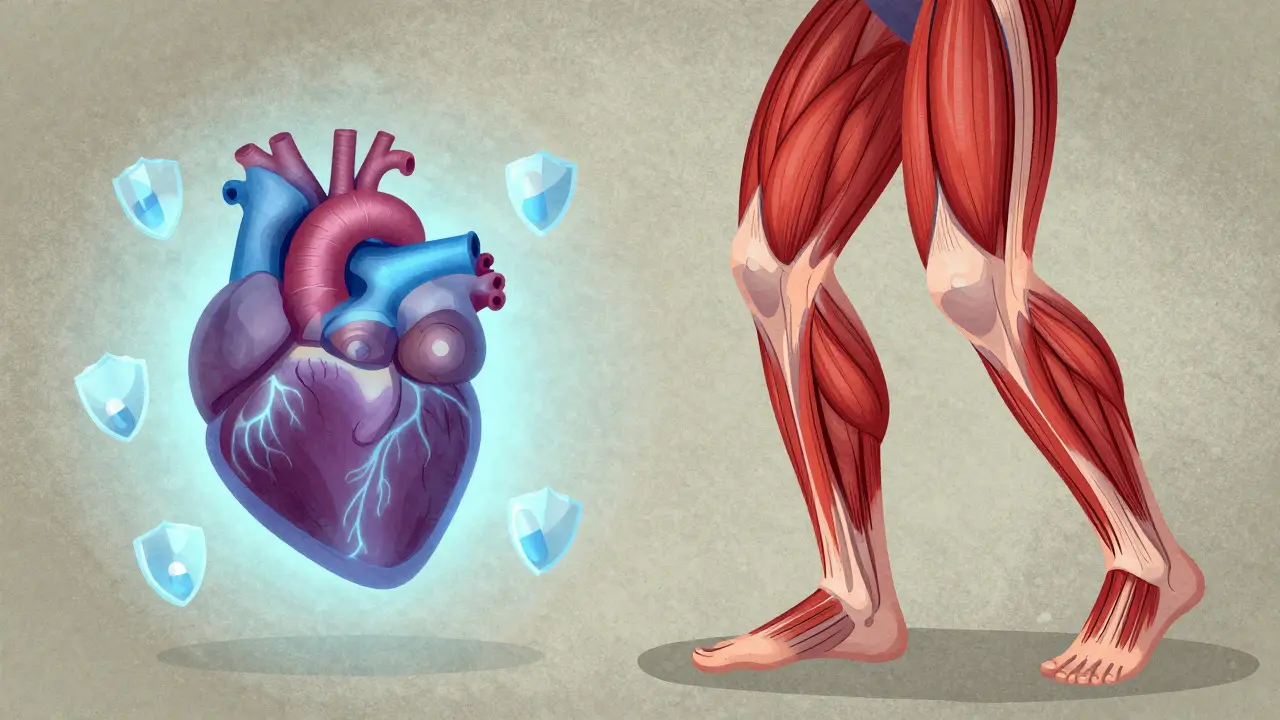
Statin Exercise Safety & Risk Calculator
Personalized Assessment
Lipophilic Statins
Atorvastatin, Simvastatin, Lovastatin
Higher muscle penetration; potentially higher risk of side effects.
Hydrophilic Statins
Pravastatin, Rosuvastatin
Lower muscle penetration; generally fewer muscle-related side effects.
Your Assessment Result
Why this matters:
Imagine you’ve been told to take a daily pill to protect your heart. You’re doing the right thing. But then, every time you go for a run or lift weights, your muscles ache in a way that feels different-deeper, slower to fade. You start wondering: is the exercise hurting me, or is it the medication? Or worse, are they teaming up against you?
This is the reality for millions of people managing cholesterol with Statins, which are HMG-CoA reductase inhibitors used to lower LDL cholesterol and prevent cardiovascular disease. While these drugs are the gold standard for heart health, a significant number of users report muscle discomfort. The big question isn't just whether you can exercise while on statins-it's how to do it safely without triggering severe pain or long-term damage.
The Reality of Statin-Associated Muscle Symptoms (SAMS)
Let’s get the numbers straight first. It’s not just "you." Clinical trials suggest that about 5% to 10% of statin users experience what doctors call Statin-Associated Muscle Symptoms (SAMS). However, real-world data paints a broader picture. A widely cited 2014 study published in *JAMA Internal Medicine* found that up to 29% of patients reported muscle-related side effects. That’s nearly one in three people.
SAMS isn’t a single condition. It ranges from mild achiness and weakness to rare but serious conditions like rhabdomyolysis, where muscle tissue breaks down rapidly. For most, it’s that nagging soreness that doesn’t quite go away after a night’s sleep. Understanding this spectrum is crucial because it changes how you approach your workout routine. If you assume all muscle pain is normal post-exercise soreness, you might miss early warning signs. If you assume all pain means you must stop exercising entirely, you risk losing the cardiovascular benefits that exercise provides.
How Exercise Interacts with Statin Therapy
Here is the core conflict: Statins work by blocking an enzyme in the liver to reduce cholesterol production. This process also reduces the synthesis of Coenzyme Q10 (CoQ10), a molecule essential for energy production in cells, including muscle cells. Research indicates that statin therapy can drop CoQ10 levels by approximately 40% within 30 days. When you exercise, your muscles demand more energy. If the fuel supply (CoQ10) is compromised, mitochondrial dysfunction can occur, leading to fatigue and pain.
But does exercise make this worse? The answer depends heavily on intensity. A pivotal study published in the *Journal of the American College of Cardiology* (JACC) in April 2023 shed light on this. Researchers measured biomarkers like creatine kinase (CK)-a protein released when muscle is damaged-in statin users before and after moderate cycling. They found no significant difference in CK elevation between symptomatic statin users, asymptomatic users, and those not on statins. This suggests that moderate-intensity exercise is generally safe and does not inherently exacerbate muscle injury in most people.
However, the story changes with high intensity. Data from Boston Marathon runners showed significantly higher CK levels in statin users compared to non-users after the race. Older athletes were particularly susceptible. This distinction between moderate and vigorous activity is the key to managing your health effectively.
| Exercise Type | Intensity Level | Risk Profile for Statin Users | Recommended Action |
|---|---|---|---|
| Moderate Aerobic | 40-70% Max Heart Rate | Low Risk | Generally safe; continue as prescribed |
| Vigorous Aerobic | 70-85% Max Heart Rate | Moderate Risk | Monitor closely; may increase CK levels |
| Eccentric Training | High Resistance/Stretch | High Risk | Avoid if experiencing SAMS symptoms |
| Prolonged Endurance | Long Duration (>4 hours) | Moderate-High Risk | Hydrate well; monitor for unusual fatigue |

Lipophilic vs. Hydrophilic Statins: Does the Drug Matter?
Not all statins are created equal when it comes to muscle penetration. This is a critical detail often overlooked. Statins fall into two categories based on their solubility:
- Lipophilic Statins: These include Atorvastatin, Simvastatin, and Lovastatin. Because they are fat-soluble, they easily cross cell membranes and penetrate muscle tissue deeply. This makes them highly effective at lowering cholesterol but also increases the likelihood of muscle side effects.
- Hydrophilic Statins: These include Pravastatin and Rosuvastatin. Being water-soluble, they stay mostly in the blood and liver, resulting in less muscle exposure and potentially fewer side effects.
Data from the STOMP trial highlighted that high-dose atorvastatin (80 mg/day) increased CK levels even in asymptomatic individuals. FDA adverse event reports from 2022 indicated that atorvastatin 80 mg carried a 10.5-fold higher risk of myopathy compared to pravastatin 40 mg. If you are struggling with muscle pain during exercise, switching from a lipophilic to a hydrophilic statin is a common and often successful strategy, with a reported success rate of 65% in clinical observations.
Practical Strategies for Managing Muscle Pain and Recovery
If you are taking statins and want to maintain an active lifestyle, you need a structured approach. Don’t just guess. Follow these evidence-based steps.
- Start Low and Go Slow: The American College of Cardiology (ACC) recommends starting with moderate walking at 3-4 METs (metabolic equivalents) for 10-15 minutes daily. Increase duration by only 5 minutes per week as tolerated. This gradual adaptation helps your muscles adjust without overwhelming them.
- Distinguish the Pain: Harvard Medical School advises using temporal analysis to identify the source of pain. Statin-related pain typically appears within 30 days of starting or changing a dose and persists regardless of activity. Exercise-induced pain follows specific workouts and resolves with rest. If the pain lingers beyond 48 hours, it’s likely related to the medication or cumulative stress, not just the workout.
- Consider CoQ10 Supplementation: Since statins deplete CoQ10, replenishing it may help. A 2023 meta-analysis in the *Journal of Clinical Lipidology* suggested that 200 mg of CoQ10 daily, combined with exercise modification, led to success in managing symptoms for many patients. Always check with your doctor before adding supplements, as interactions can occur.
- Modify High-Risk Movements: Avoid heavy eccentric exercises (like slow lowering phases in weightlifting) if you have active symptoms. These cause micro-tears in muscle fibers, which can spike CK levels significantly in statin users. Focus on concentric movements (pushing/pulling) and steady-state cardio instead.
- Monitor Biomarkers: If you have a history of SAMS, ask your doctor to check your CK levels before starting a new exercise regimen and again 24-48 hours after intense sessions. Levels exceeding 1,000 U/L (five times the upper limit of normal) warrant a pause in exercise and medical review.

When to Seek Immediate Help
Most muscle discomfort is manageable, but some signs indicate a serious problem. Watch out for:
- Dark, tea-colored urine (a sign of myoglobin release from broken-down muscle).
- Severe, unexplained muscle weakness that affects daily tasks like climbing stairs.
- Pain that is constant and not relieved by rest.
In extreme cases, such as the competitive cyclist Maria Rodriguez who developed rhabdomyolysis after combining high-dose simvastatin with intense training, hospitalization is required. Her CK levels peaked at 12,450 U/L, far above the normal range of 30-200 U/L. While rare, this underscores why listening to your body is non-negotiable.
The Future of Personalized Care
We are moving toward a more personalized approach. Genetic factors play a role; the SLCO1B1 gene variant has been identified as increasing the risk of SAMS during exercise by 2.3-fold. Dr. Robert Giugliano of Brigham and Women's Hospital predicts that within five years, genetic testing will guide both statin selection and exercise recommendations. Until then, the best tool you have is open communication with your healthcare provider.
Don’t let fear of muscle pain stop you from exercising. The cardiovascular benefits of physical activity are profound and necessary, especially for those on statins. By choosing the right type of exercise, understanding your medication, and monitoring your body’s signals, you can maintain both your heart health and your active lifestyle.
Can I still build muscle while taking statins?
Yes, but you may need to adjust your routine. Heavy resistance training, particularly eccentric movements, can increase muscle damage markers in statin users. Focus on moderate resistance with controlled tempos, prioritize recovery days, and consider supplementing with CoQ10. If pain persists, consult your doctor about switching to a hydrophilic statin like rosuvastatin.
Is CoQ10 supplementation proven to help with statin muscle pain?
Evidence is mixed but promising. While some studies show modest benefits, a 2023 meta-analysis indicated that CoQ10 supplementation (200 mg daily) combined with exercise modification improved symptom management for many patients. It works by replenishing the CoQ10 depleted by statin therapy, potentially improving mitochondrial function in muscles.
Which statin is least likely to cause muscle pain?
Hydrophilic statins, such as pravastatin and rosuvastatin, are generally associated with fewer muscle side effects because they do not penetrate muscle tissue as readily as lipophilic statins like atorvastatin or simvastatin. Pravastatin 40 mg has a significantly lower risk profile for myopathy compared to high-dose lipophilic options.
How long does it take for statin muscle pain to resolve after stopping exercise?
Normal exercise soreness should resolve within 48-72 hours. If pain persists beyond this window, especially if it is consistent regardless of activity, it may be statin-related. In cases of elevated CK levels, doctors often recommend resting until levels return to baseline, which can take several days to weeks depending on severity.