
After a colonoscopy finds and removes polyps, many people wonder: When do I need the next one? It’s not a one-size-fits-all answer. The timing depends on what kind of polyps were found, how many, and how big they were. Getting the timing right matters - too soon, and you’re wasting time, money, and discomfort. Too late, and you risk missing something that could turn into cancer.
What kind of polyps matter most?
Not all polyps are the same. The big three you’ll hear about are adenomas, sessile serrated lesions (SSLs), and hyperplastic polyps (HPs). Adenomas are the most common and the most concerning because they can turn into cancer over time. SSLs are trickier - they look harmless but can also become cancerous, often in hidden spots. HPs are usually low-risk, unless they’re large or in certain areas of the colon.Doctors don’t just count polyps. They look at size, shape, and what they look like under a microscope. A 5 mm adenoma is very different from a 15 mm one. A polyp with high-grade dysplasia or villous features is a red flag, even if it’s small. The same goes for SSLs - if they’re 10 mm or bigger, they need closer monitoring.
When to schedule your next colonoscopy
The latest guidelines from the US Multi-Society Task Force (2020) give clear intervals based on findings. Here’s what they say:- 1-2 small adenomas (≤10 mm): Wait 7-10 years. This is new. Before 2020, it was 5-10 years. Studies now show people with just one or two small adenomas have almost the same cancer risk as someone with a completely clean colon.
- 3-4 small adenomas (<10 mm): Come back in 3-5 years. This group has a slightly higher risk, so closer watch is needed.
- 5 or more adenomas: No matter the size, you need a repeat colonoscopy in 3 years. The more polyps, the higher the chance of missing something next time.
- Any adenoma ≥10 mm: Back in 3 years. Size matters. Big adenomas are harder to fully remove and carry more risk.
- Adenoma with high-grade dysplasia or villous features: 3-year follow-up. These features mean the cells are changing faster - don’t wait.
- 1-2 sessile serrated lesions (SSLs) <10 mm: 5-10 years. These are often missed during colonoscopy because they’re flat and blend in. But if you have one, you’re at higher risk for future serrated polyps.
- 3-4 SSLs <10 mm: 3-5 years. Multiple SSLs mean your colon is more prone to this type of growth.
- 5 or more SSLs: 3 years. This is a signal your colon is in a high-risk state.
- Hyperplastic polyps ≥10 mm: 3-5 years. If the polyp is large, it’s harder to tell if it’s really just a harmless HP or something more dangerous like an SSL.
What about big polyps that were removed in pieces?
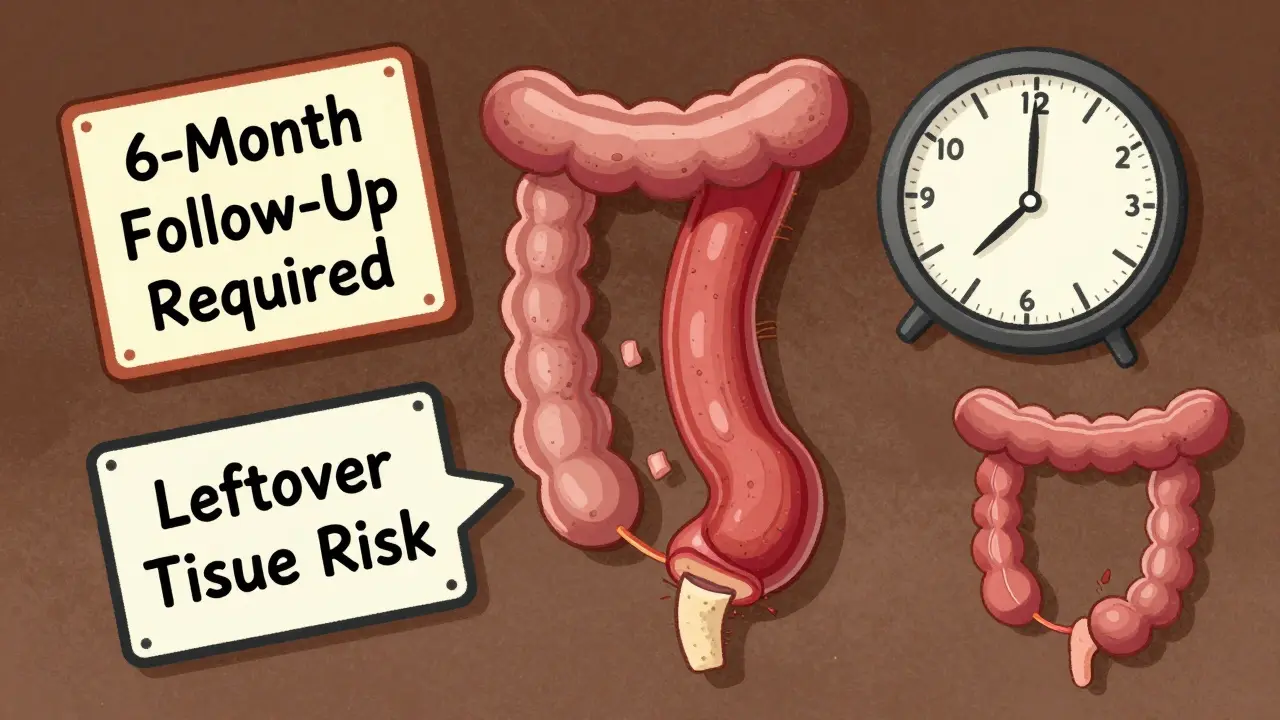
Sometimes, a large polyp - say, over 20 mm - can’t be taken out in one piece. It has to be cut into chunks. This is called piecemeal resection. It’s riskier because there’s a chance some abnormal tissue was left behind.The US guidelines say: come back in 6 months. That’s not a suggestion. It’s a requirement. The goal is to make sure the area is completely clear. If you still see abnormal tissue at the 6-month check, you’ll likely need another procedure. Some European guidelines say 3-6 months, but the US standard is fixed at 6 months for simplicity and safety.
Why do guidelines differ between countries?
You might hear conflicting advice if you’ve read guidelines from Europe or Asia. That’s because different regions use different data. The US focuses on long-term cancer prevention and has large population studies showing 7-10 years is safe for low-risk cases. Europe, especially the Netherlands and UK, has data showing that most cancers after colonoscopy happen because a polyp was missed - not because new ones grew fast. So they’re more comfortable with longer intervals, even up to 12 years for tiny adenomas.But here’s the catch: in the US, 81% of doctors still recommend a 5-year interval for 1-2 small adenomas, even though the official guideline changed in 2020. Why? Fear. Fear of lawsuits. Fear of missing something. Fear that patients won’t come back if you wait too long. It’s not about the science - it’s about practice.
What about serrated polyposis syndrome?
This is rare, but serious. If you have 20 or more serrated polyps total - or five with three of them ≥10 mm - you have serrated polyposis syndrome. Your risk of colon cancer is very high. You need a colonoscopy every 1-2 years until age 75. Some guidelines say annual. Others say every two years if no large polyps are found. But if you’ve been diagnosed with this, don’t delay. This isn’t a "wait and see" situation.Why do so many people get colonoscopies too early?
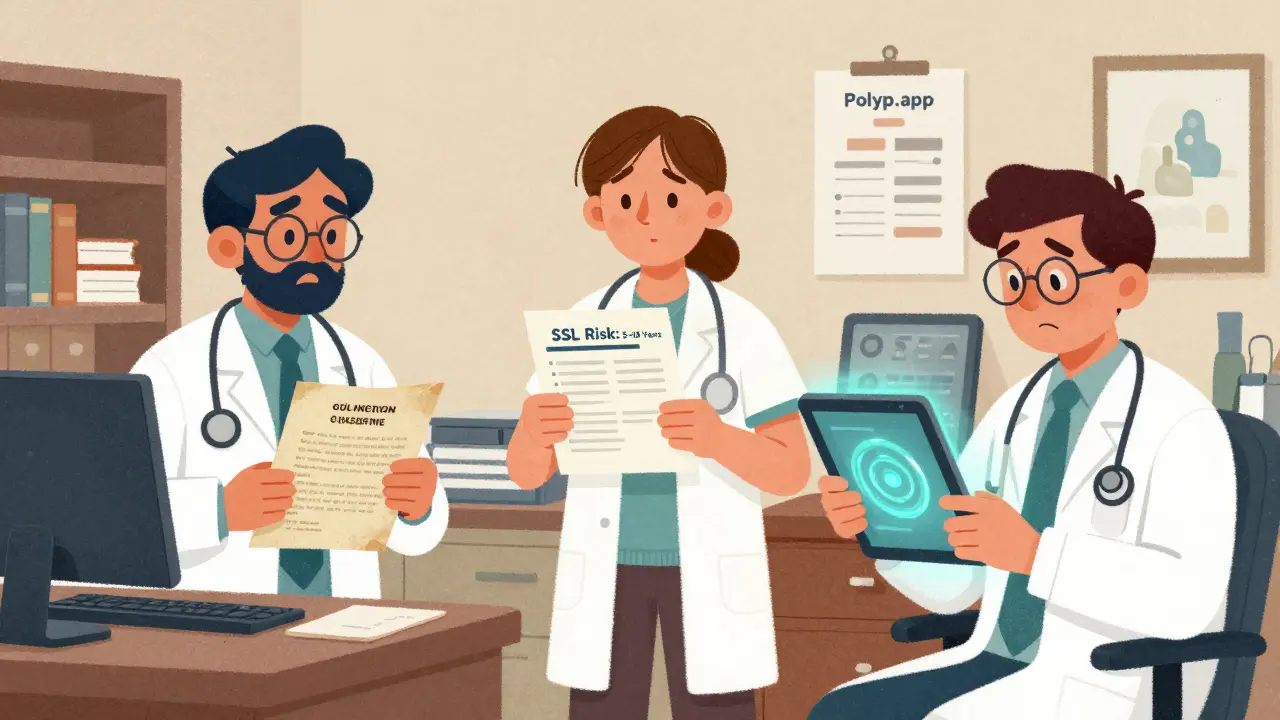
A 2020 study at a Veterans Affairs hospital found only 18.6% of doctors followed the updated 7-10 year rule for low-risk adenomas. Most kept recommending 5 years. Why? Three reasons:- They don’t know the new guidelines. A 2022 survey found only 37% of gastroenterologists could correctly identify all the risk categories.
- They’re unsure about SSLs. Only 28.5% of doctors correctly identified the 5-10 year interval for small SSLs.
- They’re trying to cover their bases. If a patient gets cancer after 8 years, the doctor might be blamed - even if the guideline says it’s fine.
Primary care doctors are even more confused. Many think everyone with polyps needs a colonoscopy in 3 years. That’s wrong. It’s only true for high-risk cases.
Tools are helping - but not enough
Apps like Polyp.app, developed by doctors at Massachusetts General Hospital, let you plug in your polyp details and get the right interval. It’s used by over 12,400 clinicians. Electronic health record systems like Epic and Cerner now have built-in prompts that suggest follow-up times based on what was found. But these tools only work if the endoscopist documents the findings accurately. If the report says "adenoma," but doesn’t specify size or histology, the system can’t help.What’s next? Personalized timing
The future isn’t just about counting polyps. Researchers are testing blood and stool tests that look for DNA changes linked to cancer risk. If a test shows high methylation markers, you might need a colonoscopy in 3 years - even if you only had one small adenoma. If the test is clean, you might safely wait 10 years. Clinical trials are underway. In the next 5 years, we may stop saying "you have 1-2 adenomas, come back in 7 years" and start saying "your molecular risk is low, wait 10 years."Bottom line: Know your numbers
Don’t just take your doctor’s word. Ask: What kind of polyps were found? How big were they? Was the biopsy report clear? Write it down. If you had 1-2 small adenomas, you’re likely fine for 7-10 years. If you had 3-4, plan for 3-5. If you had anything ≥10 mm, or a serrated lesion, or a polyp removed in pieces - don’t wait. Follow the 3-year or 6-month rule.Colon cancer is preventable. But only if you get the right follow-up at the right time. Don’t let confusion or outdated advice put you at risk. Ask questions. Demand clarity. Your colon will thank you.
How often should I get a colonoscopy if I had one small adenoma?
If you had one small adenoma (≤10 mm) and no other high-risk features, the current US guideline recommends waiting 7-10 years for your next colonoscopy. This is based on studies showing your cancer risk is nearly the same as someone with a completely normal colon. Many doctors still say 5 years out of habit, but the evidence now supports the longer interval.
Do serrated polyps require different follow-up than regular adenomas?
Yes. Sessile serrated lesions (SSLs) are more dangerous than they look. Even if they’re small, they can hide in folds and turn into cancer. If you had 1-2 SSLs under 10 mm, wait 5-10 years. If you had 3-4, come back in 3-5 years. Five or more means 3 years. SSLs are often missed during colonoscopy, so follow-up is critical.
Why do I need a colonoscopy in 6 months after a large polyp was removed?
If a polyp larger than 20 mm was removed in pieces (piecemeal resection), there’s a chance some abnormal tissue was left behind. The 6-month follow-up is a safety check. It’s not about cancer risk yet - it’s about making sure the area is fully cleared. If abnormal tissue remains, you’ll need another procedure before waiting longer.
Can I skip my next colonoscopy if I feel fine?
Feeling fine doesn’t mean you’re cancer-free. Most early colon cancers don’t cause symptoms. Polyps grow slowly, but they can turn cancerous without warning. Skipping a recommended colonoscopy based on how you feel is one of the biggest mistakes people make. Stick to the timeline based on your polyp report - not your symptoms.
What if my doctor says I need a colonoscopy in 3 years, but I had only one small adenoma?
Ask for clarification. Your doctor may be following an old guideline, or they may have seen something else - like poor bowel prep, incomplete exam, or a family history of cancer - that raises your risk. If you had one small adenoma with no other risk factors, 7-10 years is correct. Request a copy of your pathology report and ask if the polyp was confirmed as low-risk. If it was, you have the right to question the recommendation.
Randy Harkins
February 8, 2026 AT 15:42Chima Ifeanyi
February 9, 2026 AT 08:31Tori Thenazi
February 10, 2026 AT 03:47Elan Ricarte
February 11, 2026 AT 23:14Camille Hall
February 12, 2026 AT 16:48Monica Warnick
February 13, 2026 AT 15:54Ashlyn Ellison
February 14, 2026 AT 11:42Jonah Mann
February 16, 2026 AT 05:15THANGAVEL PARASAKTHI
February 18, 2026 AT 03:38Frank Baumann
February 19, 2026 AT 16:55Chelsea Deflyss
February 20, 2026 AT 00:23Tricia O'Sullivan
February 20, 2026 AT 22:29