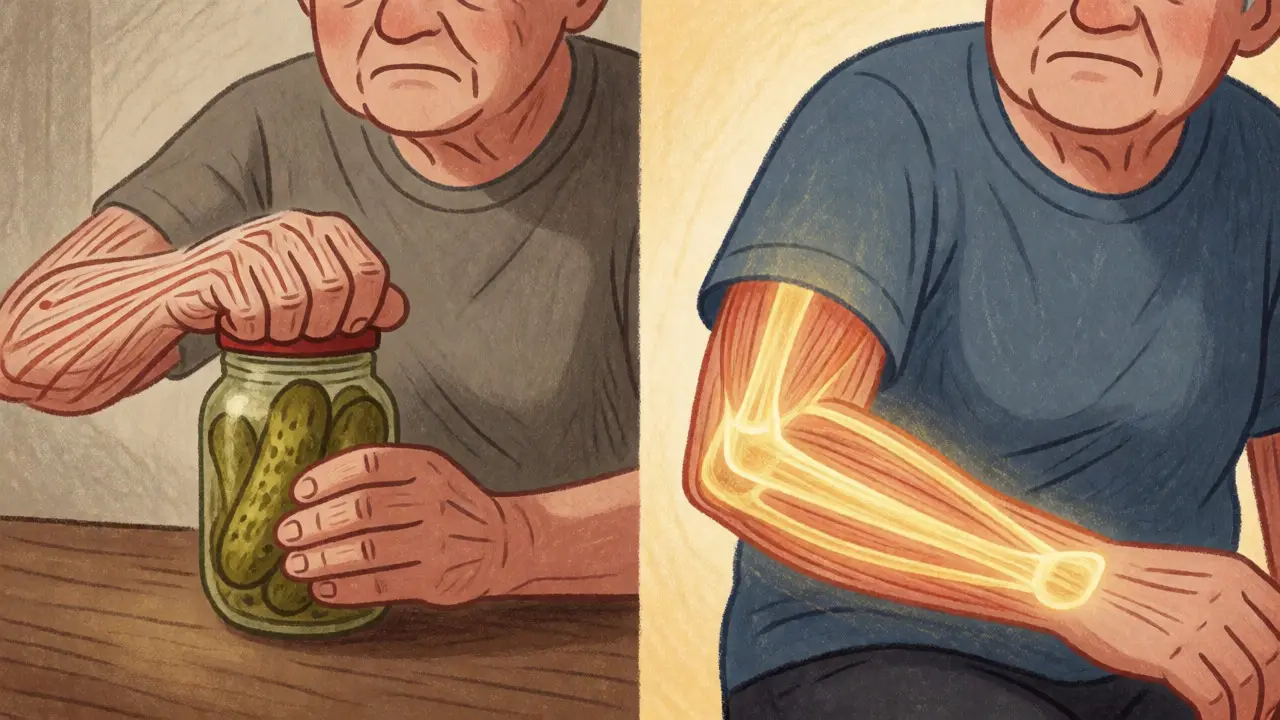
Think about the last time you struggled to open a jar of pickles or felt unsteady getting out of a deep armchair. You might blame it on bad luck or a stiff joint, but for many people over 60, this is a sign of sarcopenia, a progressive condition defined by the age-related decline in skeletal muscle mass, strength, and physical function. It’s not just "getting old"; it’s a physiological shift that starts earlier than most realize-often in your 30s or 40s-and accelerates dramatically after age 65. While we often focus on heart health or cholesterol as we age, our muscles are quietly shrinking at a rate of 1-2% per year. The good news? This isn't a one-way street. Evidence shows that targeted strength training can reverse much of this damage, restoring independence and vitality.
What Is Sarcopenia and Why Does It Happen?
Sarcopenia comes from the Greek words for "flesh" and "poverty." First recognized clinically in 1989, it was formally defined by international working groups to distinguish it from general frailty. Unlike simple disuse atrophy (muscle loss from sitting too long), sarcopenia involves complex biological changes. Your body loses motor neurons-the wires that tell muscles to contract-at a rate of 3-5% per year after age 60. Simultaneously, type II muscle fibers, which provide power and speed, shrink by up to 40% by age 80. Satellite cells, the stem cells responsible for repairing muscle tissue, lose about half their regenerative capacity by age 70. These aren't just abstract concepts; they translate to real-world struggles like slower walking speeds, reduced grip strength, and a higher risk of falls.
It’s crucial to differentiate sarcopenia from similar conditions. For instance, cachexia involves rapid weight loss driven by systemic inflammation, often seen in cancer patients, whereas sarcopenia progresses slowly. Dynapenia refers specifically to strength loss without significant muscle mass reduction. Understanding these distinctions matters because the treatment strategies differ. Sarcopenia requires both preserving mass and improving function, making exercise the cornerstone of management.
The Diagnostic Thresholds: Are You At Risk?
You don’t need a PhD to spot early signs, but medical diagnosis uses specific metrics. According to the EWGSOP3 guidelines (updated in 2023), doctors look for three key indicators:
- Grip Strength: Below 27kg for men or 16kg for women.
- Gait Speed: Walking slower than 0.8 meters per second.
- Muscle Mass: Appendicular lean mass below 7.0kg/m² for men or 5.5kg/m² for women, typically measured via DXA scan.
If you find yourself taking longer to climb stairs or needing more effort to stand up from a chair, you might already be experiencing functional impairment. Prevalence data suggests that about 10% of adults over 60 have sarcopenia, but this jumps to nearly 50% among those over 80. With healthcare costs related to fall injuries hitting $18.5 billion annually in the US alone, catching this early is critical.
Why Strength Training Beats Cardio for Muscle Preservation
Many seniors prioritize walking or swimming, which are excellent for heart health. However, cardio alone does little to stop muscle wasting. To combat sarcopenia, you need mechanical tension-the force placed on muscles during resistance exercises. Research consistently shows that progressive resistance training is the most effective intervention available. A review by Dr. Jeremy Walston at Johns Hopkins University found that older adults who engaged in structured resistance training increased muscle mass by 1-2kg and boosted strength by 25-30% within just 12-16 weeks.
How does it work? When you lift weights, you trigger the mTOR pathway, a molecular switch that tells your body to build new protein. Aging dampens this signal, but heavy enough loads reactivate it. Furthermore, strength training improves neuromuscular coordination, helping your brain communicate more efficiently with your muscles. This dual benefit explains why participants in studies see improvements in balance and fall risk scores, not just raw strength numbers.
| Intervention | Primary Benefit | Timeframe for Results | Key Challenge |
|---|---|---|---|
| Strength Training | Increases muscle mass & neural drive | 12-16 weeks | Adherence & joint pain |
| Protein Supplementation | Supports muscle synthesis | Immediate (if paired with exercise) | Kidney issues in some patients |
| Aerobic Exercise | Cardiovascular health | Variable | Minimal impact on muscle mass |
| Hormone Therapy | May slow decline | Months to years | Side effects & cost |
Starting Safely: A Protocol for Beginners
"I’m too weak to lift weights," is a common misconception. In fact, if you have sarcopenia, you likely need to lift weights. The American College of Sports Medicine recommends starting low and progressing slowly. Here is a practical roadmap based on CDC and clinical guidelines:
- Weeks 1-4: Bodyweight Foundations. Focus on form. Do chair squats (sit down and stand up without using hands if possible), wall push-ups, and standing calf raises. Aim for 2 days per week, doing 10-15 repetitions.
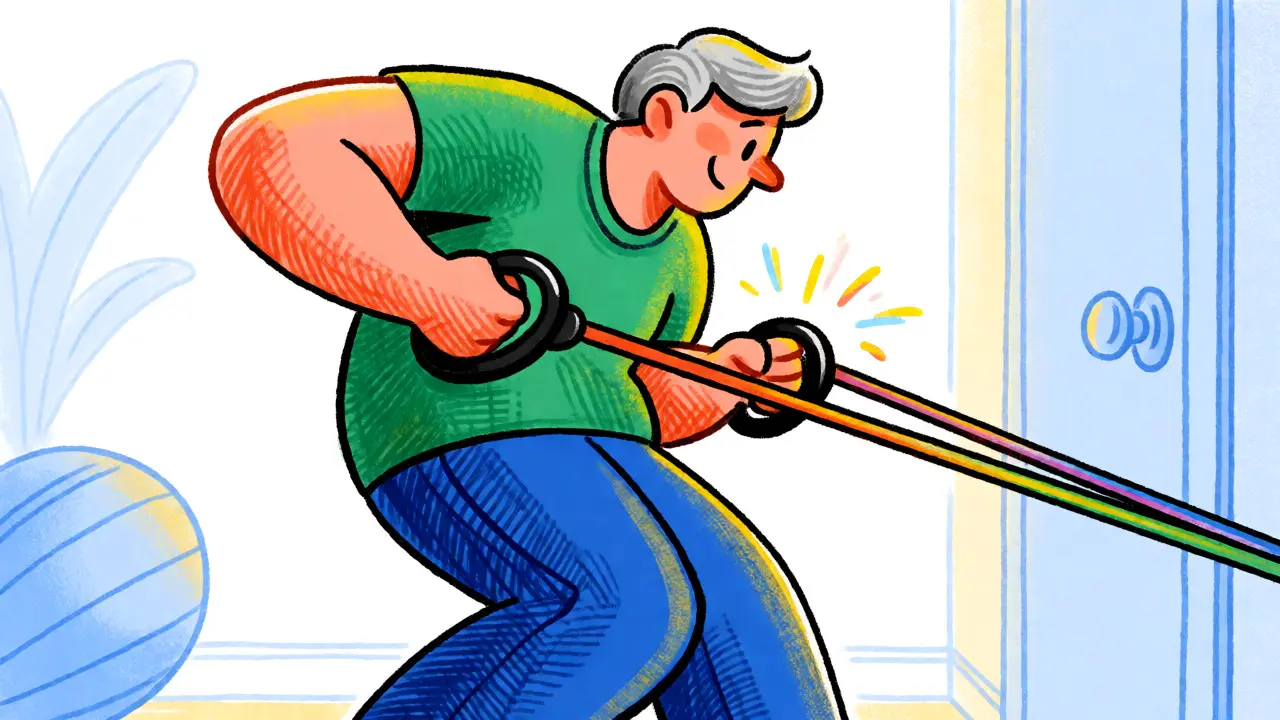
- Weeks 5-8: Resistance Bands. Introduce light external resistance. Use TheraBand levels 1-3. Perform rows against a door anchor and band-assisted lunges. Keep reps at 10-15.
- Weeks 9+: Weight Machines or Dumbbells. Move to gym machines where stability is provided. Target major muscle groups: legs, back, chest, and shoulders. Aim for 8-12 repetitions at a weight that feels challenging by the last two reps.
Remember the rule of progressive overload: increase the weight by 2.5-5% each week. If you can easily do 15 reps, it’s time to add load. Also, pay attention to breathing-exhale when you exert force (lifting) and inhale when you return to the start position.
Nutrition: Fueling the Repair Process
Exercise breaks down muscle; nutrition builds it back up. Older adults have "anabolic resistance," meaning their bodies respond less efficiently to protein signals. Consequently, you need more protein than a younger person to get the same effect. The International Society of Sports Nutrition recommends consuming 20-30g of high-quality protein within 45 minutes post-exercise. Good sources include eggs, Greek yogurt, chicken, fish, or whey protein powder.
Don’t neglect Vitamin D. Low levels are linked to muscle weakness and increased fall risk. Many seniors are deficient, so checking your levels with a doctor is wise. Hydration also plays a role; dehydrated muscles fatigue faster and recover slower.

Overcoming Barriers to Consistency
Knowing what to do is different from actually doing it. Surveys show that 34% of older adults struggle to find age-appropriate programs, while others cite joint pain or fear of injury. Here’s how to tackle these hurdles:
- Joint Pain: Modify range of motion. Use machines instead of free weights initially. Warm up thoroughly with 5-10 minutes of light movement.
- Fear of Injury: Start with supervised sessions. Programs like SilverSneakers, covered by many Medicare Advantage plans, offer guided classes specifically designed for seniors.
- Lack of Motivation: Find a buddy. Social exercise groups increase adherence rates by 35-40%. Tracking progress, such as logging handgrip strength gains, provides tangible feedback.
Real-world results are encouraging. One 68-year-old man reported his grip strength rose from 18kg to 24kg after six months of twice-weekly training, allowing him to open jars again. Another user saw her fall risk score drop significantly after a 10-week program. These aren't outliers; they represent the typical trajectory of consistent effort.
The Future of Muscle Health
As the global population ages, sarcopenia is becoming a public health priority. By 2050, one in six people worldwide will be over 65. Researchers are exploring biomarkers like myostatin and GDF-15 for earlier detection, and AI-driven apps are providing personalized exercise feedback. While pharmaceutical options remain limited, lifestyle interventions are proven and accessible. You don’t need expensive equipment or a personal trainer to start. You just need consistency, proper protein intake, and the willingness to challenge your muscles.
Reversing age-related muscle loss isn't about chasing youth; it's about maintaining autonomy. Every rep you complete is an investment in your ability to play with grandchildren, carry groceries, and live independently. The clock may tick, but your muscles don't have to quit.
Can sarcopenia be reversed completely?
While you cannot fully reverse the natural aging process, significant improvements are possible. Studies show that strength training can restore 25-30% of lost strength and add 1-2kg of muscle mass in older adults. Early intervention yields better results, but even those over 80 can gain substantial functional benefits.
How often should I train to fight sarcopenia?
The consensus among experts, including the American College of Sports Medicine, is 2-3 times per week. This frequency allows for adequate stimulus to build muscle while providing sufficient recovery time, which is crucial for older adults whose repair processes are slower.
Is walking enough to prevent muscle loss?
No. Walking maintains cardiovascular health and bone density but does not provide enough mechanical tension to stimulate significant muscle growth or preservation. Resistance training targeting major muscle groups is required to combat sarcopenia effectively.
What foods help most with sarcopenia?
Prioritize high-protein foods rich in leucine, an amino acid that triggers muscle synthesis. Eggs, dairy, poultry, fish, and legumes are excellent choices. Consuming 20-30g of protein within an hour after exercising maximizes muscle repair.
Should I worry about joint pain when starting strength training?
Mild discomfort is normal, but sharp pain is not. Start with low weights and controlled movements. Using machines can reduce stress on joints compared to free weights. If pain persists, consult a physiotherapist to adjust your form or exercise selection.
Pearl Richardson
September 2, 2026 AT 21:45It is highly suspicious that the medical establishment only now admits what we have known for decades 🧐. They hide the truth about anabolic resistance to sell us supplements and expensive therapies instead of telling us simply to lift heavy things 💪. The data on motor neuron loss is likely manipulated to scare us into compliance 📉. I refuse to believe this is natural aging when it correlates so perfectly with pharmaceutical industry profits 💊🤔.
kishhore kumar
September 4, 2026 AT 09:58interesting point about mTOR pathway but how do you handle joint pain in older folks? my dad struggles with knees and cant do squats properly :/ also does protein timing really matter that much if total daily intake is high enough? seems like a lot of nuance gets lost in these summaries imo
Vivek Chaturvedi
September 4, 2026 AT 18:11Lifting weights is moral duty not just health advice neglecting body care is selfishness against family who depend on you stop making excuses start training today no more laziness
fred eden
September 5, 2026 AT 12:22This article brought tears to my eyes 😢. My grandmother struggled so much with opening jars and getting out of chairs. It breaks my heart to think she could have had more independence if she had started strength training earlier. We need to be kinder to our elders and encourage them gently ❤️. Every rep is a gift to their future self 🎁.
Lolo Del
September 6, 2026 AT 20:54Friendly reminder that most people here are probably doing cardio wrong anyway 😂. You don't need fancy equipment, just consistency. If you're over 60 and not lifting, you're basically choosing to fall over sooner. No judgment, just facts! Stay strong fam 💪.
Sarah Kinch
September 7, 2026 AT 14:33ugh another long read about muscles... i tried gym once and hated it. too much effort for little gain imo. walking is fine. why complicate life? 🙄 lazy critics unite lol
Tobi Oyewole
September 8, 2026 AT 00:30I appreciate the balanced perspective offered here. While strength training is indeed paramount, we must respect individual limitations and cultural contexts regarding physical activity. In many parts of Africa, functional movement through daily labor maintains muscle mass without formal gym settings. However, as urbanization increases, your advice becomes crucial. Let us approach this with empathy rather than rigid dogma. Peace and strength to all.
The distinction between sarcopenia and dynapenia is particularly insightful for those of us analyzing public health trends globally.
Harry Falk
September 9, 2026 AT 03:39Respectfully noted. Starting low and progressing slowly is key. Cultural humility suggests adapting exercises to local availability. Safety first always.