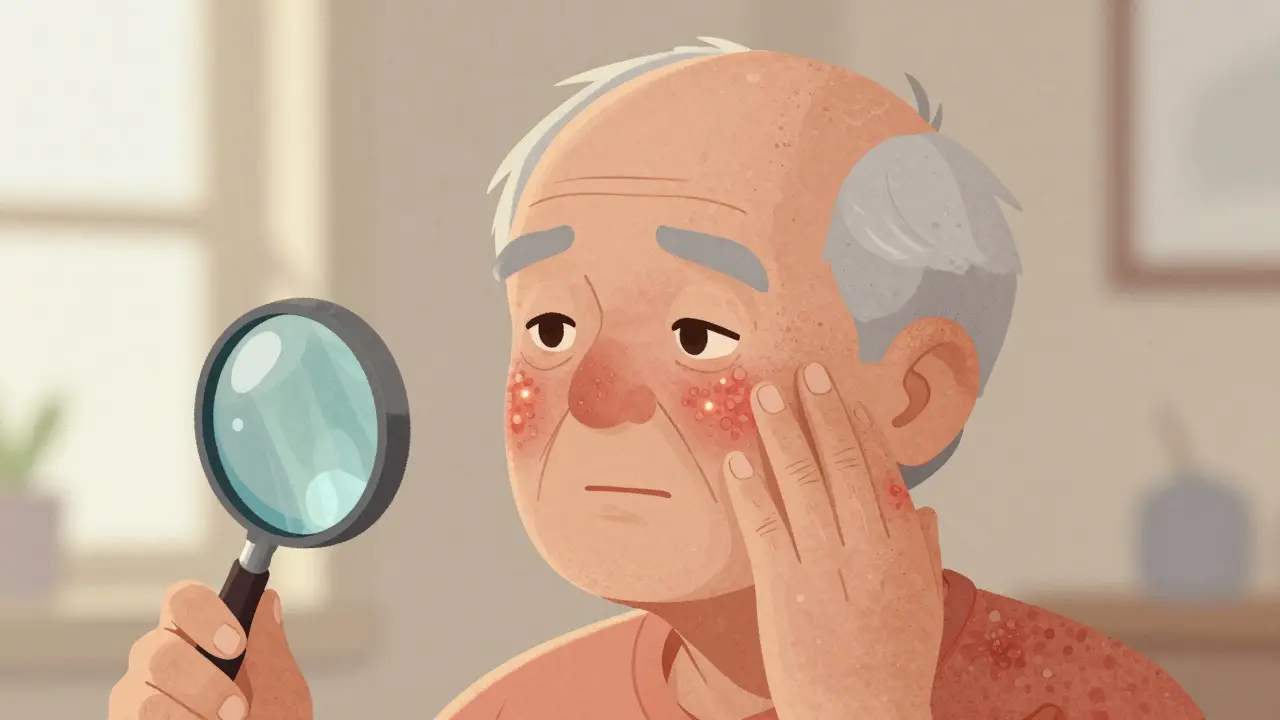
When you run your fingers over your face, neck, or hands and feel something rough-like sandpaper-you might brush it off as dry skin. But if you’re over 40 and have spent years in the sun, that rough patch could be something more serious: an actinic keratosis. These aren’t just ugly spots. They’re your skin’s warning sign that it’s been damaged by too much UV light-and left untreated, they can turn into skin cancer.
What Exactly Is an Actinic Keratosis?
An actinic keratosis (AK), sometimes called a solar keratosis, is a precancerous growth that forms on skin damaged by long-term sun exposure. It doesn’t appear overnight. It builds up slowly over years, often starting as a faint, gritty patch you feel before you see it. The Skin Cancer Foundation calls it "more easily felt than seen," and that’s true for most people. You might notice it when you’re shaving, applying lotion, or running your hand across your scalp. These lesions show up mostly on sun-exposed areas: the face, ears, scalp (especially if you’re bald), neck, forearms, and backs of the hands. About 85% show up on the face and scalp. The color varies-red, pink, brown, gray, or even skin-colored. In people with darker skin, they often look like dark spots that don’t fade. Their texture is the real clue: scaly, crusty, or bumpy, sometimes with a horn-like bump sticking out. That’s a red flag. According to the American Academy of Dermatology, around 58 million Americans have them. In places like Arizona or New Zealand-where UV levels are high-it’s even more common. About 40-60% of fair-skinned people over 40 have at least one. That’s not rare. It’s a normal part of aging for many who’ve spent decades in the sun without consistent protection.Why Should You Care About AKs?
Because they can become cancer. Actinic keratoses aren’t cancer yet. But they’re the first step toward it. The Cleveland Clinic says 90% of cutaneous squamous cell carcinomas (SCC)-the second most common type of skin cancer-start as untreated AKs. About 5-10% of individual AKs will turn into SCC over 10 years. That number jumps to 25% if you’re immunosuppressed, whether from organ transplants, HIV, or certain medications. And it’s not just one lesion. Most people have multiple. The NHS reports that 60% of patients have 7-10 or more. That’s important because it means the damage isn’t isolated. The whole sun-exposed area-the "field"-is damaged. That’s why treating just one spot isn’t enough. You need to treat the whole area before more spots turn cancerous. Dermatologists now see AKs as early-stage skin cancer. Dr. Amanda Oakley from DermNet NZ says they’re "an early form of cutaneous squamous cell carcinoma." That’s not an exaggeration. It’s the current medical consensus.How Are They Diagnosed?
Most of the time, a dermatologist can spot an AK just by looking and feeling it. Board-certified dermatologists get it right 95% of the time using just their eyes and fingers. No biopsy needed. But if a lesion is thick, tender, bleeding, or growing fast, they’ll take a small sample. That’s because it could be an early SCC. The difference matters. An AK is flat or slightly raised. An SCC might be a hard bump, ulcerated, or larger than half a centimeter. If it’s painful or doesn’t heal, it’s time for a biopsy. Dermatoscopy-a handheld magnifying tool-helps confirm the diagnosis. It shows patterns of blood vessels and scales that are unique to AKs. In places like Dunedin, where the ozone layer is thin and UV levels are high, dermatologists are trained to catch these early. The biggest mistake? Ignoring them. A 2023 survey on RealSelf showed 87% of patients felt anxious when they first learned their "rough patch" was precancerous. But 63% were surprised by how many lesions they had during a full-body exam. That’s the key: you can’t find them all yourself. You need a professional.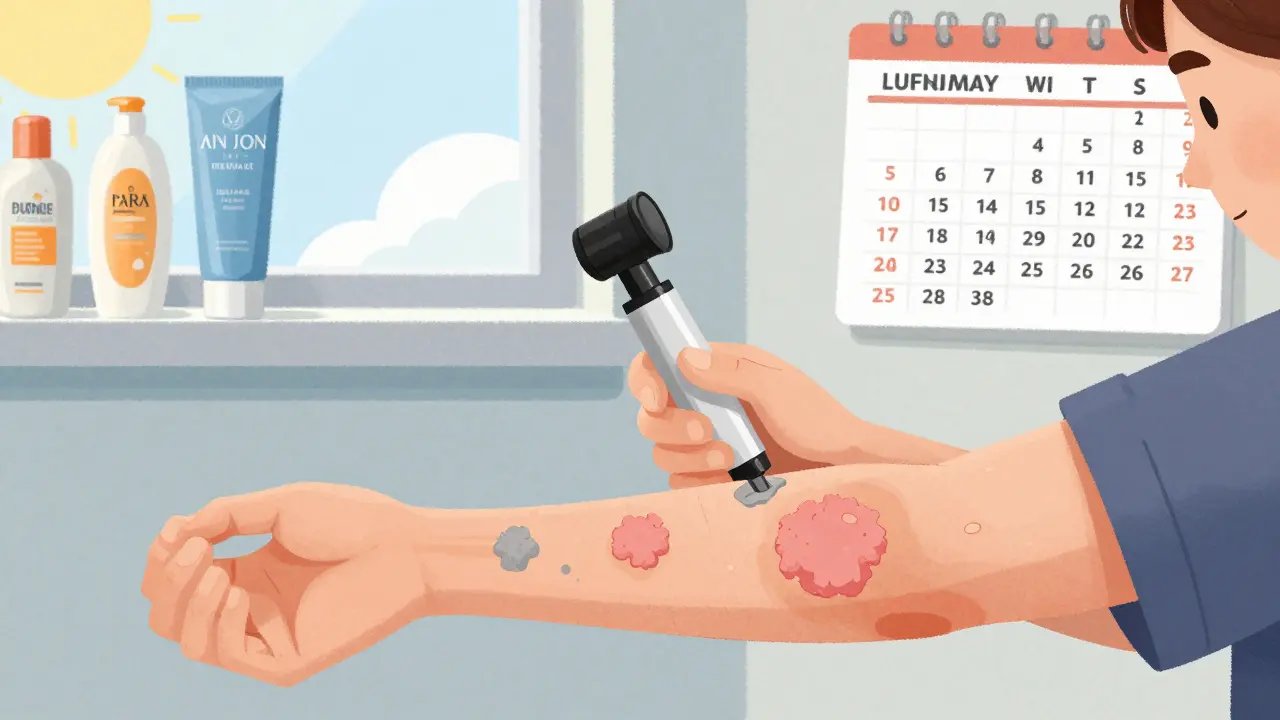
Field Treatments: The Gold Standard
Treating one AK with cryotherapy (freezing) works-but only for that one spot. If you have five, ten, or twenty, you need a different approach. That’s where field treatments come in. Field treatments don’t just remove visible lesions. They treat the entire sun-damaged area, including spots you can’t see yet. This stops new cancers before they start. There are three main types:- Topical creams and gels-applied daily for days or weeks
- Chemical peels-a strong acid that removes the top skin layer
- Photodynamic therapy (PDT)-light-activated treatment using a special cream and blue light
| Treatment | Duration | Clearance Rate | Cost (USD) | Common Side Effects |
|---|---|---|---|---|
| 5% Fluorouracil (5-FU) | 2-4 weeks | 75-85% | $120 | Redness, peeling, burning, crusting |
| Imiquimod 3.75% or 5% | 16 weeks | 54-75% | $800-$1,200 | Flu-like symptoms, itching, swelling |
| Tirbanibulin (Klisyri) | 5 days | 44-75% | $650 | Pain, redness, scaling |
| Ingenol Mebutate | 2-3 days | 40-50% | $1,000 | Severe irritation, blistering |
| Photodynamic Therapy (PDT) | 1-2 sessions | 44-75% | $500-$1,000 | Sensitivity to light for 48 hours |
Fluorouracil (5-FU) is the oldest and cheapest option. It works by killing abnormal cells. But you’ll have a week or two of red, burning, peeling skin. One patient on HealthUnlocked said, "Worth the 4 weeks of redness to stop cancer before it starts." That’s the mindset.
Tirbanibulin (Klisyri) is newer. Approved by the FDA in 2020, it clears lesions in just five days. It’s ideal for the face because it’s less messy than 5-FU. But it’s pricier.
PDT is great for large areas. You apply a light-sensitive cream, wait a few hours, then sit under a blue light. It kills abnormal cells and stimulates healing. The downside? You can’t go outside for two days after. But for many, the results are worth it.
What Doesn’t Work?
Some people try home remedies-apple cider vinegar, tea tree oil, or scraping them off. These don’t work. They might irritate the skin, but they won’t stop cancer. Also, waiting for a lesion to "get worse" is dangerous. The progression from AK to SCC isn’t always predictable. Some stay harmless. Others turn cancerous in months. There’s no way to know which is which. The British Association of Dermatologists says you might skip treatment for a single, low-grade AK in an elderly person with limited life expectancy. But that’s rare. For most, early treatment is the only safe choice.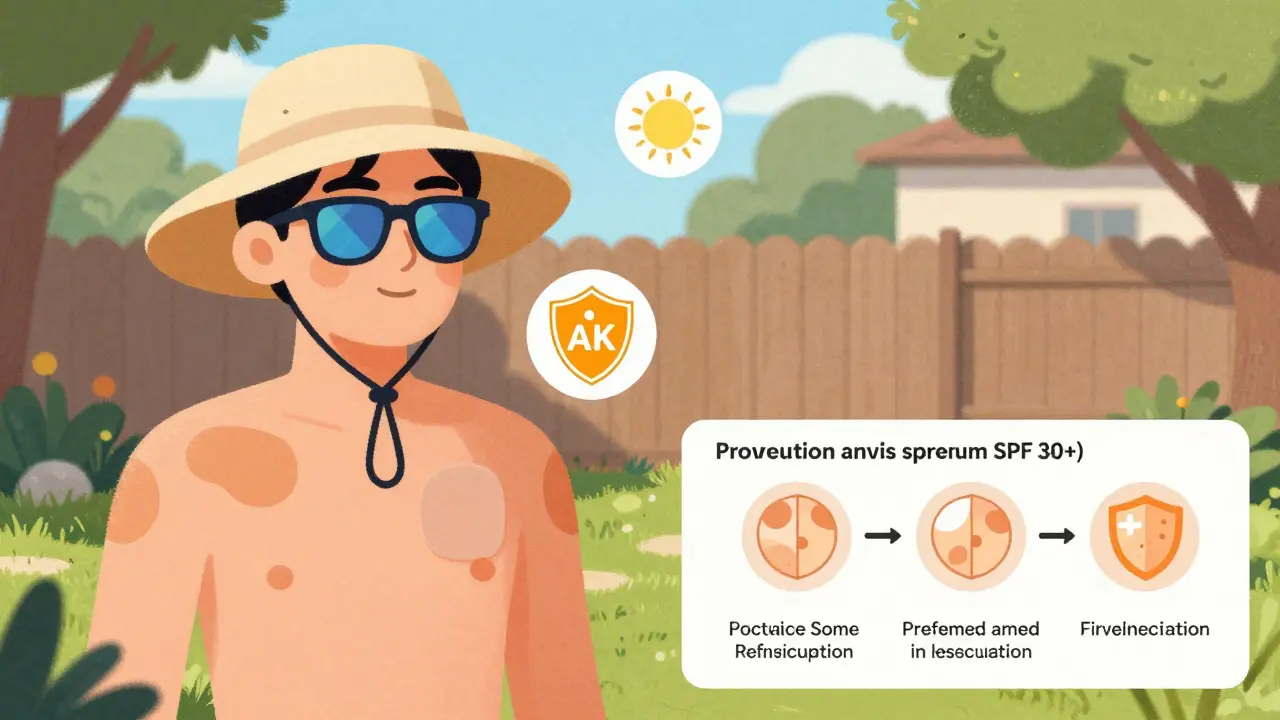
Prevention: The Best Treatment
The best way to deal with AKs? Don’t get them in the first place. Sun protection isn’t optional. It’s essential. The Skin Cancer Foundation found that patients who got structured sun safety counseling reduced new AKs by 37% over two years. Here’s what works:- Wear broad-spectrum SPF 30+ every day-even in winter
- Reapply every two hours if you’re outside
- Wear wide-brimmed hats and UV-blocking sunglasses
- Avoid direct sun between 10 a.m. and 4 p.m.
- Use UPF-rated clothing (not just regular fabric)
- Check your skin monthly. Run your fingers over your face, neck, hands. If it feels rough, get it checked
Annual skin exams are a must if you’re fair-skinned, over 40, or have a history of sunburns. Many clinics now use total body photography to track changes over time. It’s like having a photo log of your skin’s health.
Chris Bird
March 11, 2026 AT 20:26Adam Kleinberg
March 12, 2026 AT 18:57Bridgette Pulliam
March 14, 2026 AT 05:09Mike Winter
March 16, 2026 AT 04:08Randall Walker
March 16, 2026 AT 22:07Miranda Varn-Harper
March 18, 2026 AT 18:10Alexander Erb
March 18, 2026 AT 20:18Donnie DeMarco
March 20, 2026 AT 06:11Tom Bolt
March 20, 2026 AT 16:52