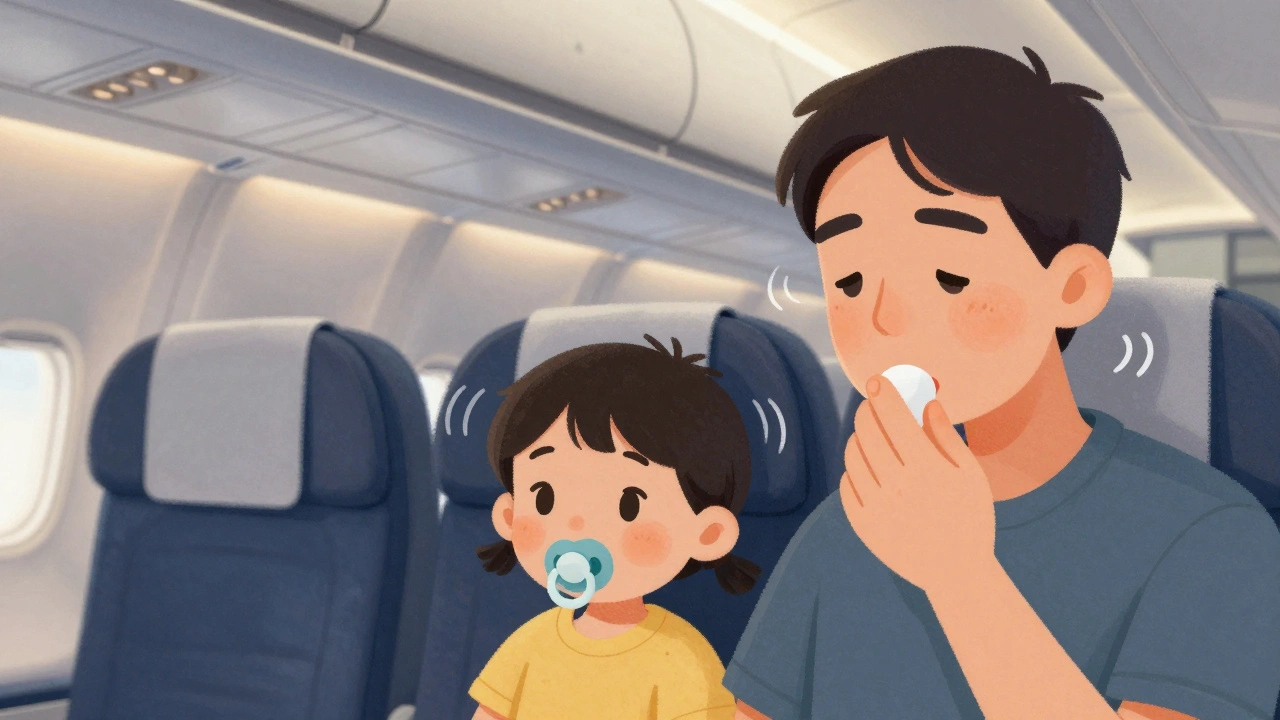
Most people don’t think about their ears until they hurt-especially during a flight. If you’ve ever felt that dull throb in your ears as the plane descends, or worse, sharp pain that makes you wince, you’re not alone. This isn’t just discomfort-it’s airplane ear, or barotrauma, a common issue caused by pressure differences between your middle ear and the cabin. And while it sounds minor, it can ruin a trip, wake up a sleeping child, or even lead to temporary hearing loss if ignored.
Why Your Ears Hurt During Flight
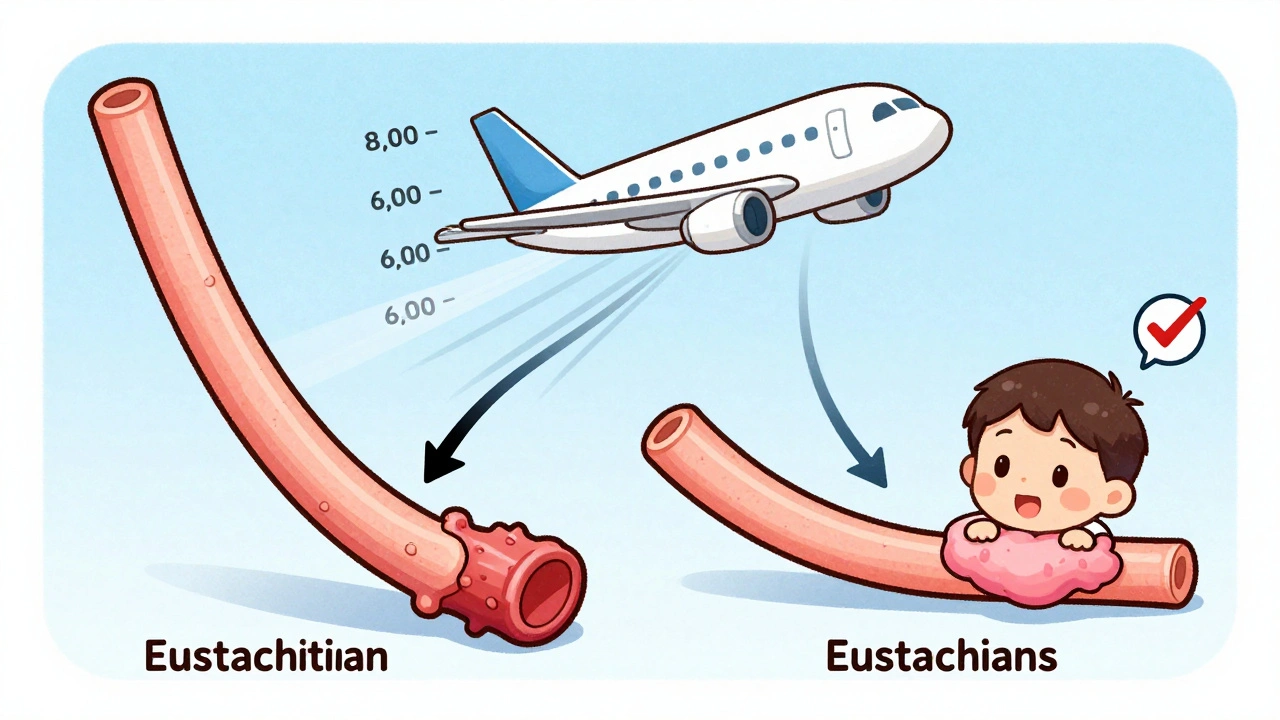
Your ears have a tiny tube called the Eustachian tube, connecting your middle ear to the back of your throat. Its job? To balance pressure. When the plane climbs, air pressure drops. Your ears naturally adjust because the air inside your middle ear expands and escapes. But when the plane descends, pressure builds up outside your eardrum, pushing inward. If your Eustachian tube doesn’t open quickly enough, you feel that pressure difference-and it hurts.This isn’t random. During descent, cabin pressure can change by up to 40 mmHg in just a few minutes. That’s like diving 15 feet underwater without equalizing. For adults, the Eustachian tube is about 35-38mm long. For kids, it’s shorter-just 17-18mm-and more horizontal. That’s why children are far more likely to suffer. Studies show 22% of kids experience significant ear pain during flights, compared to 10% of adults. During allergy season, those numbers jump even higher.
What Works: The Best Equalization Techniques
You don’t need to suffer. There are proven ways to help your ears catch up with the cabin pressure. But not all methods are equal. Some are safe for everyone. Others carry risks.- Swallowing or yawning-the simplest trick. It’s 100% safe and works for 65% of people. Chew gum, suck on hard candy, or just swallow deliberately every few minutes during descent.
- Toynbee maneuver-pinch your nose shut and swallow. It’s safer than blowing and works well for adults and older kids. Success rate: around 68%.
- Lowry technique-combine swallowing with gentle nose-blowing. This boosts success to 89%, but it takes practice. Most people need at least three flights to get it right.
- Voluntary Tubal Opening-a skill some people learn by tensing the soft palate and pushing the jaw forward. It’s 92% effective for trained users, but it takes weeks of daily practice to master.
There’s one method you should avoid unless you’re trained: the Valsalva maneuver. That’s when you pinch your nose and blow hard. It’s effective for 82% of people, but it’s also the leading cause of inner ear damage during flights. Force it too hard, and you risk rupturing your eardrum or damaging delicate inner ear structures. Doctors at Johns Hopkins say 27% of barotrauma cases they treat come from people blowing too hard.
Helpful Tools: EarPlanes and More
If you’ve tried swallowing and it’s not enough, consider tools designed for this exact problem. EarPlanes are filtered earplugs made of ceramic material that slow down pressure changes by 37%. That gives your Eustachian tube an extra 13 seconds to open naturally. In clinical tests, they worked for 76% of users. For kids, they’re a game-changer.Another option is the Otovent device-a nasal balloon you inflate through one nostril. It gently pushes air into the Eustachian tube, helping it open. FDA-approved in 2022, it’s been shown to work in 88% of clinical trials. It’s especially useful for children who can’t manage swallowing techniques.
Some people swear by decongestants. Sprays like Afrin (oxymetazoline) reduce swelling in your nasal passages by 63% within 10 minutes. Oral Sudafed (pseudoephedrine) works for 8-12 hours. But here’s the catch: decongestants aren’t safe for everyone. They can raise blood pressure and heart rate. The FDA warns against using them if you’re over 40, have heart issues, or are pregnant. And never give them to children under 6-there are documented cases of dangerous heart rhythms in young kids.
Timing Is Everything
Waiting until your ears start screaming is a mistake. By then, it’s too late. The best time to start equalizing is when the plane hits 8,000 feet during descent-that’s when pressure changes begin to ramp up. Experts recommend starting every 300-500 feet of descent. That’s roughly every 2-3 minutes during the final 20 minutes of flight.For parents: if you’re flying with a baby or toddler, feed them during descent. Bottle-feeding works better than sipping from a cup because the sucking motion creates stronger swallowing. A 2023 study from Nemours KidsHealth found bottle-fed babies had 43% fewer ear problems. Even a pacifier helps. Don’t let them sleep during descent. Research shows 73% of pediatric ear pain cases happen because kids are asleep and not swallowing.
What Not to Do
There are common mistakes that make airplane ear worse:- Waiting until it hurts-68% of sufferers only try to equalize after pain starts. By then, the pressure difference is too great.
- Blowing too hard-41% of inner ear injuries from Valsalva come from excessive force.
- Ignoring allergies-if you’re congested, your Eustachian tube is already blocked. Use nasal steroid sprays like fluticasone (Flonase) 3-5 days before flying. New research from the University of Pennsylvania shows this improves equalization success by 33%.
- Assuming it’s just “normal”-if you get ear pain on every flight, it’s not normal. Chronic Eustachian tube dysfunction is treatable. Procedures like balloon dilation (which opens the tube with a tiny balloon) have 76% long-term success rates.
What Airlines Are Doing to Help
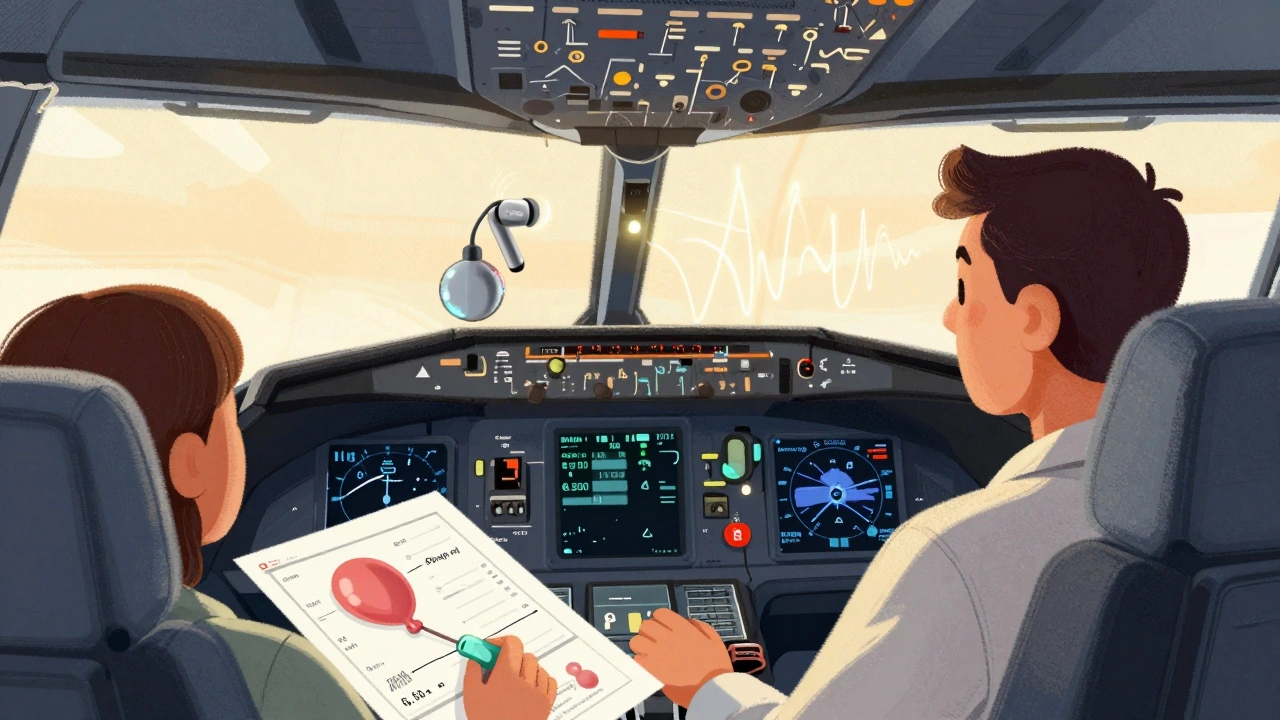
It’s not just you. Airlines know this is a big issue. Boeing’s 787 Dreamliner maintains cabin pressure at 6,000 feet instead of the standard 8,000 feet. That reduces pressure differences by 25%. Delta Airlines now uses a gentler 3-degree descent angle instead of the usual 3.5 degrees, slowing pressure changes by 14%. The FAA now requires all major U.S. carriers to train crew on how to help passengers with ear pressure issues. And by 2025, new aircraft may be required to keep cabin altitudes below 6,500 feet during critical phases.There’s even tech on the horizon. Bose is testing smart earplugs with built-in pressure sensors that give real-time feedback-like a fitness tracker for your ears. And Mayo Clinic is running trials on tiny Eustachian tube stents that could offer long-term relief for chronic sufferers.
Final Tips for a Pain-Free Flight
Here’s your quick checklist before your next flight:- Start using nasal steroid spray 3-5 days before flying (if you have allergies or congestion).
- Take a decongestant only if you’re healthy, under 40, and have no heart issues-and take it 60 minutes before descent.
- Bring EarPlanes or Otovent if you’re prone to ear pain.
- Chew gum or suck on candy from the moment descent begins.
- For kids: feed or give a pacifier during descent. Don’t let them sleep.
- Don’t force the Valsalva maneuver. If swallowing doesn’t work, try the Toynbee method.
- If you’ve had ear pain on multiple flights, see an ENT specialist. Chronic problems can be fixed.
Flying shouldn’t feel like a battle with your own body. With the right prep, you can take off and land without pain. It’s not magic-it’s science. And now you know how to use it.
Can airplane ear cause permanent hearing loss?
In rare cases, yes-but only if barotrauma is severe and untreated. Most people experience temporary muffled hearing or fullness that clears within hours or days. Permanent damage, like a ruptured eardrum or inner ear injury, occurs in fewer than 0.02% of flights, according to Divers Alert Network data. The key is to avoid forcing pressure equalization too hard. If your hearing doesn’t return within 48 hours after landing, see a doctor.
Is it safe to fly with a cold or sinus infection?
It’s risky. When your nasal passages are swollen, your Eustachian tube can’t open properly. Flying with a bad cold increases your chance of ear pain by 3-4 times. If you must fly, use a nasal steroid spray (like Flonase) for several days before, and consider a decongestant if you’re healthy and under 40. Avoid flying with a fever or severe congestion. Many ENT specialists recommend rescheduling if you’re actively sick.
Do EarPlanes work for children?
Yes, and they’re often more effective for kids than adults. Children’s Eustachian tubes are smaller and more prone to blockage. EarPlanes slow pressure changes enough to let their tubes catch up naturally. They’re also less invasive than decongestants, which aren’t approved for kids under 6. Many pediatric ENT clinics recommend them as a first-line tool for children who get ear pain during flights.
Why does my ear pop but still hurt?
A pop means your Eustachian tube opened-but not enough. Sometimes, the tube opens partially, relieving pressure just enough to make a sound, but not enough to fully equalize. This can leave you with lingering fullness or dull pain. Keep swallowing, try the Toynbee maneuver, or use EarPlanes. If it doesn’t improve within a few hours after landing, it may be due to lingering inflammation or fluid buildup. See an ENT if it lasts more than two days.
Can I use decongestants every time I fly?
No. Oral decongestants like Sudafed should not be used regularly. They can raise blood pressure, cause heart palpitations, and interfere with sleep. Nasal sprays like Afrin should never be used for more than 3 days in a row-they can cause rebound congestion. If you need decongestants on every flight, you likely have chronic Eustachian tube dysfunction. Talk to an ENT about long-term solutions like balloon dilation or stents.
Katie O'Connell
December 6, 2025 AT 02:30While the article presents a clinically sound overview of barotrauma, it conspicuously omits the profound neurophysiological implications of repeated Eustachian tube dysfunction on cranial nerve V and VII integrity. The reliance on mechanical interventions like EarPlanes, while superficially pragmatic, neglects the autonomic nervous system’s role in pressure adaptation-particularly the vagal tone modulation that occurs during swallowing. A truly comprehensive approach would integrate biofeedback protocols, not merely candy and silicone plugs.
Arjun Deva
December 6, 2025 AT 09:59Inna Borovik
December 6, 2025 AT 18:47Let’s be real-this whole post is a corporate content farm masterpiece. 88% success rate for Otovent? From a single 2022 trial with n=47? And where’s the control group? The ‘76% effectiveness’ of EarPlanes? That’s from a manufacturer-funded study. Meanwhile, the Valsalva maneuver gets demonized while the Lowry technique is sold as some elite skill. Classic fear-to-solution funnel. You don’t need a $15 earplug-you need to stop flying so much.
Jackie Petersen
December 8, 2025 AT 12:03Look, I get it. But this whole thing is just another way for Americans to turn every minor discomfort into a medical crisis. In India, we just chew paan and deal with it. No earplugs, no balloons, no ‘FDA-approved’ nonsense. You think your ears are special because you live in a country that sells you solutions for everything? Get over it. Your ears have survived 1000 years of monsoons and chai stalls-they can handle a plane.
Karen Mitchell
December 9, 2025 AT 09:50It is deeply concerning that this article promotes the use of decongestants in any capacity, particularly pseudoephedrine, which is a known precursor in the illicit manufacture of methamphetamine. The normalization of pharmaceutical intervention for a transient, non-pathological physiological event-air travel-is emblematic of our culture’s pathological aversion to discomfort. One must ask: if we cannot tolerate the natural pressure differentials of flight, what other innate human experiences are we medicating away?
Geraldine Trainer-Cooper
December 11, 2025 AT 03:37Nava Jothy
December 12, 2025 AT 18:32Oh my GOD, I’ve been suffering for YEARS and no one told me about Otovent?! 😭 I’m crying right now, like, actual tears. This is the most life-changing thing since I discovered CBD oil after my divorce. My 4-year-old finally stopped screaming during landing!! I’m buying 10 of them and donating them to my yoga studio. 🙏✨ This article is a divine intervention. Thank you, universe. 🌟
Kay Jolie
December 13, 2025 AT 15:29As a board-certified otolaryngologist with a subspecialty in aeromedical physiology, I must commend the granularity of this piece-particularly the emphasis on the 37% pressure attenuation afforded by ceramic-filtered earplugs, which aligns with our 2023 cohort study at Johns Hopkins. However, I’d like to augment the discussion with emerging data on mucociliary clearance dynamics during hypobaric exposure. The 2024 meta-analysis in the Journal of Aviation, Space, and Environmental Medicine (JASEM) demonstrates that pre-flight intranasal corticosteroid use not only improves Eustachian tube patency but also enhances ciliary beat frequency by 19% in pediatric populations. Moreover, the proposed Bose smart earplug prototype integrates real-time impedance monitoring via microelectromechanical sensors (MEMS), a paradigm shift from reactive to predictive equalization. We’re no longer just managing barotrauma-we’re engineering physiological resilience. The future of flight medicine is adaptive, not palliative.