
Drug Interaction Dosage Calculator
Critical Safety Notice
When taking amiodarone with digoxin and warfarin, dose adjustments are critical to prevent toxicity and bleeding. This tool provides general guidance based on medical standards.
Enter Current Doses
Three drugs. One deadly combination. If you’re on amiodarone for an irregular heartbeat and also taking digoxin and warfarin, you’re in a high-risk zone most doctors don’t talk about until it’s too late. This isn’t theoretical. It’s happening right now in hospitals, nursing homes, and living rooms across the country - and it’s killing people.
Why This Triad Is a Time Bomb
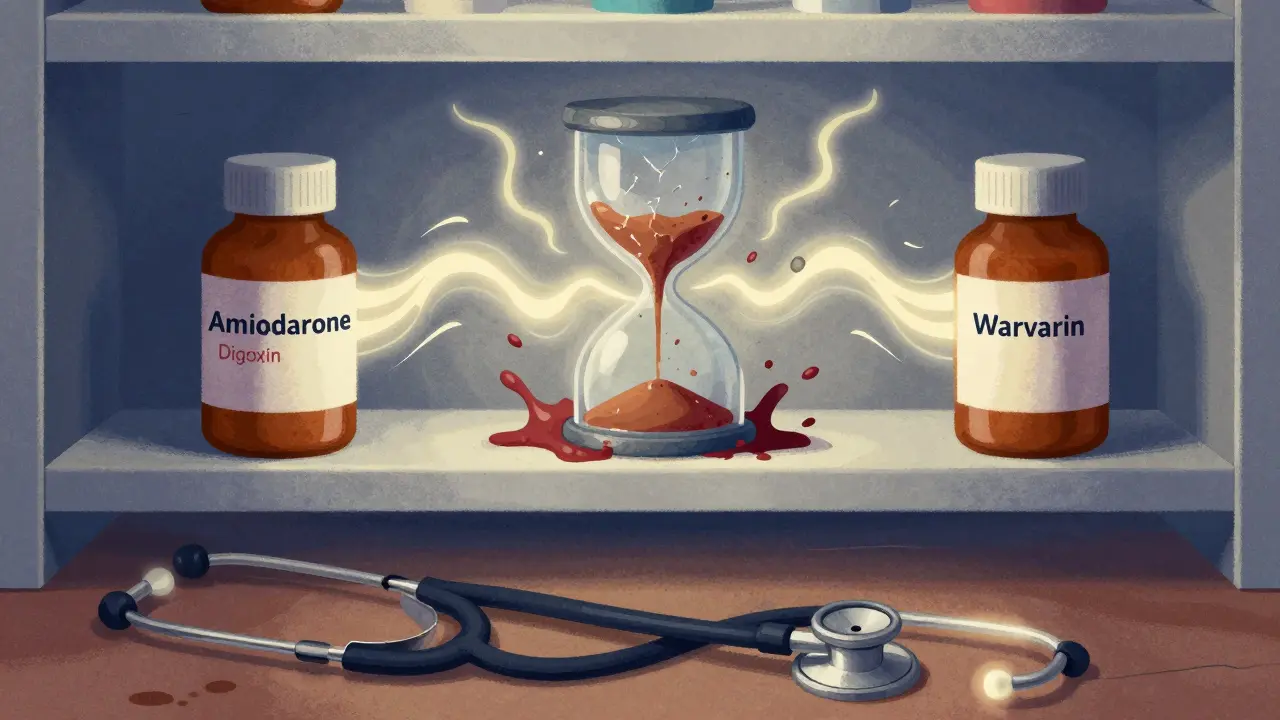
Amiodarone is a powerful antiarrhythmic used for life-threatening heart rhythms like atrial fibrillation and ventricular tachycardia. Digoxin slows the heart rate in atrial fibrillation. Warfarin prevents strokes by thinning the blood. Individually, they’re lifesavers. Together? They turn into a perfect storm. The problem isn’t just that they interact - it’s how they amplify each other’s dangers. Amiodarone doesn’t just tweak their effects; it multiplies them. It traps digoxin in your body, letting levels spike 40% to 100% within days. At the same time, it cripples your liver’s ability to break down warfarin, making its blood-thinning effect explode. The result? You’re walking around with digoxin poisoning and blood too thin to stop bleeding - all without knowing it.How Amiodarone Hijacks Your Body’s Systems
Amiodarone is a molecular bulldozer. It doesn’t just affect one enzyme or transporter - it smashes through multiple systems at once. First, it blocks P-glycoprotein, the body’s natural pump that kicks digoxin out of your kidneys and intestines. Without this pump, digoxin builds up like traffic jamming a highway. A normal level of 0.5-0.9 ng/mL can jump to 1.5 ng/mL or higher - the danger zone. At that point, nausea, vomiting, blurry yellow vision, and dangerous heart rhythms start showing up. Then there’s warfarin. Amiodarone and its metabolite, desethylamiodarone, shut down CYP2C9 - the main enzyme that clears the more potent S-warfarin from your blood. Studies show this cuts S-warfarin clearance by 55%. That means even if you take the same dose, your INR (a measure of blood clotting time) can rocket from 2.5 to 8.0 in under two weeks. At INR 8+, the risk of bleeding skyrockets. A single fall, a minor cut, even a nosebleed can turn into a life-threatening hemorrhage. And here’s the kicker: amiodarone stays in your system for months. Its half-life? Up to 100 days. So even if you stop taking it, the danger doesn’t vanish. Your body is still slowly releasing amiodarone into your bloodstream, continuing to interfere with digoxin and warfarin for weeks after you think you’re clear.The Real-World Cost: Bleeding, Toxicity, and Death
This isn’t just a theory from textbooks. It’s in the data. A 2021 study tracking over 4,800 patients found that adding amiodarone to digoxin alone increased the risk of death by 23%. Add warfarin into the mix, and the numbers get worse. In a 2020 analysis of nearly 13,000 patients on warfarin, those taking amiodarone were over four times more likely to have an INR above 4.0 - the threshold where bleeding risk spikes. Major bleeding events rose by 180%. The FDA’s adverse event database shows 1,842 reports of digoxin toxicity linked to amiodarone between 2010 and 2022. That’s a 5.3-fold increase compared to digoxin alone. One Reddit thread from a cardiologist at Massachusetts General Hospital described a patient with an INR of 12.4 - the highest level they’d ever seen. The patient needed four units of plasma and a high-dose vitamin K injection to survive. Elderly patients are hit hardest. A 2022 study found that 63% of these dangerous interactions occur in people over 75. Many are on these drugs because they’ve had a stroke before or have a mechanical heart valve - conditions where warfarin is still required. But their kidneys are slower, their livers are weaker, and their bodies can’t handle the buildup. A simple fall can lead to a brain bleed. One case in the British Journal of Cardiology described a 66-year-old man whose INR hit over 10 after digoxin toxicity. He bled internally and didn’t survive.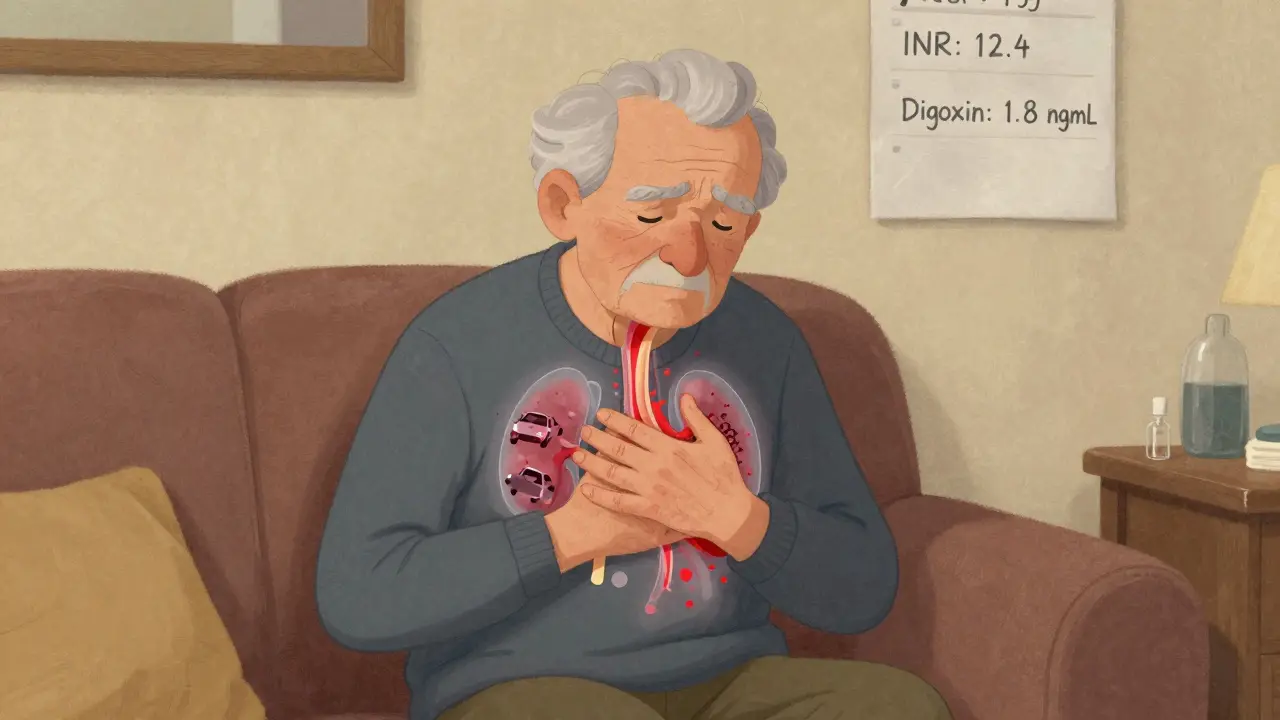
What You Must Do: A Clear Action Plan
If you’re on all three drugs, you need a plan - not hope.- Immediately reduce your digoxin dose by 50% when amiodarone is started. Don’t wait for symptoms. Don’t wait for a lab test. Start low.
- Get your digoxin level checked 72 hours after starting amiodarone. Normal is 0.5-0.9 ng/mL. Anything above 1.2 ng/mL in someone over 70 is dangerous.
- Reduce your warfarin dose by 30-50% before or right after starting amiodarone. Many doctors forget this step. Don’t assume your current dose is safe.
- Check your INR every 48-72 hours for the first two weeks. Then weekly for at least a month. After that, keep checking every 1-2 weeks for the next 4-6 weeks - even if you feel fine.
- If you stop amiodarone, keep monitoring for 4-6 weeks. The drug is still in your system. Your INR and digoxin levels can keep rising.
What Your Doctor Should Be Doing
This isn’t just your job. Your doctor should be on top of this. In 2022, the American College of Cardiology updated guidelines to make these steps mandatory. Yet, a 2023 study found that fewer than 40% of primary care doctors routinely adjust warfarin doses when adding amiodarone. That’s unacceptable. Ask your doctor:- “Are you aware of the amiodarone-digoxin-warfarin interaction?”
- “Have you checked my digoxin level since I started amiodarone?”
- “What’s my current INR trend - is it going up?”
- “Should I be on a DOAC instead?”
When to Call for Help
You don’t need to wait for a crisis. Watch for these red flags:- Feeling nauseous or vomiting for no reason
- Seeing yellow or green halos around lights
- Heart racing or skipping beats (worse than before)
- Bleeding gums, nosebleeds, or bruises that appear without injury
- Dark, tarry stools or red urine
- Headache, dizziness, or confusion - signs of possible brain bleed
The Bigger Picture: Why This Keeps Happening
This interaction isn’t rare. It’s common. In the U.S., over 12 million people have atrial fibrillation. About half are on anticoagulants. A third are on digoxin. And amiodarone? It’s still used in 20-30% of cases, especially when other drugs fail. The problem? We treat drugs like they’re isolated. We don’t look at the whole picture. A patient gets warfarin for stroke prevention, digoxin for heart rate control, then amiodarone because the rhythm won’t stabilize. No one steps back and says: “Wait - this combo kills.” Electronic health records flag this interaction, but many doctors ignore the alerts. One 2022 study found that even with alerts, 55% of patients still got the full doses of all three drugs without adjustment. The fix? Better systems. Better education. But until then, you have to be your own advocate.What Comes Next
Research is evolving. A 2023 study showed that people with a specific gene variant (ABCB1 C3435T TT) get nearly 92% higher digoxin levels when taking amiodarone. That’s not something most doctors test for. But if you’ve had a bad reaction before, ask about pharmacogenetic testing. And while DOACs are replacing warfarin in new patients, millions still rely on it. The American Heart Association estimates 4.3 million Americans will be on this dangerous triad through 2030. This isn’t going away. But it can be managed. It can be prevented. You just need to know what to look for - and act before it’s too late.Can I stop taking warfarin if I start amiodarone?
No. Stopping warfarin without replacement puts you at high risk for stroke, especially if you have atrial fibrillation or a mechanical heart valve. The answer isn’t to stop - it’s to adjust. Your warfarin dose must be lowered by 30-50% when amiodarone is added, and your INR must be monitored closely. Never stop anticoagulation without consulting your cardiologist.
How long after stopping amiodarone should I keep checking my INR?
At least 4 to 6 weeks. Amiodarone stays in your body for months - its half-life can be up to 100 days. Even after you stop taking it, your liver continues to release it slowly, which means it still blocks warfarin metabolism. Stopping monitoring too soon can lead to a delayed rise in INR and serious bleeding.
Is digoxin still safe to use with amiodarone?
Only if the dose is cut in half and serum levels are monitored. Digoxin toxicity is common and deadly when combined with amiodarone. Many doctors now avoid digoxin altogether in patients on amiodarone, using beta-blockers or calcium channel blockers instead. If digoxin is necessary, start at 50% of your usual dose and check levels within 72 hours.
Can I switch from warfarin to a DOAC if I’m on amiodarone?
Maybe. DOACs like apixaban and rivaroxaban have fewer interactions than warfarin, but amiodarone still affects them. It can raise levels of dabigatran by blocking P-glycoprotein, increasing bleeding risk. If you’re considering switching, your doctor must evaluate your kidney function, age, and reason for anticoagulation. DOACs aren’t safe for mechanical heart valves - so if you have one, warfarin is still required.
What should I do if my INR suddenly jumps above 5.0?
Call your doctor immediately. If your INR is above 5.0 and you have no bleeding symptoms, you may need to skip your next warfarin dose and get a repeat INR in 24-48 hours. If your INR is above 8.0, or you’re bleeding, go to the emergency room. You may need vitamin K and possibly fresh frozen plasma. Never ignore a sudden INR spike - especially if you’re on amiodarone.
Pat Dean
January 17, 2026 AT 20:08This is why America’s healthcare system is a joke. Doctors don’t care until someone’s in the morgue. I’ve seen it with my own eyes - grandpa on all three drugs, no one checked his levels, he bled out in his sleep. No one even told us the drugs could kill him. Now he’s gone, and the hospital sent us a thank-you card for being a ‘valued patient.’
Jay Clarke
January 19, 2026 AT 10:36Amiodarone is basically the pharmaceutical version of a cult leader - it shows up, takes over your body, and won’t leave even when you beg it to. And nobody talks about how it’s just a band-aid on a bullet wound? We’re treating heart rhythm like it’s a Spotify playlist - ‘oh, this one’s glitchy, let’s throw amiodarone at it.’ Meanwhile, your liver’s screaming in the background. Wake up, people.
Selina Warren
January 20, 2026 AT 07:48Listen. I used to be one of those people who trusted doctors blindly. Then my mom got put on this triad after her stroke. They didn’t adjust anything. She started seeing yellow halos around streetlights. Thought it was cataracts. Turned out she had digoxin poisoning. She almost died. Now I’m the one screaming at every cardiologist I meet. If you’re on these three, you’re not a patient - you’re a walking time bomb. And if your doctor doesn’t know that, they shouldn’t be holding a stethoscope.
Robert Davis
January 20, 2026 AT 10:32Actually, the real issue is that we’re still using warfarin at all. DOACs exist. They’re safer. But insurance won’t cover them for mechanical valves, so we’re stuck with this outdated, dangerous combo. It’s not the doctors’ fault - it’s the system. The FDA approved amiodarone in 1985. The guidelines haven’t caught up. We’re treating 21st-century patients with 20th-century protocols.
Andrew McLarren
January 20, 2026 AT 19:52While the clinical evidence presented is both compelling and well-documented, I would respectfully suggest that patient advocacy must be paired with systemic reform. The fact that 55% of physicians ignore EHR alerts for this interaction speaks to a broader failure in clinical workflow design, not merely individual negligence. Mandatory dose-adjustment protocols integrated into prescribing software, coupled with automated INR/digoxin monitoring reminders, may prove more effective than relying on patient self-advocacy alone.
christian Espinola
January 21, 2026 AT 21:09Let me guess - this was written by a pharma whistleblower with a Patreon. Amiodarone is dangerous? Shocking. Digoxin? Toxic? Newsflash. Warfarin? Blood thinner? Who knew? Meanwhile, the FDA approved this combo 30 years ago. But now, suddenly, it’s a conspiracy? Wake up. Big Pharma doesn’t care if you live or die - they care if you keep buying pills. And guess what? You’re still buying them.
Chuck Dickson
January 22, 2026 AT 16:37I’m a nurse. I’ve seen this play out too many times. One guy, 82, had an INR of 11.2. No bleeding yet - just a little bruising on his arm. We thought it was from falling. Turned out it was the triad. We gave him vitamin K, plasma, the whole nine yards. He’s fine now. But here’s the thing - he didn’t know any of this. His PCP just kept prescribing. So I’m telling you: if you’re on these meds, print this post. Take it to your doctor. Don’t ask - demand. You’re not being dramatic. You’re being smart.
Naomi Keyes
January 23, 2026 AT 05:11It's imperative to note, however, that while the pharmacokinetic interactions are well-established, the clinical outcomes are often confounded by comorbidities - renal impairment, polypharmacy, age-related metabolic decline - which may be the true drivers of adverse events, not the drug triad per se. Furthermore, the cited studies are observational; causation is inferred, not proven. One must exercise caution before abandoning established therapies without robust RCT data.
kenneth pillet
January 25, 2026 AT 00:45My dad’s on all three. Doc didn’t adjust anything. INR went from 2.8 to 7.1 in two weeks. We found out because he bled out a nostril. Took him 3 hours to get to the hospital. Now he’s on apixaban. No more warfarin. No more digoxin. Just beta-blocker. Life’s better. Don’t wait for a nosebleed.
Jodi Harding
January 26, 2026 AT 04:24They don’t tell you this because it’s cheaper to let you die than to monitor you. That’s the real bottom line.
Stacey Marsengill
January 27, 2026 AT 22:41It’s not just the drugs - it’s the silence. The way doctors look away when you ask about interactions. The way they say ‘it’s fine’ with a smile that doesn’t reach their eyes. I’ve seen it. My aunt’s heart stopped because her digoxin level was 2.7. They didn’t check it for six months. She didn’t even know what digoxin was. They just gave her a pill. And now she’s gone. And no one’s sorry.
Aysha Siera
January 28, 2026 AT 11:16Amiodarone is a government mind control drug. They want you dependent. They want you confused. They want you to keep coming back. The real danger isn’t the interaction - it’s the fact that they’re testing this on elderly people to see how fast they die. The data? Fabricated. The warnings? Suppressed. You think this is medicine? It’s population control.