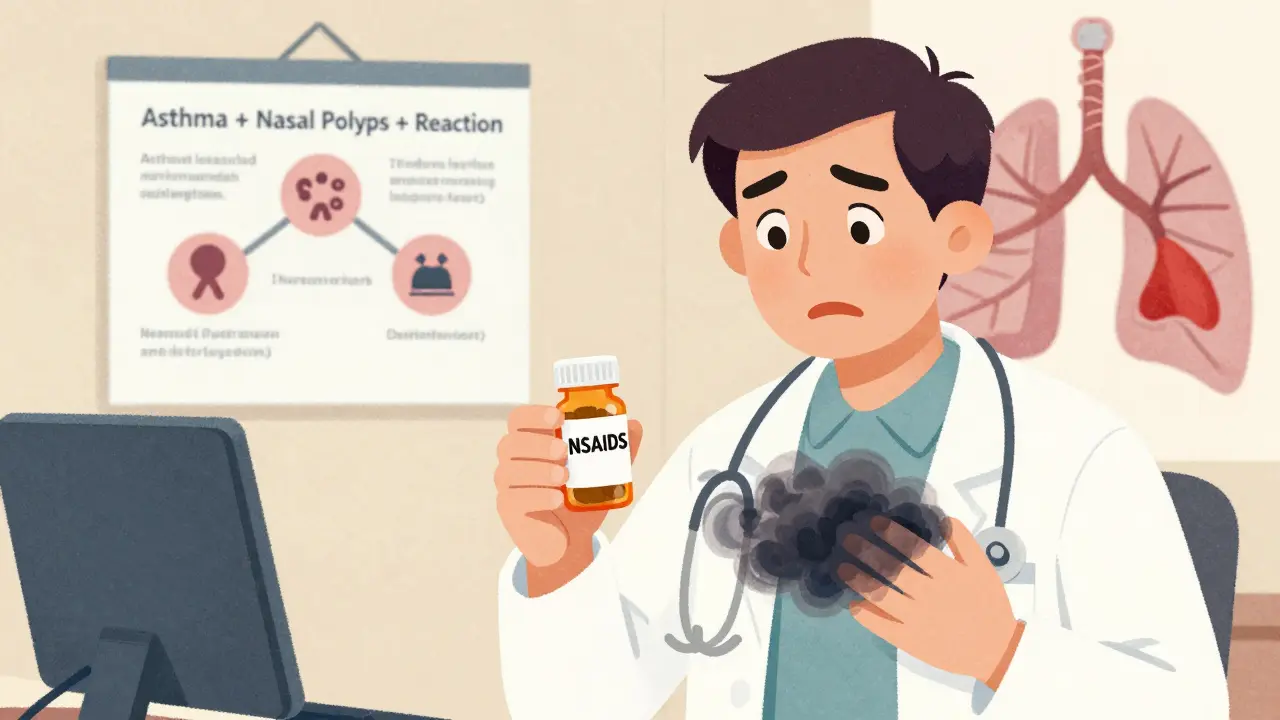
What Is Aspirin-Exacerbated Respiratory Disease?
Aspirin-Exacerbated Respiratory Disease, or AERD, is not just a bad reaction to painkillers. It’s a chronic condition that hits adults-usually between 20 and 50-with a powerful one-two punch: asthma, recurring nasal polyps, and severe breathing problems after taking aspirin or common NSAIDs like ibuprofen or naproxen. This trio is so consistent it’s called Samter’s Triad, named after the doctors who first mapped it out in the 1960s. About 7% of all adult asthmatics have it, and if you have nasal polyps along with asthma, your chance jumps to nearly 1 in 7.
Unlike regular allergies, AERD isn’t triggered by pollen or pet dander. It’s a metabolic glitch. When you take aspirin or similar drugs, your body overproduces inflammatory chemicals called cysteinyl leukotrienes. These flood your airways, causing swelling, mucus buildup, and intense bronchoconstriction. The result? You can’t breathe. Your nose gets stuffed. Your sinuses feel like they’re packed with wet cement. And your asthma flares up without warning.
How Do You Know If You Have AERD?
There’s no single blood test or scan that confirms AERD. Diagnosis comes down to three things: your history, your symptoms, and sometimes, a controlled challenge.
If you’ve had asthma since adulthood-especially if it got worse after starting ibuprofen for a headache-and you’ve had nasal polyps that keep coming back after surgery, you’re likely looking at AERD. Over 94% of people with this condition need surgery at least once to remove polyps. And almost everyone who has it reacts to NSAIDs within 30 to 120 minutes, with symptoms like wheezing, nasal congestion, facial flushing, or even anaphylaxis.
When the story isn’t clear, doctors may recommend an oral aspirin challenge. This isn’t something you do at home. It’s done in a hospital or allergy clinic with emergency equipment on standby. You start with a tiny dose-20 to 30 milligrams-and every 90 to 120 minutes, the dose doubles. You’re monitored closely for breathing changes. If you react, the test stops. If you don’t reach 325mg without symptoms, you’re likely not AERD-positive. About 98% of people who go through this test get a clear answer.
Lab tests can support the diagnosis. Blood eosinophils are often above 500 cells/μL. Urinary leukotriene E4 levels are elevated in nearly 9 out of 10 patients during active disease. These aren’t diagnostic alone, but when they line up with your symptoms, they add strong evidence.
What Happens If You Just Avoid Aspirin and NSAIDs?
It seems logical: stop taking the drugs that trigger your symptoms, and you’ll feel better. But that’s not how AERD works.
Even if you avoid every NSAID on the planet-including those hidden in cold medicines, headache pills, and even some acne treatments-your asthma and polyps still progress. The disease doesn’t pause just because you skip the trigger. Your airways keep inflaming on their own. Studies show that avoidance alone doesn’t stop polyp regrowth or prevent worsening asthma.
That’s why medical management is the next step. High-dose steroid nasal rinses-50 to 100mg of budesonide twice daily-shrink polyps by 30-40% in just eight weeks. Intranasal sprays like fluticasone (two sprays per nostril, twice a day) improve nasal congestion scores by 35% after 12 weeks. For asthma, a combination inhaler like fluticasone/salmeterol (250/50μg, two puffs twice daily) boosts lung function by 15-20% in most patients.
But even with all that, many people still struggle. That’s where the next layer of treatment comes in.
Medications That Target the Root Cause
AERD is driven by excess leukotrienes. So blocking those makes sense.
Zileuton is a 5-lipoxygenase inhibitor that stops leukotriene production at the source. Taken four times a day, it slashes urinary leukotriene E4 by 75% in two weeks. About 28% of users report "extreme effectiveness." But it requires frequent dosing and liver monitoring, which makes it hard to stick with.
Montelukast and zafirlukast block leukotriene receptors instead. They’re easier to take-once daily-but only 15% of AERD patients find them "extremely effective." They help a bit, but rarely turn the tide.
Then there are the biologics. These are injectable drugs that target specific parts of the immune system. Dupilumab, given as a weekly or biweekly shot, cuts nasal polyp size by 55% and improves quality-of-life scores by 40% in 16 weeks. Mepolizumab, given monthly, drops eosinophil counts by 85% and reduces the need for repeat sinus surgery by over half in a year. These aren’t cheap-costing thousands per month-but for severe cases, they’re life-changing. Since 2022, their use in AERD has jumped from 12% to 38% of eligible patients.

Aspirin Desensitization: The Game-Changer
Here’s the counterintuitive part: the best treatment for AERD is to take aspirin-regularly, every day.
Aspirin desensitization is a process where you’re slowly exposed to increasing doses of aspirin under medical supervision until your body adjusts. Once you’re desensitized, you continue taking 650mg twice daily, every single day. No skipping. No gaps.
Why does this work? Long-term aspirin use reprograms your body’s inflammatory response. It suppresses leukotriene production and reduces eosinophil activity. The results are dramatic: patients who stick with it cut their need for oral steroid bursts from over four per year to just one. Polyp recurrence after sinus surgery drops from 85% to 35% within two years.
One study found that combining sinus surgery with aspirin desensitization reduces polyp recurrence to just 25-30% at two years. Surgery alone? 60-70% of patients are back in the operating room within 18 months. That’s the difference between managing symptoms and changing the disease’s course.
And it’s not just about breathing. Smell returns. In one survey, desensitized patients saw their smell test scores jump from 12.4 to 23.7 out of 40. People report smelling coffee again for the first time in years.
Who Shouldn’t Try Desensitization?
It’s powerful-but not for everyone.
Desensitization is risky if you have severe heart disease, active peptic ulcers, or a history of gastrointestinal bleeding. It’s also not recommended if you can’t commit to daily aspirin. Missing just two or three doses in a row means you lose your tolerance. In 68% of cases, you’ll need to go through the whole process again.
Side effects happen. About 22% of long-term users develop stomach upset, ulcers, or bleeding. That’s why many take it with food or switch to enteric-coated aspirin. Some need a proton-pump inhibitor to protect their stomach.
Experts estimate that 15% of potential candidates are ruled out because of these risks or lifestyle barriers. But for the rest? It’s the most effective long-term strategy we have.
The Big Picture: Surgery, Drugs, and Daily Aspirin
The best outcomes come from combining all three: surgery, medical therapy, and daily aspirin.
Functional endoscopic sinus surgery (FESS) clears the blockage. Steroid rinses and inhalers keep inflammation down. Daily aspirin prevents the disease from bouncing back.
Dr. Tanya Laidlaw, who leads research at Brigham and Women’s AERD Center, calls this combo the "gold standard." It’s not just about symptom relief-it’s about preventing years of repeated surgeries, emergency visits, and steroid dependence.
And the cost savings are real. Each revision sinus surgery costs about $18,500. Aspirin desensitization adds $12,500 per quality-adjusted life year gained-far cheaper than repeated operations or biologics over time. Over a patient’s lifetime, integrated care could save $87,000 in healthcare costs.

What’s Next for AERD Treatment?
The field is moving fast. New drugs are in the pipeline. MN-001 (tipelukast), a dual inhibitor of leukotriene and PDE4 pathways, showed a 60% drop in leukotriene E4 in early trials with few side effects. Combining dupilumab with aspirin therapy led to better outcomes than either alone.
But access remains a problem. There are only about 35 dedicated AERD centers in the U.S. Most allergists aren’t trained to do aspirin challenges. Rural patients often can’t get within 100 miles of a specialist. Telemedicine has helped, increasing access by 35% since 2020, but it’s not enough.
Patients are also speaking up. Online communities like r/SamtersTriad share tips: using tea tree oil in saline rinses to fight fungal growth, checking OTC meds for hidden NSAIDs, scheduling aspirin with meals to avoid stomach upset. These aren’t medical advice-but they’re real-life hacks that help people survive.
What Should You Do If You Suspect AERD?
If you’re an adult with asthma and recurring nasal polyps-and you’ve had breathing trouble after taking aspirin, ibuprofen, or naproxen-talk to an allergist who specializes in airway inflammation. Don’t assume it’s just "bad allergies."
Ask about:
- Getting a full clinical history review
- Whether an aspirin challenge is appropriate
- If you’re a candidate for sinus surgery combined with desensitization
- Options for biologics if medications aren’t enough
Don’t wait until you’ve had three surgeries. Don’t assume avoiding NSAIDs will fix it. AERD is treatable-but only if you know what you’re dealing with.
Living With AERD: Practical Tips
- Always check labels on cold, flu, and pain meds. Look for ibuprofen, naproxen, diclofenac, or ketoprofen.
- Use saline rinses daily with budesonide or a steroid solution as prescribed.
- Keep a symptom journal-note when you feel congested, wheezy, or smell loss worsens.
- If you’re on aspirin therapy, never skip doses. Set phone alarms. Keep extra pills in your bag.
- Carry an epinephrine auto-injector if you’ve had severe reactions in the past.
- Connect with patient communities. You’re not alone.
Can you outgrow Aspirin-Exacerbated Respiratory Disease?
No, AERD is a lifelong condition. It doesn’t go away on its own. Even if symptoms improve with treatment, stopping aspirin therapy or avoiding triggers won’t reverse the underlying inflammation. The disease remains active, and symptoms can return if management stops.
Is aspirin desensitization safe?
Yes, when done under medical supervision in a controlled setting. The risk of a severe reaction during the challenge is real, but facilities that perform these procedures are equipped with emergency equipment and trained staff. Over 98% of patients complete the process successfully. Long-term daily aspirin use carries risks like stomach bleeding, but these can be managed with proper dosing and protective medications.
Can you use acetaminophen if you have AERD?
Yes. Acetaminophen (Tylenol) is generally safe for people with AERD because it doesn’t inhibit COX-1 the same way aspirin and NSAIDs do. Most patients tolerate it well, though a small percentage may still react. Always start with a low dose and monitor for symptoms.
How long does aspirin desensitization take?
The procedure usually takes 2 days. On the first day, you receive increasing doses every 90 to 120 minutes until you reach 325mg or have a reaction. If you complete it in one day, you return the next day to confirm tolerance. Once desensitized, you start daily aspirin therapy immediately.
Do you need surgery if you do aspirin desensitization?
Many patients still need sinus surgery before starting aspirin therapy. Polyps often block the sinuses so badly that medications can’t reach the tissue. Surgery clears the way, making aspirin and nasal rinses much more effective. After surgery, desensitization dramatically reduces the chance of polyps coming back.
Are biologics a cure for AERD?
No. Biologics like dupilumab and mepolizumab are powerful tools that control inflammation and reduce symptoms, but they don’t cure the disease. You need to keep taking them indefinitely. They’re often used alongside aspirin therapy, especially for patients who can’t tolerate aspirin or have severe disease.
Can children get AERD?
AERD is almost exclusively an adult-onset disease. It rarely appears before age 18. If a child has asthma and nasal polyps, other conditions like cystic fibrosis, primary ciliary dyskinesia, or allergic fungal sinusitis are more likely. AERD is diagnosed in people aged 20-50, with most cases starting in the 30s.
What happens if you miss a dose of aspirin after desensitization?
Missing one or two doses is usually okay. But if you miss three or more consecutive days, you lose your desensitization. You’ll need to go through the full challenge process again to regain tolerance. That’s why sticking to a daily schedule is critical.
John Hay
December 21, 2025 AT 03:47Jon Paramore
December 21, 2025 AT 09:01Cameron Hoover
December 22, 2025 AT 16:15Sandy Crux
December 24, 2025 AT 10:40Sarah Williams
December 26, 2025 AT 07:27Christina Weber
December 26, 2025 AT 21:04Cara C
December 28, 2025 AT 01:34Michael Ochieng
December 29, 2025 AT 11:57