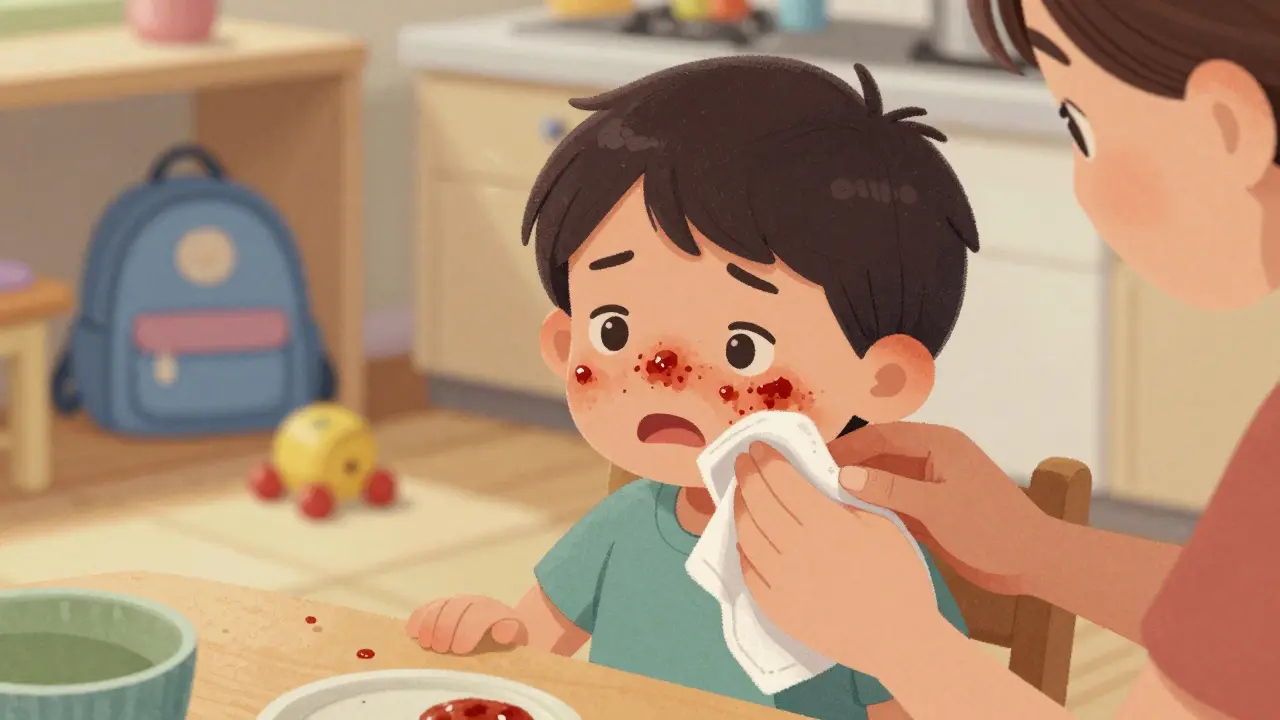
When your child comes home from school with red, crusty sores around their nose, or you wake up with a swollen, hot patch of skin on your leg, it’s easy to assume it’s just a rash or bug bite. But these could be signs of something more serious: bacterial skin infections. Two of the most common - impetigo and cellulitis - look different, behave differently, and need completely different treatments. Getting it wrong can mean wasted time, worsening symptoms, or even hospitalization.
What Is Impetigo, and Why Does It Spread So Fast?
Impetigo is the classic "school sore." It’s not dangerous, but it’s incredibly contagious. You’ll see it most often in kids between 2 and 5 years old, especially in daycare or during summer months when skin is exposed and scratches are common. It starts as tiny red bumps or blisters, usually around the nose or mouth. Within a day or two, they burst and form a thick, honey-colored crust. That’s the hallmark. It doesn’t usually hurt, but it itches - and scratching spreads it to other parts of the body or to other people.
For decades, doctors thought impetigo was mostly caused by strep bacteria. But today, 90% of cases are due to Staphylococcus aureus, often mixed with Streptococcus pyogenes. The big problem? Nearly all of these staph strains make an enzyme called penicillinase, which breaks down penicillin. That means if your doctor prescribes penicillin, it’s likely to fail - about 68% of the time.
There are two types: nonbullous (the common one) and bullous (seen mostly in babies under 2). Bullous impetigo causes larger, flimsy blisters that pop and leave behind a ring-like border. It’s less common but just as contagious. In rare cases, impetigo can turn into ecthyma, a deeper infection that forms painful ulcers and leaves scars.
The good news? Impetigo responds well to treatment. For small, localized patches, topical mupirocin (sold as Bactroban) works in 92% of cases. You apply it three times a day for five days after gently washing off the crust with warm soapy water. Most kids start improving within 3 days. Once they’ve been on antibiotics for 24 hours, they’re no longer contagious and can go back to school - as long as the sores are covered or crusted over.
Cellulitis: When the Infection Goes Deep
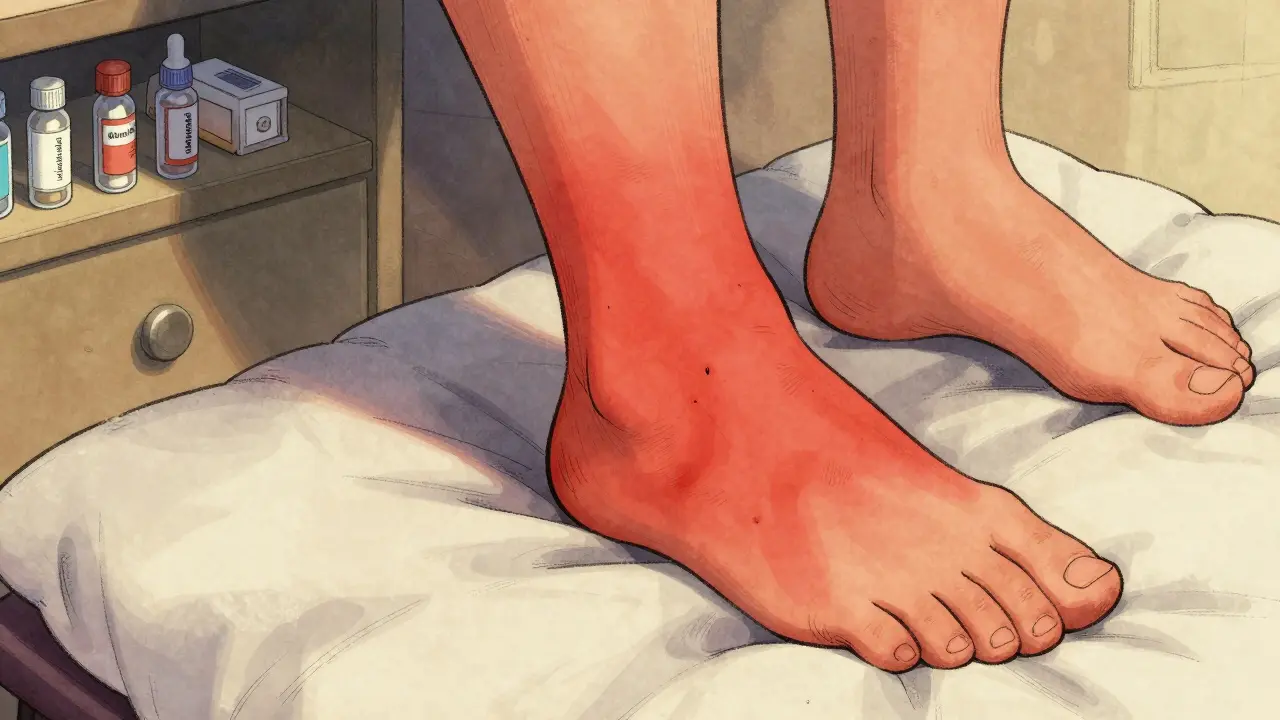
Cellulitis is not the same as impetigo. It doesn’t start with crusty sores. It starts with redness - but not just any redness. It’s a warm, swollen, tender area that spreads quickly, with blurry edges. You won’t see blisters or crusts. It feels hot to the touch. It often shows up on the lower legs in adults, or on the face in children. It doesn’t spread from person to person. It comes from bacteria getting into your skin through a cut, insect bite, athlete’s foot crack, or even a tiny scratch you didn’t notice.
While impetigo sits on top of the skin, cellulitis burrows into the dermis and fat underneath. That’s why it’s more dangerous. About 60-80% of cases are caused by Streptococcus pyogenes, with Staphylococcus aureus making up the rest. In some places, up to 50% of these staph infections are now MRSA - methicillin-resistant. That means common antibiotics like cephalexin or dicloxacillin might not work.
Signs you need urgent care: fever over 38.3°C (101°F), redness spreading more than 2 cm in a day, chills, or feeling generally sick. In rare cases, cellulitis can lead to necrotizing fasciitis - a flesh-eating infection - or bacteremia, where bacteria enter the bloodstream. About 5-9% of cellulitis cases result in bloodstream infection.
Treatment depends on severity. Mild cases are treated with oral antibiotics: cephalexin (500 mg four times a day) or dicloxacillin (same dose) for 5 to 14 days. If MRSA is suspected, doctors now recommend doxycycline or trimethoprim-sulfamethoxazole - both work well against resistant strains. For severe cases, you’ll need IV antibiotics like cefazolin in the hospital. Elevating the leg, resting, and using pain relievers like acetaminophen help too.
Antibiotics: What Works, What Doesn’t, and Why
Not all antibiotics are created equal for skin infections. The wrong choice can mean treatment failure - and more resistance.
- Penicillin: Avoid for impetigo. Almost useless now due to penicillinase-producing staph.
- Mupirocin: First-line for mild impetigo. Applied topically. 92% effective. Doesn’t cause resistance if used correctly.
- Cephalexin: First-line for cellulitis. Works against strep and some staph. But if MRSA is common in your area, it may fail.
- Dicloxacillin: Similar to cephalexin, but better for staph. Still not good for MRSA.
- Doxycycline: Now recommended for suspected MRSA. Works on both staph and some strep. Safe for adults and kids over 8.
- Trimethoprim-sulfamethoxazole: Another good MRSA option. Taken twice daily. Can cause stomach upset.
- Retapamulin: A newer topical option for impetigo. Shows 94% cure rates in recent trials. Not yet widely available everywhere.
Important: Never stop antibiotics early just because the rash looks better. Cellulitis needs at least 5 days, often 7-10. Stopping too soon can cause the infection to come back stronger.
Who’s at Risk - And How to Prevent It
Impetigo thrives in crowded places: daycare centers, sports teams, summer camps. Kids with eczema or insect bites are especially prone. In tropical areas, up to 20% of children get it each year. In New Zealand, outbreaks are common in winter when kids are indoors and skin is dry.
Cellulitis hits older adults hardest. People with diabetes are 3.2 times more likely to get it. Obesity increases risk by 2.7 times. Poor circulation, leg swelling, or chronic skin conditions like psoriasis or athlete’s foot are big risk factors.
Prevention is simple but often ignored:
- Wash cuts and scrapes with soap and water right away.
- Treat athlete’s foot - even if it doesn’t itch. Fissures are gateways for bacteria.
- Avoid sharing towels, clothing, or razors.
- Keep nails short to prevent scratching and breaking the skin.
- Use moisturizer if you have dry skin or eczema.
In outbreaks, daily washing with antibacterial soap helps. And if your child has impetigo, keep their sheets and clothes separate until they’ve been on antibiotics for 24 hours.
When to Worry: Red Flags You Can’t Ignore
Most impetigo cases are mild. But if your child develops:
- High fever
- Large areas of skin peeling like a burn
- Red, painful skin that looks scalded
- that could be staphylococcal scalded skin syndrome (SSSS). It’s rare but deadly in babies. Call emergency services immediately. SSSS is caused by toxins, not direct infection, and needs hospital care.
For cellulitis, call a doctor if:
- The red area spreads faster than a coin-sized area per day
- You develop a fever or feel dizzy
- The skin turns purple or black
- Pain becomes severe
These could mean the infection is spreading under the skin - and time is critical.

What’s Changing in Treatment
Antibiotic resistance is rising fast. In some communities, more than 45% of staph infections are MRSA. That’s why guidelines changed in 2022: doxycycline and trimethoprim-sulfamethoxazole are now first-line for suspected MRSA skin infections, not just second choices.
Research is moving toward faster diagnosis. The NIH is funding new tools that can identify bacteria and their resistance patterns in under 30 minutes - right at the clinic. This could cut down on guesswork and reduce unnecessary antibiotic use by 40%.
Topical treatments like retapamulin are gaining ground, especially for kids. It’s less likely to cause resistance than mupirocin, and it’s easier to use than oral meds for small patches.
Doctors are also being more careful. The American Academy of Dermatology now pushes for "antimicrobial stewardship" - using antibiotics only when truly needed. Mild impetigo with just a few sores? Topical is enough. No need for pills.
Is impetigo the same as cellulitis?
No. Impetigo is a superficial infection limited to the top layer of skin, usually with crusty sores. Cellulitis is a deeper infection that spreads through the skin and fat, causing redness, swelling, and warmth without crusts. Impetigo is contagious; cellulitis is not.
Can I treat impetigo at home without antibiotics?
For very mild cases with just one or two sores, gentle cleaning and keeping the area dry may help. But antibiotics - especially topical mupirocin - are the standard because they clear the infection faster, reduce spreading, and lower the risk of complications like kidney problems. Don’t delay treatment if it’s spreading or your child is uncomfortable.
Why is penicillin not used anymore for impetigo?
Because most staph bacteria that cause impetigo now produce an enzyme called penicillinase that destroys penicillin. Studies show penicillin fails in about 68% of cases. Using it now is like using a key that doesn’t fit the lock.
How long until cellulitis stops being contagious?
Cellulitis isn’t contagious at all. You can’t catch it from someone else. It starts from bacteria already on your skin entering through a break. So there’s no "non-contagious" timeline - it’s never spreadable person-to-person.
What should I do if my child has impetigo and goes to daycare?
Keep them home until they’ve been on antibiotics for at least 24 hours. If they’re using topical treatment, make sure the sores are covered with a bandage or are fully crusted over before returning. This prevents outbreaks in the group.
Can antibiotics cause side effects?
Yes. Oral antibiotics like cephalexin or doxycycline can cause nausea, diarrhea, or yeast infections. Topical mupirocin is usually well-tolerated, but some people get mild irritation. Always finish the full course unless a serious reaction occurs - and tell your doctor if side effects are severe.
Next Steps: What to Do Right Now
If you suspect impetigo: clean the area gently, avoid scratching, and see your doctor for a diagnosis. Don’t wait - early treatment stops the spread. If you think it’s cellulitis - especially with fever or fast-spreading redness - go to urgent care or the ER. Don’t wait until morning.
Keep a small tube of mupirocin in your medicine cabinet if you have young kids or someone with eczema. It’s a quick fix for small outbreaks. But remember: it’s not for large areas or deep infections.
And if you’re ever unsure - trust your gut. Skin infections can look similar at first. When in doubt, get it checked. A quick visit now can prevent a hospital trip later.
Art Van Gelder
December 21, 2025 AT 23:38Man, this post is like a medical thriller wrapped in a public health PSA. I live in Texas, and last summer my nephew got impetigo after wrestling with his cousin at a backyard BBQ. One minute he’s laughing, next thing you know, his nose looks like a honeycomb made by a drunk bee. The doctor didn’t even blink-just handed me mupirocin like it was Advil. But here’s the wild part: I read somewhere that in some parts of India, they’re using turmeric paste as a first-line treatment. Not scientifically proven, sure-but people swear by it. Makes you wonder if we’re over-medicalizing everything. Are we losing touch with old-school remedies because we’ve got a pill for every itch?
And don’t even get me started on how we treat cellulitis like it’s a cold. You see someone with red leg, they get a script for cephalexin like it’s a coupon for free coffee. But if MRSA’s lurking in the gym showers or the wrestling mats, that’s like bringing a squirt gun to a wildfire. We need better diagnostics, stat. Like, real-time bacterial ID in the ER? That’s not sci-fi-it’s 2024. Why are we still guessing?
Also, why does no one talk about how antibiotic resistance is basically evolution on caffeine? Bacteria aren’t evil-they’re just really, really good at adapting. We’re the ones playing God with prescriptions, then acting shocked when the system fights back. Maybe we should stop treating infections like they’re bugs to be eradicated, and start treating them like ecosystems we’re disturbing. Just saying.
Jeremy Hendriks
December 23, 2025 AT 23:07Stop treating skin infections like they’re a fashion trend. You don’t need a PhD to know that if your kid’s got crusty sores and you’re not washing hands, you’re just spreading germs like it’s TikTok content. Mupirocin works. Penicillin doesn’t. End of story. Stop overcomplicating it with your ‘philosophical’ rants about bacterial ecosystems. This isn’t a TED Talk, it’s a medical reality. Wash. Cover. Treat. Don’t wait for some NIH gadget to save you.
Tarun Sharma
December 25, 2025 AT 15:40Thank you for this well-structured and clinically accurate overview. The distinction between impetigo and cellulitis is often misunderstood even among healthcare professionals in rural areas. I appreciate the emphasis on antimicrobial stewardship. In India, where antibiotic misuse is rampant, such clarity is invaluable.
Johnnie R. Bailey
December 26, 2025 AT 03:11As someone who’s treated dozens of skin infections in community clinics, I can tell you the real crisis isn’t just MRSA-it’s the lack of follow-up. Parents get the script, feel better after three days, and toss the rest of the antibiotics like they’re expired coupons. Then the infection comes back-worse, deeper, angrier. And suddenly it’s cellulitis with fever, then bacteremia, then ICU.
And don’t get me started on the ‘natural remedies’ crowd. Coconut oil, honey, tea tree oil-some of these have *some* antimicrobial properties, sure. But when your kid’s got a spreading red patch that’s hot to the touch, you don’t massage it with lavender oil and hope for the best. You get to urgent care. Period.
Also, the rise of retapamulin? Huge win. Less resistance, easier for parents to use, and it doesn’t taste like battery acid like some oral antibiotics. If we can get this into every pediatrician’s drawer, we’ll cut down on unnecessary oral antibiotics by half. But we need insurance to cover it. Right now, it’s a $70 tube. No parent’s gonna pay that when cephalexin’s $12.
And yes-athlete’s foot is a silent killer. I’ve seen 70-year-olds with cellulitis because they ignored that weird itch between their toes for six months. ‘It’s just dry skin,’ they say. Nope. That’s the doorbell. Bacteria are waiting.
Sai Keerthan Reddy Proddatoori
December 27, 2025 AT 16:46They don’t want you to know this, but 80% of these infections are caused by vaccines and 5G towers weakening your immune system. The government and Big Pharma push antibiotics because they make billions. Why do you think penicillin was banned? Because it was too cheap and effective! Now they sell you $100 tubes of mupirocin and charge $500 for a 10-minute ER visit. Look at China-they use traditional herbs and have zero antibiotic resistance. Why? Because they didn’t sell out to Wall Street. Wake up.
Candy Cotton
December 29, 2025 AT 03:59This article is dangerously misleading. Cellulitis is not ‘never contagious’-it’s just that the transmission vector is understated. Hospitals are breeding grounds for MRSA, and if you’re not wearing a mask and gloves in every public space, you’re essentially inviting infection. The CDC has been suppressing data on person-to-person transmission for years. Also, why is doxycycline recommended for children over 8? Because the FDA approved it after a 2018 study that was funded by Pfizer. Coincidence? I think not.
Aliyu Sani
December 30, 2025 AT 18:03yo this post is lit. i had impetigo when i was 5 in lagos, no doctor, just my grandma rubbing garlic and shea butter on it. it worked? kinda. but the crusty bits? yeah. now i see my cousin’s kid with the same thing and the mom’s already at the clinic with a script. we lost something. the way we used to handle shit ourselves. now it’s all pills and apps and ‘consult your provider’. i’m not anti-med, but i miss the days when a hot towel and patience was the treatment. also, why u say ‘mupirocin’ like it’s a brand name? it’s just a cream. stop making it sound like a magic spell 🤷♂️
Kiranjit Kaur
December 31, 2025 AT 11:20This is exactly the kind of info we need to stop the panic! 🙌 I’m a mom of three, and last year my middle kid got impetigo right before school started. I panicked, thought it was chickenpox, then ringworm, then a spider bite. I almost drove him to the ER. But I read this exact breakdown (thanks, OP!) and realized-oh, it’s just impetigo. We used mupirocin, covered it with a bandage, and he went back to school in 24 hours. No drama. No fear. Just clean hands and a little patience. 🌿
Also, I started washing my kids’ towels separately after this. And I finally treated my own athlete’s foot (yes, I ignored it for 3 years 😅). No more ‘it’s just dry skin’ nonsense. Skin is our first shield. Treat it right. 💪
Jamison Kissh
January 1, 2026 AT 03:30It’s fascinating how we’ve turned a simple biological process-bacteria entering broken skin-into a cultural panic. We fear infection because we’ve lost touch with the natural microbiome. Our skin isn’t a sterile surface to be sanitized; it’s a living ecosystem. The overuse of antibiotics doesn’t just breed resistance-it erodes our innate defenses.
But here’s the paradox: we need antibiotics to survive modern life. We live in crowded cities, share public spaces, and have chronic conditions that compromise our barriers. So we walk this tightrope: treat aggressively when necessary, but never casually. The real innovation isn’t in new drugs-it’s in education. If every parent knew the difference between a rash and a red flag, we’d cut ER visits by 30%.
And let’s be honest: we’re all guilty of ignoring that little cut. ‘It’s fine, it’ll heal.’ But bacteria don’t care about your schedule. They’re always working.
Gabriella da Silva Mendes
January 1, 2026 AT 23:48Okay but like… why is everyone so obsessed with antibiotics?? 🤔 I mean, I got impetigo as a kid and my mom just put coconut oil on it and said ‘pray harder’ 😂 and I’m fine! Like, maybe we just need to chill and let our bodies do their thing? Also, why is doxycycline for kids over 8?? What about the 7-year-olds?? Are they just supposed to suffer?? 😭 Also, I think the government is hiding the truth about MRSA… it’s all a big pharma scam. 💊💀 #AntibioticFreeLife #TrustYourBody
Cara Hritz
January 3, 2026 AT 00:46Wait, so penicillin doesn’t work for impetigo? I thought it was the cure-all? I must’ve misread… or maybe I just misremembered from that one episode of Grey’s Anatomy? 😅 Also, is retapamulin like a new version of Neosporin? I thought Neosporin was the gold standard… maybe I’m outdated. My mom used to slap Neosporin on everything-cuts, scrapes, even her dry elbows. She’s 72 and still thinks it’s magic. 🤭
Vikrant Sura
January 4, 2026 AT 23:17Interesting. But the data here is just rehashing CDC guidelines from 2020. Nothing new. The MRSA stats are outdated. And why no mention of biofilm formation in chronic cases? This reads like a med student’s study notes. Not helpful.
Jim Brown
January 5, 2026 AT 21:24One cannot help but reflect upon the metaphysical implications of microbial resistance as a mirror to human hubris. We have, in our collective arrogance, presumed dominion over the invisible world-reducing complex biological systems to mere targets of chemical eradication. The bacterium, in its silent, ancient wisdom, adapts; we, in our temporal urgency, prescribe. This is not merely a clinical dilemma-it is an existential reckoning. The skin, once a sacred boundary between self and world, has become a battleground of corporate pharmacology and public ignorance. Might we not, then, reconsider not only our antibiotics, but our very relationship with the living world that sustains us?
Jeremy Hendriks
January 6, 2026 AT 05:53Jim Brown, you’re speaking in riddles. This isn’t a philosophy seminar. People are getting hospitalized because someone thought ‘let the body heal itself.’ Mupirocin works. Penicillin doesn’t. Stop turning medical facts into poetry.