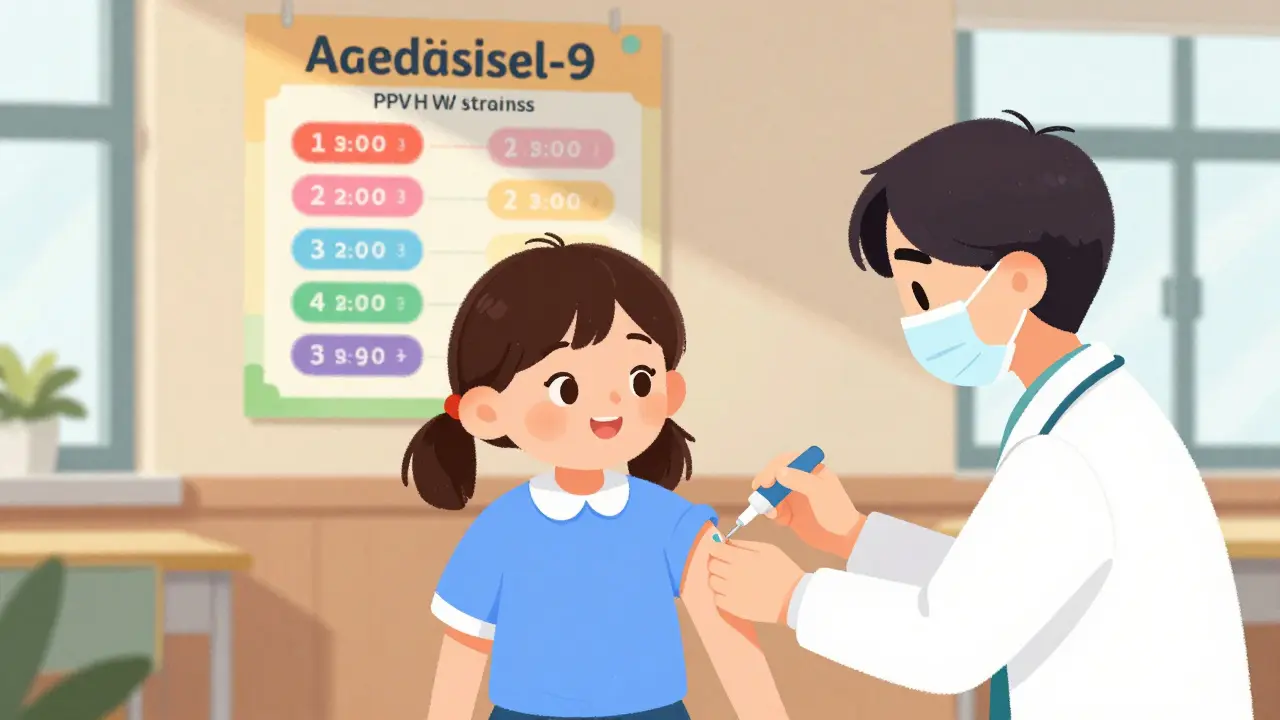
Cervical cancer used to be one of the leading causes of cancer death in women. Today, it’s one of the most preventable. Thanks to two simple, proven tools - the HPV vaccine and regular Pap testing - we’re on the verge of eliminating it entirely. But only if people use them.
HPV Is the Cause - And the Target
Almost all cervical cancers are caused by the human papillomavirus, or HPV. Not just any strain - types 16 and 18 are responsible for about 70% of cases. These strains don’t cause symptoms. Most people never know they have them. But over time, especially if the infection lasts for years, HPV can turn normal cells in the cervix into cancer.
The good news? We’ve had a vaccine for this since 2006. The current version, Gardasil-9, protects against nine high-risk HPV strains, including 16 and 18. It’s not just about preventing cancer - it prevents the cell changes that lead to cancer. Studies show it’s 97% effective when given before any exposure to HPV.
When to Get the Vaccine - And Why Timing Matters
The CDC recommends routine HPV vaccination at age 11 or 12. That’s not because kids are sexually active - it’s because their immune systems respond strongest at that age. The vaccine works best when given before any sexual contact, even just one. That’s when the body builds the strongest, longest-lasting defense.
For kids starting the vaccine before age 15, only two doses are needed, spaced at least six months apart. If vaccination starts at 15 or older, three doses are required. The vaccine is given as a shot in the arm. More than 98% of people develop protective antibodies after the full series.
Even if someone missed the ideal window, catch-up vaccination is still helpful. The CDC recommends it through age 26. For adults 27 to 45, it’s a personal decision with a doctor - especially if they haven’t been exposed to many HPV types. The vaccine still offers protection against strains they haven’t encountered.
What the Data Shows: Vaccination Is Working
The results are no longer theoretical. They’re real, measurable, and dramatic.
In Scotland, a study of nearly 140,000 women vaccinated between ages 12 and 13 found zero cases of invasive cervical cancer. That’s the first time in history a whole group of vaccinated women showed no cervical cancer at all.
In Sweden, girls vaccinated before age 17 had an 88% lower risk of cervical cancer. In the U.S., cervical cancer deaths among young women dropped 62% over the last decade - directly tied to rising vaccination rates.
A 2021 study found that women vaccinated by age 16 had an 86% lower risk of cervical cancer. Even those vaccinated between 17 and 19 saw a 68% drop. The benefit fades if vaccination starts after age 20 - not because the vaccine doesn’t work, but because exposure to HPV likely already happened.
And here’s the game-changer: a single dose might be enough. Studies in Kenya and Costa Rica showed that even one shot of the HPV vaccine provided 97% protection against high-risk strains. This could revolutionize global access, especially in countries with limited healthcare resources.
Pap Testing Still Matters - Even for the Vaccinated
Some people think: ‘I got the vaccine, so I don’t need screenings.’ That’s a dangerous myth.
The HPV vaccine doesn’t protect against all cancer-causing strains. It covers the most common ones - but not every single one. Also, not everyone gets all the doses. And not everyone was vaccinated at the right age.
That’s why screening is still essential. Pap tests look for abnormal cells on the cervix before they turn into cancer. For years, this was the only tool we had. Now, we have better ones.
As of 2023, the American College of Obstetricians and Gynecologists (ACOG) recommends:
- Start Pap testing at age 21, no matter if you’re vaccinated.
- At age 25, switch to HPV testing alone every five years. This is now the preferred method.
- Co-testing (HPV plus Pap) every five years is also acceptable.
- If you only get Pap tests, do them every three years.
For vaccinated women, the screening interval can be longer - five years instead of three - because their risk is so much lower. But skipping screening entirely? That’s not safe.
Barriers to Prevention - And How to Overcome Them
Despite the science, progress is uneven.
In the U.S., only 60.4% of teens completed the full HPV vaccine series in 2022. That’s far below the 90% goal set by the World Health Organization. Vaccine hesitancy, misinformation, and lack of access - especially in rural areas - are major reasons. During the pandemic, U.S. vaccination rates dropped 17%. They’ve partially recovered, but gaps remain.
Globally, the picture is worse. Only 12.9% of eligible girls worldwide received the full HPV vaccine series. Most cervical cancer deaths happen in low-income countries where screening is rare and vaccines are hard to reach.
But solutions are emerging. In January 2024, the FDA approved the first HPV self-sampling test. Women can now collect their own sample at home - no doctor’s visit needed. Early data shows this could increase screening access by 40%.
The WHO has prequalified single-dose HPV vaccines for global use. Gavi, the Vaccine Alliance, is investing over $1 billion to bring them to 50+ low-income countries by 2025. If we scale this up, we could prevent millions of cases.
What’s Next? The End of Cervical Cancer
Experts now believe cervical cancer could be the first cancer ever eliminated as a public health problem.
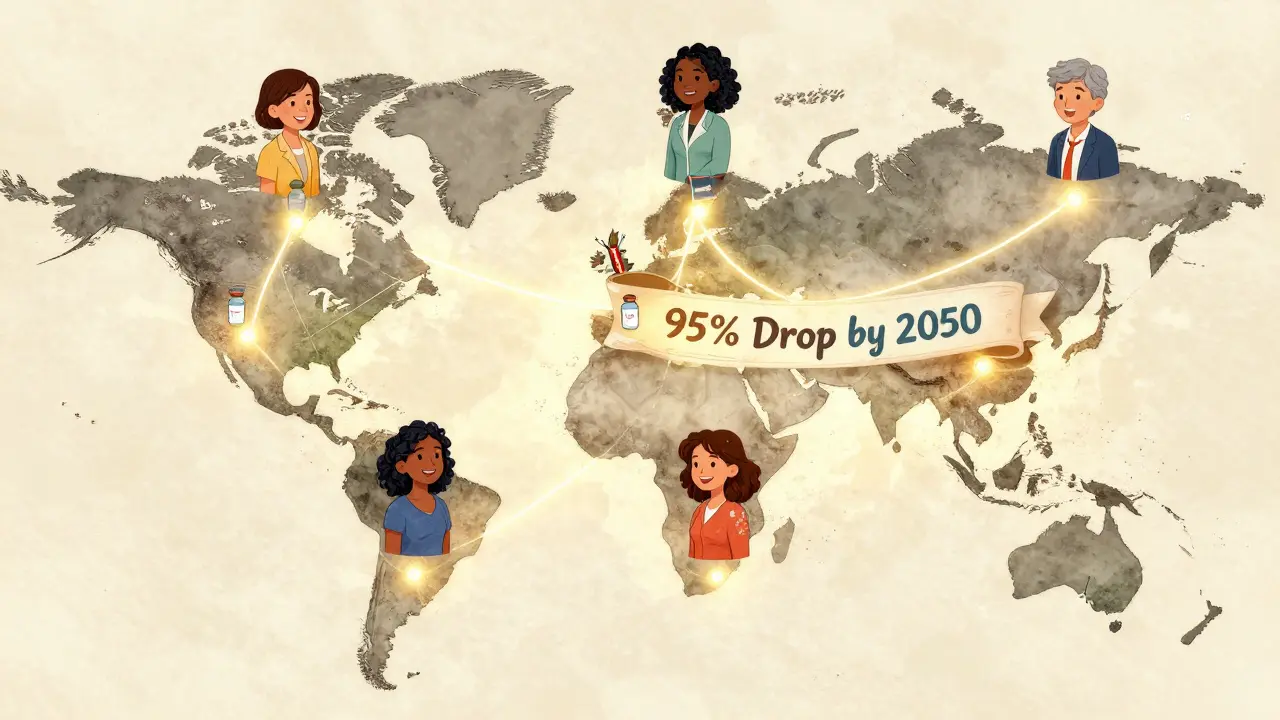
Australia, which started vaccinating girls in 2007, is on track to eliminate cervical cancer by 2028. Scotland’s vaccinated cohort showed no cases of invasive cancer. The International Papillomavirus Society predicts a 95% drop in global cervical cancer cases by 2050.
But this won’t happen by accident. It needs action:
- Get the HPV vaccine at 11 or 12 - or catch up before 26.
- Start screening at 21, switch to HPV testing at 25.
- Don’t skip doses or screenings, even if you feel fine.
- Support policies that make vaccines and tests affordable and accessible.
Cervical cancer isn’t inevitable. It’s preventable. And with the tools we have today, we can make sure no woman dies from it again.
Rod Wheatley
January 20, 2026 AT 23:46Just wanted to say this is one of the clearest, most compassionate explainers I’ve read on this topic. I work in public health and see so much misinformation out there - this deserves to be shared everywhere. The single-dose data? Game-changer. Especially for rural communities and low-resource settings. We need to stop treating this like a political issue and start treating it like the medical win it is.
Also, props to the WHO and Gavi for pushing single-dose vaccines globally. That’s real progress.
Jerry Rodrigues
January 21, 2026 AT 16:25Been waiting for someone to say this out loud.
It’s not about fear. It’s about facts.
Malvina Tomja
January 22, 2026 AT 08:30Oh great. Another vaccine push disguised as public health. You know what else was 'proven' to prevent cancer? The 1950s radium toothpaste. Science is just a trend until it's not.
Also, why are we vaccinating 11-year-olds? That's not prevention - that's social engineering.
Glenda Marínez Granados
January 24, 2026 AT 06:18Malvina’s comment is peak 2024 energy 😅
Meanwhile, in Scotland, 140k girls are living proof that science works.
Also, my 12-year-old niece got her second shot last week. She didn’t turn into a lab rat. Just a happy human with a future.
Philip Williams
January 25, 2026 AT 18:55While the data on HPV vaccination is overwhelmingly positive, we must acknowledge structural inequities in access. The fact that only 12.9% of eligible girls globally received the full series is not a failure of individual choice - it is a failure of global policy. The FDA’s approval of self-sampling kits is a vital step, but without funding, distribution, and cultural education, even the best tools remain inaccessible. This is not merely a medical issue - it is a human rights issue.
Melanie Pearson
January 27, 2026 AT 18:14Let’s not pretend this isn’t about controlling women’s bodies. Vaccinating children before they’re even teens? That’s not science - that’s indoctrination. And who benefits? Big Pharma. Always. I’ve seen too many parents pressured into this. No one should be shamed for asking questions.
Uju Megafu
January 28, 2026 AT 00:06OH MY GOD. I JUST READ THIS AND I’M CRYING. I LOST MY COUSIN TO CERVICAL CANCER AT 28. SHE NEVER GOT THE VACCINE BECAUSE HER MOM THOUGHT IT WAS 'FOR PROMISCUOUS GIRLS'. NOW I’M MAKING SURE MY DAUGHTER GETS IT. NO MORE STIGMA. NO MORE SILENCE. #HPVISNOTASHAME
Samuel Mendoza
January 29, 2026 AT 01:1097% effective? That’s a lie. My cousin got the vaccine and still got HPV. Also, Pap smears are outdated. We should just rely on genetics.
Jarrod Flesch
January 30, 2026 AT 22:54Just got back from a clinic in rural Queensland where they’re using mobile vans to give single-dose HPV shots. No appointments. No stigma. Just a nurse, a shot, and a lollipop for the kids. That’s the future. Simple. Human. Effective.
Also, the self-sampling kits? Genius. My mum used one last year - said it was easier than a pap test. No one cried. Not even her.
Andrew Rinaldi
January 31, 2026 AT 13:39I appreciate the data here - really do. But I think we need to talk about how we talk about this. Framing it as 'saving lives' is powerful, but sometimes it feels like guilt-tripping parents who are hesitant. Maybe instead of saying 'you’re putting your child at risk,' we say 'here’s what we know, and here’s how we can protect them together.'
People don’t resist facts - they resist feeling judged. And that’s on all of us, not just the medical system.
Barbara Mahone
February 1, 2026 AT 08:11The American College of Obstetricians and Gynecologists’ 2023 guidelines are clear, evidence-based, and align with global standards. It is imperative that healthcare providers communicate these recommendations with precision and consistency. Misinterpretations of screening intervals - such as assuming vaccination eliminates the need for testing - remain dangerously prevalent in clinical practice.
Amber Lane
February 3, 2026 AT 03:00My mom got a pap test at 45 and caught it early. She’s fine now. Don’t skip screenings. Ever.
lokesh prasanth
February 3, 2026 AT 17:53why vaccinate kids? they dont even know what sex is. also pap test is for rich people only. in india no one gets it. so why talk?
Stephen Rock
February 4, 2026 AT 23:23So we’re now calling cancer prevention a 'public health win' while ignoring that the vaccine was developed by a company that lobbied for mandatory school policies? Classic. Also, I’ve got 3 kids. I don’t need a Reddit post to tell me how to parent.