Medication Adherence Impact Calculator
Improve your understanding of how medication adherence affects health outcomes. Based on real-world studies, this tool shows the impact of different adherence rates on hospitalizations and treatment success.
What percentage of your prescribed medication do you take as directed?
Results will appear here after calculation
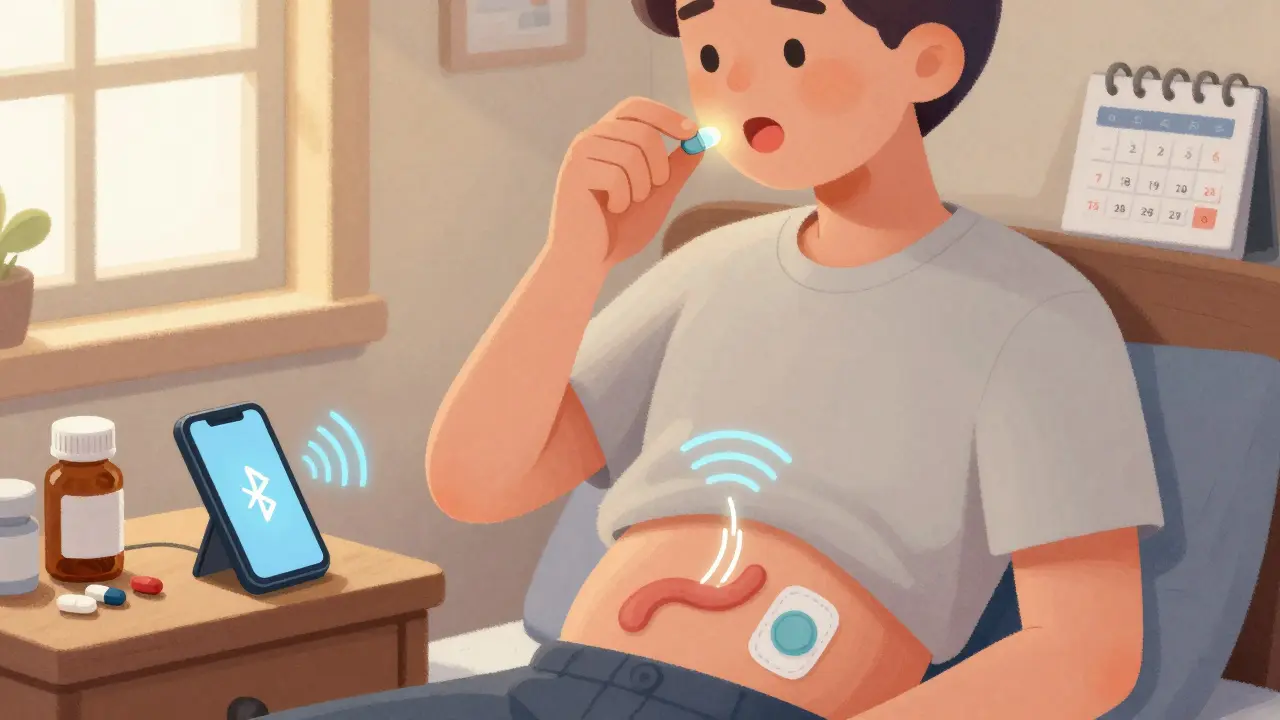
Imagine swallowing a pill and knowing, with certainty, that it reached your stomach. Not just hoping you took it, but knowing-because a tiny sensor inside the pill sends a signal to a patch on your skin, which then tells your phone and your doctor exactly when you took it. This isn’t science fiction. It’s happening now. Digital pill sensors are quietly changing how we manage chronic illnesses, especially when missing a dose can mean serious consequences.
How Digital Pills Actually Work
A digital pill isn’t just a tablet with a chip. It’s a three-part system: the ingestible sensor, a wearable patch, and a mobile app connected to a secure server. The sensor is smaller than a grain of rice-just 5 mm wide and 0.3 mm thick. Made of silicon, copper, and magnesium, it does one thing: activate when it hits stomach acid. The magnesium and copper react chemically, producing a tiny electric current-about 1 to 2 volts. That’s enough to send a unique signal via Bluetooth Low Energy (BLE) to a patch stuck to your abdomen.
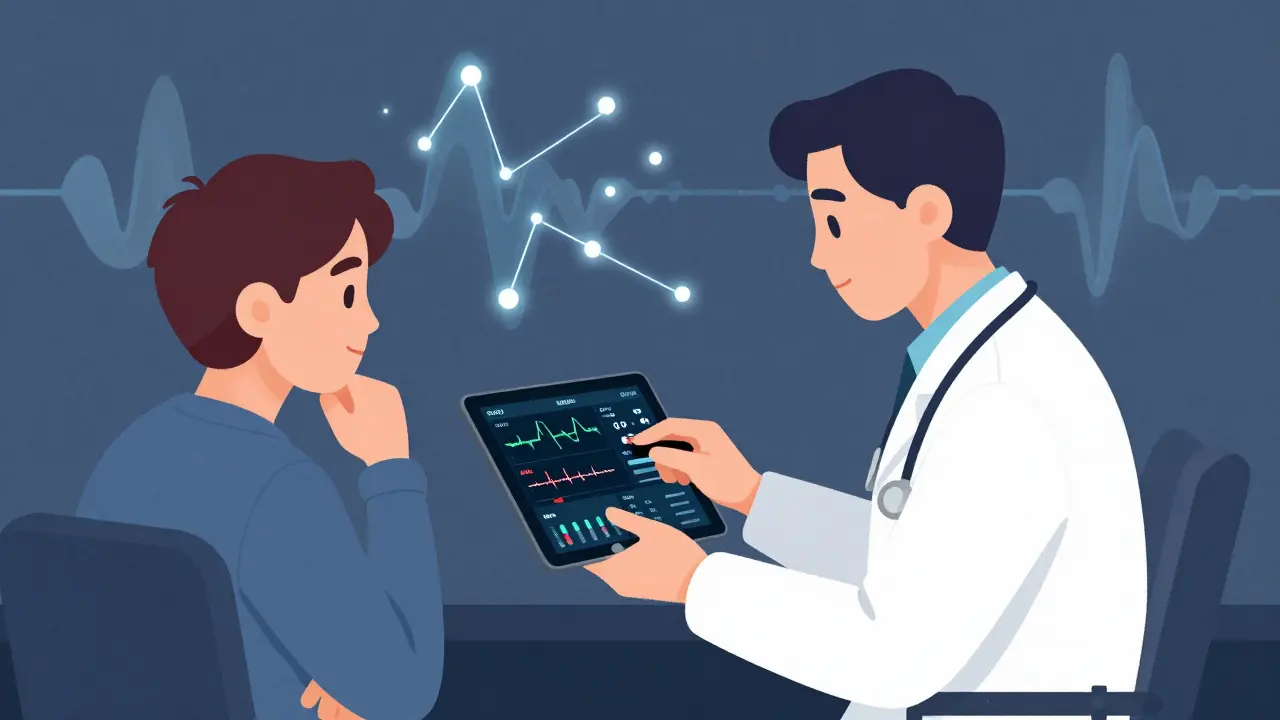
The patch isn’t just a receiver. It also tracks your heart rate (within ±2 beats per minute) and how many steps you take each day. All this data flows to your phone, then to a secure web portal where your doctor or care team can see it. Systems like Proteus’s Abilify MyCite and etectRx’s ID-Cap use AES encryption to protect the data. The whole process-from swallowing to signal-takes under 30 seconds. And unlike older methods that relied on pill counts or self-reports, this gives real, verifiable proof of ingestion.
Why Adherence Matters More Than You Think
Half of all people with chronic illnesses don’t take their meds as prescribed. That’s not laziness. It’s forgetfulness, fear of side effects, cost, confusion, or simply feeling fine and thinking they don’t need it anymore. The World Health Organization calls this one of the biggest problems in modern medicine. For someone on antipsychotics for schizophrenia, missing a dose can mean a psychotic episode. For someone with HIV, it can lead to drug resistance. For heart patients, it can mean hospitalization.
Digital pills change that. In a 12-week study of 157 people on antipsychotics, adherence jumped from 62% to 84% when they used the system. One patient on Reddit said, “Seeing the records made me realize I was skipping doses on weekends.” Another said, “It felt like my psychiatrist was watching me swallow pills.” That tension-between support and surveillance-is real. But for many, the benefit outweighs the discomfort. In the same study, 68% of patients with serious mental illness said they’d use it again. Only 42% of those with high blood pressure felt the same.
What These Pills Can Detect Beyond Ingestion
Early versions only confirmed the pill was swallowed. Now, the technology is evolving. Newer systems like Philips’s IntelliCap can measure stomach pH and temperature in real time. Why does that matter? Because how a drug is absorbed depends on your stomach environment. If your pH is too high or too low, the pill might not dissolve properly. The sensor can flag that-not just that you took it, but whether it actually worked.
And that’s just the start. By 2026, 60% of digital pill systems are expected to include side effect detection. How? By linking ingestion data with changes in heart rate, movement, or even subtle shifts in skin conductivity. If your heart rate spikes 15 minutes after taking a pill, and you didn’t exercise, that could signal an adverse reaction. If you stop walking as much after starting a new drug, it might mean fatigue or dizziness. These aren’t guesses. They’re patterns built from thousands of data points.
Who’s Using This-and Who Isn’t
Right now, digital pills are mostly used in two places: clinical trials and mental health treatment. About 78% of systems are used by pharmaceutical companies to monitor patients in research studies. That’s because they need accurate data to prove a drug works. Otsuka’s Abilify MyCite, approved by the FDA in 2017, is the most widely used in clinical settings, especially for schizophrenia and bipolar disorder.
But adoption outside trials is slow. Only 12% of systems are used directly by patients at home. Why? Reimbursement. Insurance companies won’t pay for the patch or the software unless there’s clear proof it reduces hospital visits. And right now, the evidence is mixed. One study showed potential savings of $100-290 billion a year in the U.S. alone-but that’s still theoretical. Until payers see hard numbers on reduced ER visits or hospitalizations, they won’t cover it.
There’s also a tech gap. Elderly patients had trouble connecting the patch to their phones in trials. Nearly 40% needed help. That’s a big barrier if the goal is to help older adults with heart disease or diabetes. And for people with limited smartphone access, the system just doesn’t work.
The Privacy and Ethical Tightrope
Every time you swallow a digital pill, you’re handing over intimate health data. The Electronic Frontier Foundation warns this could be used by insurers or employers to penalize people who miss doses. What if your employer finds out you skipped your blood pressure meds? What if your insurer raises your premium because you didn’t take your diabetes drug on a weekend?
Current laws like HIPAA protect data sent through healthcare channels. But what about data stored on your phone? What if the app gets hacked? What if your doctor sees you skipped a dose and assumes you’re noncompliant-without asking why? One patient said, “I didn’t take it because I was too scared of the nausea. But the app just showed ‘missed.’ No context.”
And then there’s the psychological effect. Some patients feel empowered. Others feel trapped. Dr. Michelle Mello from Stanford calls this “therapeutic misconception”-the belief that the sensor itself is helping, not just tracking. That can make people feel guilty for missing doses, even when the reason is valid: depression, cost, side effects.
Technical Hurdles and Real-World Failures
The tech isn’t perfect. Signal loss happens. In real-world use, 8-12% of transmissions fail. For people with a BMI over 35, that jumps to 18%. Why? Body fat can block the Bluetooth signal between the sensor and the patch. Sensor orientation in the stomach matters too-if it lands sideways, the electrodes might not connect properly with gastric fluid.
The wearable patch lasts only 72 hours. After that, you need to replace it. Some users reported skin irritation, and 22% stopped using the system because of it. Setup takes 15-20 minutes: download the app, pair the patch, create a password, log into the portal. For someone with dementia or limited tech skills, that’s a lot.
And here’s the biggest gap: the system confirms ingestion, not absorption. Just because the pill reached your stomach doesn’t mean your body used it. If you have a gut disorder, or you vomit 20 minutes later, the sensor still sends a “taken” signal. That’s a flaw no one has fully solved yet.
The Future: AI, Predictions, and Broader Use
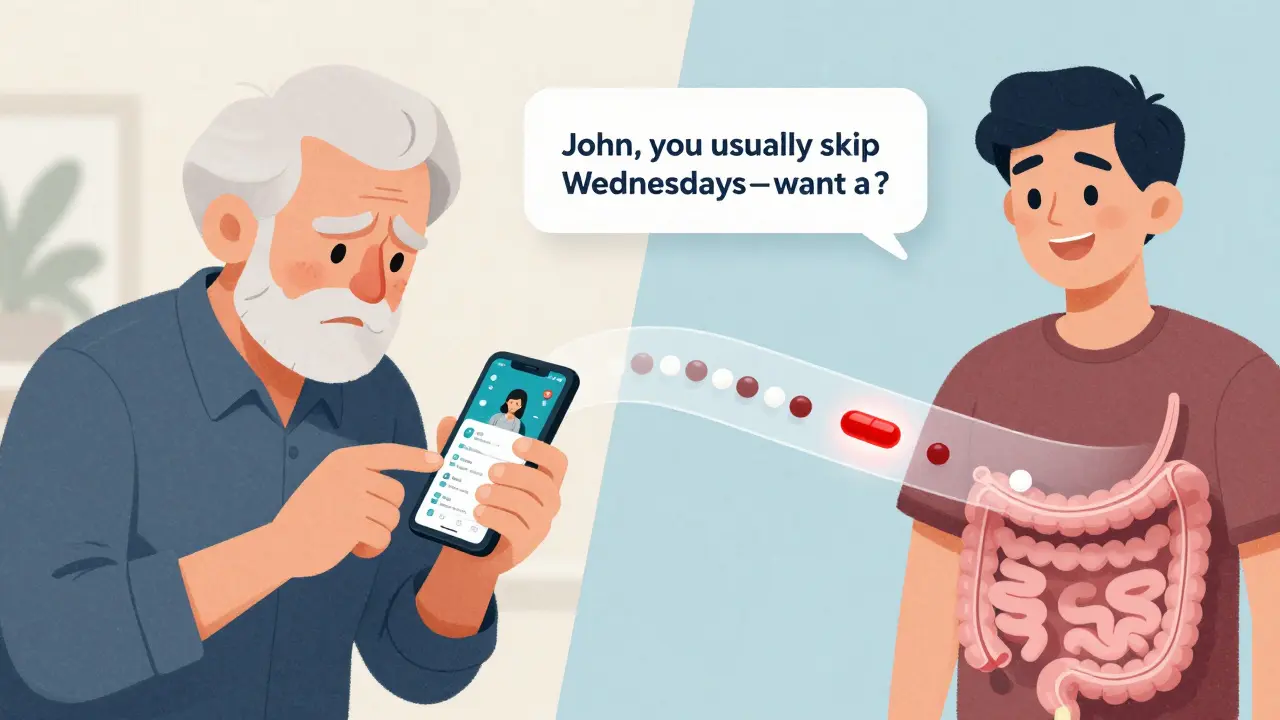
The next leap isn’t just tracking-it’s predicting. etectRx teamed up with IBM Watson Health in late 2023 to build AI models that forecast when someone is likely to miss a dose. The system looks at past behavior, weather, sleep patterns, even how often they open their pill bottle. Early results show 82% accuracy. That means your care team could get a heads-up: “John usually skips Wednesday doses. Maybe call him Tuesday night.”
The FDA approved the first digital pill for tuberculosis treatment in March 2023. That’s huge. TB treatment requires taking 4-6 pills a day for 6-9 months. Missing even one dose can lead to drug-resistant strains. Digital pills could be a game-changer here, especially in low-resource settings where clinic visits are rare.
By 2026, experts expect digital pills to become standard for high-risk regimens: transplant patients, epilepsy, severe mental illness. But for routine meds-like statins or blood pressure pills-they’ll stay niche. Why? Cost. The patch alone costs $5-$10 per day. For someone on Medicare or without insurance, that’s not sustainable.
What’s Next for Patients and Providers
If you’re considering this technology, ask: Is this for me? If you’re managing a life-threatening condition and have struggled with adherence, the data might help. If you’re on a simple daily pill and just forget sometimes, a phone alarm might be enough.
For providers, the key isn’t just seeing data-it’s using it. A missed dose isn’t a failure. It’s a signal. Was it a side effect? A missed appointment? A change in routine? The system gives you a starting point. The real work is the conversation that follows.
Digital pills aren’t magic. They don’t cure anything. They just show you what’s happening. And sometimes, seeing the truth-no matter how uncomfortable-is the first step toward change.
Do digital pills actually improve health outcomes?
Digital pills don’t cure diseases, but they can improve outcomes by ensuring patients take their meds as prescribed. Studies show adherence rates increase from around 50% to over 80% in mental health and TB treatment. Better adherence leads to fewer hospitalizations, fewer drug resistance cases, and more stable health. But the system only works if patients and providers use the data to make real changes-not just monitor.
Can digital pills detect side effects like nausea or dizziness?
Not directly. The sensors don’t measure how you feel. But they can detect indirect signs. A sudden drop in steps after taking a pill might mean dizziness. A spike in heart rate could signal an allergic reaction. AI models are being trained to link these patterns to side effects, and by 2026, most new systems will include this feature. Still, patient self-reporting remains essential for symptoms like nausea or mood changes.
Are digital pills safe to swallow?
Yes. The sensors are made of biocompatible materials-silicon, copper, and magnesium-that are non-toxic and pass through the digestive system without being absorbed. They’re designed to be excreted naturally in stool within 24-72 hours. No long-term effects have been reported in clinical trials. The main risks are skin irritation from the patch or discomfort from the idea of being tracked.
Who pays for digital pill systems?
Right now, most costs are covered by research grants or pharmaceutical companies running clinical trials. In clinical care, insurance rarely pays for the patch or software. Medicare and private insurers are hesitant because long-term cost savings aren’t yet proven. Some pilot programs in mental health clinics have shown promise, but widespread reimbursement is still years away. Patients often pay out-of-pocket, which limits access.
Can I stop using the digital pill if I change my mind?
Yes. You can stop wearing the patch at any time. The sensor in the pill doesn’t stay in your body-it passes through naturally. You can also delete your account or ask your provider to stop sharing data. Consent is required at every step, and you have the right to opt out. But if you’re in a clinical trial or under court-ordered treatment, stopping might have consequences. Always talk to your provider before discontinuing.