Going out to eat shouldn’t mean giving up control over your blood sugar. With diabetes, dining at a restaurant can feel like walking through a minefield of hidden carbs, oversized portions, and sugary sauces. But it doesn’t have to be that way. The key isn’t avoiding restaurants-it’s knowing how to navigate them with confidence. You can enjoy a meal out without spiking your glucose, as long as you use simple, proven strategies backed by real-world data and clinical guidelines.
Use the Plate Method-No Math Required
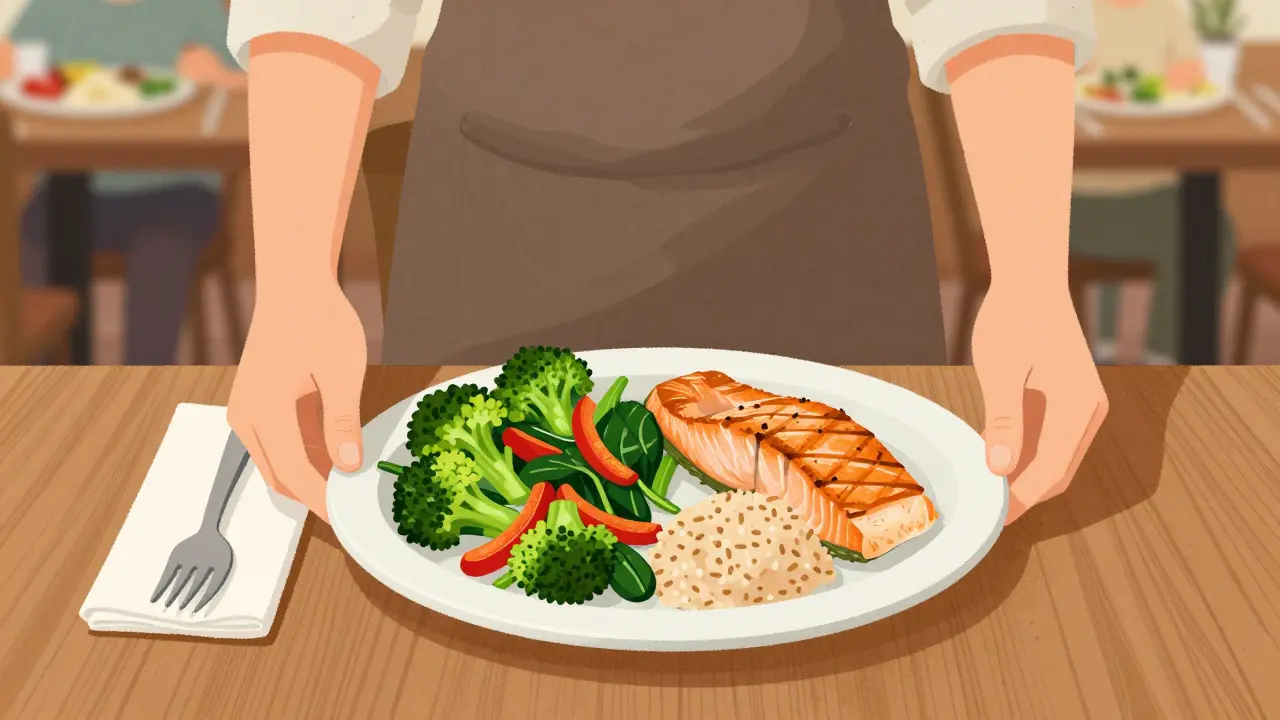
The easiest way to balance your meal without counting every gram of carb is the Diabetes Plate Method. It’s simple: grab a nine-inch plate and divide it in your head. Half the plate gets filled with non-starchy vegetables-things like broccoli, spinach, peppers, or asparagus. One-quarter gets lean protein: grilled chicken, fish, tofu, or lean beef. The last quarter? That’s your carb zone. And here’s the catch: you’re not getting a giant pile of rice or pasta. You’re getting one-quarter of a normal restaurant plate, which usually means 15 to 30 grams of carbs total. That’s about half a cup of rice, a small roll, or a single serving of mashed potatoes. Most restaurants serve portions that are two to three times bigger than this. You don’t need to calculate insulin ratios or track net carbs-just build your plate this way and you’re already ahead of 80% of diners.Know What’s Hidden in Your Food
Sauces, dressings, and gravies are the silent carb bombers. A spoonful of teriyaki sauce? That’s 10 grams of sugar. Creamy Caesar dressing? Another 8 grams. Even "healthy" options like tomato basil pasta sauce can pack 15 grams of carbs per half-cup. The American Diabetes Association says these hidden carbs can add 15 to 20 grams per meal-enough to send your blood sugar sky-high. Always ask for sauces on the side. Dip your fork, don’t drown your food. And watch out for words like "creamed," "breaded," "crispy," or "au gratin." These mean extra flour, batter, or cheese, which means extra carbs. A breaded chicken sandwich might look like a protein choice, but it’s often 60+ grams of carbs just from the coating and bun. Go for grilled, roasted, or steamed instead.Portion Control Is Your Best Friend
Restaurant portions aren’t made for people managing diabetes-they’re made for appetite stimulation. A typical steakhouse entree might come with a 12-ounce steak and a mound of mashed potatoes the size of a baseball. That’s not one meal-it’s two. The solution? Don’t wait until you’re starving. Arrive a little hungry, not ravenous. Research from the CDC shows this cuts impulsive carb choices by 37%. Order an appetizer-sized entree if available. Share your meal with someone. Or, right after you sit down, ask the server to box up half your food before it’s served. That way, you’re not staring at a giant plate tempting you to finish it all. You’ll eat less, feel better, and have a ready-made lunch for tomorrow.Choose Your Restaurant Wisely
Not all restaurants are created equal. Fast food chains are the hardest. A Big Mac has 46 grams of carbs. A chicken burrito bowl with rice and beans? Close to 70. Even "salads" can be traps-add croutons, cheese, and creamy dressing, and you’re over 50 grams without realizing it. Full-service restaurants give you more control. You can ask for substitutions: swap fries for steamed veggies, ask for brown rice instead of white, or skip the bread basket entirely. Chains like Chipotle, Panera, and Applebee’s now offer carb counts on their menus, thanks to FDA labeling rules. But don’t trust them blindly-testing by the ADA found only 32% of listed carb counts were accurate. Use the Restaurant Ready app (launched by ADA in 2023) for verified data on over 15,000 menu items. It’s free, updated daily, and works offline.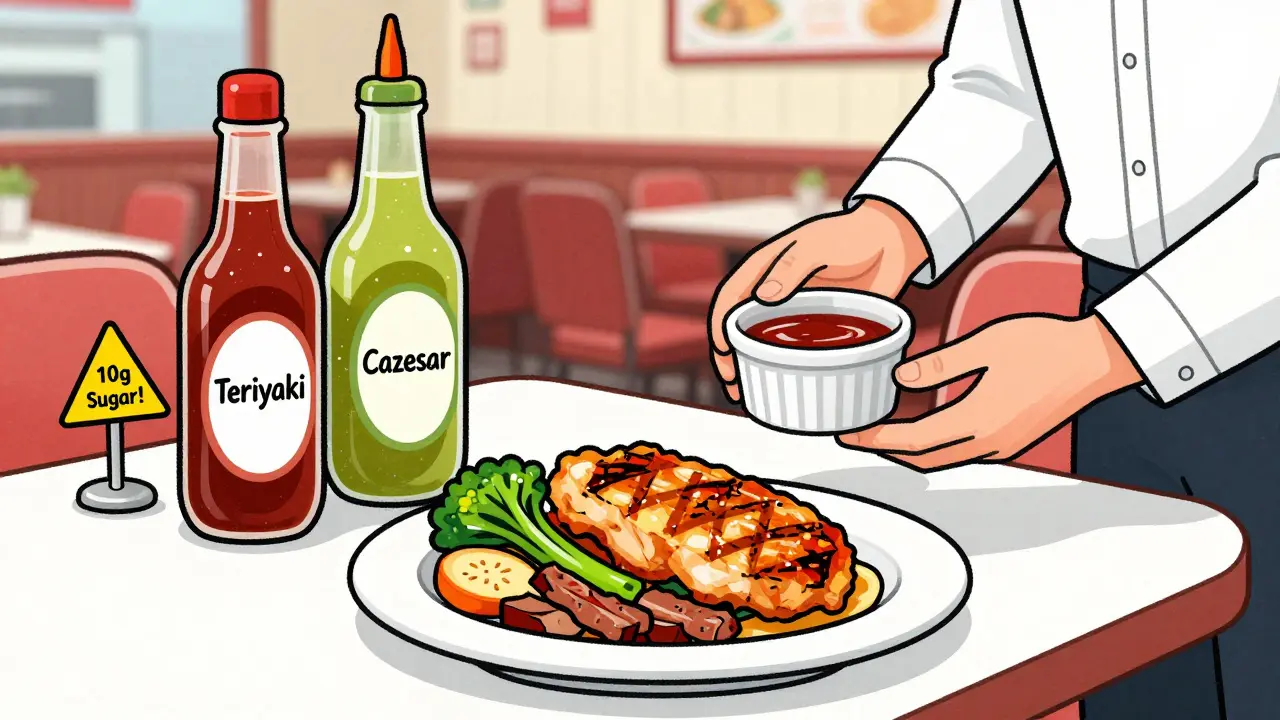
Buffets and All-You-Can-Eat Are Landmines
If you’re going to a buffet, you’re playing Russian roulette with your blood sugar. A 2021 study from the University of Illinois found buffet meals caused blood glucose spikes 65 mg/dL higher than standard restaurant meals. Why? Unlimited access means you’ll try everything-and you won’t stop until you’re full. The problem isn’t just carbs. It’s the lack of portion awareness. You don’t have a plate. You don’t have a plan. You just keep walking. If you must go, stick to one trip. Fill half your plate with salad and grilled protein. Skip the pasta station, the fried foods, and the dessert bar. Drink water. Chew slowly. And if you’re on insulin, check your glucose before and after. You’ll need to adjust your dose.Plan Ahead-It’s Not Optional
The most successful people with diabetes who eat out don’t wing it. They check the menu online before they leave the house. A Parkview Health study found that people who reviewed menus 24 hours in advance were 58% more likely to stick to their carb goals. Look for grilled items. Look for vegetable sides. Look for dishes that don’t have "sauce" or "glaze" in the name. Make a mental or written plan: "I’ll get the grilled salmon, double veggies, and no rice." Stick to it. If you’re meeting friends, text them ahead: "I’m watching my carbs tonight-mind if we pick somewhere with good grilled options?" Most people are understanding once you explain it. You’re not being difficult-you’re being smart.Carry Your Tools
Always bring your glucose meter and fast-acting carbs. Why? Because restaurants are unpredictable. Your food might come late. Your insulin might act faster than expected. Or you might end up eating a smaller portion than planned. If you’re on insulin, you could drop your blood sugar. The ADA reports that 23% of people with diabetes have had a low blood sugar episode while dining out in the past year. Keep glucose tablets or juice boxes in your bag. Don’t wait until you feel shaky. Check your numbers before you eat, and again an hour after. That way, you’re not guessing-you’re responding.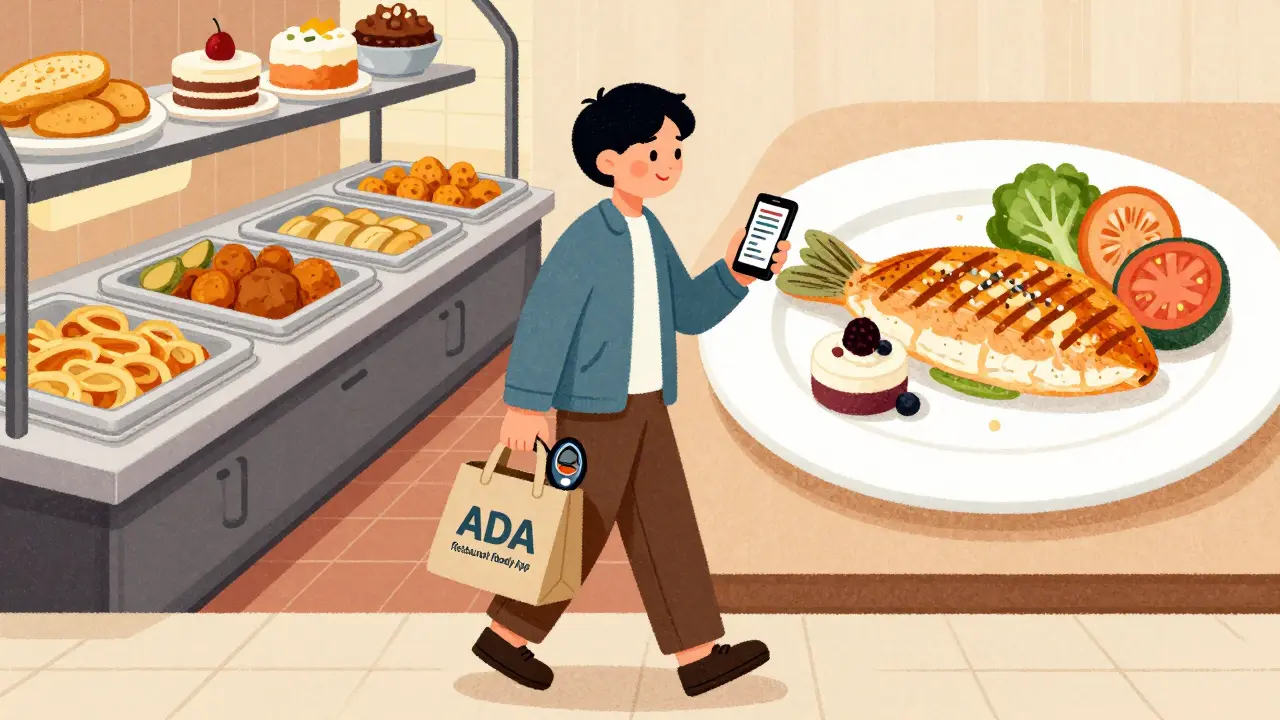
What About Dessert?
You don’t have to give up dessert forever. But you need to make it count. Skip the cake. Go for a small portion of fruit-like a few strawberries or a half-cup of berries. Or share a single scoop of ice cream with your table. Ask for it without the cone or toppings. If you’re using insulin, match your dose to the actual carb count. A scoop of vanilla ice cream has about 15 grams of carbs. That’s one serving in your carb zone. Don’t eat it on top of a full meal. Save it for when you’ve already eaten your protein and veggies. And if you’re not on insulin? You might skip it altogether. It’s not about deprivation-it’s about timing and balance.It Gets Easier With Practice
Learning to eat out with diabetes isn’t something you master overnight. The Joslin Diabetes Center says most people need 3 to 5 real dining experiences with guidance before they feel confident. That’s normal. You’ll make mistakes. You’ll overestimate a side dish. You’ll forget to ask for sauce on the side. That’s okay. What matters is that you keep trying. Every time you choose grilled over fried, or veggies over fries, you’re building better habits. People who stick with these strategies for six months see their HbA1c drop by 0.8% to 1.2%. That’s not magic. That’s consistency.Can I still eat pasta when dining out with diabetes?
Yes-but in small amounts. A standard restaurant serving of pasta is often 2 to 3 cups, which can contain 70 to 100 grams of carbs. Instead, ask for half a portion and pair it with a large side of vegetables and lean protein. Or choose whole grain pasta if available-it has more fiber and a slower impact on blood sugar. Still, limit it to one meal a week if you’re trying to stabilize your numbers.
What’s the best way to handle sauces and dressings?
Always ask for them on the side. A single tablespoon of ranch dressing can have 6 grams of carbs. Thousand Island? Up to 12. Even "light" versions often have added sugar. Dip your fork into the dressing, then your food-don’t pour it over. Olive oil and vinegar are safer bets. If the restaurant doesn’t offer them, bring your own small container of olive oil and balsamic vinegar in your bag.
Do I need to count carbs if I’m on metformin?
Yes. Metformin helps your body use insulin better, but it doesn’t block the effect of carbs. Eating too many carbs will still raise your blood sugar, even if you’re not on insulin. Portion control and smart carb choices matter just as much. You might not need to count every gram, but you still need to stay within your carb limit per meal-usually 45 to 60 grams for most adults.
Is it okay to drink alcohol while dining out?
Yes-but with caution. Alcohol can lower blood sugar, especially if you’re on insulin or certain diabetes pills. Stick to dry wines, light beer, or spirits with soda water (no sugary mixers). Avoid sweet cocktails, margaritas, or dessert wines-they’re packed with sugar. Always eat food when you drink. And check your blood sugar before bed if you’ve had more than one drink.
How do I deal with pressure from friends to eat more?
Be clear but calm. Say something like, "I’m working on keeping my blood sugar steady, so I’m sticking to smaller portions." Most people will respect that. If they push, remind them this isn’t about being picky-it’s about staying healthy. You’re not saying no to fun-you’re saying yes to feeling good the next day.
Steven Pam
February 25, 2026 AT 22:29Love this post. Seriously. I’ve been diabetic for 12 years and this is the first time someone broke it down like a real human, not a textbook. The plate method? Game changer. I started doing it last month and my A1c dropped from 8.2 to 7.1. No magic, just consistency. Also, asking for sauce on the side? I do it like it’s my job now. Waiters think I’m weird. I don’t care. I’m not dying for a spoonful of teriyaki.
Spenser Bickett
February 27, 2026 AT 20:10lol so basically if you’re not eating like a monk who’s been banished from the food court, you’re failing at life? 🙃 I get it, carbs are the devil, but can we just admit restaurants are built to make you eat too much? It’s capitalism, not a diabetes trap. Also, who has time to check a 15k-item app before dinner? I just eat and hope for the best. My pancreas is a mess but my soul is free.
Larry Zerpa
February 28, 2026 AT 21:36Let’s be real - this whole guide is built on the assumption that people with diabetes have unlimited time, money, and social privilege. You suggest using an app? Most of us don’t have smartphones with data. You say ‘ask for sauce on the side’? Try that at a rural diner where the server has never heard of ‘carbs.’ And ‘portion control’? Try telling that to someone who’s been food insecure since childhood. This reads like a wellness influencer’s fantasy, not a practical guide. Real people don’t have ‘carb zones.’ They have bills, kids, and 12-hour shifts. Stop pretending this is about health. It’s about guilt.
Erin Pinheiro
March 1, 2026 AT 00:25ugh i’m so tired of this. like, i get it, you’re trying to be helpful, but honestly? the fact that we even NEED a 2000-word guide to eat at a restaurant is just… tragic. i mean, why can’t food just be food? why does everything have to be a math problem? i tried following this advice last week and ended up crying in the parking lot because i couldn’t decide if the salad dressing was ‘safe’ or if i should’ve just eaten the bread. i’m 34. i shouldn’t have to feel like a criminal for wanting garlic bread.
Nandini Wagh
March 1, 2026 AT 10:38lol at the ‘Restaurant Ready’ app. yeah right. i used it last night and it said ‘grilled chicken salad = 12g carbs’ - turned out the ‘grilled chicken’ was breaded and fried. the app’s wrong. the FDA’s wrong. the whole system’s rigged. they want us to think we’re in control. we’re not. we’re just playing along while the food industry laughs all the way to the bank. also, why is everyone so obsessed with ‘portion control’? maybe the portions are just too damn big. maybe we should shut down restaurants and go back to cooking.
Christopher Wiedenhaupt
March 1, 2026 AT 23:22Thank you for this comprehensive and well-researched breakdown. The data cited from ADA and CDC lend credibility, and the practical strategies - especially the plate method and pre-meal menu review - are grounded in behavioral science. I’ve shared this with my diabetes education group. The section on hidden carbs in sauces is particularly vital; many patients underestimate how quickly those add up. A small, consistent shift in behavior, as noted, yields measurable clinical outcomes. Well done.
tia novialiswati
March 2, 2026 AT 17:55YOU ARE DOING AMAZING. 💪 seriously, every time you choose veggies over fries, you’re winning. i’ve been there - crying over a bread basket, feeling like a failure. but you? you’re showing up. that’s everything. your body is grateful. your future self is high-fiving you. keep going. you’ve got this. and if you slip? tomorrow’s a new plate. 🌱❤️
Ashley Johnson
March 3, 2026 AT 14:59ok but have you heard about the sugar cartel? they put carbs in everything because they’re scared of the truth - that real food doesn’t need sauce. they even put sugar in bread. in bread! and they got the FDA to lie about carb counts so we keep buying. i know someone who works at Applebee’s and she says they use corn syrup in the ‘low-sugar’ marinades. it’s all a scam. i don’t eat out anymore. i grow my own veggies and cook with olive oil and sea salt. if you’re not doing that, you’re part of the problem.
Holley T
March 4, 2026 AT 14:13Let’s be honest - the whole ‘plate method’ is just a marketing ploy to sell smaller plates. Why not just eat smaller portions? Why do we need a diagram? And why is everyone so obsessed with ‘non-starchy vegetables’? What’s so wrong with potatoes? They’re not evil. And the whole ‘ask for sauce on the side’ thing? That’s not a solution - that’s a burden. Who has the energy to negotiate every single meal? I’m tired. I’m not a nutritionist. I’m just trying to enjoy a meal with my friends without feeling like I’m doing something wrong. This post reads like a self-help book written by someone who’s never had to choose between paying rent and buying insulin. It’s not helpful. It’s performative.