
When a patient in Berlin picks up a generic version of a blood pressure pill, they’re not just getting a cheaper alternative-they’re benefiting from a complex, multi-country regulatory system that took decades to build and is now undergoing its biggest overhaul in 20 years. The European Union’s approach to generic medicines isn’t one rulebook. It’s four different paths, 27 national agencies, and a patchwork of local rules that can delay a drug’s availability by over a year-even after it’s been approved. As of 2025, these rules are changing fast, and the impact is already being felt by manufacturers, pharmacies, and patients across the continent.
How Generic Drugs Get Approved in the EU
There are four main ways a generic drug can get approved in the EU. Each one has different costs, timelines, and risks. The choice isn’t just about speed-it’s about strategy.
The Centralized Procedure is the fastest route to EU-wide access. A company submits one application to the European Medicines Agency (EMA), and if approved, the drug can be sold in all 27 EU countries plus Iceland, Liechtenstein, and Norway. This path takes about 180 days under the 2025 reforms, down from 210. But it’s expensive: application fees alone run around €425,000, and you’ll need another €1.2-1.8 million in consulting and study costs. Only companies targeting high-value generics-those expected to sell over €250 million across the EU-usually go this route. Sandoz used it to launch its version of Novartis’s Cosentyx across the entire bloc in Q2 2025, 11 months faster than the old system would’ve allowed.
The Mutual Recognition Procedure (MRP) is the most popular, used in 42% of cases. A company gets approval first in one country (the Reference Member State), then asks others to accept it. The official timeline is 90 days for consensus, but in reality, it takes 132.7 days on average. Why? Because countries often add their own requirements. Teva’s generic rosuvastatin was approved in Germany in January 2023, but didn’t hit Dutch and Belgian shelves until nine months later because of pricing delays.
The Decentralized Procedure (DCP) lets companies apply to multiple countries at once, without needing prior approval anywhere. It’s meant to be faster, but it’s the most chaotic. About 37% of DCP applications face delays longer than six months. The issue? Countries like Poland and Romania interpret EMA quality standards differently, especially for complex generics like inhalers or injectables. One company reported that a single national objection resets the entire 210-day clock-meaning a 6-month delay can turn into a year-long wait.
The National Procedure is for single-country plays. It’s slow-180 to 240 days-and defeats the purpose of EU harmonization. But it’s still useful. If a country like France has high reimbursement rates for a specific drug, a company might skip the EU-wide routes and go straight to ANSM, France’s agency. Accord Healthcare found it took 197 days for a national approval in France, but only 142 days via MRP to cover five countries. So it’s not always slower-but it’s less efficient.
What Makes a Generic Drug Legally Equivalent
It’s not enough for a generic to have the same active ingredient. It must be bioequivalent. That means it works the same way in the body. The EMA requires strict proof: the 90% confidence interval for how quickly the drug enters the bloodstream (Cmax) and how much is absorbed overall (AUC) must fall between 80% and 125% of the original brand-name drug. This isn’t a suggestion-it’s a legal requirement.
But here’s where things get messy. While the EMA sets the standard, some countries demand more. Germany’s BfArM requires extra pharmacodynamic studies for inhalers. France wants pediatric formulation details even if the original drug wasn’t meant for children. These extra demands aren’t in the EU-wide rules-they’re national add-ons. A 2025 ABPI survey of 47 generic companies found that 68% listed inconsistent bioequivalence requirements as their biggest regulatory headache.
Even the reference product matters. If the original drug was approved years ago and its data is outdated, manufacturers must prove their version matches it-even if the original’s own quality standards have changed. One company spent 14 months just tracking down the original batch specifications for a 20-year-old drug. The EMA’s guidance says this is acceptable, but national agencies often push back.
The 2025 Pharma Package: What Changed
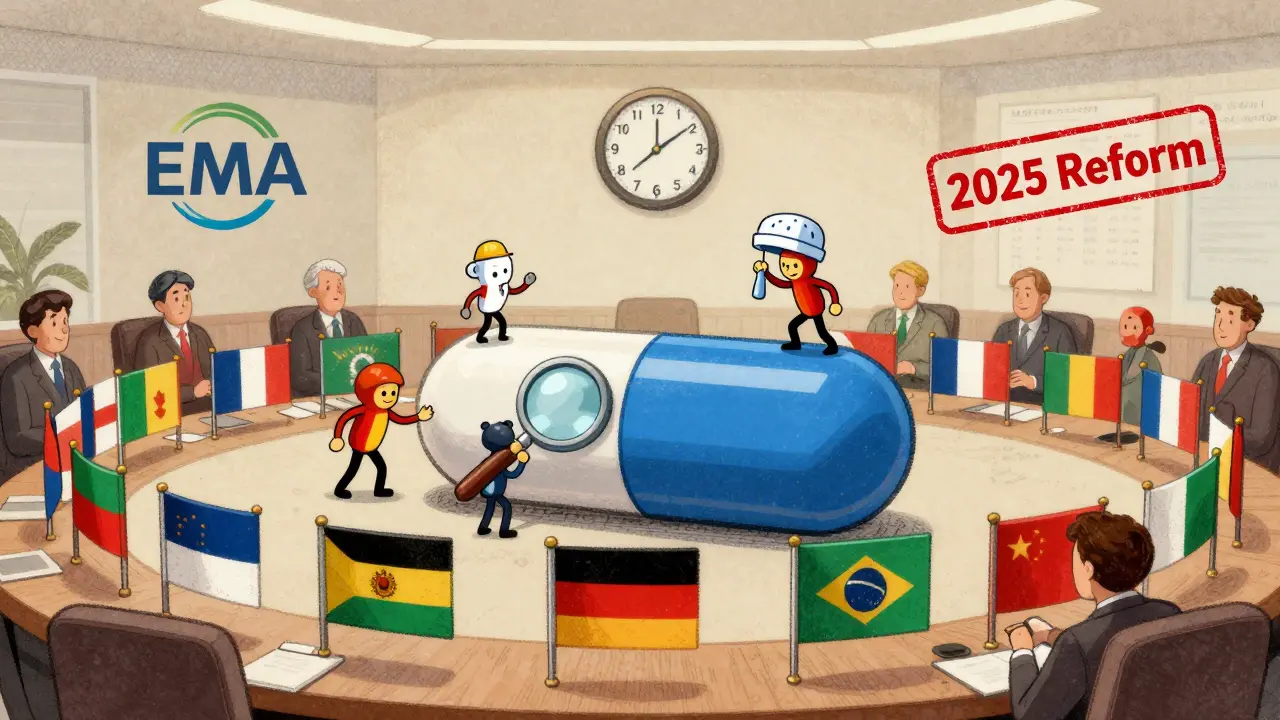
In June 2025, the EU finalized the biggest update to its pharmaceutical rules since 2004. The changes hit generics hard-and fast.
First, regulatory data protection was shortened. Before, generics had to wait 10 years after a brand-name drug’s approval before they could use its clinical data to apply for approval. Now, it’s 8 years, plus 1 year of market exclusivity-so 9 years total. For drugs that meet public health goals (like treating rare diseases), it can be extended to 10. This pushes generic entry earlier, but it also creates a new problem: companies that invest in complex generics may now see less return. The €490 million sales threshold for a Transferable Exclusivity Voucher-a bonus period for innovators-could lock out mid-sized European firms who can’t compete with big pharma’s budgets.
Second, the Bolar exemption was expanded. Before, generic makers could start negotiating prices and reimbursement with health authorities only two months before the patent expired. Now, they can start six months earlier. This might sound small, but it’s huge. REMAP Consulting estimates this alone will cut generic launch delays by 4.3 months on average. It also gives payers more power: if multiple generics are ready to enter at the same time, competition drives prices down faster. Evaluate Pharma predicts this will lower launch prices by 12-18%.
Third, the obligation to supply rule now requires companies to guarantee enough stock of essential generics. The EU lists 200 critical medicines-antibiotics, insulin, epilepsy drugs-and manufacturers must maintain minimum stockpiles. This reduces shortages but adds new compliance costs. A company that can’t prove it has enough supply can be fined or blocked from selling. For smaller firms, this could be a barrier to entry.
Who’s Winning and Who’s Struggling
The EU generics market was worth €42.7 billion in 2024, growing at 6.2%. But the winners aren’t evenly spread.
Indian manufacturers now hold 38% of all EU generic approvals, up from 29% in 2020. Their low-cost production and aggressive regulatory strategy let them dominate simpler generics-like metformin or atorvastatin. They often use the DCP or MRP to enter multiple markets at once, accepting delays in exchange for lower upfront costs.
European firms like Sandoz and Viatris still lead in market share (52%) because they focus on high-value drugs and use the Centralized Procedure. They can afford the €1.5 million price tag because they target drugs with annual sales over €300 million. Their advantage? Experience. They’ve built internal teams that know how to navigate EMA requirements and anticipate national quirks.
But even the big players struggle. Mylan (now Viatris) reported that MRP coordination delays added €3.2 million in carrying costs per high-value generic launch. Why? Because when one country requests more data, the whole process stalls. And with 27 countries, that’s a lot of moving parts.
What’s Next: The Road to 2026 and Beyond
The next big change arrives July 1, 2026: the revised Regulatory Data Protection framework. This will reduce protection for biologics from 8+2 years to 8+1 (or 8+2 with extension). That could open up 78 high-value biologics to generic competition sooner than expected.
Also starting in 2026, all product information must be submitted electronically in XML format (ePI). This isn’t just paperwork-it’s a tech overhaul. Companies need new systems to generate, validate, and update digital product leaflets. White & Case estimates this will cost €180,000-250,000 per firm. Smaller companies may not survive the upgrade.
And then there’s the US-EU Framework Agreement, effective September 2025. It adjusts tariffs on some pharmaceutical ingredients. The exact impact isn’t clear yet, but it could raise costs for generics that rely on raw materials from the U.S. or China.
One thing is certain: the EU is trying to fix its biggest weakness-fragmentation. But fixing it won’t be easy. As Professor Panos Kanavos of LSE Health warned, "The 1-year default market protection period may disincentivize generic investment in complex molecules, potentially creating new access gaps for biosimilars targeting niche indications."
For now, the system still works-but it’s fragile. A single national authority’s interpretation, a delayed pricing negotiation, or a supply shortage can hold up a drug for months. The 2025 reforms are meant to fix that. Whether they succeed will depend on whether all 27 countries actually play by the same rules.
Practical Tips for Generic Manufacturers
If you’re planning to launch a generic in Europe, here’s what you need to know:
- Choose your pathway wisely: If your drug is high-value and you want EU-wide access fast, go Centralized. If you’re targeting 3-5 countries and want to save money, use MRP. Avoid DCP unless you’re prepared for delays.
- Start early: Preparing for a Centralized Procedure takes 15-18 months. Bioequivalence studies alone take 6-8 months. Don’t wait until the patent is about to expire.
- Know the national quirks: Germany wants extra stability data for polymorphic compounds. France needs pediatric info. Spain checks impurity profiles differently. Don’t assume EMA approval = automatic national approval.
- Use the EMA’s free Q&A portal: It’s updated quarterly and answers common questions. But don’t rely on it alone-national agencies often give conflicting answers.
- Plan for ePI: If you haven’t started upgrading your documentation systems for XML submissions, you’re already behind. Budget €200,000 for IT changes.
The bottom line? The EU generic market is more competitive than ever-but it’s also more complicated. The rules are changing, the players are shifting, and the stakes are higher. The companies that win won’t be the cheapest. They’ll be the ones who understand the system-and play it smart.
Siobhan K.
December 21, 2025 AT 08:49The EU's generic drug system is a bureaucratic nightmare disguised as harmonization. Four pathways, 27 national agencies, and every country thinks they know better than the EMA. I’ve seen companies spend 18 months just to get a simple generic approved because France demanded pediatric data for a drug never meant for kids. It’s not regulation-it’s regulatory theater.
Brian Furnell
December 22, 2025 AT 00:15Let’s be real-the 2025 reforms are a double-edged sword. Shorter data exclusivity? Great for patients, terrible for mid-sized EU innovators trying to compete with Indian giants who operate on 3% margins. And don’t get me started on the Bolar exemption extension-payors are going to use that leverage to squeeze prices into the ground. The system’s being optimized for cost, not innovation. We’re trading long-term R&D incentives for short-term savings, and that’s a dangerous bet.
mukesh matav
December 23, 2025 AT 07:18Indian companies are winning because they play the game smarter. We don’t care about fancy EU procedures. We file DCP, accept delays, and keep costs low. If one country says no, we move to the next. It’s not elegant, but it works. The EU wants uniformity, but we just want to sell medicine. Simple.
Peggy Adams
December 23, 2025 AT 10:35So… the EU is forcing companies to stockpile insulin and antibiotics? Who’s paying for that? And why do I feel like this is just the beginning of a bigger government takeover of pharma? Next thing you know, they’ll be dictating which generics you can prescribe. This isn’t regulation-it’s control.
Theo Newbold
December 25, 2025 AT 07:55Let’s crunch the numbers: €425k application fee + €1.5M in studies + 18-month timeline = 38% ROI on a €300M drug. Meanwhile, Indian firms do the same for €150k and 12 months. The EU system isn’t broken-it’s designed to protect Big Pharma. The ‘reforms’ just make it look like they care about patients. They don’t. They care about control.
Jay lawch
December 25, 2025 AT 18:27Europe is falling apart because they think bureaucracy equals progress. They spend decades building a system where a single German inspector can delay a drug for a year because he doesn’t like the polymorph form. Meanwhile, India and China are manufacturing medicine like it’s smartphones-fast, cheap, scalable. The EU isn’t protecting patients, it’s protecting its own ego. This isn’t science, it’s nationalism dressed in lab coats. And the worst part? They think they’re the gold standard. They’re not. They’re the museum.
Erika Putri Aldana
December 26, 2025 AT 02:51why do we even have 4 ways to approve drugs?? its 2025 not 1995. just make one rule. everyone does it in the usa. why is europe so complicated?? also why are we still using paper forms??
Grace Rehman
December 27, 2025 AT 02:17It’s funny how we call this ‘harmonization’ when every country still does whatever it wants. The EMA sets the rules, but national agencies act like they’re sovereign kingdoms with their own interpretations. It’s not a system-it’s a collection of stubborn opinions. The real innovation isn’t in the drugs, it’s in the bureaucracy. And nobody’s winning.
Jerry Peterson
December 27, 2025 AT 05:40As someone who’s worked with generics in both the US and EU, I can tell you-the EU’s system is like trying to drive a Ferrari with 27 different brake pedals. You’ve got one car, but every state says ‘no, you need to turn left here, not right.’ The 2025 changes help, but they’re just band-aids. What we need is a single digital gateway with real-time alignment. Until then, we’re just moving paper around.
Meina Taiwo
December 28, 2025 AT 03:17DCP delays are the real killer. One country says no, the whole clock resets. No one wins. Just more waiting.
Orlando Marquez Jr
December 28, 2025 AT 08:00The introduction of the ePI requirement in XML format represents a significant infrastructural burden for smaller enterprises. The capital expenditure necessary for compliance may inadvertently consolidate market power among larger multinational corporations, thereby reducing competitive diversity within the generic pharmaceutical sector. This is a systemic risk that has not been adequately addressed in the policy documentation.
Jackie Be
December 28, 2025 AT 11:07THEY MADE US WAIT 18 MONTHS FOR A DRUG THAT COSTS 20 BUCKS?!?!?!?!?!?!?!?!?!?!?!!? I’M SO MAD RIGHT NOW I COULD SCREAM!!