
When you pick up a generic pill, you might think you’re getting the exact same medicine as the brand name version. After all, the active ingredient is identical. But what you don’t see-the excipients-can make a big difference in how your body reacts. These are the so-called "inactive" ingredients: fillers, dyes, preservatives, and binders that help make the pill work. And while they don’t treat your condition, they can cause real, sometimes severe, side effects.
What Are Excipients, Really?
Excipients are the non-active parts of a drug. They’re not meant to cure anything, but they do a lot of heavy lifting behind the scenes. They help the pill hold its shape, dissolve properly in your stomach, taste better, and last longer on the shelf. Without them, most pills would crumble, taste awful, or break down too fast.
Common excipients include lactose (a milk sugar), magnesium stearate (a lubricant), croscarmellose sodium (a disintegrant), and artificial colors like FD&C Blue #2 or Yellow #5. According to a 2019 study analyzing over 42,000 oral medications, nearly 90% of them contain at least one excipient known to trigger reactions in sensitive people. The average pill has about 8.8 of these ingredients. That’s a lot of hidden variables in what looks like a simple tablet.
Why "Inactive" Is a Misleading Term
Calling excipients "inactive" is like calling the engine of a car "inactive" because it doesn’t carry passengers. It’s not doing the main job-but without it, the whole thing fails.
Some excipients are actually active ingredients in other medicines. Simethicone, for example, is used in pills to reduce gas-but it’s also the main ingredient in Gas-X. Polyethylene glycol is in laxatives and also in some cough syrups. These aren’t just harmless fillers. They’re chemicals with known biological effects.
The FDA itself warns that excipients can change the safety profile of a drug, especially when used in high doses, over long periods, or in people with allergies, intolerances, or compromised immune systems. A 2021 study found that 73.5% of pharmacists had patients report problems after switching from brand to generic drugs-problems they suspected were due to excipients, not the active ingredient.
How Generics Differ-Even When They’re Supposed to Be the Same
When a generic drug is approved, the FDA only requires it to be bioequivalent to the brand version. That means the active ingredient must be absorbed into your bloodstream at the same rate and amount. But it doesn’t have to contain the same excipients.
That’s where things get messy. Two different generic versions of the same drug-say, levothyroxine-can have completely different fillers, dyes, or preservatives. One might use lactose. Another might use corn starch. One might have Blue #2 dye. Another might be dye-free. If you’re sensitive to any of those, switching generics-or even switching from brand to generic-can trigger symptoms.
Patients on thyroid medication, epilepsy drugs, or antidepressants often report sudden nausea, bloating, headaches, or rashes after a switch. Many doctors dismiss it as "just in their head." But the data says otherwise. In one survey, 68% of independent pharmacists reported patients experiencing adverse reactions after switching generics, with symptoms matching known excipient sensitivities.
The Most Common Problematic Excipients
Not all excipients are created equal. Some are far more likely to cause issues than others. Here are the top offenders:
- Lactose: Found in 40-60% of oral pills. Even small amounts-1 to 2 grams-can cause bloating, cramps, and diarrhea in lactose-intolerant people. That’s less than a teaspoon of sugar. Many don’t realize their GI issues are from pills, not food.
- Artificial Colors: Yellow #5 (tartrazine) and Blue #2 (indigotine) are linked to allergic reactions, hives, and even behavioral changes in sensitive children. One Reddit user reported severe stomach pain after switching from brand Synthroid to a generic containing Blue #2.
- Parabens: Used as preservatives. Can trigger skin rashes and allergic reactions, especially in people with eczema or sensitive skin.
- Gluten: While not common, some generics use wheat starch as a filler. For people with celiac disease, even trace amounts can damage the gut lining.
- Sulfites: Used in some liquid or injectable generics. Can cause asthma attacks in susceptible individuals.
These aren’t rare. They’re standard. And unless you’re told, you won’t know what’s in your pill.
Who’s at Risk?
It’s not just people with diagnosed allergies. Anyone with a sensitive gut, autoimmune condition, or chronic illness may be more vulnerable. Children, older adults, and people on multiple medications are especially at risk because their bodies process chemicals differently.
Patients with celiac disease, lactose intolerance, mast cell activation syndrome, or multiple chemical sensitivities are often hit hardest. A 2022 survey found that 70% of people with lactose intolerance experience symptoms from pills containing even small amounts of lactose. Many don’t connect the dots until they stop taking the pill-and feel better.
Even if you’ve never had a reaction before, it can happen after long-term use. Your body changes. Your gut flora shifts. Your tolerance drops. What was fine last year might cause problems now.
What to Do If You Suspect an Excipient Reaction
If you notice new symptoms after switching medications-bloating, headaches, rashes, fatigue, or nausea-don’t ignore it. Here’s what to do:
- Track the timing. Did symptoms start within a few days of switching pills? That’s a red flag.
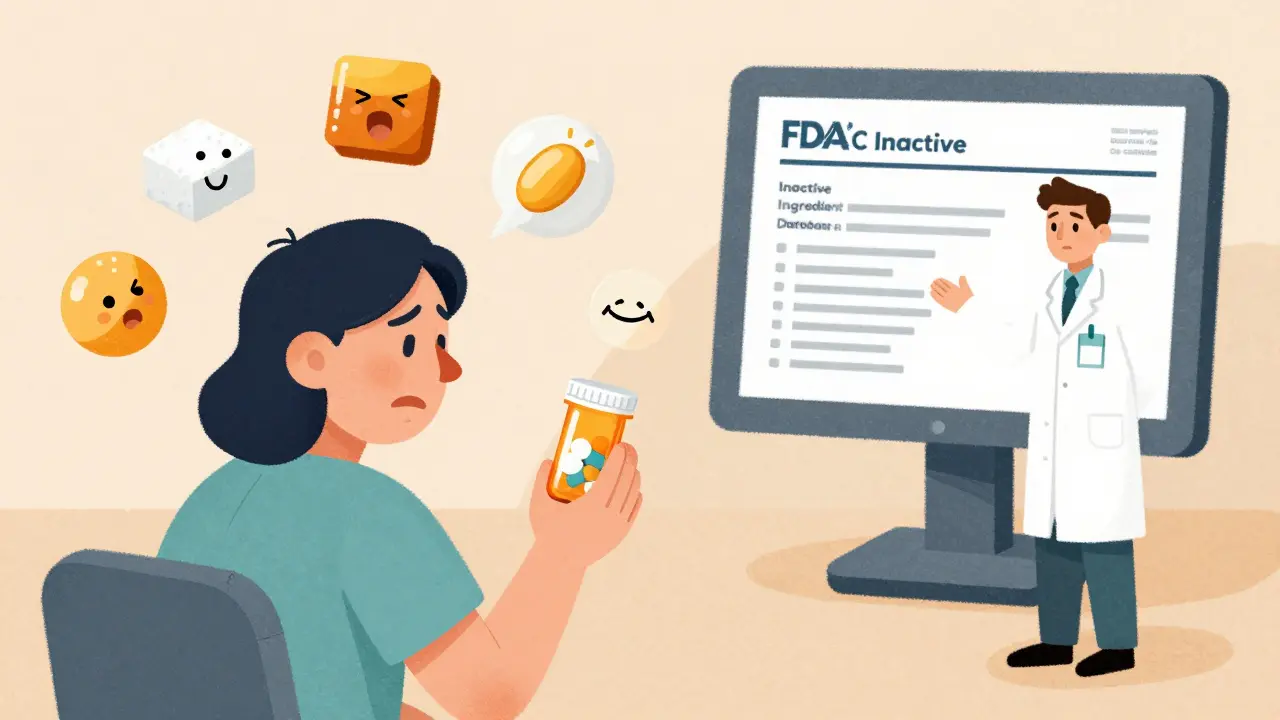
- Check the ingredients. Use the FDA’s Inactive Ingredient Database or the Pillbox tool from the National Library of Medicine. Look up the exact name of your pill and see what’s inside.
- Ask your pharmacist. They can tell you which excipients are in your generic. If they don’t know, ask them to call the manufacturer. Brand-name drugs list everything on the box. Generics? Not always.
- Try switching back. If you switched from brand to generic, go back to the brand for a few weeks. If symptoms disappear, then switch to a different generic manufacturer. Sometimes, one company’s version is fine, another isn’t.
- Document it. Write down the drug name, manufacturer, excipients, and your symptoms. This helps your doctor connect the dots.
Some pharmacists spend over 7 minutes per patient just researching excipient issues. That’s how important it is.
What’s Changing in the Industry
Things are starting to shift. The FDA launched its Excipient Safety Modernization Initiative in 2023 to include patient-reported data in its databases. By 2025, drug manufacturers will be required to list all excipients in electronic prescriptions.
Companies are also responding. The market for gluten-free, lactose-free, and dye-free generics hit $18.7 billion in 2022 and is growing fast. Sixty-three percent of pharmaceutical executives believe personalized excipient profiles will be a major selling point by 2030.
MIT researchers have even developed an AI tool that predicts your risk of reacting to specific excipients based on your genetics. It’s not mainstream yet-but it’s coming.
Bottom Line: Your Pill Isn’t Just the Active Ingredient
Generics save money. That’s great. But they’re not always interchangeable when it comes to your body’s tolerance. Excipients aren’t just filler-they’re active players in how you feel.
If you’ve had unexplained symptoms after switching medications, it might not be "all in your head." It might be a dye, a sugar, or a preservative you didn’t know was there.
Don’t assume all generics are the same. Don’t assume "inactive" means harmless. Ask questions. Check the label. Talk to your pharmacist. Your body will thank you.
Karen Mccullouch
December 16, 2025 AT 16:05Michael Gardner
December 16, 2025 AT 19:39Willie Onst
December 18, 2025 AT 11:58Ronan Lansbury
December 19, 2025 AT 22:05Constantine Vigderman
December 20, 2025 AT 11:46Cole Newman
December 21, 2025 AT 08:38Casey Mellish
December 22, 2025 AT 01:48Tyrone Marshall
December 22, 2025 AT 15:19Emily Haworth
December 24, 2025 AT 08:57Tom Zerkoff
December 25, 2025 AT 02:39Yatendra S
December 26, 2025 AT 18:48Webster Bull
December 27, 2025 AT 00:41Deborah Andrich
December 27, 2025 AT 15:19