Feverfew Clearance Calculator
Feverfew Clearance Calculator
Calculate how long you should stop taking feverfew before surgery based on your anticoagulant medication. Feverfew can stay in your system for up to 21 days and increase bleeding risk during procedures.
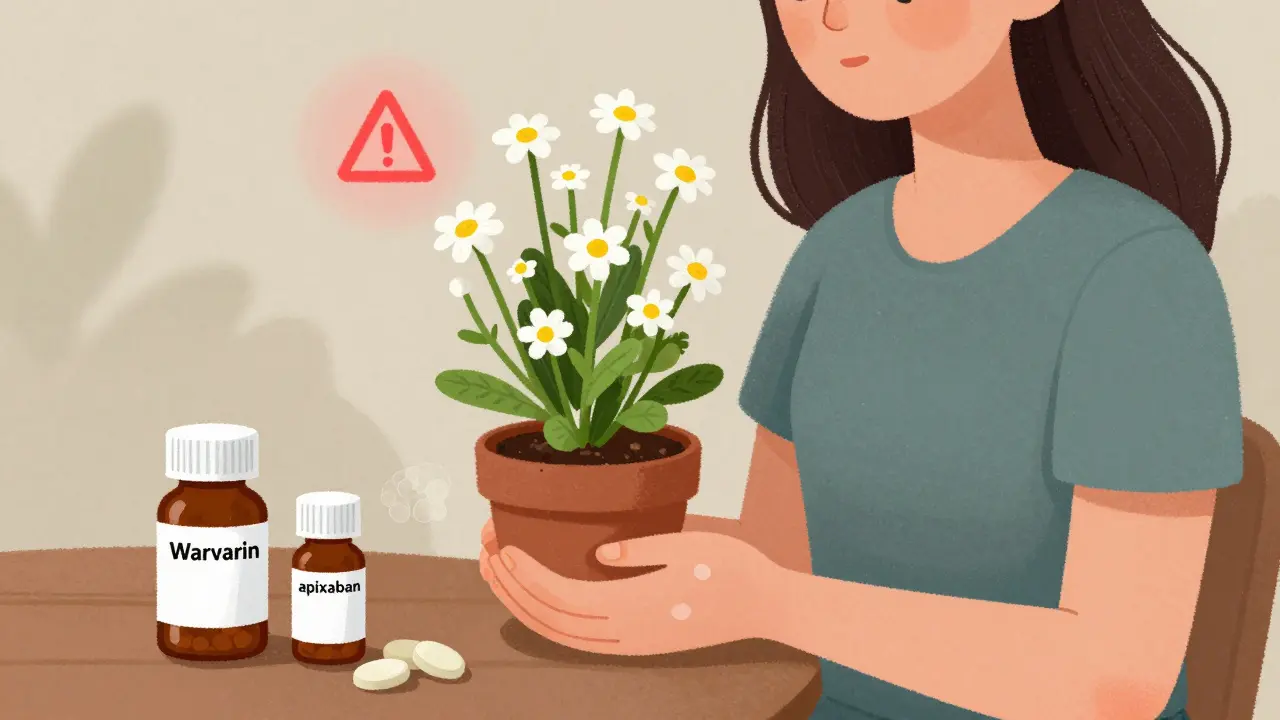
When you’re taking blood thinners like warfarin, apixaban, or rivaroxaban, even small changes in your routine can affect how well they work. One thing many people don’t realize is that feverfew, a popular herbal remedy for migraines, can interfere with these medications and increase your risk of bleeding. It’s not just about pills and prescriptions - what you put in your body as a supplement matters just as much.
What Is Feverfew and Why Do People Take It?
Feverfew (Tanacetum parthenium) is a flowering plant in the same family as daisies and ragweed. For centuries, people have used its leaves to reduce fever, ease joint pain, and prevent migraines. Today, it’s sold in capsules, tinctures, and teas, often marketed as a natural alternative to prescription migraine drugs.
The active ingredient, parthenolide, works by blocking serotonin release in platelets, which reduces inflammation and prevents excessive clotting. That’s why it helps with migraines - but it’s also why it can be dangerous if you’re already on anticoagulants. Unlike aspirin, which affects all platelets, feverfew targets a specific pathway. That sounds safer, but it doesn’t mean it’s harmless when combined with other blood-thinning agents.
How Feverfew Interacts With Anticoagulants
Feverfew doesn’t just make your blood thinner - it can also interfere with how your body breaks down anticoagulant drugs. Studies show it inhibits key liver enzymes (CYP2C9 and CYP3A4) that metabolize warfarin. This means warfarin sticks around longer in your system, raising your INR levels and increasing bleeding risk.
A 2021 case report from the NIH documented a 36-year-old woman who developed severe coagulopathy after taking feverfew daily for several months. Her prothrombin time (PT) jumped to 27.3 seconds (normal is 11-16), and her partial thromboplastin time (PTT) soared to 42 seconds (normal: 18-28). Her hemoglobin dropped to 10 g/dL - a sign of internal bleeding. After stopping feverfew for four months, all values returned to normal.
Even if you’re not on warfarin, feverfew can still pose a risk. If you’re taking newer anticoagulants like apixaban or rivaroxaban, there’s no direct clinical data yet - but lab studies suggest similar enzyme interference. The lack of evidence doesn’t mean safety; it just means we haven’t seen enough cases to confirm it.
The Real Risk: Bleeding, Bruising, and Surgery
The biggest danger isn’t a sudden hemorrhage - it’s subtle, cumulative damage. People on feverfew and anticoagulants often report:
- Easy bruising, even from light bumps
- Nosebleeds lasting longer than usual (15-45 minutes vs. 5-10)
- Unexplained gum bleeding when brushing teeth
- Heavier or longer menstrual periods
- Blood in urine or stool
A 2023 survey of 1,287 users on Healthline found that 41% of those on anticoagulants reported increased bruising while taking feverfew - compared to just 12% of users not on blood thinners. These aren’t rare side effects. They’re red flags.
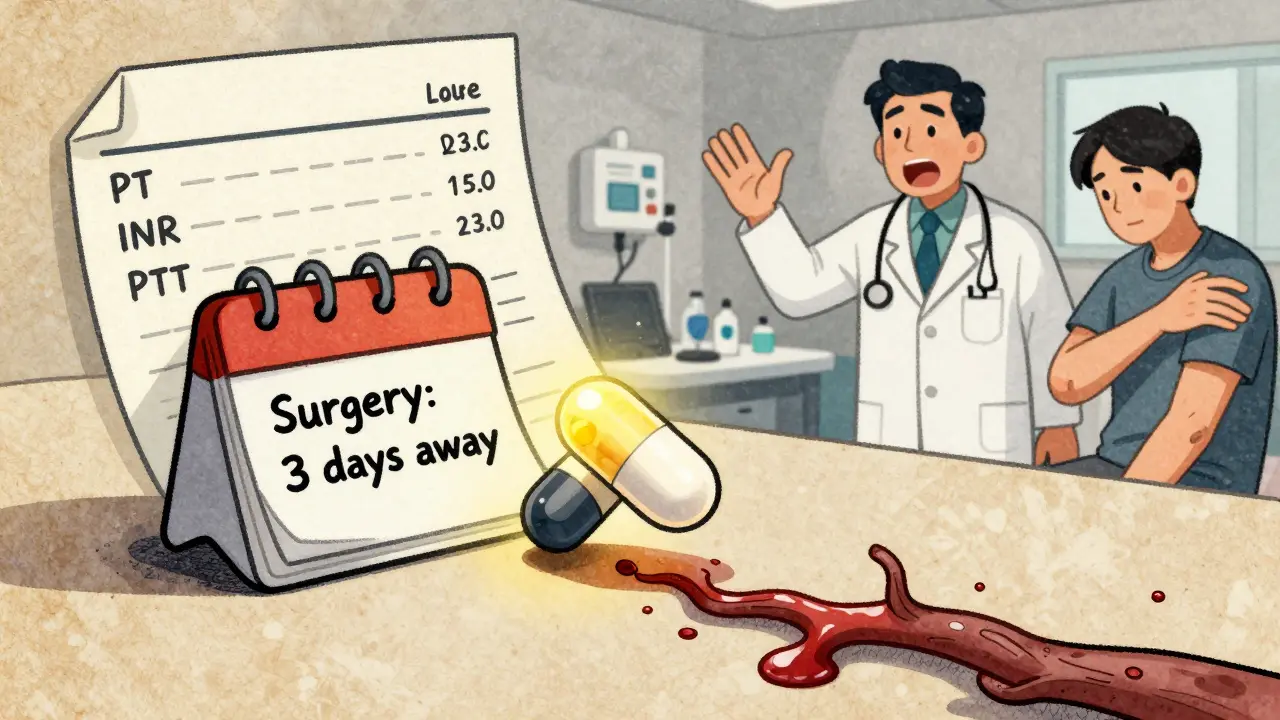
If you’re scheduled for surgery - even a simple dental extraction - feverfew can turn a routine procedure into a life-threatening event. The American Society of Anesthesiologists recommends stopping feverfew at least 14 days before any surgery. For high-risk procedures like spinal taps or major orthopedic surgery, 21 days is safer. Why? Because feverfew doesn’t just affect platelets - it lingers in your system longer than garlic or ginger, which clear out in 72 hours.
Feverfew vs. Other Herbal Blood Thinners
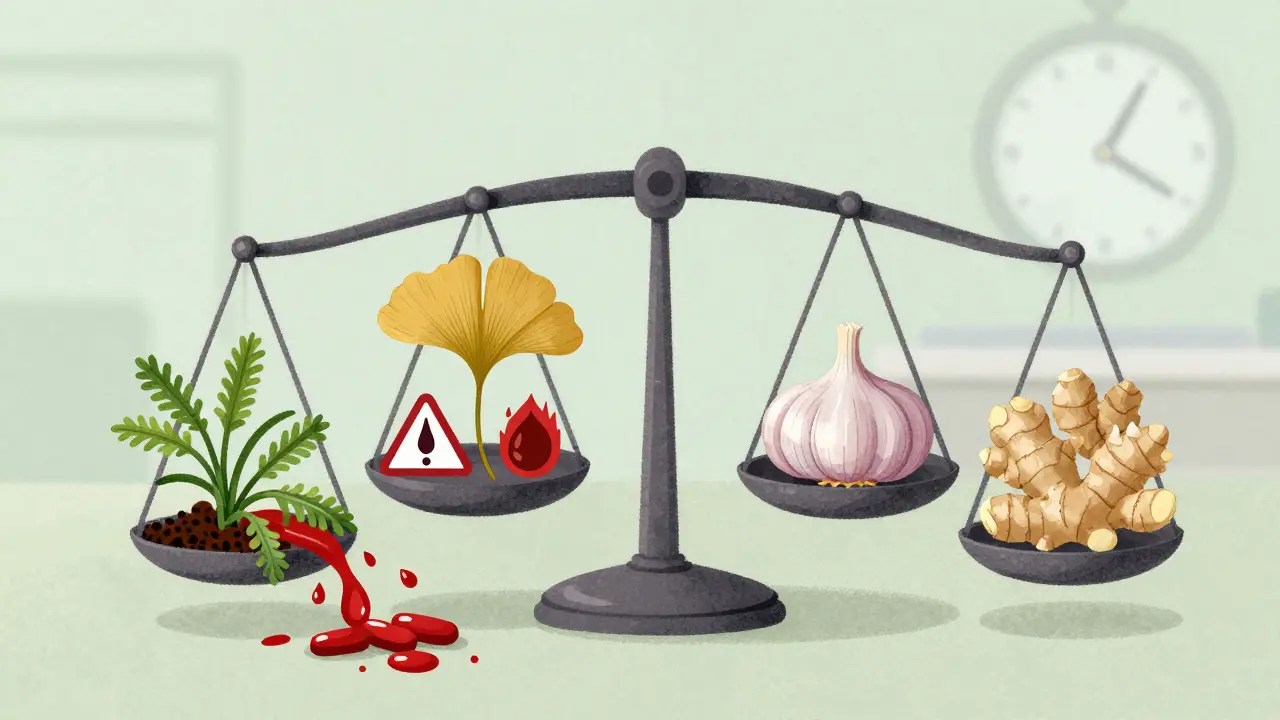
Feverfew is part of a group known as the “Few Gs”: feverfew, ginger, ginkgo, garlic, and ginseng. These are the top five herbs linked to bleeding risk with anticoagulants.
Here’s how feverfew stacks up:
| Herb | Primary Mechanism | Time to Clear Body | Documented Cases of Bleeding | Pre-Surgery Discontinuation |
|---|---|---|---|---|
| Feverfew | Inhibits serotonin-induced platelet aggregation | 14-21 days | 1 confirmed case (NIH 2021) | 14-21 days |
| Ginkgo biloba | Reduces platelet aggregation, inhibits PDE | 7-10 days | 12+ documented cases | 14 days |
| Garlic | Inhibits thromboxane synthesis | 2-3 days | 8 documented cases | 7 days |
| Ginger | Weak antiplatelet effect | 1-2 days | 2 documented cases | 7 days |
| Dong quai | Contains natural coumarins (like warfarin) | 5-7 days | 15+ documented cases | 14 days |
While ginkgo has more documented cases, feverfew is more insidious because of its long clearance time and withdrawal symptoms. Many people stop taking it cold turkey before surgery - only to suffer insomnia, joint pain, anxiety, or rebound headaches. The NIH study found 32% of users had insomnia, 41% had headaches, and 87% had muscle stiffness after quitting. That’s why tapering over 2-3 weeks is recommended.
What You Should Do If You’re on Blood Thinners
If you’re taking anticoagulants and using feverfew - even occasionally - here’s what you need to do:
- Stop taking feverfew immediately if you notice unusual bruising, nosebleeds, or prolonged bleeding.
- Don’t quit cold turkey. Reduce your dose by half for one week, then stop completely. This lowers your risk of withdrawal symptoms.
- Get baseline blood tests. Ask your doctor for PT, INR, and PTT before starting or stopping feverfew.
- Inform all healthcare providers. Dentists, surgeons, and ER staff need to know you’ve taken feverfew - even months ago.
- Choose encapsulated forms. Chewing fresh feverfew leaves causes mouth sores in nearly 1 in 9 people. Capsules avoid this.
There’s no safe dose of feverfew if you’re on anticoagulants. The European Medicines Agency classifies it as “Category C” - meaning the risk is theoretical, but not ruled out. The FDA hasn’t issued a specific warning for feverfew, but they’ve warned about 11 other herbs. That’s not a green light - it’s a warning sign.
What’s Next for Feverfew Research
A 2023 clinical trial (NCT05567891) is currently testing feverfew’s interaction with apixaban in 120 healthy volunteers. Results are expected in mid-2024. Meanwhile, the NIH has tripled its funding for feverfew research since 2020, signaling growing concern.
Experts predict that within five years, feverfew supplements will be standardized to contain less than 0.2% parthenolide for people on blood thinners. There are even plans to develop point-of-care tests that can measure parthenolide levels in the blood - so doctors can tell if it’s safe to proceed with surgery.
Until then, caution is the only reliable strategy.
Bottom Line: Is Feverfew Safe With Blood Thinners?
No. Not if you’re on anticoagulants.
There’s no such thing as a “low-risk” dose. The one documented case of severe bleeding was in a young, otherwise healthy woman. She didn’t have liver disease, didn’t take high doses, and wasn’t on multiple blood thinners. Just feverfew and warfarin - and it pushed her into dangerous territory.
If you’re using feverfew for migraines, talk to your doctor about alternatives like riboflavin (vitamin B2), magnesium, or coenzyme Q10 - all have strong evidence for migraine prevention without bleeding risk.
Supplements aren’t harmless just because they’re natural. They’re powerful chemicals with real effects on your body. And when you’re on blood thinners, your body is already on a tightrope. Don’t add another weight to one side.
Can I take feverfew if I’m on aspirin?
No. Even low-dose aspirin is an antiplatelet drug, and feverfew works on the same pathway. Combining them increases your risk of bruising, nosebleeds, and internal bleeding. A 2023 Reddit survey of 27 users found that 14 experienced prolonged nosebleeds after taking both. If you’re on aspirin for heart health, avoid feverfew entirely.
How long does feverfew stay in your system?
Feverfew’s active compound, parthenolide, can linger in your body for 14 to 21 days after your last dose. That’s why stopping it just a few days before surgery isn’t enough. The NIH case report showed it took four months for coagulation to fully normalize after stopping. Plan ahead - taper off slowly over 2-3 weeks.
Does the form of feverfew matter (capsule vs. tea vs. fresh leaves)?
Yes. Fresh leaves can cause mouth sores in about 11% of users, but capsules are safer. However, the bleeding risk is the same regardless of form. Whether you’re taking 50mg in a pill or chewing leaves, your blood is still affected by parthenolide. Don’t assume capsules are risk-free - they’re just less irritating to your mouth.
Can feverfew cause bleeding even if I’m not on anticoagulants?
It’s unlikely in healthy people without other risk factors. But if you have a bleeding disorder, liver disease, or are taking NSAIDs like ibuprofen, feverfew could tip the balance. The herb isn’t dangerous on its own - but it’s not harmless either. Use it only under medical supervision if you have any health conditions.
What should I do if I’ve been taking feverfew and just started a blood thinner?
Stop feverfew immediately and contact your doctor. Get a PT/INR test within 48 hours. If your INR is above 4.0, you’re at high risk of bleeding. Your doctor may need to adjust your anticoagulant dose or monitor you more closely. Don’t wait for symptoms - bleeding can start without warning.
Are there safer herbal alternatives to feverfew for migraines?
Yes. Riboflavin (vitamin B2) at 400mg daily, magnesium (400-500mg), and coenzyme Q10 (100-300mg) have strong clinical evidence for migraine prevention - and none affect blood clotting. A 2022 Cochrane review confirmed these are as effective as feverfew, without the bleeding risk. Ask your doctor about these options.
Jeanette Jeffrey
December 26, 2025 AT 21:07Oh wow, so feverfew is basically the quiet assassin of herbal supplements? I’ve been taking it for migraines for years and just assumed ‘natural’ meant ‘safe.’ Thanks for the gut-punch reality check. I’m cancelling my next order today. Also, who the hell markets this stuff as ‘migraine relief’ without a giant warning label?!
Jody Kennedy
December 26, 2025 AT 21:53YESSSSS this needs to be shouted from the rooftops!! I had a friend who went into the ER after a nosebleed that wouldn’t stop-turned out she was on warfarin AND feverfew tea. Like, lady, your tea is not your therapist. 🙃 Stop the herbal chaos before it stops YOU.
jesse chen
December 27, 2025 AT 15:13I really appreciate how thorough this is. The enzyme inhibition details? The clearance timelines? The withdrawal symptoms? This isn’t just a warning-it’s a manual. I’m forwarding this to my entire family. My mom’s been on warfarin for 12 years and swears by her ‘natural remedies.’ She’s going to need this.
Joanne Smith
December 28, 2025 AT 08:42So… let me get this straight. The FDA hasn’t warned about feverfew, but they’ve warned about 11 other herbs? So… we’re supposed to just… trust the silence? That’s like saying ‘this knife isn’t sharp’ because it hasn’t cut anyone yet. The real danger isn’t the herb-it’s the myth that ‘natural’ = ‘innocent.’
Prasanthi Kontemukkala
December 28, 2025 AT 10:21Thank you for writing this with so much care. I’m from India, and many of us use herbal remedies without thinking twice. This post helped me realize I was being careless-not because I didn’t care, but because I didn’t know. I’m going to talk to my aunt who takes feverfew for arthritis. Maybe we can switch to magnesium together. 💛
Alex Ragen
December 29, 2025 AT 11:16It’s fascinating-really-that we’ve built an entire alternative medicine industry predicated on the assumption that ‘natural’ is synonymous with ‘safe,’ while simultaneously ignoring the pharmacological reality that plants are, in fact, complex chemical factories. Feverfew is not a ‘remedy’-it’s a bioactive compound with pharmacokinetic consequences. And yet, we treat it like chamomile. The cognitive dissonance is breathtaking.
Lori Anne Franklin
December 31, 2025 AT 07:40OMG i had no idea!! i’ve been taking feverfew capsules for like 2 years and i’m on rivaroxaban… i just thought the bruising was from being clumsy 😅 i’m stopping right now and calling my doc. thanks for saving me from myself!!
Bryan Woods
December 31, 2025 AT 16:33Well-researched and clearly presented. The comparison table is particularly useful. I work in pharmacy and have seen multiple patients unaware of these interactions. This is the kind of content that should be shared with every primary care clinic and ER. The 14–21 day clearance window is critical and often overlooked.
Ryan Cheng
December 31, 2025 AT 19:11Just wanted to add-don’t forget to tell your dentist. I had a tooth pulled last year and the dentist asked if I was on anything weird. I said ‘no’-didn’t mention feverfew. They had to pause the procedure and call my cardiologist. Don’t be me. Speak up. Your gums will thank you.
wendy parrales fong
January 2, 2026 AT 10:18It’s so easy to think herbs are gentle. But your body doesn’t care if something came from a plant or a lab-it just reacts to the chemistry. I used to think feverfew was my miracle cure. Now I know it was a slow leak in my safety net. I’m switching to riboflavin. My migraines are still there… but at least my blood is too.
Shreyash Gupta
January 3, 2026 AT 00:29LOL you people are panicking over a leaf? I’ve been taking feverfew with apixaban for 5 years and I’m fine. Maybe your bodies are weak? Or maybe you just need to stop being so scared of nature? 🌿😎
Ellie Stretshberry
January 4, 2026 AT 11:26im so glad i read this before my knee surgery next week… i had no idea feverfew stuck around that long. i’ve been taking it since last summer. i’m gonna taper it slowly like you said. thanks for the heads up, seriously. you saved me from a bad time 💕
Zina Constantin
January 5, 2026 AT 16:39This is exactly the kind of post that makes Reddit valuable. I’m from Greece-we have a long tradition of herbal medicine. But this? This isn’t tradition-it’s science. I’m sharing this with my community group. We need to update our beliefs with evidence, not nostalgia.
Dan Alatepe
January 6, 2026 AT 01:12Bro… I’m Nigerian. We use feverfew for everything-headaches, fever, even ‘bad luck.’ My cousin took it with warfarin and ended up in the hospital with a brain bleed. He’s fine now… but he’s got a scar on his skull and a new fear of plants. 🙏🌿 #NatureIsNotAlwaysNice