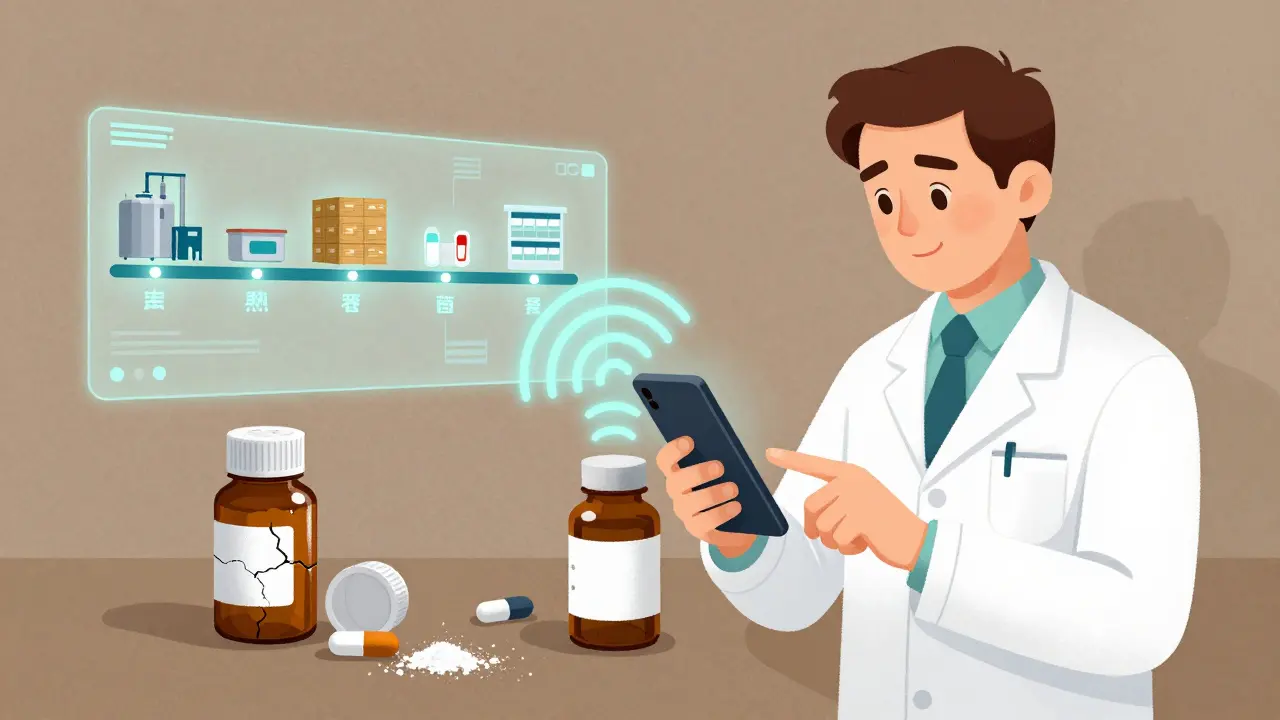
Every year, millions of people around the world take pills that don’t contain the right medicine-or any medicine at all. Counterfeit drugs aren’t just a scam. They’re deadly. A fake drug might have the wrong dose, toxic fillers, or nothing but flour and chalk. The World Health Organization estimates that 1 in 10 medical products in low- and middle-income countries are falsified. In some regions, that number climbs higher. And while rich countries have stronger controls, no supply chain is immune. The stakes? Your life, your family’s life, your community’s health.
Why Fake Drugs Are Getting Harder to Spot
Ten years ago, counterfeiters made bad copies. They printed fake labels, reused old bottles, and slipped in placebo pills. Today, they’re using high-resolution printers, real packaging molds, and even QR codes that scan correctly. Some fake drugs now look, feel, and scan just like the real thing. A 2025 study by ForgeStop found that 78% of pharmaceutical QR codes on the market are easily copied because they lack cryptographic protection. That means a fake bottle can pass a quick phone scan-and end up in your medicine cabinet.Counterfeiters are also exploiting supply chain gaps. After the U.S. and EU tightened rules, many fake drug operations shifted to countries with weaker enforcement. Then came the April 2025 tariffs on pharmaceutical imports from China and India. Tariffs ranging from 10% to 46% disrupted global supply chains, causing delays of 3 to 6 weeks. That created openings for smugglers and fraudsters to slip in fake products during the chaos.
Serialization: The Foundation of Modern Drug Security
The single most important tool in the fight against fake drugs today is serialization. This means every pill bottle, blister pack, or vial gets a unique digital code-like a fingerprint-for that exact item. It’s not just a batch number. It’s a one-of-a-kind identifier tied to the product’s entire journey: from the factory floor, through the distributor, to the pharmacy counter.By November 2025, the U.S. Drug Supply Chain Security Act (DSCSA) will require every prescription drug in the country to have this serial code. The EU’s Falsified Medicines Directive already enforces this. These aren’t suggestions-they’re laws with heavy fines for non-compliance. Serialization captures data at every handoff. If a batch is recalled, companies can pinpoint exactly which units are affected, cutting recall time by nearly 60%.
But serialization alone isn’t enough. The code is only as good as how it’s read. Traditional barcodes are still widely used, but they’re easy to replicate. That’s why the industry is moving fast toward smarter options.
NFC: The Smartphone That Checks Your Medicine
Imagine tapping your phone on a medicine bottle and instantly seeing its full history: where it was made, when it left the warehouse, what temperature it was stored at, and whether it’s been tampered with. That’s not science fiction. It’s NFC (Near Field Communication) technology-and it’s already in use.NFC chips are tiny, cost less than a penny to embed, and work with any modern smartphone (Android 8.0+ or iOS 11+). Over 89% of phones sold in 2025 support NFC. When you tap, the chip sends encrypted data to a secure server. No internet? No problem. The phone can verify the code offline using a preloaded digital signature. ForgeStop’s 2025 tests showed NFC authentication takes under 2 seconds and has a 99.98% accuracy rate. False positives? Reduced by 92% compared to barcode scanners.
One Latin American pharmacy chain saw counterfeit incidents drop by 98% within six months of switching to NFC. Pharmacists now verify over 1,200 packages a day, adding just 3 to 5 seconds to each transaction. Unlike QR codes, NFC can’t be copied with a photo. The data is cryptographically signed, so even if someone prints a perfect label, the chip’s digital signature won’t match.
Blockchain: The Unbreakable Ledger
What if every time a drug changed hands, that event was recorded on a public, unchangeable record? That’s what blockchain does. It doesn’t store the drug itself-it stores proof of its journey. Each step: manufacturing, shipping, warehousing, dispensing-is added as a block. Once added, it can’t be altered or deleted.Companies like De Beers used blockchain to track diamonds. Now, pharmaceutical firms are adapting the same tech. The system links serial codes to real-time data from IoT sensors: Did the shipment get too hot? Was the container opened unexpectedly? Was it held in a warehouse longer than allowed? All of it is recorded.
But blockchain isn’t quick to deploy. Gartner estimates full integration takes 18 to 24 months. It needs strong IT infrastructure, trained staff, and cooperation across suppliers, distributors, and pharmacies. For small manufacturers, that’s a big hurdle. Still, for global brands, it’s becoming essential. Ennoventure’s 2025 report says blockchain is now the backbone of regulatory compliance in the U.S. and EU.
DNA and Forensic Markers: The Invisible Shield
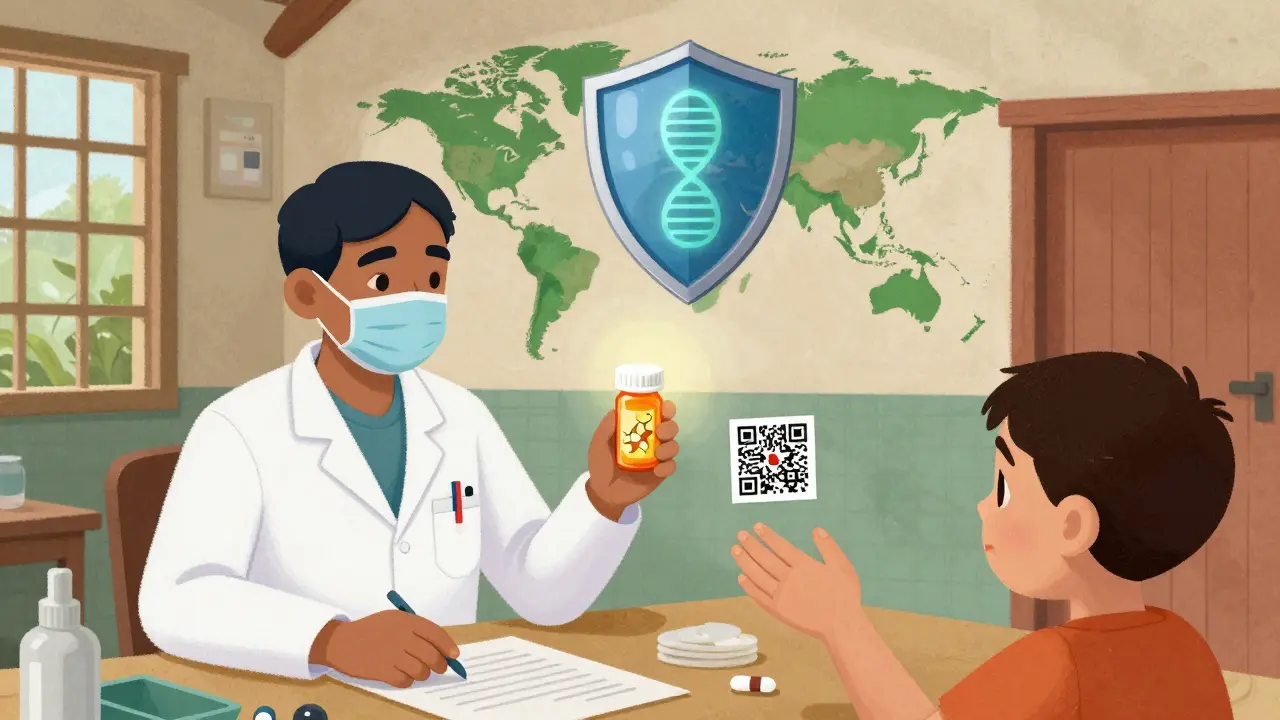
Some of the most advanced anti-counterfeit tech is invisible to the naked eye. DNA-based authentication embeds a unique biological code into the packaging or even the drug itself. This code can be verified with a lab test-like a forensic fingerprint. It’s nearly impossible to replicate without access to the original DNA sequence.But here’s the catch: it costs $0.15 to $0.25 per unit. Compare that to $0.02 to $0.05 for standard serialization. That makes DNA markers too expensive for most mass-market drugs. Right now, they’re mostly used for high-value biologics, cancer treatments, or vaccines.
Other forensic tools include thermochromic inks (change color with heat), UV-reactive patterns, and micro-printed guilloches (complex lines too fine to copy). These are layered with overt features like tamper-evident seals and holograms. The goal isn’t to stop every fake-it’s to make it so hard and expensive that counterfeiters give up.
AI and Smart Cameras: The Eyes of the Supply Chain
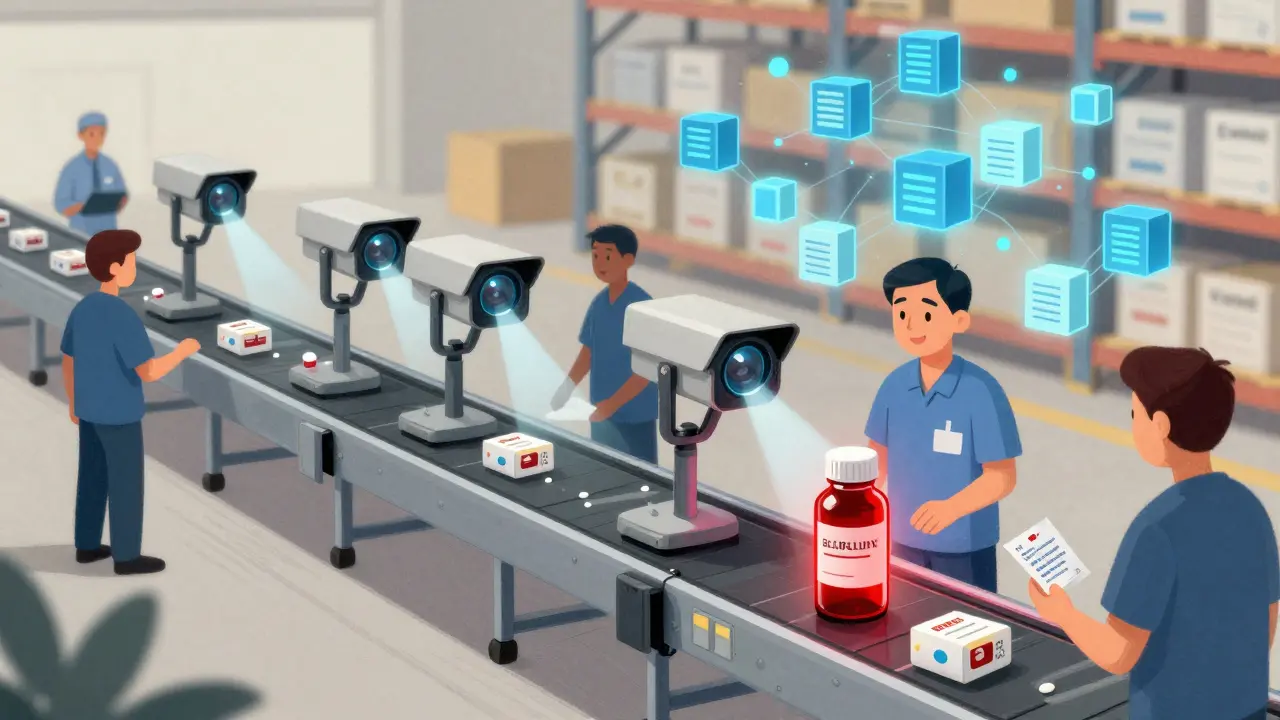
At distribution centers and pharmacies, workers don’t have time to check every bottle with a phone. That’s where AI-powered visual inspection systems come in. Cameras scan packages at high speed, analyzing patterns, colors, fonts, and seals. In controlled labs, these systems now detect counterfeits with 99.2% accuracy. Real-world conditions are tougher-lighting changes, packaging wrinkles, dust on the lens-but accuracy has improved from 89.7% in 2024 to 94.3% by mid-2025.These systems don’t replace human checks. They augment them. A warehouse worker might see a flagged package on a screen and pull it for manual verification. In one U.S. distribution center, AI cut counterfeit escapes by 85% in the first year of use.
What’s Working-and What’s Not
Not all tech is created equal. Here’s how the top methods stack up:| Technology | Security Level | Cost per Unit | Verification Speed | Adoption Rate (Top 50 Pharma) |
|---|---|---|---|---|
| Serialization + Barcode | Medium | $0.02-$0.05 | 5-10 seconds | 97% |
| QR Code (unsecured) | Low | $0.01-$0.03 | 3-7 seconds | 68% |
| NFC (cryptographically secured) | High | $0.04-$0.08 | Under 2 seconds | 83% |
| DNA Authentication | Extreme | $0.15-$0.25 | Lab test (hours) | 12% |
| Blockchain Integration | High | High (infrastructure) | Real-time (via app) | 79% |
QR codes without encryption? They’re a liability. A major U.S. drugmaker lost $147 million in 2025 after counterfeiters copied their unsecured QR codes. NFC, on the other hand, is growing fast-43% year-over-year adoption among top pharma firms. The future belongs to layered security: a visible seal, a hidden ink, a digital code, and a blockchain record.
Who’s Falling Behind-and Why
Large pharmaceutical companies have mostly caught up. By 2025, 97% of the top 100 had implemented serialization. But small and mid-sized manufacturers? Only 43% have done it. Why? Cost. Training. Legacy systems. One European distributor spent €2.3 million and 14 months just to get their warehouse software talking to the new serialization system. Throughput dropped 37% until they optimized.Developing countries are catching up fast. Brazil made serialization mandatory in January 2025. Nigeria followed in Q3. But without funding or tech support, many local pharmacies still rely on visual checks. That’s dangerous. In rural areas, patients often buy from unlicensed vendors. Without digital tools, there’s no way to know what’s real.
What’s Next: Eco-Friendly and Smarter Packaging
The next wave of anti-counterfeit tech isn’t just about security-it’s about sustainability. Over 62% of new packaging solutions now use recyclable materials. Some companies are embedding traceable markers directly into biodegradable films. Imagine a pill bottle made from plant-based plastic that also carries an NFC chip. After use, it can be recycled-and the chip dissolves harmlessly.By 2027, the EU’s Digital Product Passport rules will require every drug package to link to a digital profile showing its environmental impact, ingredients, and manufacturing history. That’s not just about counterfeiting. It’s about transparency. Patients will soon be able to scan a bottle and see not just if it’s real-but how it was made, and what its carbon footprint was.
Final Thoughts: It’s Not One Technology. It’s a System.
There’s no silver bullet. No single gadget that can stop every fake drug. The real answer is layered defense: serialization to track, NFC to verify, blockchain to audit, forensic markers to deter, and AI to monitor. And it’s not just for big companies. Even small pharmacies can start with NFC-enabled packaging and smartphone apps-no server farm needed.The goal isn’t perfection. It’s making counterfeiting so hard, so expensive, and so risky that it’s not worth the effort. Right now, the industry is moving in that direction. Patients are becoming more aware. Pharmacists are empowered with tools. Regulators are enforcing rules. And the technology? It’s ready.
The question isn’t whether we can stop fake drugs. It’s whether we’ll use the tools we already have.
Joanna Brancewicz
January 8, 2026 AT 18:57Serialization is non-negotiable. If you're still using unsecured QR codes, you're not just cutting corners-you're putting lives at risk. The DSCSA deadline isn't a suggestion; it's a mandate for ethical practice.
Lois Li
January 9, 2026 AT 15:51I've seen this play out in my neighborhood pharmacy-people buying meds online because they're cheaper, not realizing they could be getting chalk pills. We need public education as much as tech. Not everyone knows what NFC even is.
Prakash Sharma
January 11, 2026 AT 13:03USA and EU pushing their tech on developing nations while ignoring their own supply chain corruption. India and China produce 80% of the world's generics-yet you blame them for counterfeits while your own tariffs create the chaos that lets fakes in. Hypocrisy.
Donny Airlangga
January 12, 2026 AT 09:39My grandma just got a new prescription. She doesn’t have a smartphone. What happens to her when the pharmacy starts rejecting bottles without NFC? We can’t leave elderly people behind in the name of security.
Evan Smith
January 14, 2026 AT 08:11So we're spending billions on NFC chips and blockchain to stop people from buying fake Adderall off Instagram? Maybe we should just legalize the damn thing and cut out the middleman.
Manish Kumar
January 16, 2026 AT 03:24Think about it-counterfeiting isn't just a crime, it's a symptom. It's the result of a system that prices life-saving drugs out of reach for billions. You can embed DNA markers in every pill, but if someone can't afford the real one, they'll take the fake. The real problem isn't the counterfeiters-it's the pharmaceutical monopolies that turn medicine into luxury goods.
Kristina Felixita
January 16, 2026 AT 14:20Wait-so you’re saying we can scan our medicine with our phones and see its whole journey?? That’s insane!! I mean, like, WHOA. My cousin works at a clinic in Guatemala and they still use handwritten logs… this tech could literally save lives!!
Ken Porter
January 18, 2026 AT 03:36Another tech solution from the US that ignores the real issue: corruption in customs. No amount of NFC will stop a bribed inspector from letting a truckload of fake pills through. Fix the system, not the label.
swati Thounaojam
January 20, 2026 AT 00:44My dad died from fake antibiotics. This isn’t theoretical. We need this now.
Dave Old-Wolf
January 20, 2026 AT 18:01I get that NFC is cool and all, but what about the 30% of people in rural areas who don’t have smartphones? Or the ones who can’t afford to upgrade? Tech shouldn’t become a privilege to access medicine.
Molly Silvernale
January 22, 2026 AT 07:04It’s not about stopping fakes-it’s about restoring trust. We’ve turned medicine into a mystery box. You swallow a pill and pray it’s not poison. What if the real miracle isn’t the chip in the bottle… but the moment we stop treating human life like a supply chain optimization problem?
christy lianto
January 23, 2026 AT 09:22Look, I’m not against tech-but when the cost of a single NFC chip is more than the profit margin on a generic blood pressure pill, something’s broken. We’re solving the wrong problem with expensive toys while people die waiting for affordable meds.
Annette Robinson
January 24, 2026 AT 07:46As a pharmacist for over 20 years, I’ve seen the evolution. Serialization saved us. NFC is the next step. But the real win? When patients start asking for it. When they demand transparency. That’s the cultural shift we need.
Luke Crump
January 26, 2026 AT 00:56Blockchain? Please. You think a distributed ledger stops a corrupt distributor? You’re romanticizing technology like it’s a religion. The truth? The only thing that stops counterfeits is prison sentences for the people who make them. Not chips. Not codes. Jail.
Aubrey Mallory
January 26, 2026 AT 13:22Everyone’s focused on the tech, but what about the people? Training pharmacists in Nigeria to use these tools? Funding community clinics? Without local capacity, even the best tech becomes a paperweight. Innovation without equity is just another form of colonialism.
Joanna Brancewicz
January 26, 2026 AT 18:43Replying to @6656: You’re right about corruption-but tech raises the cost of bribery. A forged label is easy. Forging a cryptographically signed NFC chip with a blockchain audit trail? That requires a team, time, and money. It’s not perfect, but it shifts the risk calculus.