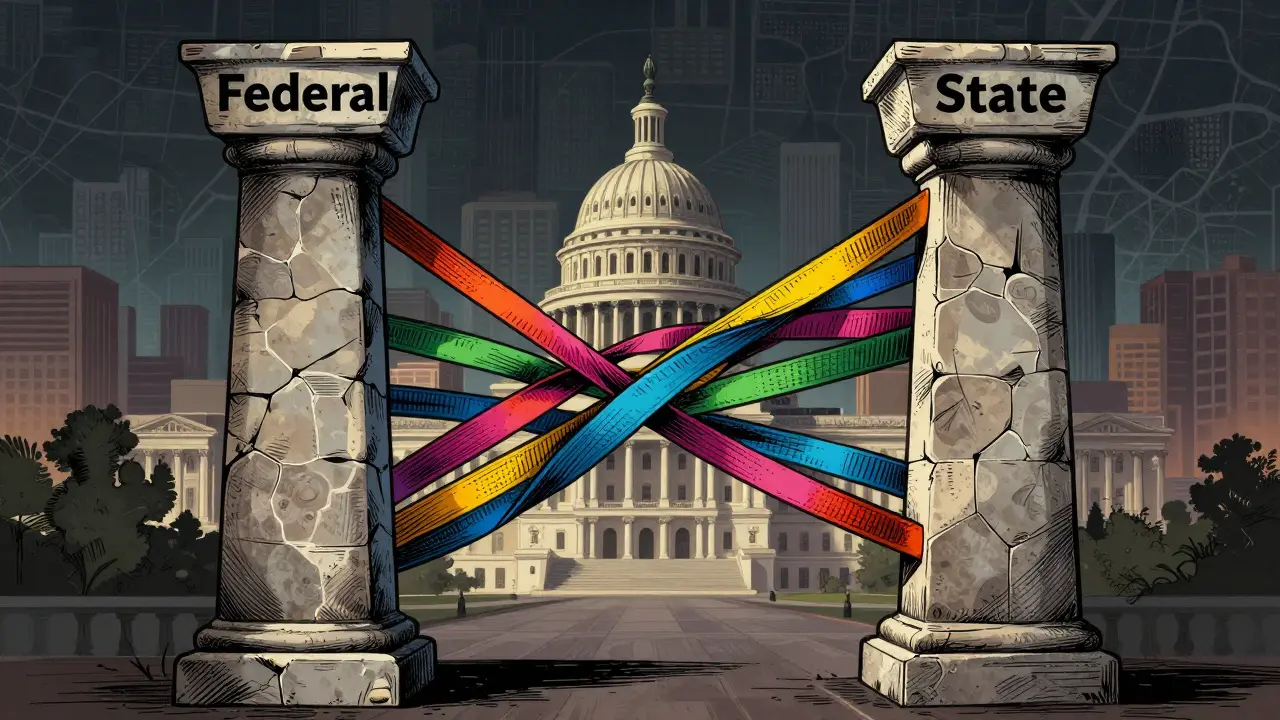
It feels like laws change faster than we can read the headlines. You are likely wondering how to keep your business or personal life compliant without spending a fortune on lawyers. We have passed the halfway point of a massive regulatory shift. In the United States, regulatory activity jumped by more than 13% compared to 2024 levels. That number might sound abstract until you realize what it costs.
Companies operating across multiple states are facing a unique problem. Federal rules are loosening in some areas while state rules get tighter in others. This creates a tangled web where compliance is no longer a check-the-box activity. It is a constant, enterprise-wide effort requiring robust systems.
Understanding the Core Regulatory Shift
The legal landscape for 2026 is defined by divergence. On one side, the federal administration has signaled looser oversight around Medicare Advantage and certain insurance regulations. On the other hand, state governments like California are pushing hard on employment and housing rights. This split creates complexity.
Regulatory Change Management is the process of tracking, analyzing, and implementing legal requirements within an organization. Unlike simple record-keeping, it requires compliance adaptation where policies are updated in real-time to match new statutes. Organizations failing to adapt face higher enforcement risks.We see specific examples of this divergence in the 119th Congress sessions. Legislation moving through Washington contrasts sharply with what happens in Sacramento or Austin. For instance, the federal government adjusted tax reporting thresholds to help small businesses, while states simultaneously increased wage theft penalties.
Federal Tax and Financial Rules
Money moves differently under the new laws. The most significant change came with the One, Big, Beautiful Bill, a comprehensive legislative package signed into law on July 4, 2025. This legislation fundamentally altered how individuals report income and claim deductions.
If you are over 65, you now have access to a new $6,000 deduction. This applies to tax years 2025 through 2028. The IRS issued notice IR-2025-107 to clarify implementation details. They also reverted the Form 1099-K reporting threshold to $20,000. This matters because previously there was confusion about lower limits that hurt freelancers and gig workers.
Tax professionals reported a 40% increase in enrollment for update courses last autumn. If you manage finances, you need to review your employee retention credits under these new provisions. The IRS released fact sheet FS-2025-07 to address specific credit calculations.
| Change Type | Effective Date | Impact Description |
|---|---|---|
| Individual Deduction | Tax Year 2025 | $6,000 reduction for citizens aged 65+ |
| Form 1099-K Threshold | October 23, 2025 | Reverted to $20,000 minimum reporting limit |
| Inflation Adjustments | Early 2026 | Billed amendments from the One, Big, Beautiful Bill |

Labor and Employment Standards
Workplace rules are changing faster than any decade in recent memory. Thirty-seven of the fifty states enacted at least one significant employment law change in 2025 alone. California led this trend with several major bills.
Assembly Bill 406 took effect on October 1, 2025. This law consolidated victims' leave provisions into the Fair Employment and Housing Act. It aligns paid sick leave rules with these new protections. Employers had to update their notices immediately. The Civil Rights Department planned to issue a revised model notice titled 'Survivors of Violence and Family Members of Victims Right to Leave.'
Pay secrecy rules also shifted. Senate Bill 642 modified how pay scale disclosures happen. You now have stricter obligations when listing job descriptions. Ignoring this can lead to complaints filed with the state labor board.
The cost of adapting to these labor rules is real. California employers spent between $1,200 and $1,800 per employee on compliance training related to these specific changes. While it hurts the budget, non-compliance fines often exceed training costs. Companies are hiring more compliance staff, with many increasing teams by 15-20%.
Housing and Development Regulations
Builders and developers face the most dramatic timeline changes. Governor Gavin Newsom signed transformative housing legislation as part of the 2025-2026 state budget. This includes Assembly Bill 130 and Senate Bill 131.
These bills implement sweeping exemptions from the California Environmental Quality Act (CEQA). The goal is to accelerate housing production by removing environmental review delays for qualifying projects. The Governor called this reform consequential for infrastructure development.
The California Building Industry Association estimated reductions in project approval processes ranging from 18 to 24 months for qualifying developments. This helps solve the housing shortage but puts pressure on municipalities to inspect quality faster. State economic analyses projected annual housing production increases of 15-20% due to these reforms.

Law Enforcement and Firearms
Nationally, the LEOSA Reform Act of 2025 passed the House in May 2025. H.R.2243 broadens authority for qualified active and retired law enforcement officers. It permits carrying concealed firearms across state lines in school zones, national parks, and certain public facilities.
This legislation addresses long-standing gaps in officer safety protections during travel. States can reduce qualification standard frequency requirements for retired officers. For retirees, this means less paperwork to maintain carry privileges while visiting other states.
U.S. Sentencing Commission submitted final amendments to sentencing guidelines to Congress on April 30, 2025. These became effective November 1, 2025. Changes appear in the Federal Register. Corporate counsel needs to track these updates for white-collar crime exposure.Strategies for Compliance Survival
Managing these changes requires a shift in mindset. Deregulation does not simplify compliance. Even removing obligations demands careful review of internal controls. Firms must ensure they remain aligned with the current law after a rule is lifted.
Industry surveys show 78% of Fortune 500 companies plan to implement AI-powered regulatory monitoring systems by 2026. This technology tracks changes automatically and flags policy conflicts. Gartner projected 35% year-over-year growth in regulatory technology solutions for 2025. Investing here saves manual labor hours.
Cross-functional collaboration is essential. Legal teams can work alone anymore. You need HR, IT, and Finance working together to translate rules into operational controls. Failure to adapt could result in 15-25% higher compliance costs according to analysis firms.
To survive the remainder of 2026, you should establish an enterprise-wide regulatory change management capability. Treat this as a continuous function rather than a periodic audit. Review your vendor contracts to ensure they guarantee compliance updates. Update your employee handbooks quarterly, not annually.
How did the 1099-K reporting threshold change in 2025?
The IRS issued notice IR-2025-107 on October 23, 2025, which reverted the Form 1099-K reporting threshold back to $20,000. This change simplifies reporting requirements for small businesses and gig economy workers who faced lower limits previously.
What is the One, Big, Beautiful Bill tax impact for seniors?
This legislation introduced a new $6,000 tax deduction specifically for individuals aged 65 and older. It is effective for tax years 2025 through 2028. Seniors should consult their tax advisors to ensure proper filing for eligible amounts.
Which California labor laws changed in late 2025?
Assembly Bill 406 consolidated victims' leave provisions and revised paid sick leave laws. Senate Bill 642 modified pay scale disclosure requirements. These changes required updated employer notices and cost roughly $1,800 per employee for training.
Does deregulation mean less compliance work for companies?
Not necessarily. Experts warn that even the removal of obligations requires reviewing policies to ensure alignment with remaining laws. Deregulation can create complex transitions where firms must carefully map removed versus retained responsibilities.
How do I prepare for 2026 Supreme Court decisions?
The 2025-2026 term marks 20 years of the Roberts Court. Analysts predict transformations in constitutional rights and presidential power. Legal departments should increase constitutional law expertise by 25% to handle potential shifts in case precedents.
Hope Azzaratta-Rubyhawk
April 2, 2026 AT 05:19We cannot ignore the regulatory shifts coming in 2026.
Every single business owner needs to wake up and pay attention.
The federal rules are loosening which is great news for us.
At the same time states are tightening screws on employment.
We have to prepare ourselves for this divergence immediately.
Ignoring the One Big Beautiful Bill will be a costly mistake.
Seniors getting that deduction shows real support for older citizens.
Reverting the tax threshold helps gig workers significantly too.
We must embrace these changes rather than fighting them blindly.
Compliance is not a burden but a necessary shield for growth.
Investing in AI monitoring systems is definitely the smart move.
Cross-functional teams working together is essential for survival.
Companies failing to adapt will simply fall behind the curve quickly.
We need to view this as a continuous function not an audit.
Updating handbooks quarterly is better than doing it annually.
We must stay aggressive in pursuing these benefits proactively.
Vicki Marinker
April 3, 2026 AT 01:52This optimism feels dangerously naive regarding actual implementation costs.
Most people ignore the friction involved in updating policies constantly.
Reading through all this legalese is genuinely exhausting for normal humans.
The cost of non-compliance seems overstated compared to training expenses.
Bureaucracy is designed to consume resources without adding value.
Sakshi Mahant
April 4, 2026 AT 21:47Different regions will inevitably interpret these laws differently across borders.
We see similar trends happening in international markets simultaneously today.
Respect for local governance structures remains vital during transitions like this.
Balancing federal directives with state mandates creates unique challenges everywhere.
HARSH GUSANI
April 5, 2026 AT 02:56America stands strong against these confusing regulations regardless! 🇺🇸
The Charlotte Moms Blog
April 6, 2026 AT 16:49Financial reports suggest otherwise in many sectors!!
The data presented here needs rigorous validation before we panic!!!!
You cannot trust headlines without cross-referencing official documents!!!!
Look at the numbers again very closely!!!!
Aysha Hind
April 7, 2026 AT 09:41Something feels fundamentally wrong about this sudden shift in policy direction.
They are likely tracking us more closely than we realize right now.
Every new bill serves a hidden agenda beneath the surface clearly.
Tax changes are often used to control behavior of the populace indirectly.
Providing deductions to seniors ensures temporary security within the system.
Security for seniors is actually a trap to keep spending money locally.
Labor laws tightening while taxes loosen creates a specific imbalance.
The government wants us dependent on the system for survival reasons.
Corporate compliance costs are rising because they need your fees badly.
Tech solutions monitor employees more than they protect privacy rights.
Surveillance capitalism drives these regulatory frameworks into existence daily.
Trusting the IRS notice is risky when history proves they change minds fast.
Housing exemptions accelerate development but displace communities quietly anyway.
Police reforms broaden reach into areas previously protected by distance.
We are moving toward a surveillance state disguised as safety improvements.
Stay vigilant about what information you share with financial institutions.
Lawrence Rimmer
April 7, 2026 AT 23:55True freedom exists only when you stop worrying about external rules constantly.
Compliance is the mind prison we build around our own actions daily.
Hudson Nascimento Santos
April 8, 2026 AT 18:49Law is merely a reflection of societal consensus shifting over time slowly.
Understanding the philosophy behind statutes helps navigate the practical application better.
Static rules cannot govern dynamic human interactions effectively forever.
Divine Manna
April 10, 2026 AT 06:37Accuracy regarding recent legislation requires careful verification of details.
The citation regarding IR-2025-107 refers to the October 2025 notice specifically.
It reverted Form 1099-K thresholds to twenty thousand dollars exactly.
Prior confusion stemmed from proposed legislation that never fully materialized legally.
Small businesses benefited from the removal of lower reporting limits significantly.
The age bracket for the six thousand dollar deduction is sixty-five years old.
This provision lasts until the end of the tax year twenty twenty-eight inclusive.
Employee retention credits were updated via fact sheet FS-2025-07 officially.
California Assembly Bill 406 consolidated leave provisions under FEHA correctly.
Pay secrecy violations carry heavier penalties under Senate Bill 642 now.
CEQA exemptions apply only to qualifying housing projects meeting criteria strictly.
Approval process reductions estimated at eighteen months are optimistic projections though.
LEOSA Reform Act of 2025 affects active and retired law enforcement officers mainly.
Federal sentencing guidelines amendments became effective on November first two thousand twenty five.
Regulatory change management demands constant adaptation rather than passive observation.
Enterprise-wide capabilities must replace periodic audits for modern compliance needs.
Vendor contracts should guarantee updates to mitigate operational risks effectively.