
You’ve got that nagging stomach pain, maybe some bloating after meals, and your doctor suspects H. pylori is the culprit. It’s a common scenario. This bacterium infects roughly half the world’s population, but here in New Zealand and other developed nations, we’re closer to the 20-30% mark. The problem isn’t just having the bug; it’s figuring out if you have it, which test actually works, and whether the standard antibiotics will still kill it. With resistance rates climbing globally, the old "take three pills for seven days" approach often fails. Let’s break down exactly how to get tested correctly and what modern treatment looks like when resistance enters the picture.
Why Testing Strategy Matters More Than You Think
Not all tests are created equal, and picking the wrong one can lead to false reassurance or unnecessary anxiety. If you’re trying to diagnose an active infection, you need a test that detects live bacteria. Serology (blood tests) measures antibodies, which linger long after the bacteria are gone. So, if you had H. pylori ten years ago and treated it successfully, a blood test might still say "positive." That’s useless for confirming current infection unless you’ve never been treated before.
The two gold-standard non-invasive options are the urea breath test (UBT) and the stool antigen test. Both have high sensitivity and specificity, hovering around 95%. But there’s a catch with preparation. For the UBT, you must stop proton pump inhibitors (PPIs) like omeprazole or esomeprazole for at least 14 days and antibiotics for four weeks prior. Why? Because PPIs suppress the bacteria without killing them, leading to false negatives. Patients often complain about the heartburn rebound during this washout period, but skipping it compromises the result. Stool antigen tests are more forgiving regarding medication history, though they require careful sample collection to avoid contamination. For kids, stool tests are preferred by pediatricians because they avoid the awkwardness of blowing into a bag after drinking a sour citric acid solution.
| Test Type | Sensitivity/Specificity | Preparation Required | Best Use Case |
|---|---|---|---|
| Urea Breath Test (UBT) | 95-98% | Stop PPIs 14 days, Antibiotics 4 weeks | Confirming active infection in adults |
| Stool Antigen Test | 93-95% | No med restrictions usually, but check with doctor | Pediatrics, post-treatment confirmation |
| Serology (Blood) | 85-90% Sensitivity | None | Epidemiology, initial screening in high-risk groups |
| Rapid Urease Test (Biopsy) | 85-95% | Endoscopy required | During upper GI endoscopy |
The Rise of Quadruple Therapy as First-Line Defense
If you grew up hearing about "triple therapy"-two antibiotics plus a PPI-you might be surprised to learn that this regimen is losing its edge. Clarithromycin, a key component of triple therapy, faces resistance rates exceeding 15% in many Western countries, including parts of Europe and North America. When resistance hits that threshold, empirical triple therapy drops below acceptable eradication rates (often under 80%). Enter bismuth quadruple therapy.
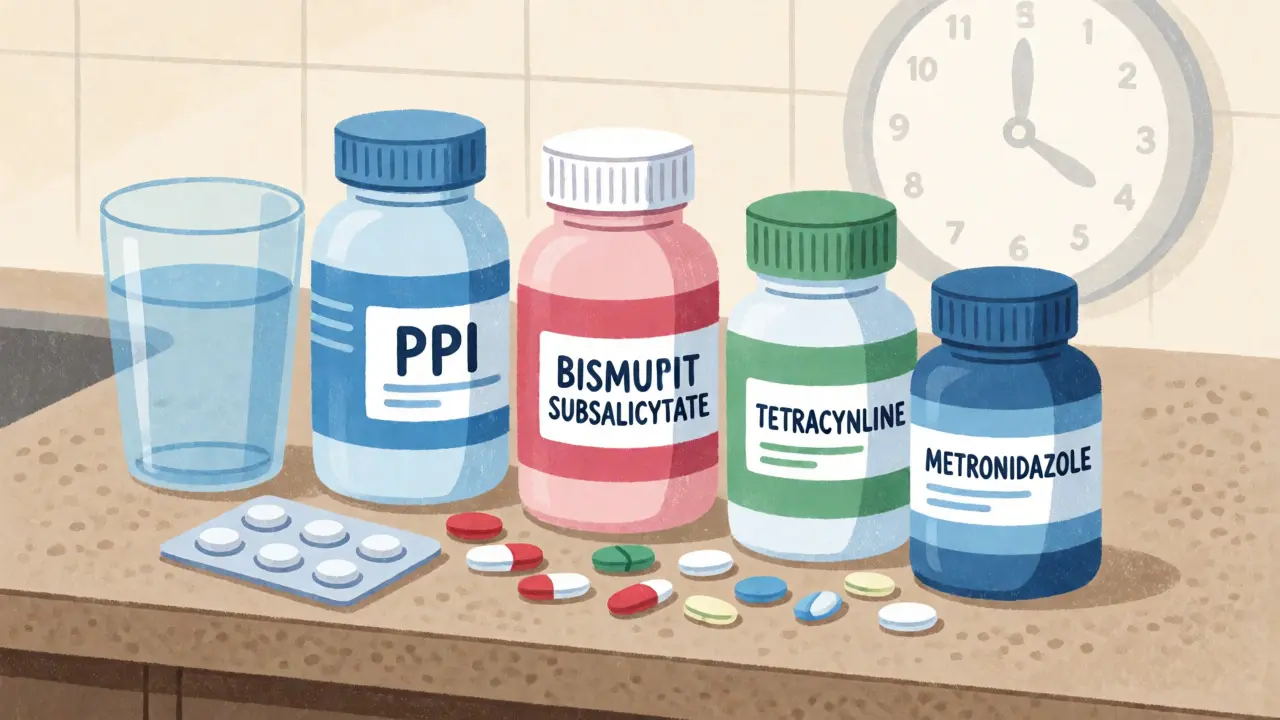
This regimen combines a PPI, bismuth subsalicylate (like Pepto-Bismol), tetracycline, and metronidazole. It’s tougher on the stomach because you’re taking four different medications, often multiple times a day for 10-14 days. But it works. The Maastricht VI/Florence Consensus Report recommends this as first-line treatment in regions with clarithromycin resistance >15%. Bismuth has its own antibacterial properties and helps protect the stomach lining, while tetracycline and metronidazole tackle the bacteria from different angles. It’s less likely to fail due to pre-existing resistance compared to clarithromycin-based regimens.
Another emerging option involves vonoprazan, a potassium-competitive acid blocker approved recently. Unlike traditional PPIs, vonoprazan raises gastric pH faster and higher, creating a better environment for antibiotics to work. Early data suggests it boosts eradication rates significantly, especially in resistant cases, though availability varies by region and cost remains a barrier for some patients.
Navigating Antibiotic Resistance: A Growing Threat
Antibiotic resistance isn’t just a buzzword; it’s reshaping how we treat H. pylori. Global resistance to clarithromycin ranges from 15% to over 50% depending on where you live. Levofloxacin resistance is also rising, hitting 15-30% in Western countries. This means doctors can’t just prescribe the same cocktail for everyone anymore. If you’ve taken macrolide antibiotics (like azithromycin or clarithromycin) in the past year for something else, your H. pylori might already be resistant to them.
How do we fight back? Tailored therapy based on susceptibility testing is becoming the new standard. Traditionally, this meant growing the bacteria in a lab from a biopsy, which is slow and technically difficult. Now, molecular methods like PCR can detect specific genetic mutations associated with resistance directly from tissue samples. For instance, mutations in the 23S rRNA gene predict clarithromycin resistance. A newer platform, GeneXpert, can deliver these results in 90 minutes, allowing doctors to choose the right drugs immediately rather than waiting weeks for culture results.
There’s even hope for non-invasive resistance testing. Researchers are validating stool-based PCR panels that can detect resistance genes from a simple poop sample. Imagine getting your treatment plan tailored without ever needing an endoscopy. While not yet universally available, trials are underway, and this could revolutionize care within the next few years.
Practical Tips for Accurate Results and Better Compliance
Getting the diagnosis right requires cooperation between patient and provider. Here’s what you need to know to avoid common pitfalls:
- Watch the Washout Period: If you’re doing a breath test, missing the 14-day PPI pause is the most common reason for false negatives. Plan ahead so your symptoms don’t become unmanageable.
- Sample Quality Matters: For stool tests, ensure the sample doesn’t touch toilet water or urine. Contamination dilutes the antigen and can skew results.
- Adherence is Key: Quadruple therapy is complex. Missing doses allows surviving bacteria to multiply and potentially develop further resistance. Set alarms. Take meds with food if needed to reduce nausea, but follow specific instructions for each drug.
- Retesting Protocol: Never retest too soon. Wait at least four weeks after finishing antibiotics and two weeks off PPIs to confirm eradication. Testing earlier can pick up residual bacterial fragments, giving a false positive.
Patient experience plays a huge role here. Many people quit early because of side effects like metallic taste from metronidazole or dark stools from bismuth. Talk to your pharmacist about managing these effects. Darkening of the tongue or stool is harmless with bismuth, but knowing that beforehand prevents panic.

When Endoscopy Becomes Necessary
While non-invasive tests handle most cases, endoscopy remains vital for certain scenarios. If you’re over 60 with new-onset dyspepsia, have alarm features like weight loss, difficulty swallowing, or gastrointestinal bleeding, or have a family history of gastric cancer, direct visualization via endoscopy is recommended. During the procedure, biopsies are taken from both the antrum and corpus of the stomach. Taking multiple fragments increases the chance of catching the bacteria if it’s unevenly distributed.
Endoscopy also allows for histology-the microscopic examination of tissue. Pathologists look for inflammation patterns and the presence of the spiral-shaped bacteria. It’s highly accurate but depends heavily on the pathologist’s skill. Additionally, if you’ve failed two courses of therapy, endoscopic culture and sensitivity testing become crucial to guide third-line treatments.
Frequently Asked Questions
Can I drink alcohol during H. pylori treatment?
It is strongly advised to avoid alcohol completely during treatment, especially if you are taking metronidazole. Combining metronidazole with alcohol can cause severe nausea, vomiting, flushing, and rapid heartbeat. Even moderate drinking can interfere with liver metabolism of the antibiotics, potentially reducing their effectiveness or increasing side effects. Stick to water until your course is finished and you’ve completed the post-treatment washout period.
Why did my blood test show positive but my breath test was negative?
This discrepancy is common. Blood tests (serology) detect antibodies, which remain in your system for months or even years after the infection is cured. If you were previously infected and treated, your blood test will stay positive. The breath test detects active urease activity from living bacteria. A negative breath test generally indicates successful eradication, assuming proper preparation. Always rely on breath or stool tests for confirming cure.
Is H. pylori contagious?
Yes, H. pylori can spread from person to person, likely through oral-oral or fecal-oral routes. Close contact with an infected partner or family member increases risk, particularly in childhood. However, adult-to-adult transmission is less efficient. Good hygiene practices, such as handwashing after using the bathroom and before eating, help reduce spread. Some clinicians recommend testing close household contacts if one member is diagnosed, though guidelines vary by country.
What happens if I miss a dose of my quadruple therapy?
Missing occasional doses is unlikely to ruin the entire treatment, but consistency is critical. If you miss a dose, take it as soon as you remember, unless it’s almost time for the next scheduled dose. Do not double up. Frequent missed doses lower the concentration of antibiotics in your stomach, allowing bacteria to survive and potentially develop resistance. If you struggle with adherence, ask your doctor about simplified regimens or blister packs that organize daily doses.
Do probiotics help with H. pylori eradication?
Probiotics are not a substitute for antibiotics, but they can serve as helpful adjuncts. Certain strains, such as Saccharomyces boulardii and Lactobacillus reuteri, may reduce side effects like diarrhea and nausea associated with heavy antibiotic use. Some studies suggest they slightly improve eradication rates by competing with H. pylori and modulating gut inflammation. They won’t cure the infection alone, but adding them to your regimen can make the treatment easier to tolerate and complete.