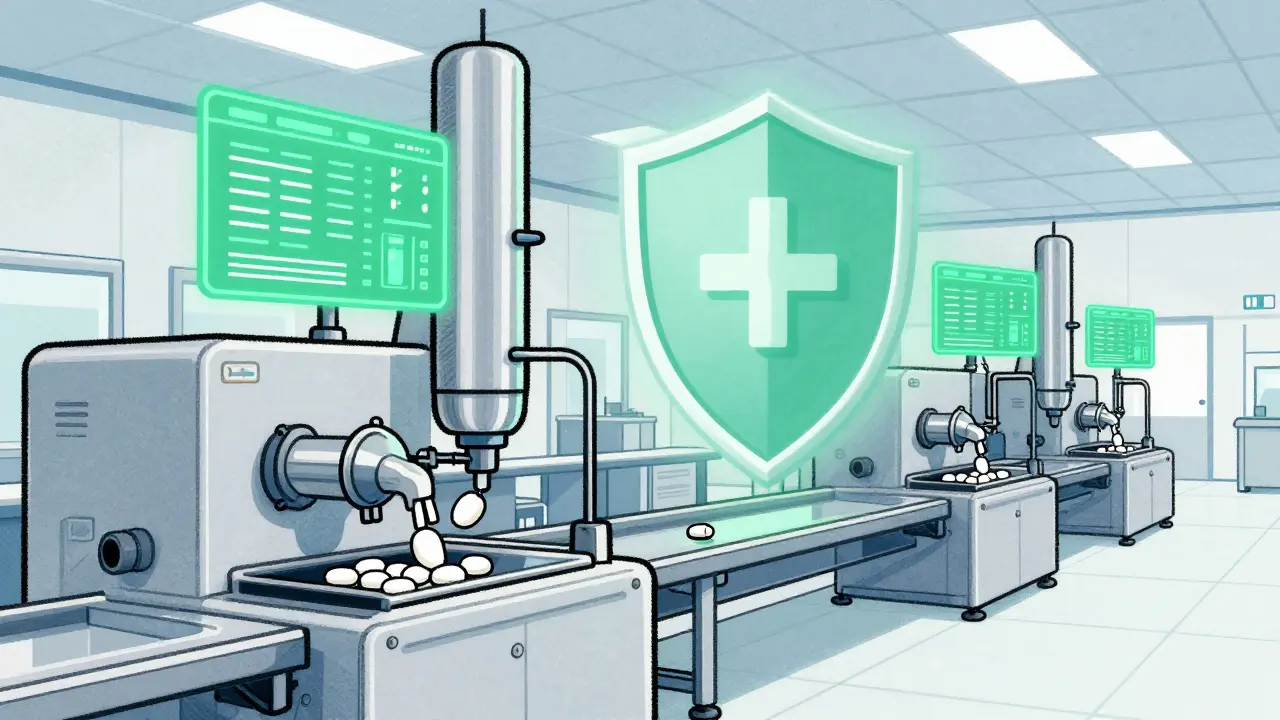
Imagine picking up a bottle of blood pressure medication from your local pharmacy. You trust it will work because the label says so. But what if that pill was made in an unregulated basement instead of a certified facility? This is the nightmare scenario that generic manufacturing standards are designed to prevent. These aren't just bureaucratic red tape; they are the invisible shield protecting millions of patients from dangerous counterfeit drugs.
The fear of fake medications is real, but the reality of how safe generic drugs are might surprise you. When manufactured under strict regulations, generics are not "cheaper versions"-they are chemically identical to brand-name drugs. The difference lies in the rigorous quality control systems that verify this identity at every single step. Understanding these standards helps us see why we can trust the pills on our shelves and how the industry fights back against fraud.
The Foundation: Why Quality Can't Be Tested In
A common misconception is that quality control means testing the final product to see if it's good enough. If a pill fails, it gets tossed. If it passes, it ships. Modern pharmaceutical law rejects this idea entirely. As the U.S. Food and Drug Administration (FDA) states, "Quality cannot be tested into a finished product; it must be built into the design and manufacturing process at every single step."
This principle comes from Current Good Manufacturing Practices (cGMP), specifically outlined in 21 CFR Part 211. These regulations mandate that manufacturers control their processes rather than relying solely on end-product inspection. Think of it like baking bread. You don't wait until the loaf is burnt to realize you set the oven too high. You monitor the temperature, the mixing time, and the humidity during the entire process to ensure the result is perfect. In drug manufacturing, this means controlling raw materials, equipment cleanliness, and environmental conditions before a single tablet is pressed.
The history behind these rules is stark. The 1938 Federal Food, Drug, and Cosmetic Act was born after the sulfanilamide elixir tragedy killed 107 people. Later, the 1962 Kefauver-Harris Amendments required proof of efficacy. Today, these laws form the backbone of global pharmaceutical safety, ensuring that both brand-name and generic makers adhere to the same stringent benchmarks.
The SQUIPP Framework: What Actually Gets Tested
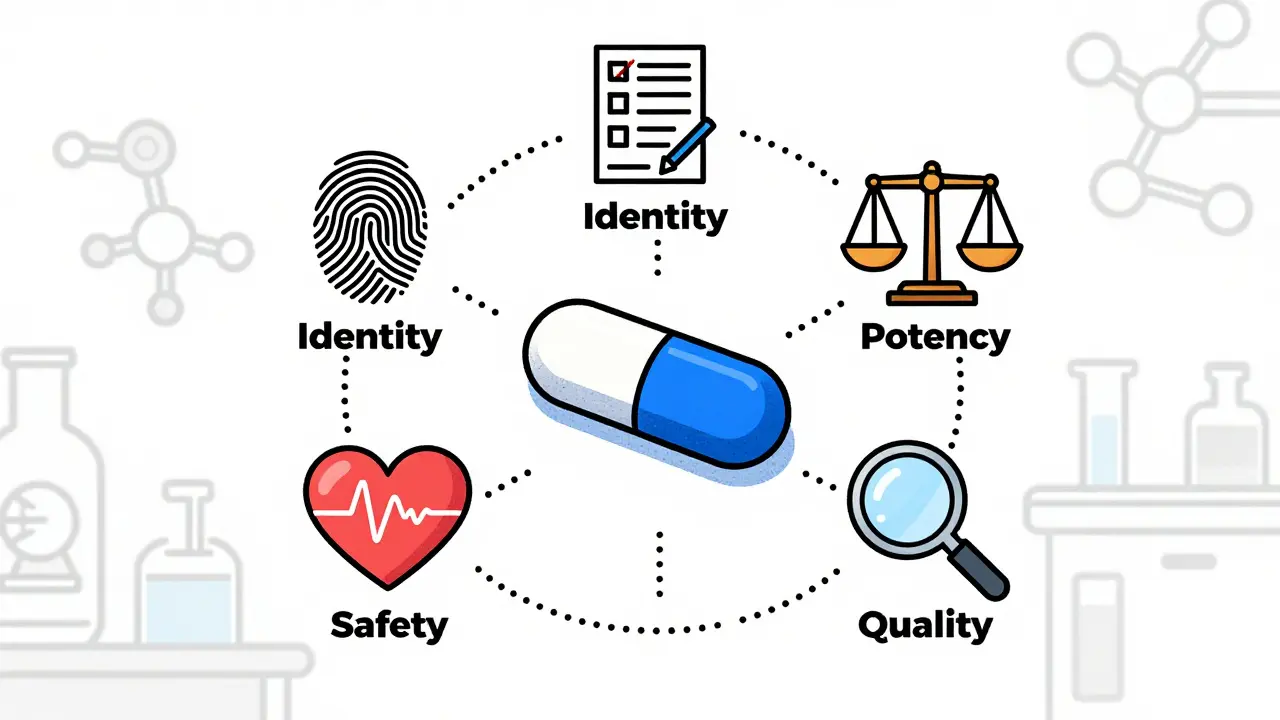
To ensure a generic drug is authentic and effective, manufacturers follow the SQUIPP framework. This acronym stands for Safety, Quality, Identity, Potency, and Purity. Each letter represents a critical checkpoint that acts as a barrier against counterfeits.
- Identity: Is this actually the drug it claims to be? Manufacturers use techniques like infrared spectroscopy and high-performance liquid chromatography to match the chemical fingerprint of the active ingredient against reference standards. This method achieves 99.9% accuracy in distinguishing genuine products from fakes.
- Potency: Does the pill contain the correct amount of active ingredient? Too little, and it won't work. Too much, and it could be toxic. Strict limits ensure every dose falls within a narrow therapeutic window.
- Purity: Are there harmful contaminants? This checks for impurities introduced during synthesis or storage, such as the nitrosamine impurities found in some recalls.
- Safety: Does the drug cause unexpected adverse reactions? This involves monitoring biological effects and long-term stability.
- Quality: Does the product meet all physical specifications, including dissolution rates?
Dissolution testing is particularly crucial for generics. A pill might have the right chemicals, but if it doesn't dissolve in your stomach quickly enough, the medicine never reaches your bloodstream. Regulations require samples to achieve 80% drug release within specific timeframes, typically 30 to 45 minutes. Statistical process control charts monitor over 20 parameters per manufacturing step to maintain process capability indices above 1.33, ensuring consistency across millions of units.
Digital Fingerprints: Serialization and Track-and-Trace
Physical testing catches bad batches, but digital tracking stops counterfeits from entering the supply chain in the first place. The U.S. Drug Supply Chain Security Act (DSCSA) mandates serialization, which places a unique identifier on each package. This creates a digital fingerprint that can be verified through track-and-trace systems with 99.99% accuracy.
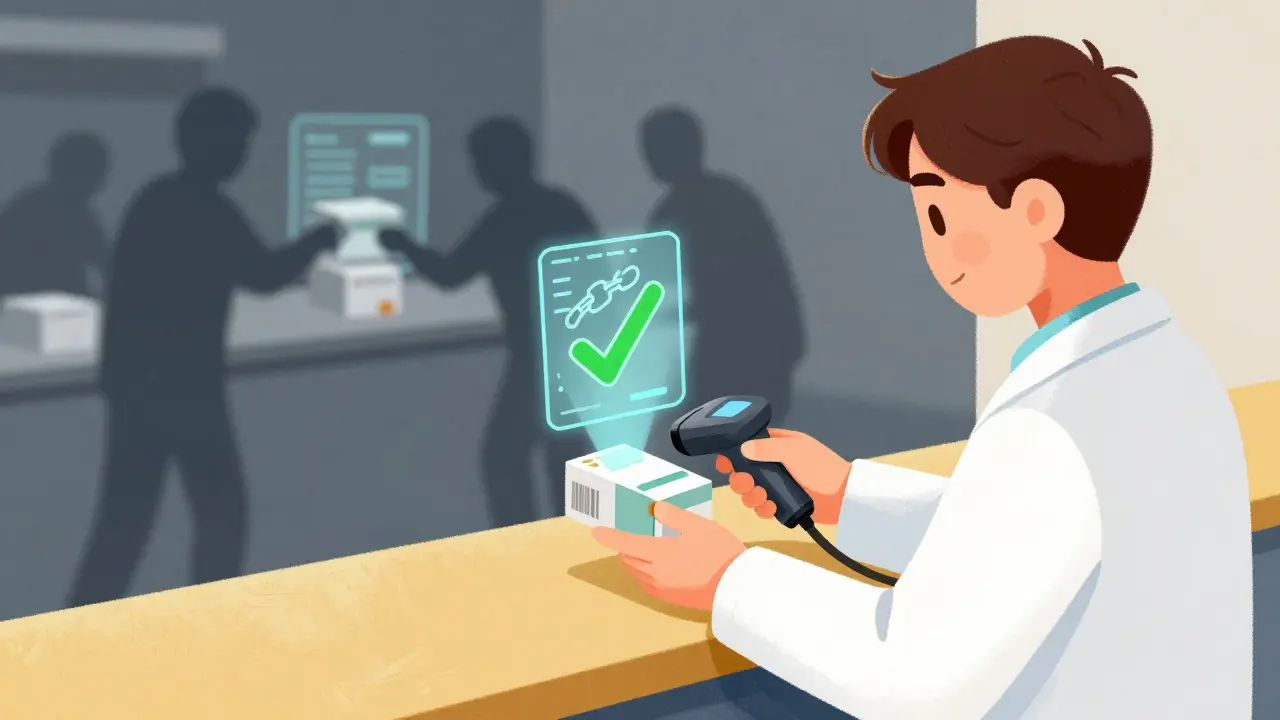
When a pharmacist scans a box of antibiotics, the system checks that unique code against a central database. If the code has already been scanned at a different location, or if it doesn't exist, the alarm sounds immediately. This technology makes it nearly impossible for criminals to sell fake drugs through legitimate pharmacies without detection. By 2023, 92% of the top 50 generic manufacturers had adopted serialization technology, creating a robust net around the supply chain.
Beyond serialization, Electronic Quality Management Systems (eQMS) play a vital role. Cloud-based platforms now monitor over 15,000 quality parameters per production batch in real-time. These systems flag deviations instantly, allowing teams to investigate issues before they become widespread problems. For example, a slight temperature fluctuation in a clean room can trigger an automatic alert, prompting immediate review before any product is released.
Generic vs. Brand: The Myth of Inferiority
Many consumers assume that because generic drugs cost less, they are lower quality. This is a dangerous myth. Regulatory agencies hold generic manufacturers to the exact same cGMP standards as brand-name companies. In fact, data often shows generics are safer due to stricter oversight of newer facilities.
| Feature | Brand-Name Drugs | Generic Drugs (FDA-Approved) |
|---|---|---|
| Regulatory Standard | cGMP (21 CFR Part 211) | cGMP (21 CFR Part 211) |
| Active Ingredient | Original formulation | Identical chemical structure |
| Bioequivalence Requirement | N/A (Reference Product) | 90% confidence interval within 80-125% of reference |
| Adverse Event Rate | 0.03% | 0.02% |
| Counterfeit Risk (Regulated Supply) | Low | Low |
The key metric here is bioequivalence. To get approval via the Abbreviated New Drug Application (ANDA) pathway, a generic manufacturer must prove its drug performs identically to the brand-name version in the body. The 90% confidence intervals for peak concentration (Cmax) and total exposure (AUC) must fall within 80-125% of the reference product. This standard is significantly more stringent than ranges accepted in some emerging markets, where gaps in regulation allow inferior products to slip through.
The Generic Pharmaceutical Association reports that FDA-regulated generic drugs have a slightly lower adverse event rate (0.02%) compared to brand-name drugs (0.03%). This demonstrates that when proper quality controls are implemented, generics are not just equivalent-they are exceptionally reliable.
The Global Challenge: Where the System Strains
While the U.S. and European systems are robust, the global nature of pharmaceutical manufacturing introduces vulnerabilities. The FDA’s 2023 inspection data revealed that while 94% of U.S.-based generic manufacturers achieved "No Action Required" status, compliance drops to 78% for facilities in India and 65% for Chinese facilities. This isn't necessarily a reflection of the countries' capabilities, but rather the varying intensity of regulatory oversight and resource allocation.
Counterfeiters are also becoming smarter. They no longer just sell chalk pills labeled as Viagra. They replicate the chemical composition of genuine drugs but use incorrect crystal forms or polymorphs. These subtle differences can render a drug ineffective even though standard chemical tests pass. The 2018 valsartan recall highlighted this issue, where impurities weren't detected through traditional protocols because the counterfeiters mimicked the expected chemical profile closely enough to fool basic screening.
In developing regions, the problem is more acute. The World Health Organization estimates that while counterfeit medicines represent only 1% of the supply in developed countries, they can make up to 30% in some developing areas. Interpol’s Operation Pangea X seized $21 million worth of counterfeit medicines in 2022, with 78% falsely labeled as generics. This highlights the urgent need for stronger international collaboration and technology adoption in vulnerable markets.
Future Tech: AI and Blockchain in Pharma
The fight against counterfeits is evolving rapidly with new technologies. Artificial Intelligence (AI) is being deployed to analyze complex datasets from manufacturing lines, predicting failures before they happen. Industry analysts predict AI-powered quality control systems will reduce counterfeit incidence by 40% by 2027. Companies like IBM and Siemens are investing heavily in these solutions, aiming to create self-correcting manufacturing environments.
Blockchain technology offers another layer of security. By creating an immutable ledger of every transaction in the supply chain, blockchain ensures that once a drug leaves the factory, its journey cannot be altered or falsified. The WHO rolled out blockchain-based verification for generic antimalarials in Africa in 2024, providing a model for other regions. Additionally, quantum-resistant cryptography is being developed for serialization systems to protect against future hacking threats, as mandated by EU regulations.
Molecular "taggants"-microscopic markers added to the drug substance-are also emerging. These tags act like a DNA test for pills, allowing verification at the molecular level. While still in early stages, this technology promises to make counterfeiting virtually impossible for sophisticated criminals.
What Patients Can Do
As a consumer, you are the last line of defense. Here’s how to protect yourself:
- Buy from licensed pharmacies: Avoid online sources that don’t require a prescription or offer prices that seem too good to be true. The FDA found that 96% of products from unregulated online pharmacies failed quality standards.
- Check the packaging: Look for signs of tampering, misspellings, or unusual colors. Legitimate pharmacies use serialized codes that you can sometimes verify.
- Monitor your reaction: If a medication suddenly seems less effective or causes new side effects, contact your doctor immediately. It could indicate a change in manufacturer or, rarely, a counterfeit product.
- Ask questions: Don’t hesitate to ask your pharmacist about the manufacturer of your generic drug. Reputable pharmacies are transparent about their sourcing.
Remember, quality control is a shared responsibility. By staying informed and purchasing from trusted sources, you support a system that prioritizes your health over profit.
Are generic drugs really the same as brand-name drugs?
Yes, FDA-approved generic drugs must contain the same active ingredients, strength, dosage form, and route of administration as the brand-name drug. They must also meet the same standards of identity, strength, purity, and quality. The main differences are usually in inactive ingredients (like fillers or dyes) and price.
How do manufacturers detect counterfeit drugs?
Manufacturers use a combination of methods including infrared spectroscopy, high-performance liquid chromatography, and mass spectrometry to verify the chemical identity and purity of drugs. Digital serialization and track-and-trace systems also help identify fake products in the supply chain by verifying unique package identifiers.
Why are generic drugs cheaper if the quality is the same?
Generic manufacturers don't have to repeat the expensive clinical trials and marketing campaigns that brand-name companies did when the drug was first developed. They only need to prove bioequivalence. This reduced R&D and marketing cost allows them to offer the drug at a lower price while maintaining high manufacturing standards.
Is it safe to buy generic drugs from other countries?
It depends on the country's regulatory standards. Countries with strong regulatory bodies similar to the FDA or EMA generally produce safe generics. However, buying from unverified online sources or countries with weak oversight increases the risk of receiving substandard or counterfeit medications. Always consult your healthcare provider before importing medications.
What is the SQUIPP framework?
SQUIPP stands for Safety, Quality, Identity, Potency, and Purity. It is a comprehensive framework used in pharmaceutical quality control to ensure that every batch of medication meets strict standards for effectiveness and safety, preventing defective or counterfeit products from reaching patients.