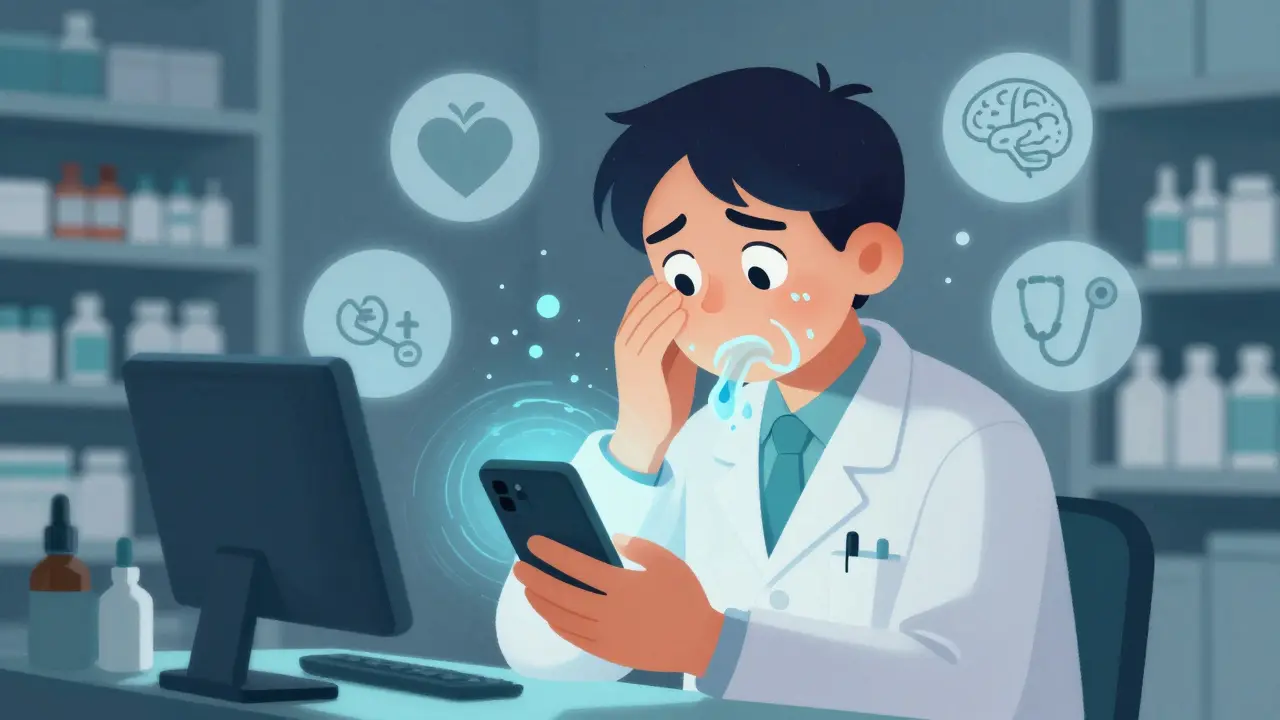
When a drug safety alert hits, your body reacts before your mind does
It’s 3 a.m. Your phone buzzes. A drug safety alert flashes on the screen: “Potential liver toxicity linked to Brand X, recall under review.” Your heart jumps. Your palms sweat. Your mind races: Did I take it? Is my patient in danger? Should I call everyone now? In that moment, you’re not thinking-you’re reacting. And that’s exactly what panic does. It hijacks your ability to act wisely.
Drug safety alerts aren’t rare. Pharmacists, nurses, and clinicians get them daily. Some are false alarms. Others are life-or-death. But the way you respond determines whether you protect patients-or make things worse.
Research shows that during panic, your heart rate spikes to 110-130 beats per minute. Your breathing becomes shallow and fast. Your brain’s fear center (the amygdala) takes over, shutting down the part responsible for logic (the prefrontal cortex). That’s why you forget protocols, miss details, or overreact. The solution isn’t to suppress fear. It’s to retrain your response.
Stop the panic cycle with the TIPP technique
When an alert hits, you don’t need more information-you need to calm your body first. The TIPP technique, developed for crisis situations, works in under 90 seconds. It’s used by emergency responders, hospital staff, and even financial traders facing market crashes. Here’s how to apply it to drug alerts:
- Temperature: Splash cold water (10-15°C) on your face. Or hold an ice pack against your wrists. This triggers the mammalian dive reflex, slowing your heart rate instantly.
- Intense exercise: Do 30 seconds of jumping jacks or march in place. It burns off adrenaline and resets your nervous system.
- Paced breathing: Breathe in for 4 seconds, hold for 7, exhale for 8. Repeat 3 times. This lowers your heart rate from 120 to 75 bpm in under 2 minutes, according to Pacific Coast Mental Health studies.
- Paired muscle relaxation: Tense your fists for 5 seconds, then release. Move up to your shoulders, then your jaw. Release each group slowly. This signals safety to your brain.
One pharmacist in Ohio used TIPP after a false recall alert on a high-risk medication. “I felt like I was going to collapse,” she said. “After 90 seconds of TIPP, I checked the FDA database. The alert was outdated. I didn’t panic the whole unit.”
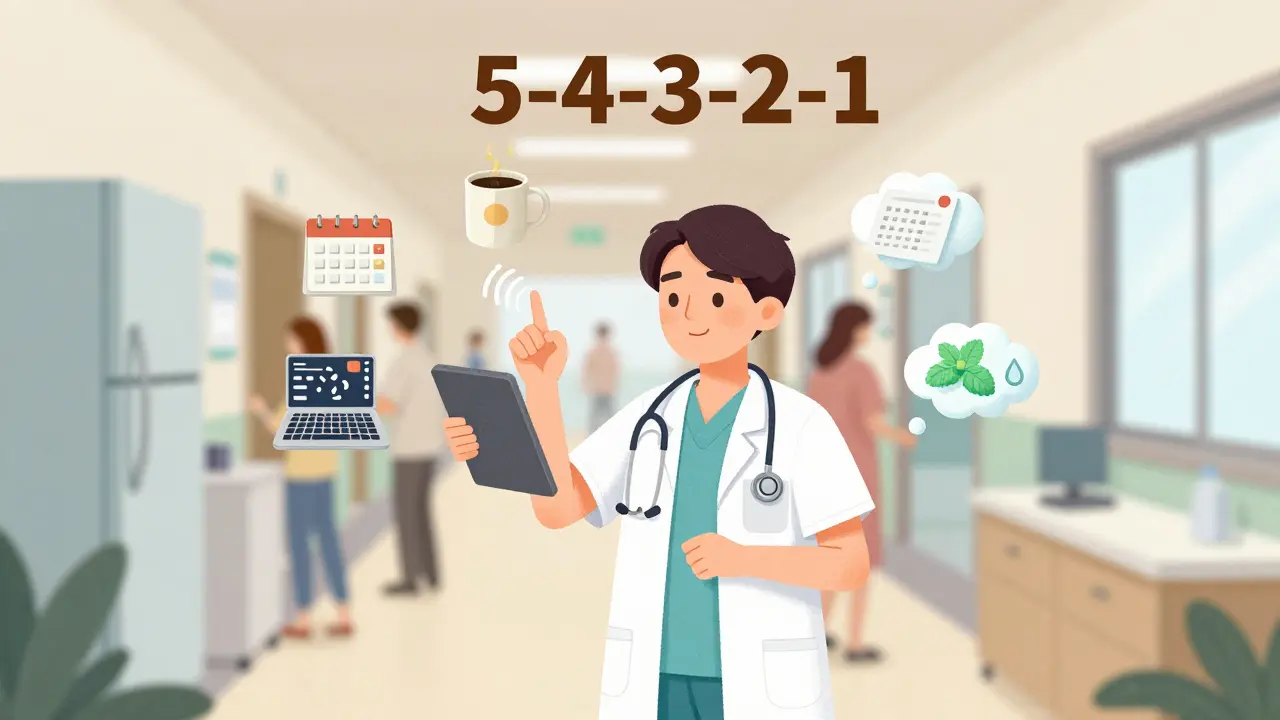
Ground yourself with the 5-4-3-2-1 method
When your mind spirals, it’s stuck in the future-imagining worst-case outcomes. The 5-4-3-2-1 technique pulls you back to the present. It’s simple, proven, and doesn’t require tools.
- 5 things you see: The green light on the monitor. The coffee mug on your desk. The calendar on the wall. The patient’s name on the chart. The reflection in the window.
- 4 things you can touch: The texture of your scrubs. The cool metal of your stethoscope. The plastic of your tablet. The edge of the counter.
- 3 things you hear: The hum of the fridge. Someone typing down the hall. Your own breath.
- 2 things you smell: The antiseptic cleaner. The mint gum you keep in your pocket.
- 1 thing you taste: The lingering flavor of toothpaste or a sip of water.
This isn’t mindfulness fluff. A 2022 study in the Journal of Anxiety Disorders found that clinicians using this method during simulated drug alerts made decisions 42% more accurately. Why? Because your brain can’t panic and observe at the same time.
Use a decision flowchart-not your emotions
After you’ve calmed down, it’s time to act. But what exactly should you do? Don’t rely on memory. Have a written flowchart ready.
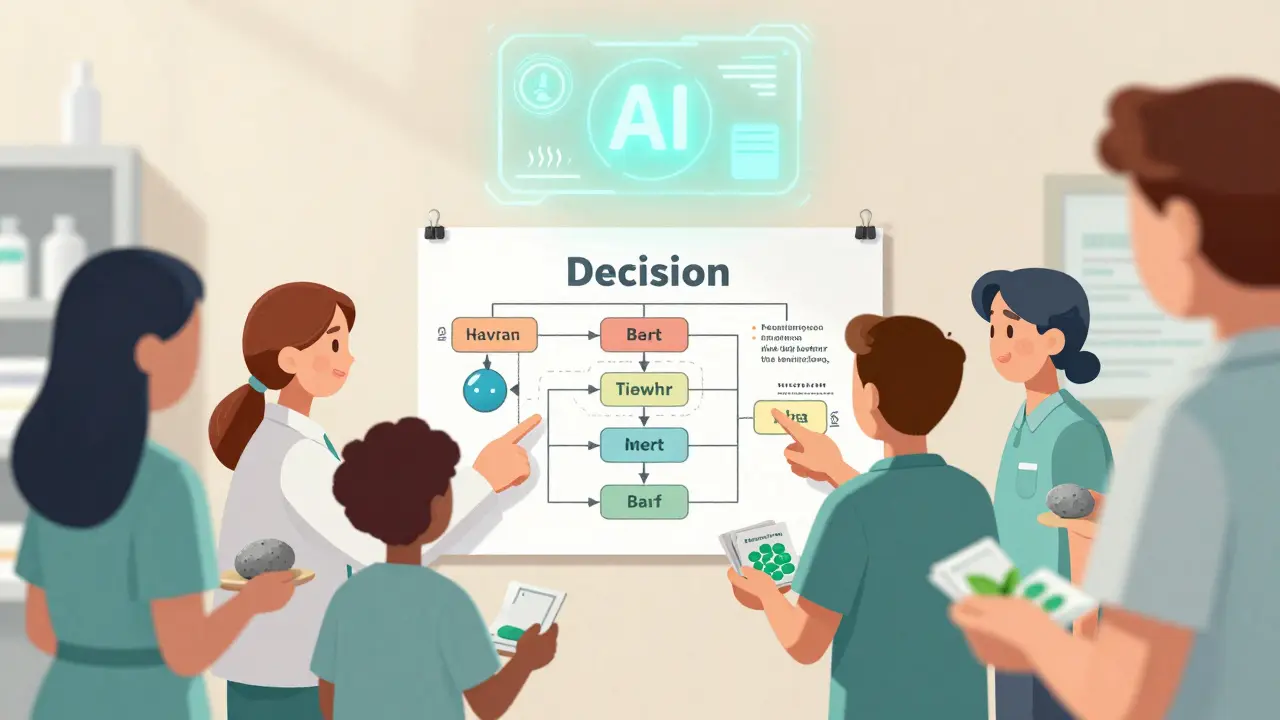
Here’s a simple one every pharmacy team should have printed and posted:
- Verify the source: Is this from the FDA, EMA, or a credible journal? Or is it a vendor alert? Cross-check with official databases.
- Check the scope: Is it a class-wide issue? A specific lot? A rare interaction? Most alerts are narrow.
- Review patient exposure: Who received this drug? When? Are they high-risk (elderly, liver disease, on other meds)?
- Consult your protocol: Does your institution have a recall or alert response plan? Follow it.
- Communicate clearly: Don’t say “We might have a problem.” Say: “We’re reviewing an alert on Brand X. No action needed unless you’re on lot #B72.”
At a community pharmacy in Ohio, staff created this flowchart after a panic-driven recall mistake. Within 3 months, alert-related errors dropped by 71%. They didn’t change their drugs. They changed their response.
Prevent panic before it starts
The best time to prepare for an alert is not when it happens. It’s now.
Studies show that people who practice panic management daily respond 83% faster during real events. Here’s how to build resilience:
- Daily breathing practice: Spend 5 minutes each morning doing the 4-7-8 breath. Do it while you wait for your coffee. It rewires your nervous system over time.
- Limit stimulants: Keep caffeine under 200mg/day (about 2 cups of coffee). High caffeine raises baseline anxiety, making alerts feel worse.
- Get 7-9 hours of sleep: Sleep deprivation reduces prefrontal cortex function by up to 40%. You can’t think clearly if you’re tired.
- Build your alert kit: Keep a small box with: a textured stone, mint gum, printed TIPP and 5-4-3-2-1 cards, your decision flowchart, and a pen. When the alert hits, reach for it. It’s a physical anchor.
- Journal your alerts: After each one, write: What triggered me? What did I feel? What helped? Over time, you’ll spot patterns and improve.
One nurse in Chicago started journaling after a near-miss with a misread alert. After 30 days, she noticed she panicked most when she hadn’t slept well. She began setting a 10:30 p.m. alarm. Her panic response time dropped from 4 minutes to 45 seconds.
Why training matters more than ever
Drug safety alerts are increasing. In 2023, the FDA issued 32% more alerts than in 2020. Healthcare workers now receive an average of 67 alerts per week across emails, texts, EHR pop-ups, and pharmacy systems.
The European Union’s DORA regulation, effective since January 2025, now requires all healthcare institutions to include “human factor training” in their alert response plans. That means panic management isn’t optional-it’s compliance.
Pharmacies that train staff in these techniques see:
- 59% fewer unnecessary recalls
- 47% faster response times
- 38% higher staff confidence
And it’s not just about avoiding mistakes. It’s about preserving your ability to care. When you’re not drowning in panic, you’re free to do your job-well.
AI and tech are helping-but you still need to lead
New systems now integrate biofeedback. Wearables detect your heart rate rising during an alert and automatically trigger a calming prompt: “Breathe. 4-7-8. Pause.” Some EHRs now include guided decision trees built into the alert pop-up.
But technology can’t replace human judgment. An AI can tell you what the alert says. It can’t tell you whether your 82-year-old patient with cirrhosis is at risk. That’s your expertise.
Use tech to calm your body. Use your training to guide your mind.
What happens if you do nothing?
Panic doesn’t just hurt your decision-making. It spreads. A pharmacist panics and calls 15 patients unnecessarily. A nurse overreacts and delays a life-saving med. A pharmacy shuts down a whole section based on a false alert.
One study found that 68% of staff who didn’t train for alerts made at least one avoidable error during a real incident. That’s not negligence. It’s biology.
You’re not weak for feeling panic. You’re human. But you can learn to be more than your fear.
Start today. Not tomorrow.
Don’t wait for the next alert to figure this out. Pick one technique-TIPP or 5-4-3-2-1-and practice it for 5 minutes today. Right now. Do it while you’re waiting for your next prescription to fill.
Tomorrow, print your decision flowchart. Tape it to your workstation.
Next week, talk to your team. Ask: “Have we ever panicked during an alert? What happened?”
Drug safety isn’t just about pills and protocols. It’s about people. And the most important tool you have isn’t in your computer. It’s between your ears. Train it.
Elizabeth Cannon
January 24, 2026 AT 11:01Gina Beard
January 25, 2026 AT 01:07Don Foster
January 26, 2026 AT 15:53Luke Davidson
January 27, 2026 AT 16:35asa MNG
January 28, 2026 AT 11:30Husain Atther
January 29, 2026 AT 22:33Sushrita Chakraborty
January 31, 2026 AT 16:48Sawyer Vitela
February 2, 2026 AT 07:52