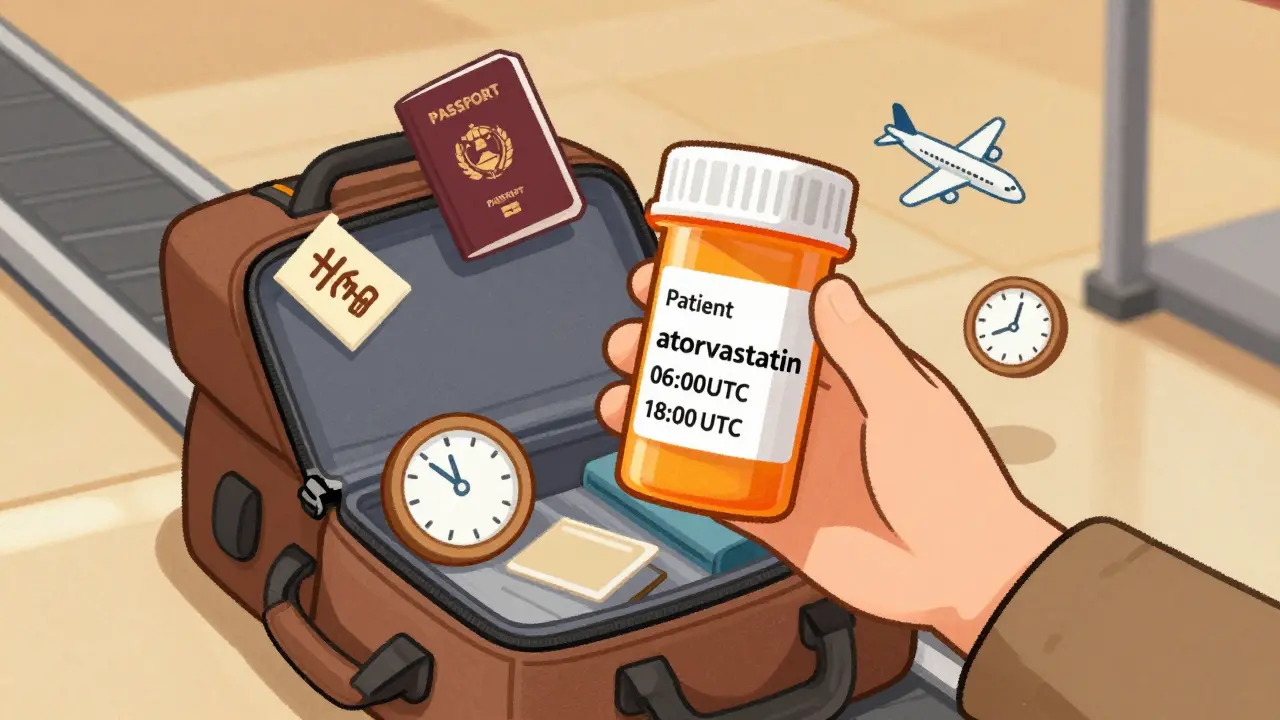
Getting through airport security with your meds shouldn’t feel like a quiz you didn’t study for. You’ve packed your clothes, your charger, your travel pillow-but did you check your prescription labels? If you’re flying across time zones, a simple misunderstanding on that little paper slip could mean missing a dose, taking two by accident, or getting detained at customs. It’s not rare. In 2023, over 1,200 medication-related seizures happened at Japanese airports alone-most because the label didn’t match local requirements. And that’s just one country.
What’s Actually on Your Prescription Label?
Your prescription label isn’t just a receipt. It’s your medical passport. There are seven key parts you need to check before you leave:- Patient name-It must match your passport exactly. No nicknames. No middle initials missing. If your passport says “Sarah Elizabeth Johnson,” your label better say the same.
- Medication name-Look for both the brand name (like “Lipitor”) and the generic name (“atorvastatin”). Many countries only recognize the generic. If you’re heading to Japan, you’ll need the kanji version too.
- Dosage strength-Is it 10 mg? 500 mg? 100 IU? Don’t guess. Write it down.
- Directions for use-This is where time zones mess you up. Look for phrases like “q24h” (every 24 hours) or “q12h” (every 12 hours). Avoid AM/PM. Those don’t travel well.
- Prescriber info-Doctor’s name, phone, and license number. Some countries require this. If it’s not there, ask your pharmacy to add it.
- Pharmacy details-Address and license number. This helps customs verify the script is real.
- Prescription number-Useful if you need a refill abroad or if your meds get lost.
Most U.S. pharmacies now offer a “travel supplement” on request. Ask them to add UTC time equivalents. For example: “Take one tablet at 08:00 UTC (03:00 EST).” About 78% of major chains will do this if you ask. Don’t assume it’s there.
Time Zones Don’t Care About Your Schedule
You’re used to taking your blood pressure pill at 8 a.m. local time. But when you land in Bangkok, it’s 11 p.m. back home. Do you take it now? Wait until 8 a.m. Bangkok time? Or stick to your home schedule?The answer depends on the drug. For most medications, the International Society of Travel Medicine recommends switching to local time immediately. But there are exceptions.
- Insulin, anticoagulants (like warfarin), seizure meds, and thyroid pills-these have narrow therapeutic windows. Even a small timing shift can cause problems. Stick to your home time zone for the first 2-3 days, then slowly adjust.
- Antibiotics, birth control, daily vitamins-these are more forgiving. Switch to local time as soon as you land. Just space doses evenly-every 12 or 24 hours, not “morning and night.”
Here’s the trick: convert everything to Coordinated Universal Time (UTC). That’s the global standard. No AM/PM. No confusion. If your pill is due every 12 hours, write down: “06:00 UTC, 18:00 UTC.” When you land in Tokyo (UTC+9), that’s 15:00 and 03:00 local time. No guessing. No panic.
There’s a free app from the World Health Organization called the Medication Time Zone Converter. It’s been downloaded over 287,000 times. Use it. Don’t rely on your phone’s clock alone.
Country Rules Are Wildly Different
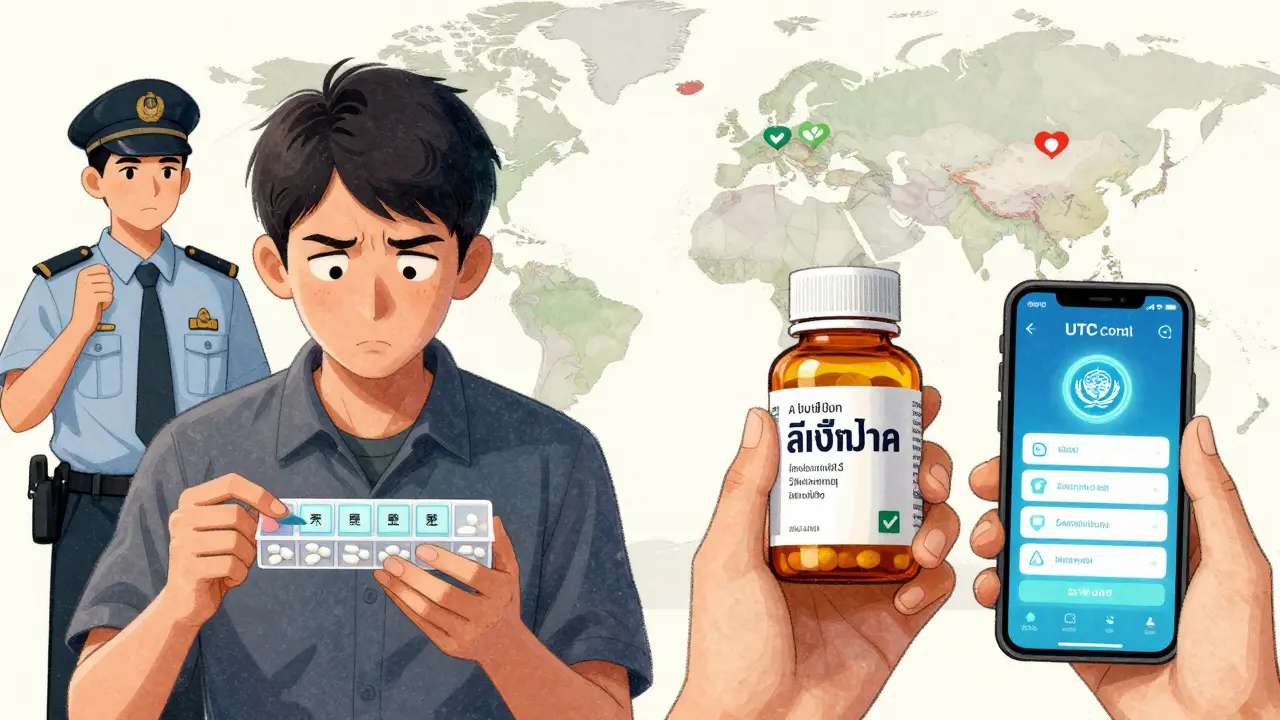
You can’t assume your U.S. prescription label works everywhere. Each country has its own rules-and enforcement is getting stricter.- Japan-All prescription labels must include kanji for the active ingredient. If your label says “ibuprofen” but not “イブプロフェン,” you could be detained. In 2023, 68% of medication seizures at Narita Airport were due to missing kanji.
- Thailand-Labels must be in both English and Thai. If your bottle says “Lisinopril” but not “ลิซิโนプリล,” customs might confiscate it.
- Saudi Arabia-The Arabic name of the active ingredient is required. In early 2023, 22% of seized meds at Riyadh Airport had no Arabic text.
- European Union-Labels must be in the local language of the country you’re entering. Your German prescription won’t fly in Spain unless it has Spanish text.
- Caribbean nations-Many require English and Spanish. A 2022 study found only 37% of U.S. prescriptions met this standard.
Pro tip: Print out a copy of your prescription from your pharmacy’s website. Add the generic name in the local language if you can find it. Some travelers carry a doctor’s note explaining the medication and dosage. It doesn’t guarantee entry, but it helps.
What You Should Never Do
There are three big mistakes people make-and they’re easy to avoid.
- Don’t transfer meds to pill organizers. TSA says you don’t need original bottles, but customs officers worldwide do. If you’re caught with 20 white pills in a plastic box labeled “BP,” you’re asking for trouble. Keep meds in their original labeled containers.
- Don’t assume your doctor’s note is enough. A note might help, but it’s not a substitute for a proper label. Customs cares about the bottle, not your email.
- Don’t guess timing. If your label says “take with food,” but you’re on a 14-hour flight with no meals, what do you do? Call your pharmacist before you go. Some meds (like bisphosphonates) must be taken on an empty stomach with plain water. Mess this up, and you risk esophageal damage.
A Reddit user in 2022 took double the dose of levothyroxine because they thought “take on empty stomach” meant “take before breakfast”-but they landed in Prague at 3 a.m. local time. They ended up in the ER. That’s not a story you want to live.
How to Prepare (Step-by-Step)
Start 4-6 weeks before you leave. Here’s what to do:
- Call your pharmacy. Ask for a “travel-ready” label with UTC timing, generic names, and your doctor’s license number. Request a printed copy of your prescription with all details.
- Check destination rules. Visit the U.S. State Department’s travel site or IATA’s pharmaceutical regulations database. Look up your destination’s medication import rules.
- Create a UTC schedule. Use the WHO app or a simple spreadsheet. List each medication, dosage, and UTC time. Convert it to local time for your destination.
- Bring extra. Pack at least a 10-14 day surplus. Flights get delayed. Bags get lost. Don’t risk running out.
- Carry a printed checklist. Include: medication names (generic + brand), dosages, UTC times, doctor’s contact info, and a note saying “for personal use.”
Travelers who use UTC-based schedules report 89% fewer timing issues, according to a 2023 GoodRx survey. Those who wing it? Over 60% had problems.
What’s Changing in 2025
By the end of 2025, the WHO will require all international prescription labels to include a standardized “travel supplement” section. That means:
- UTC timing clearly printed
- Active ingredient names in at least two languages
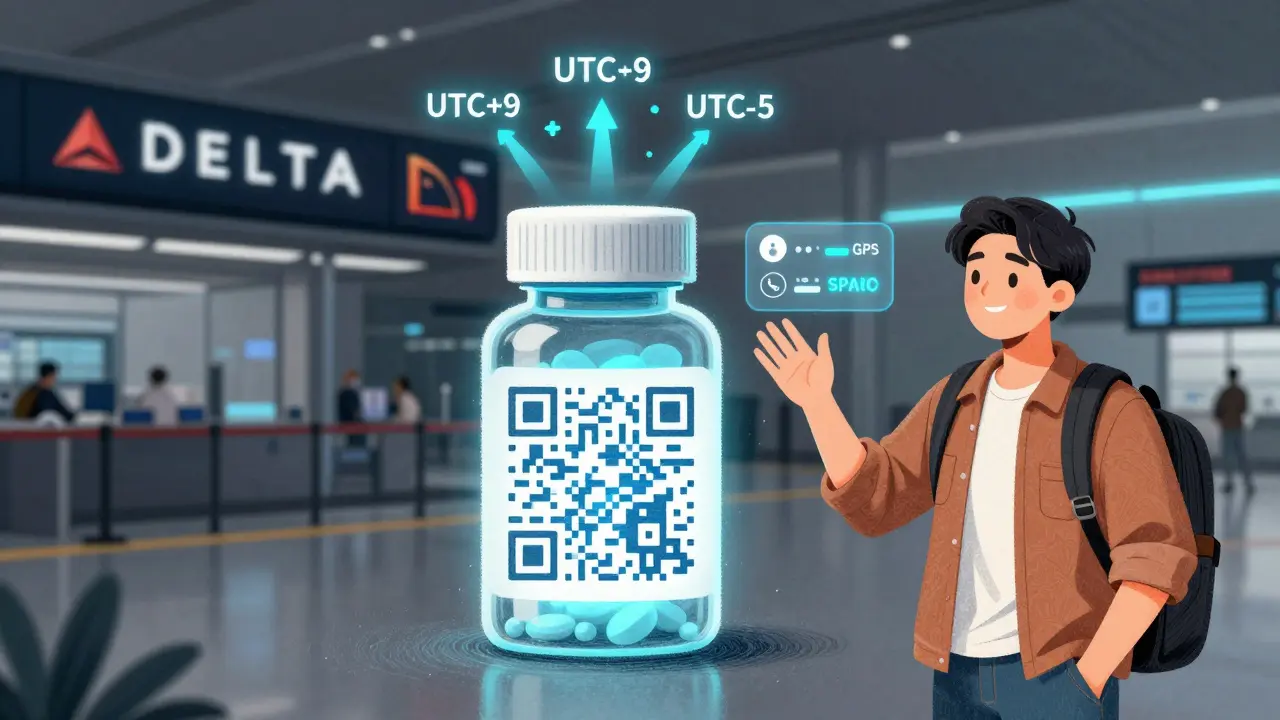
- A QR code linking to multilingual info
Some airlines, including Delta and Emirates, are already testing a Universal Medication Travel Card-a digital pass that syncs your meds with your flight and destination rules. It’s not everywhere yet, but it’s coming.
Meanwhile, pilot programs in Singapore and Dubai are testing AR labels-smart bottles that adjust timing instructions based on your GPS location. It sounds like sci-fi, but it’s real. The future of travel meds is automated.
Final Reminder: It’s Not Just About Convenience
Misreading a label isn’t just embarrassing. It’s dangerous. A missed dose of warfarin can cause a stroke. Taking too much insulin can send you into a coma. A 2022 study by International SOS found that 70% of medication-related travel emergencies come from timing errors-often because the label looked simple, but wasn’t.
There’s no excuse for guessing. You’ve got the tools: apps, pharmacy support, global databases. Use them. Your health isn’t a backup plan. It’s the whole trip.
Lindsey Kidd
December 24, 2025 AT 09:34OMG YES THIS!! 🙌 I once got stopped at Tokyo airport because my label said "ibuprofen" and not "イブプロフェン"... they made me open my bag right there in front of everyone 😭 Thank you for the WHO app tip-I just downloaded it!
Rachel Cericola
December 25, 2025 AT 23:23Let me tell you, this is the most practical travel advice I’ve read in years. Most people think "I’ll just wing it" with meds until they’re in a foreign ER with a confused pharmacist and no translation app. The UTC conversion is non-negotiable-especially for anticoagulants and insulin. I’m a nurse and I’ve seen people nearly die because they took their pill at 8 a.m. their time and then landed in Singapore and took it again at 8 a.m. local time. That’s double dose. That’s dangerous. Don’t be that person. Print your label with UTC. Use the app. Keep meds in original bottles. And for the love of all things medical, don’t transfer them to a pill organizer unless you want to be interrogated by customs like a drug smuggler. This isn’t about convenience-it’s about not ending up on a news headline titled "American Tourist Hospitalized After Misreading Prescription."
CHETAN MANDLECHA
December 26, 2025 AT 19:28Very useful. I traveled to Japan last year with my father’s diabetes meds. We had the English label but no kanji. They let us through after 45 minutes of questions. Next time I will print the Hindi translation too-just in case. Good point about the doctor’s license number. Many Indian pharmacies don’t print it. Will ask next refill.
Ajay Sangani
December 28, 2025 AT 11:45you know… i was thinking… if the world is moving toward utc-based labels and qr codes… then why do we still rely on paper? isn’t this just a temporary fix? like… what if your phone dies? or the qr code is blurry? or the app crashes? isn’t the real solution… a global medical blockchain? where your prescription is tied to your biometrics and synced across borders? just… food for thought. maybe we’re overcomplicating the label… and undercomplicating the system.
Pankaj Chaudhary IPS
December 29, 2025 AT 21:14As a citizen of India and a global traveler, I commend this guide for its clarity and cultural sensitivity. In many developing nations, travelers assume their Western prescriptions are universally accepted. This is a dangerous misconception. I have personally witnessed Indian nationals detained in Saudi Arabia for carrying insulin without Arabic labeling. The step-by-step preparation checklist is excellent. I urge all travelers to treat their medications not as personal items, but as critical medical documents. The future of global health mobility lies in standardization-and you have outlined the path forward with precision and compassion.
Payson Mattes
December 30, 2025 AT 01:14Okay but… did you know the WHO app is actually funded by Big Pharma? I checked the domain registration-same parent company as Pfizer. And the "Universal Medication Travel Card"? That’s just a backdoor for RFID tracking. They’re gonna link your meds to your passport, your flight, your hotel, your credit card. Next thing you know, they’ll be auto-dosing you based on your location. I’ve got a friend who works at TSA-he says they’ve already started flagging people who don’t use the app. It’s not about safety. It’s about control. And they’re gonna call it "health optimization." Wake up.
Steven Mayer
December 31, 2025 AT 04:29While the utility of UTC-based temporal alignment for pharmacokinetic compliance is empirically supported, the operationalization of multilingual labeling introduces significant logistical entropy. The burden of linguistic standardization disproportionately impacts low-resource pharmacy systems. Furthermore, the assumption that QR codes are universally accessible ignores the digital divide in global travel corridors. The proposed AR-enabled smart bottles, while technologically compelling, lack interoperability with legacy regulatory frameworks and introduce novel vectors for data compromise. The underlying epistemology assumes a homogenous global pharmacopeia-a fallacy.
Diana Alime
January 1, 2026 AT 09:57so i printed my label with utc… then lost my bag… then had to buy new meds in thailand… and guess what? the pharmacy gave me the same pills but the label said "for external use only"??? like?? i’m not putting this on my skin?? i’m taking it?? i cried in a 7-eleven. why is this so hard??
Adarsh Dubey
January 2, 2026 AT 03:54This is excellent. I appreciate how you emphasized the difference between TSA guidelines and international customs regulations. Many travelers confuse the two. I once had a friend try to carry liquid insulin in a 100ml bottle through EU security, thinking TSA rules applied. They confiscated it. The correct approach is to always comply with the destination country’s rules, not the departure country’s. Your checklist is now saved on my phone.
Bartholomew Henry Allen
January 4, 2026 AT 03:36Foreign governments have no right to dictate how American citizens take their medicine. This is tyranny dressed as safety. The U.S. has the best pharmaceutical system in the world. Why should we bow to Japan’s kanji demands or Saudi Arabia’s Arabic rules? If they don’t like our labels, they should learn English. I travel with my meds in original bottles and that’s enough. No apps. No translations. No compromises. America First.