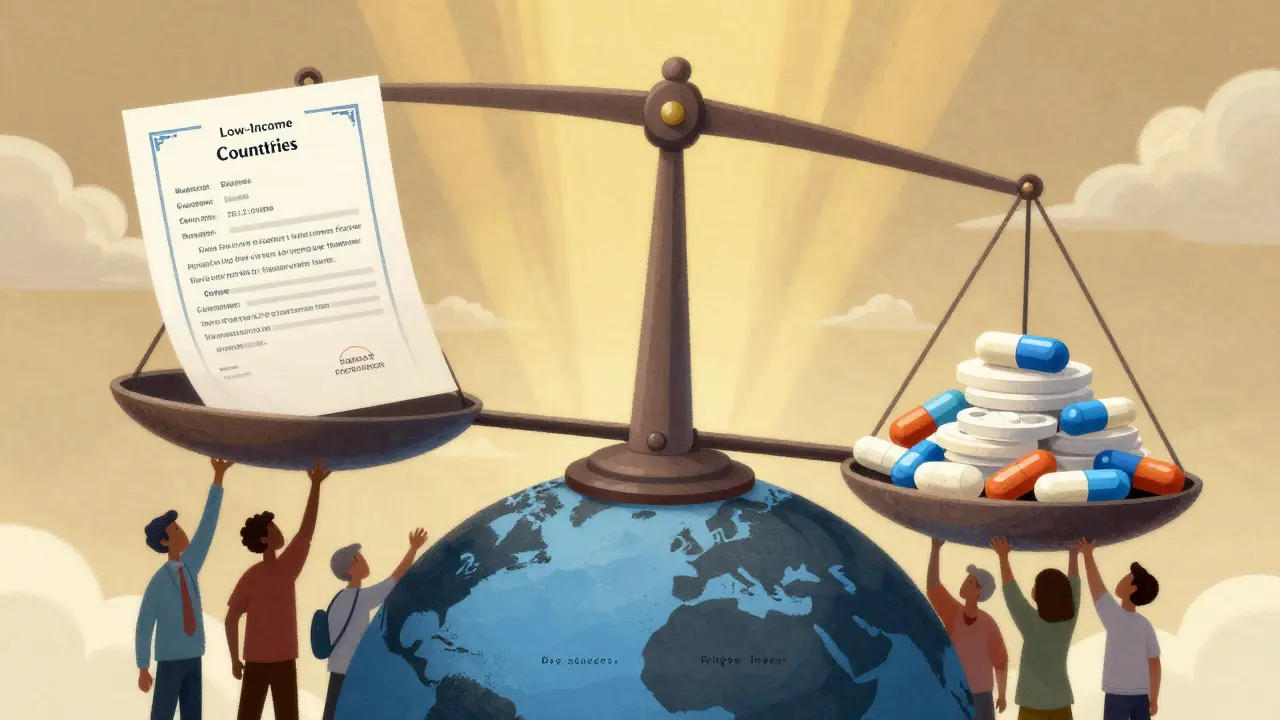
When you need a life-saving drug, price shouldn’t depend on where you live. But for millions in low-income countries, it does. The reason? A global trade rule called TRIPS - the Trade-Related Aspects of Intellectual Property Rights Agreement. It was meant to protect innovation, but in practice, it’s made essential medicines unaffordable for people who need them most.
What TRIPS Actually Does
TRIPS is a WTO treaty that forces all 164 member countries to follow the same patent rules. Before 1995, many developing nations didn’t even allow patents on drugs. India, for example, made generic versions of HIV meds by changing how they were made - not the drug itself. That was legal under old rules. TRIPS changed that. Now, every country must give drug companies at least 20 years of exclusive rights from the date the patent is filed. No exceptions.This sounds fair on paper. But here’s the catch: the 20-year clock starts when the patent is filed, often years before the drug even hits the market. That means a drug might only have 10 years of real exclusivity left by the time it’s approved. Meanwhile, companies file dozens of secondary patents - on packaging, dosages, or minor chemical tweaks - to stretch their monopoly. This is called “evergreening,” and it’s legal under TRIPS.
How Generic Drugs Got Blocked
Generic drugs are cheaper because they don’t repeat expensive clinical trials. They just prove they work the same as the original. But TRIPS added a hidden barrier: data exclusivity. Even after a patent expires, regulators can’t use the original company’s trial data to approve a generic version. That creates a 5- to 10-year delay - no matter how urgent the need.Take HIV treatment. In 2000, a first-line antiretroviral cocktail cost $10,000 per patient per year in Africa. By 2019, thanks to generic competition in countries that could bypass patent rules, it dropped to $75. But that only happened because some countries - like Brazil and South Africa - fought to use TRIPS flexibilities. Most didn’t. And newer drugs? Many still cost $300-$600 per year in low-income countries because patents and data exclusivity keep generics out.
Compulsory Licensing: The Loophole That Almost Wasn’t
TRIPS lets governments issue compulsory licenses - allowing someone else to make a patented drug without the company’s permission. But there’s a trap. Paragraph 6 says these licenses must be used “predominantly for the domestic market.” That meant countries without drug factories couldn’t import cheaper generics from others.Imagine a small African nation with no manufacturing. A neighbor has the capacity to make generic HIV meds, but under TRIPS, they can’t legally export them. So the sick people in the first country stay untreated. This wasn’t an accident. It was written into the agreement to protect big pharma profits.
In 2003, the WTO tried to fix this with the “Paragraph 6 Solution.” It allowed exports under license - but only if both countries jumped through 12 bureaucratic hoops. By 2016, only one shipment of malaria medicine had ever been sent this way. It was too slow, too complicated, and too risky for any country to try.
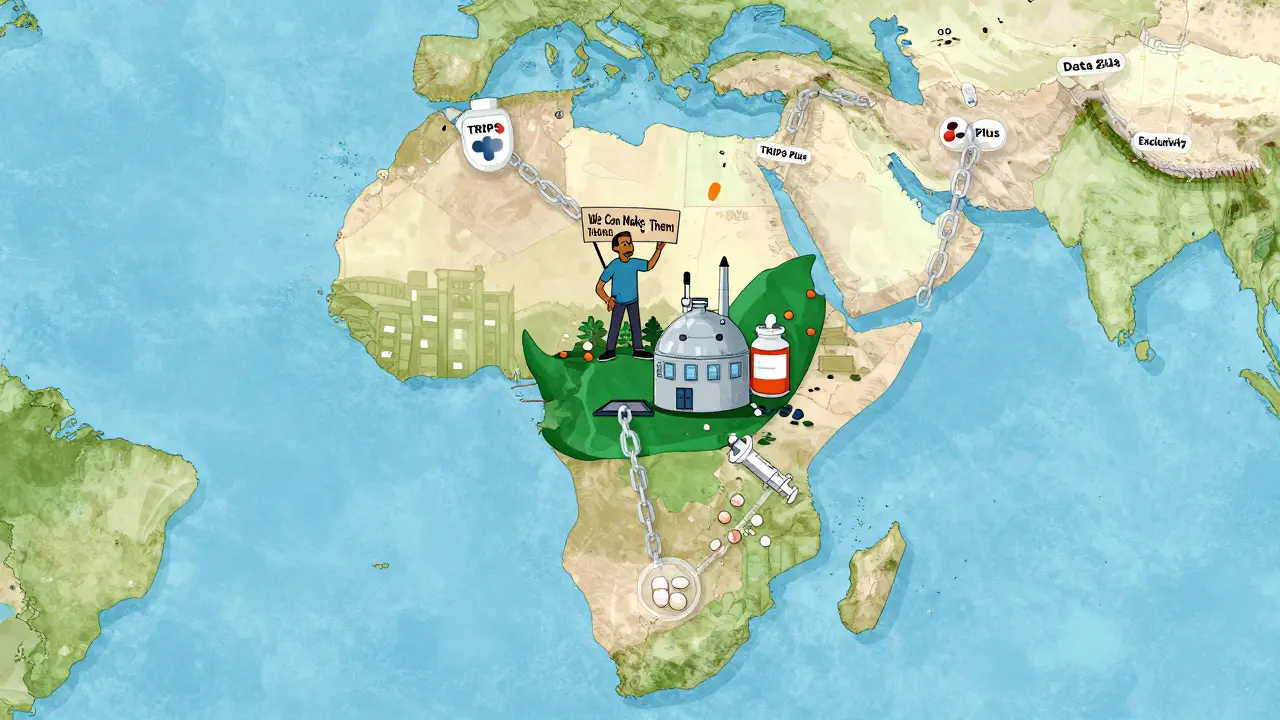
TRIPS Plus: The Hidden Rules Behind the Rules
Even when countries follow TRIPS, they’re often forced to do more. The U.S., EU, and other rich nations push “TRIPS Plus” terms into trade deals. These add extra protections: longer patent terms, stricter data exclusivity, and bans on compulsory licensing for certain diseases.The EU-Vietnam Free Trade Agreement (2020) gave drug companies 8 years of data exclusivity - three years longer than TRIPS allows. The U.S. has done the same in 85% of its free trade deals. These aren’t global rules. They’re private deals, signed quietly, that lock poorer countries into even tighter restrictions.
Who Won? Who Lost?
Big pharma says strong patents drive innovation. And yes, most new drugs come from companies in countries with strict IP laws. But here’s the twist: 70% of new drugs since 2000 treat conditions that affect rich countries. Only 13 out of 1,223 new drugs between 1975 and 1997 were for tropical diseases. That’s not innovation - that’s market-driven neglect.Meanwhile, developing countries lost their freedom to make affordable medicines. Before TRIPS, 23 of 102 developing nations allowed pharmaceutical product patents. By 2010, it was 147. India, once the “pharmacy of the developing world,” had to scrap its process-patent system by 2005. Cancer drug prices jumped 300-500% overnight.
South Africa tried to pass a law letting it import generics in 1998. Forty pharmaceutical companies sued. The case was dropped only after global protests. Brazil made generic HIV drugs in 2000. The U.S. threatened trade sanctions. They backed down - but only after public pressure.
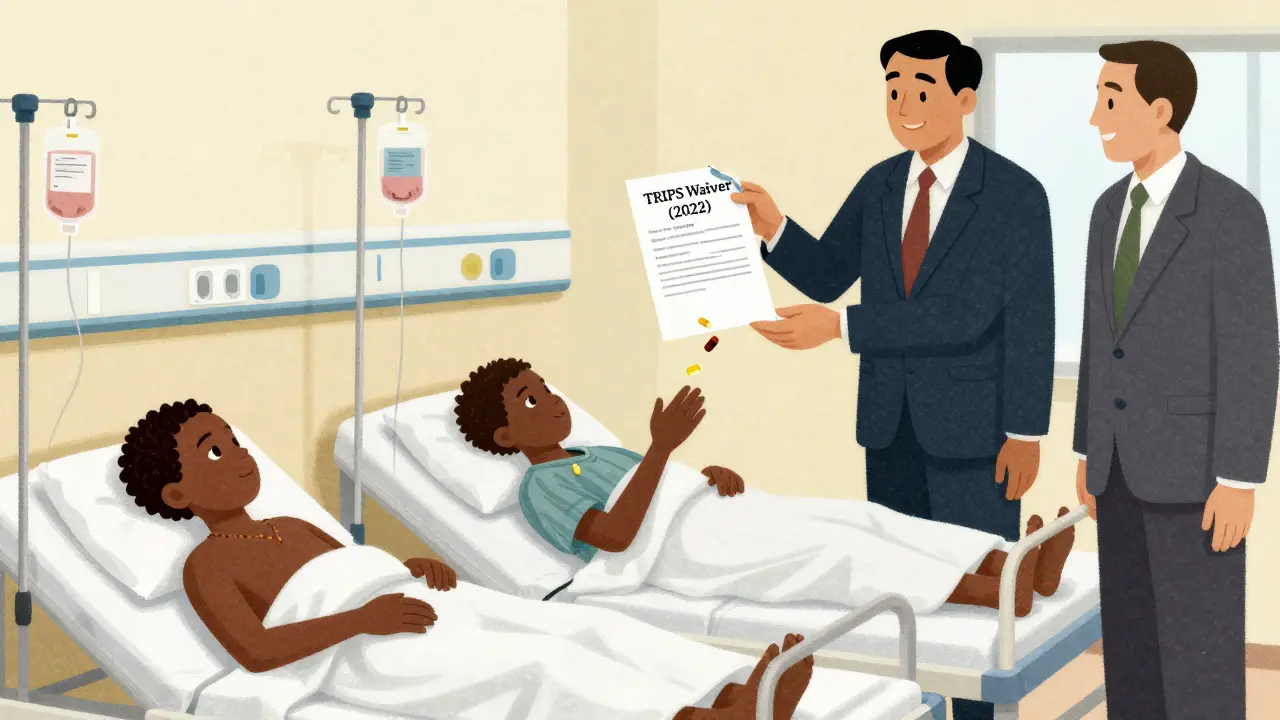
The Real Cost: Lives Delayed, Not Just Prices
This isn’t about abstract policy. It’s about who gets to live.In 2001, Médecins Sans Frontières reported that 8 million people needed HIV treatment. Only 50,000 got it - because the drugs cost more than most countries’ entire health budgets. Today, 29 million people are on antiretrovirals. That’s progress. But it happened because activists forced governments to use TRIPS flexibilities - not because the system worked.
And what about newer diseases? Hepatitis C, tuberculosis, and cancer drugs still sit behind patent walls. The Medicines Patent Pool, a nonprofit that negotiates voluntary licenses, has reached 17.4 million patients since 2010. But that’s still a drop in the ocean. Most new drugs never get licensed for low-income countries at all.
COVID-19 and the TRIPS Waiver That Almost Wasn’t
In October 2020, India and South Africa asked the WTO to temporarily waive TRIPS rules for vaccines, tests, and treatments during the pandemic. Over 100 countries supported it. The U.S., EU, and Switzerland blocked it for over a year. When they finally agreed in June 2022, the waiver was so narrow it barely mattered. It didn’t cover diagnostics or treatments. It didn’t remove data exclusivity. It didn’t apply to most low-income countries.The waiver was symbolic. A gesture. Not a solution. It proved that even in a global emergency, the system still protects profits over people.
What’s Next?
The fight isn’t over. The Medicines Patent Pool is expanding. Countries like Thailand and Brazil still use compulsory licensing. But without systemic change, the pattern will repeat: new drugs come out, patents lock them up, and the poorest wait years - if they wait at all.Some experts say the answer is reforming TRIPS. Others say it’s time to build alternatives: public funding for drug R&D, open-source drug development, and global pooling of knowledge. The World Health Organization has pushed for a treaty on pandemic preparedness that would require sharing technology and IP - but rich nations are resisting.
Until then, the gap stays wide. A child in Malawi still can’t get the same cancer drug as a child in Germany - not because the science is different, but because the rules are stacked.
Does TRIPS ban generic drugs entirely?
No, TRIPS doesn’t ban generics. It just makes them harder to produce and import. Generic drugs are allowed after patents expire - but data exclusivity, patent extensions, and bureaucratic hurdles often delay them by 5-15 years. Countries can issue compulsory licenses, but the process is complex and politically risky.
Why can’t poor countries just make their own generics?
Many can - but TRIPS and TRIPS Plus rules block them. Before 1995, India and Brazil made generics legally. Now, they must respect product patents. Even if they have the factories, they can’t legally copy a patented drug unless they get a compulsory license - and even then, exporting it is nearly impossible under current rules. Plus, many lack regulatory capacity to approve generics quickly.
What’s the difference between a patent and data exclusivity?
A patent gives a company exclusive rights to make or sell a drug. Data exclusivity prevents regulators from using the original company’s clinical trial data to approve a generic version - even after the patent expires. So a drug might be off-patent, but no generic can be approved for another 5-10 years because the regulator can’t use the data. This is a hidden barrier that extends monopolies beyond patents.
Did the Doha Declaration fix TRIPS for public health?
The 2001 Doha Declaration affirmed countries’ rights to use TRIPS flexibilities for public health. But it didn’t change the rules - just clarified them. The real problem was that the mechanisms to use those flexibilities - like compulsory licensing for exports - were so complicated that few countries could use them. The Doha Declaration gave moral support, but not practical power.
Are generic drugs safe if they’re cheaper?
Yes. Generic drugs must meet the same quality, safety, and efficacy standards as brand-name drugs. In fact, the WHO prequalifies many generics for global use. The lower price comes from skipping redundant clinical trials and competition - not from lower quality. The problem isn’t safety. It’s access.
What can individuals do about this?
Advocate. Support organizations like Médecins Sans Frontières, Knowledge Ecology International, or the Access to Medicine Foundation. Push your government to oppose TRIPS Plus trade deals. Demand transparency from drug companies. Public pressure forced the U.S. to drop its case against South Africa in 2001 - it can happen again.
Winni Victor
December 24, 2025 AT 15:47So let me get this straight - we’re all supposed to feel bad for Big Pharma because they ‘invented’ drugs that cost more than a damn Tesla? Meanwhile, kids in Malawi are dying because some lawyer in Geneva filed a patent on a molecule that’s been floating in nature for 200 years? I’m not mad, I’m just disappointed. And also, can we talk about how the same people who scream ‘free market!’ when it’s about crypto or NFTs suddenly become socialist commies when it comes to saving lives? The hypocrisy is thicker than a Pfizer quarterly report.
Bailey Adkison
December 25, 2025 AT 03:37TRIPS is not the problem. The problem is the failure of developing nations to build regulatory infrastructure. If you can't even approve generics properly, don't blame the patent system. Innovation requires protection. Without it, no one invests billions to develop drugs. You want cheap medicine? Build factories. Train inspectors. Pass laws. Stop blaming the system that made your smartphone possible.
Gary Hartung
December 26, 2025 AT 21:24Oh, wow. Just… wow. So we’re now in the era where saving lives is a ‘human rights’ issue, but patent law is some kind of colonial conspiracy cooked up in a Swiss bunker by men in suits drinking single-malt and laughing about how many African children they’ve ‘doomed’? I mean, I get it - it’s emotionally satisfying to paint the pharmaceutical industry as the new Nazis, but let’s not forget: without patents, there would be no mRNA vaccines. No remdesivir. No Paxlovid. No hope. The real villain here isn’t TRIPS - it’s the people who reduce complex global systems to cartoon villains and then demand the world bend to their moral outrage without offering a single practical solution.
Ben Harris
December 28, 2025 AT 07:38They say innovation needs protection but what they really mean is profit needs a shield. Look at insulin. Made in 1921. Patented. Sold for $1 a vial. Now it’s $300. And no one’s going to jail. Meanwhile, a kid in Uganda can’t get a $5 generic because the US told Uganda’s president ‘we’ll cut your aid if you dare’. This isn’t capitalism. This is extortion dressed in a lab coat. And don’t even get me started on how the same companies that charge $200K for a cancer drug spend $10B on ads and lobbying. The math doesn’t lie. The system is rigged. And we’re all complicit because we’re too busy scrolling to care
Justin James
December 29, 2025 AT 01:58You think this is about patents? No. This is a coordinated global operation. The WHO, WTO, and Big Pharma are all connected to the same shadow network that’s been pushing this since the 90s. The TRIPS agreement was drafted by lobbyists from Pfizer and Merck in secret meetings. The Doha Declaration? A distraction. The Paragraph 6 Solution? A trap. Even the COVID waiver was designed to fail - they knew no country would jump through 12 bureaucratic hoops while their people were dying. And now they’re pushing ‘TRIPS Plus’ through backdoor trade deals with tiny nations who don’t even have lawyers. This isn’t policy. It’s a slow-motion genocide disguised as intellectual property law. And the media won’t touch it because they’re owned by the same conglomerates. Wake up. They’re not just selling drugs. They’re selling control.
Terry Free
December 30, 2025 AT 07:13Oh look, another post about how pharma is evil. Congrats. You’ve discovered that corporations exist. Shocking. Let me guess - you also think vaccines should be free because ‘health is a human right’? Newsflash: everything costs money. Someone had to pay for the R&D. Someone had to risk billions. If you want generics, go make them. Build a lab. Hire scientists. Get FDA approval. Stop expecting someone else to foot the bill while you tweet about justice. And no, ‘compulsory licensing’ isn’t magic. It’s just theft with a UN stamp.
Lindsay Hensel
December 31, 2025 AT 06:44Thank you for this deeply researched, compassionate breakdown. It’s rare to see such nuance in public discourse. The truth is, innovation and access are not mutually exclusive - but they require moral courage, not just legal technicalities. The global community has the tools to fix this. What’s missing is the will. We must demand transparency, support public R&D models, and reject TRIPS-plus clauses in every trade negotiation. Lives are not commodities. And we, as global citizens, must act accordingly.
Sophie Stallkind
December 31, 2025 AT 10:38The emotional weight of this issue cannot be overstated. To witness a parent choosing between food and medicine for their child - and knowing that the choice was made possible by a legal framework designed to prioritize profit over survival - is a moral failure of civilization. The fact that we have the science, the capacity, and the resources to prevent this suffering, yet continue to allow systemic barriers to persist, is not just tragic. It is indefensible.