MAOI OTC Interaction Checker
Select the ingredients found in your medication label to check for potential dangerous interactions with MAOIs.
Active Ingredients:
Select ingredients on the left to see the interaction analysis.
| Ingredient | Common Product Examples | Primary Risk | Danger Level |
|---|---|---|---|
| Pseudoephedrine | Sudafed | Hypertensive Crisis | Critical |
| Phenylephrine | Sudafed PE | Hypertensive Crisis | Critical |
| Dextromethorphan | Robitussin DM, Delsym | Serotonin Syndrome | High |
| Acetaminophen | Tylenol | None Significant | Safe |
| Guaifenesin | Mucinex | None Significant | Safe |
Why MAOIs React Violently with Decongestants
To understand why a simple nasal spray or pill can be dangerous, you have to look at what Monoamine Oxidase is the enzyme that breaks down amines like tyramine, dopamine, and norepinephrine in the body. When you take an MAOI, you essentially "turn off" the cleanup crew. This means your levels of norepinephrine-the chemical that controls your "fight or flight" response-stay high. Now, enter the sympathomimetics. Ingredients like Pseudoephedrine and Phenylephrine are designed to shrink swollen blood vessels in your nose by stimulating the release of norepinephrine. In a normal person, this is fine. In someone on an MAOI, the body is flooded with norepinephrine, but there is no enzyme to clear it away. This leads to a massive, sudden spike in blood pressure. This isn't just a mild increase. Research from the University of Texas Southwestern Medical Center showed that even a single 30mg dose of pseudoephedrine can cause blood pressure to jump by an average of 42/28 mmHg. In real-world cases, this has resulted in blood pressure readings exceeding 220/110 mmHg, requiring emergency room intervention to prevent strokes or heart failure.The Hidden Danger of Cough Suppressants
While decongestants attack your blood pressure, cough suppressants can attack your brain chemistry. Many multi-symptom liquids contain Dextromethorphan, a common cough suppressant. This drug increases the amount of serotonin in your system. Since MAOIs also prevent the breakdown of serotonin, combining the two can push your brain into a state of "serotonin overload." This condition is called Serotonin Syndrome, a toxic state where your body has too much serotonin. It often starts with shivering, agitation, and sweating, but it can quickly spiral into muscle rigidity, high fever, and seizures. Because most MAOIs are irreversible-meaning they permanently disable the enzyme until your body grows new ones-this risk remains high even if you've only taken the medication for a short time.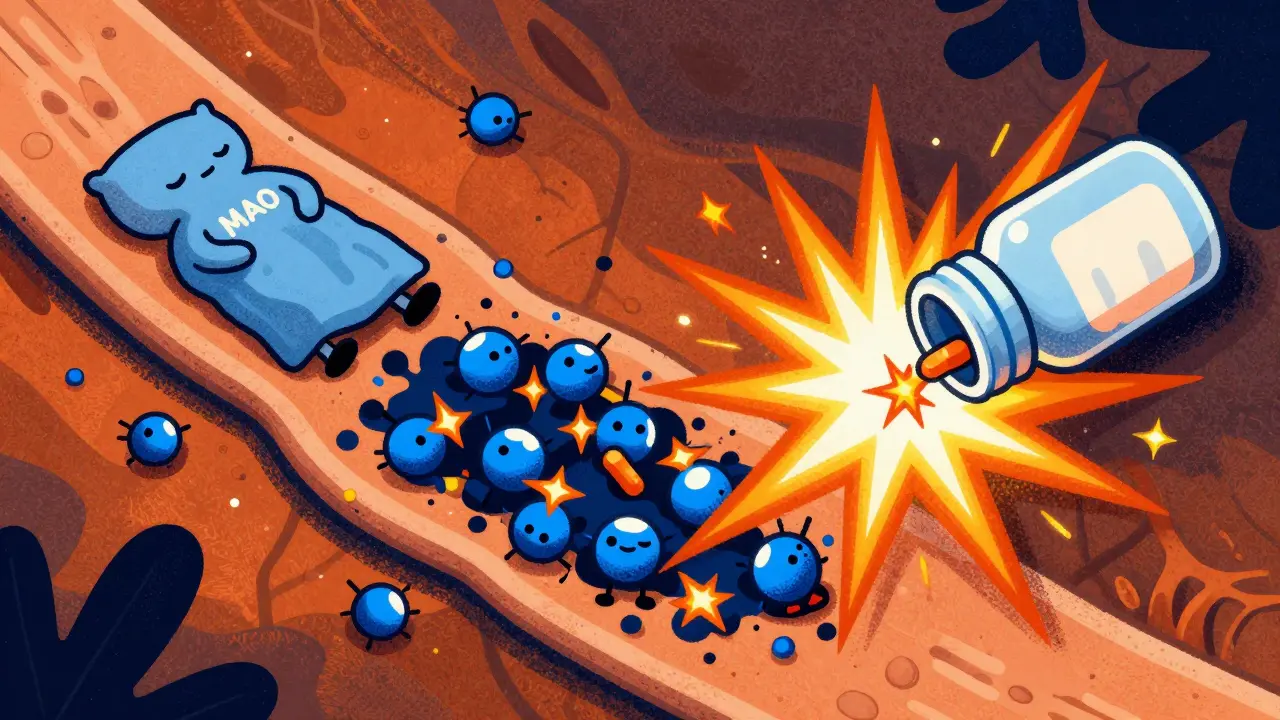
Common MAOIs and Modern Alternatives
Most people today are prescribed newer antidepressants like SSRIs, which is why MAOIs are now a niche treatment. However, they are often the only thing that works for people with atypical or severe treatment-resistant depression. You might recognize them by brand names such as Phenelzine (Nardil), Tranylcypromine (Parnate), or Isocarboxazid (Marplan). There is also the Selegiline Patch (Emsam). Because it is absorbed through the skin, it avoids some of the first-pass metabolism in the gut, meaning you don't have to follow the strict "cheese diet" (avoiding tyramine-rich foods) at low doses (6 mg/24hr). However, don't let that fool you. The drug interaction risks with OTC medicines remain exactly the same as the oral versions. A patch on your arm doesn't stop pseudoephedrine from spiking your blood pressure.How to Shop for Cold Medicine Safely
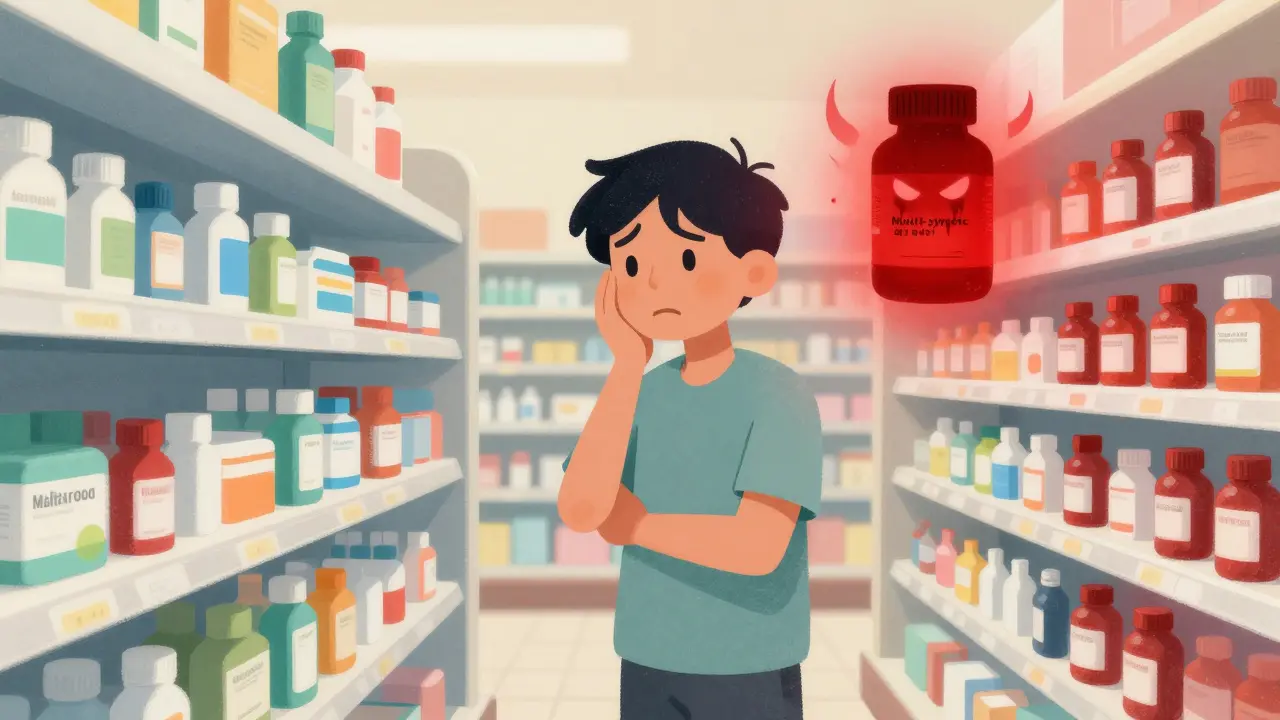
Walking down the cold and flu aisle can feel like a minefield because about 78% of multi-symptom products contain at least one prohibited ingredient. The trick is to stop buying "All-in-One" or "Day/Night" formulas and start buying single-ingredient medications. If you have a fever or body aches, stick to acetaminophen. If you have a productive cough and need to clear mucus, guaifenesin is generally safe. The danger lies in the "D" (decongestant) and "DM" (dextromethorphan) parts of the label. If you see those, put the bottle back. One pro tip is to carry a "wallet card" provided by your doctor or pharmacist. This list explicitly names prohibited ingredients. In a haze of illness, it's easy to forget a specific chemical name, and having a physical list to show the pharmacist can prevent a catastrophic mistake.
Recognizing the Warning Signs
If you or a loved one has accidentally taken a contraindicated medication, you need to know the red flags immediately. A hypertensive crisis usually hits fast and hard. Watch for:- A sudden, explosive headache (often described as the worst headache of your life)
- Stiffness in the neck or nape
- Heart palpitations or a racing pulse
- Nausea and vomiting
- Blurred vision
- Extreme agitation or restlessness
- Confusion or disorientation
- Rapid changes in mood
- Twitching muscles (myoclonus) or tremors
- Heavily dilated pupils
Can I use nasal decongestant sprays instead of pills?
While some topical sprays have less systemic absorption than oral pills, many still contain phenylephrine or oxymetazoline. Because of the risk of systemic absorption, you should never use any nasal decongestant without a direct green light from your prescribing psychiatrist or pharmacist.
How long do I have to wait after stopping an MAOI before taking cold meds?
Most clinical guidelines, including those from the American Psychiatric Association, require a minimum 14-day washout period. This is because MAOIs permanently disable the enzyme; you must wait for your body to synthesize new enzymes before it's safe to use sympathomimetic drugs.
Are all "DM" cough medicines dangerous with MAOIs?
Yes, if the "DM" stands for dextromethorphan. This ingredient is a serotonergic agent that can trigger serotonin syndrome when combined with the increased serotonin levels caused by MAOIs.
Is Tylenol safe to take with Nardil or Parnate?
Yes. Acetaminophen (Tylenol) does not affect the monoamine oxidase enzyme or serotonin levels, making it a safe choice for pain and fever relief for those on MAOIs.
What should I do if I accidentally took a multi-symptom cold pill?
Immediately monitor your blood pressure if you have a home cuff. If you experience a severe headache, chest pain, or extreme agitation, call emergency services. Be sure to inform the medical staff that you are on an MAOI, as this drastically changes the emergency protocol.
Del Bourne
April 9, 2026 AT 11:23It's so important to emphasize that pharmacists are an incredible resource here. If you're ever unsure, just ask them to check your profile for interactions before buying a multi-symptom product. Also, for those on MAOIs, remember that some prescription-strength decongestants are just as dangerous as the OTC ones!
Danielle Kelley
April 10, 2026 AT 10:05This is just a way for Big Pharma to keep us terrified of everything while they push these 'treatment-resistant' drugs on us. They want us dependent on the pharmacist for every single pill we take. Wake up people, it's all about control!
Darius Prorok
April 11, 2026 AT 21:12Basically just don't take the stuff with the 'D' or 'DM' on it. It's not that hard to read a label.
Alexander Idle
April 12, 2026 AT 10:54The sheer audacity of the pharmaceutical industry to create such volatile chemistry is truly a tragedy of Shakespearean proportions. I find the lack of bold warnings on the actual packaging to be an absolute travesty. It is simply appalling that a patient must practically hold a medical degree just to treat a common sniffle without risking a stroke. Truly a disaster!
Toby Sirois
April 14, 2026 AT 10:09You guys are overthinking. Just follow the rules. If you can't handle a simple list of meds, you're just not disciplined enough for this kind of treatment.
GOPESH KUMAR
April 15, 2026 AT 23:03The duality of man is evident here; we seek healing through a chemical lens but are terrified of the chemical consequences. It is a paradox of the modern age where the cure is as dangerous as the disease if one lacks the intellectual rigor to read a chart. Most people just want a quick fix without understanding the fundamental biological machinery of their own bodies.
Kathleen Painter
April 16, 2026 AT 04:10I totally hear where everyone is coming from, and it's really just about finding a balance that works for your own life and health journey. It can feel a bit overwhelming at first, but taking things one step at a time and being kind to yourself while you navigate these medication changes is what actually matters in the long run. Maybe we can all just agree that staying safe is the goal, regardless of how we feel about the system, and support each other in making those safe choices every day.
Windy Phillips
April 17, 2026 AT 18:01It is simply... tragic... that some people still cannot manage their own health... properly!!! One would think that a simple chart would suffice... but apparently... some prefer chaos...
Ruth Swansburg
April 18, 2026 AT 10:45Stay strong everyone! You've got this!
Stephen Luce
April 20, 2026 AT 03:05I remember when my dad was on these and the stress of the diet and med restrictions was almost as bad as the depression. It's a lot to carry.