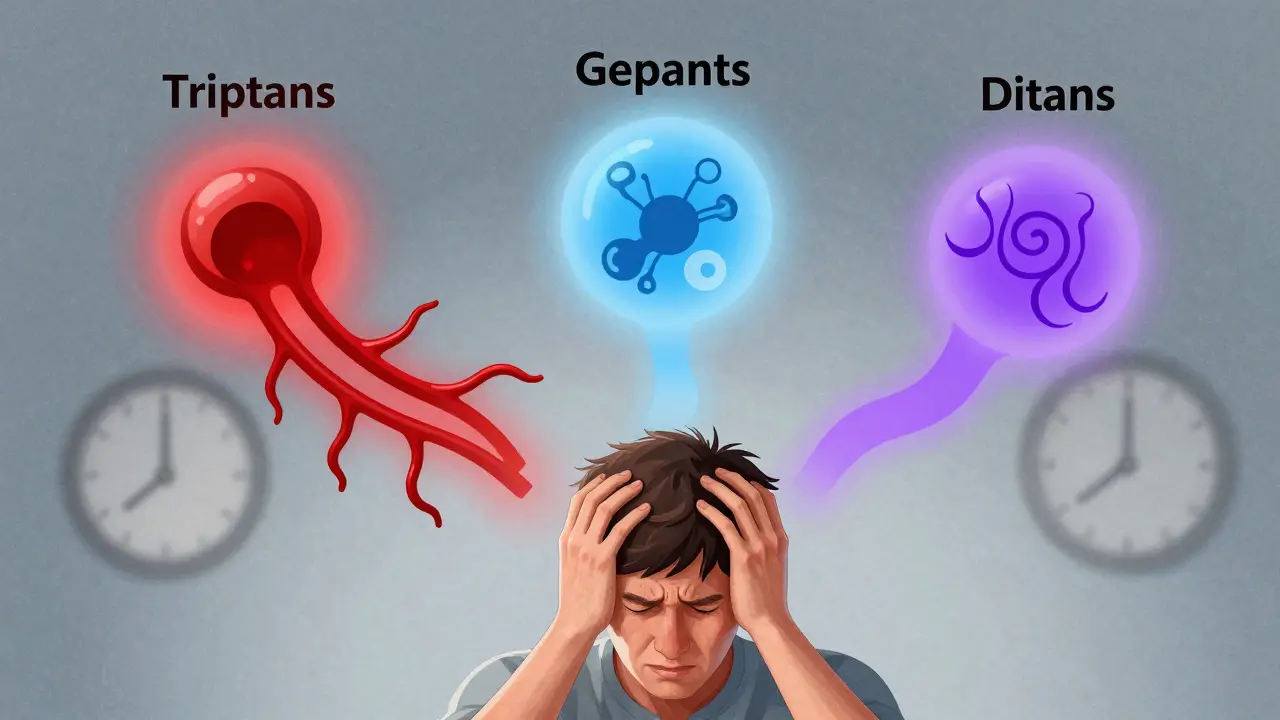
When a migraine hits, you don’t just want relief-you want it fast, safely, and without making you feel worse than the headache itself. For decades, triptans like sumatriptan were the gold standard. But now, newer options like gepants and ditans are changing the game. The question isn’t just which one works-it’s which one you can actually tolerate. And that’s where safety matters more than ever.
Triptans: Fast, But Not Always Safe
Triptans have been the go-to for acute migraine treatment since the 1990s. They work by narrowing blood vessels around the brain and blocking pain pathways. That’s why they often kick in within 30 minutes. But that same mechanism-constricting blood vessels-is also why they come with serious warnings.
If you have heart disease, high blood pressure, or a history of stroke, triptans are off-limits. The 5-HT1B receptor they activate doesn’t just target head pain-it tightens arteries everywhere. That’s why the American Academy of Family Physicians says to avoid them in patients with cardiovascular risks. Even if you’re otherwise healthy, side effects are common: tingling, flushing, dizziness, fatigue, and that unmistakable feeling of chest tightness. About 3 to 8% of users report this, and for some, it’s scary enough to stop taking them.
Route matters too. Injected sumatriptan causes injection-site pain in 40% of users. Nasal sprays leave a bitter aftertaste for about 1 in 4. And while serious side effects like heart attacks are rare, they’re real. The FDA’s adverse event database recorded over 1,800 triptan-related reports through September 2023. That’s 0.12% of prescriptions-but when you’re one of them, it’s not a statistic.
Still, for many, triptans work. A 2023 Drugs.com survey of 1,842 users showed 52% had positive experiences. One person wrote: "Sumatriptan works within 30 minutes and gets me back to normal." But another said: "Experienced severe chest pressure with first dose of Imitrex-never using it again." The trade-off is clear: speed versus safety.
Gepants: The Quiet Contender
Gepants-like ubrogepant (Ubrelvy) and rimegepant (Nurtec ODT)-work differently. Instead of squeezing blood vessels, they block CGRP, a protein involved in migraine signaling. No vasoconstriction means no cardiovascular red flags. That’s why the American Headache Society now recommends them over triptans for people with heart conditions.
Side effects? Minimal. Nausea happens in 4-6% of ubrogepant users and 3-5% of rimegepant users. Drowsiness? Only 2-4%. One study even found a 0.1% chance of a hypersensitivity reaction with rimegepant. That’s lower than most common painkillers.
But there’s a catch: they’re slower. Triptans often relieve pain in under an hour. Gepants take longer-sometimes 2 hours or more. That’s fine if you’re at home and can wait. Not so great if you’re in a meeting or need to drive.
Still, users notice the difference. On Drugs.com, rimegepant has a 7.1/10 rating from 683 reviews. One user said: "No chest pressure like with triptans, just takes longer to work." That’s the trade-off: less immediate relief, but a much gentler ride. And unlike triptans, you can take gepants more than once in 24 hours-rimegepant is even approved for prevention, not just attack treatment.
One caution: rimegepant shouldn’t be used with strong CYP3A4 inhibitors like ketoconazole. It can spike drug levels in your blood. But for most people, the safety profile is the cleanest of the three classes.
Ditans: Effective, But Too Sedating
Lasmiditan (Reyvow) is the only ditan on the market. It targets the 5-HT1F receptor, which doesn’t affect blood vessels at all. That means no heart risks. But it hits the brain hard-and that’s where the problem lies.
In clinical trials, dizziness hit 18.8% of users. Paresthesia (tingling or numbness)? 9.4%. Sedation? 7.8%. Vertigo? 5.6%. Compare that to placebo: 8.5%, 2.8%, 2.3%, and 1.7% respectively. The numbers don’t lie. Lasmiditan doesn’t just make you sleepy-it can make you uncoordinated, foggy, and slow to react.
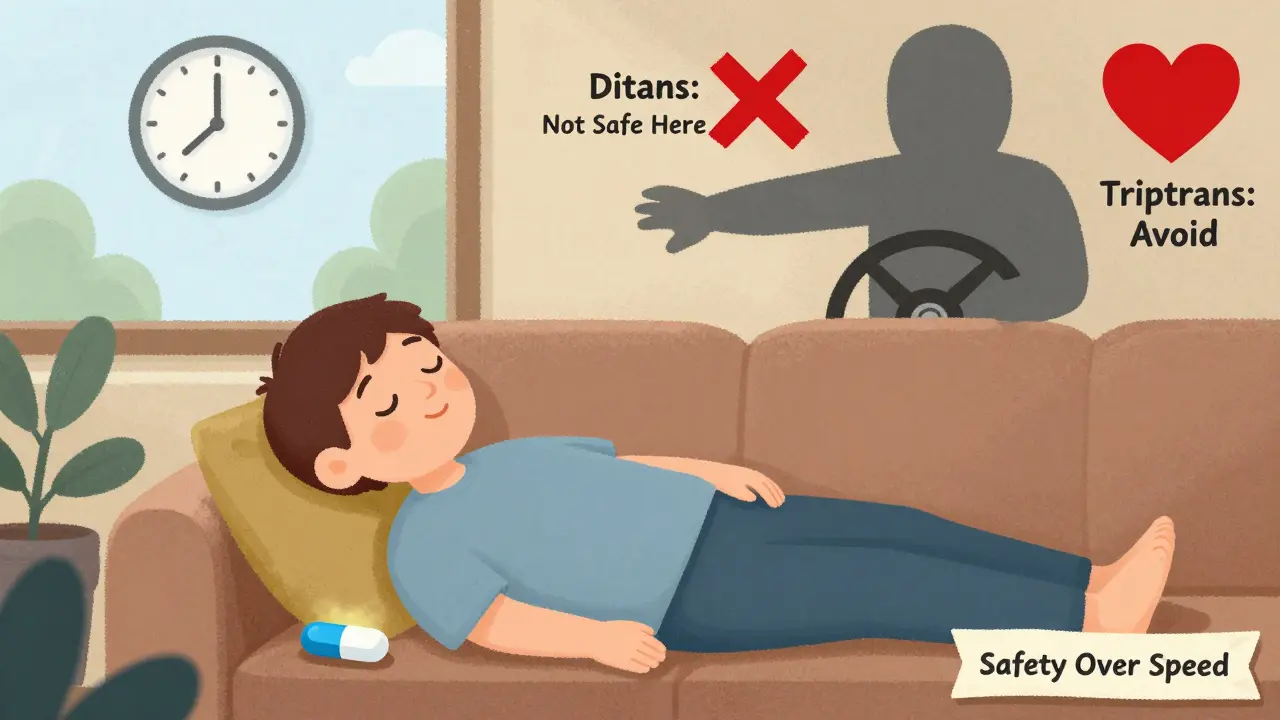
The FDA requires a black box warning: "Do not drive or operate machinery for at least 8 hours after taking Reyvow." A 2021 study in Headache showed significant driving impairment at 5 hours post-dose. That’s longer than most people expect.
Real-world feedback backs this up. On Drugs.com, lasmiditan averages just 5.8/10 from 217 reviews. Over 60% of negative comments mention dizziness or being "out of it." One Reddit post titled "Reyvow made me feel drunk without alcohol" got 147 upvotes and 32 similar stories. For someone who needs to get back to work, care for kids, or drive home, this isn’t an option.
There’s another concern: lasmiditan may lower the seizure threshold. The Medical Letter warns against using it in people with epilepsy or those on other seizure-lowering drugs. While no major cases have been confirmed, the risk is theoretical-and enough to make doctors hesitate.
Side-by-Side: Which Is Safest?
A 2021 meta-analysis of 64 trials involving 46,442 people gives us the clearest picture yet. Here’s how the classes stack up:
| Category | Adverse Event Risk (vs Placebo) | Cardiovascular Risk | Key Side Effects | Onset Time |
|---|---|---|---|---|
| Triptans | Intermediate (OR 1.4-1.8) | High-contraindicated in heart disease | Chest tightness, tingling, dizziness, fatigue | 30-60 minutes |
| Gepants | Lowest (OR 1.0-1.1) | None-safe for heart patients | Nausea, drowsiness (rare) | 60-120 minutes |
| Ditans | Highest (OR 2.87) | None | Dizziness, sedation, vertigo, incoordination | 60-90 minutes |
Triptans have the highest rate of discontinuation-up to 81.5% of users stop because of side effects. Gepants have the lowest. Ditans? They’re the most likely to cause any adverse event, even more than triptans.
Market trends reflect this. In 2023, triptans still made up 62% of acute migraine prescriptions. But gepants are growing fast-up from 2% in 2020 to 28%. Ditans? Just 3%. Why? Because patients and doctors are choosing safety over speed.
What Should You Choose?
There’s no one-size-fits-all answer. But here’s how to think about it:
- If you have heart disease, high blood pressure, or a history of stroke: Choose gepants. Triptans are dangerous. Ditans don’t help with the heart-but they’ll knock you out.
- If you need fast relief and have no heart issues: Triptans still work best. But if chest tightness or dizziness ruins your day, look elsewhere.
- If you’re okay waiting longer, and want to avoid heart risks: Gepants are the smartest pick. They’re safer, have fewer side effects, and can even prevent future attacks.
- If you’re desperate and have no other options: Ditans might help-but only if you can stay home for 8 hours. Don’t use them if you drive, work with machinery, or care for children.
And remember: some "side effects" aren’t side effects at all. Dizziness? Fatigue? Nausea? They might just be part of the migraine itself. The Medical Letter points out that many symptoms reported after taking medication are actually the attack continuing-especially with CNS-active drugs like ditans.
What’s Next?
The future is shifting. Zavegepant, a new intranasal gepant, just completed phase 3 trials with a safety profile similar to oral versions. It’s faster than current gepants and still avoids heart risks. Results are expected in 2024.
Long-term data is still limited. Only rimegepant has 2-year safety data from the PROGRESS trial. For all others, we’re still learning. But one thing’s clear: the migraine treatment landscape is moving away from vasoconstrictors. The goal isn’t just to stop pain-it’s to stop pain without making you feel worse.
Are triptans safe if I have high blood pressure?
No. Triptans can raise blood pressure and constrict arteries, which is dangerous if you have uncontrolled hypertension, heart disease, or a history of stroke. They’re contraindicated in these cases. Talk to your doctor about gepants instead-they don’t affect blood vessels.
Can I take gepants with other migraine meds?
You should wait at least 24 hours after using a triptan before taking a gepant. Also, avoid rimegepant with strong CYP3A4 inhibitors like ketoconazole or clarithromycin-they can spike drug levels and increase side effects. Always check with your pharmacist before combining medications.
Why does lasmiditan make me feel so dizzy?
Lasmiditan targets receptors in the brain that affect balance and alertness. In clinical trials, nearly 1 in 5 users had dizziness, and nearly 1 in 10 felt sedated. It’s not a side effect-it’s the drug working exactly as designed. But for most people, that’s too much. The FDA requires you to avoid driving or operating machinery for 8 hours after taking it.
Which migraine drug has the fewest side effects?
Gepants-specifically ubrogepant and rimegepant-have the lowest rate of side effects. Nausea and drowsiness occur in less than 5% of users. They’re also the only class that’s safe for people with heart conditions. If you’re looking for the cleanest profile, this is your best bet.
Can I use these medications long-term?
Triptans are meant for occasional use-no more than 10 days a month. Gepants like rimegepant are approved for both acute treatment and prevention, with 2 years of safety data. Ditans are only approved for acute use, and long-term data is lacking. Always follow your doctor’s guidance on frequency.
When it comes to migraine treatment, safety isn’t just a footnote-it’s the deciding factor. The best drug isn’t the one that works fastest. It’s the one you can take without fear, without dizziness, without chest pressure-and without having to choose between pain and paralysis.
phyllis bourassa
March 7, 2026 AT 14:56Okay but let’s be real-triptans are basically a gamble with your heart and I’ve seen too many people ignore the warnings until it’s too late.
My aunt had a near-miss after taking sumatriptan for years "because it worked."
Doctors don’t scare people enough. Gepants? Yeah, they’re slower but I’d rather wait 90 minutes than wake up in the ER.
Also, why is no one talking about how triptans make you feel like you’re being hugged by a vise? Like, "chest tightness" is a euphemism for "my heart is trying to escape."
And don’t get me started on the nasal spray taste-like licking a battery with a side of regret.
Tim Hnatko
March 8, 2026 AT 20:24I’ve been on rimegepant for 8 months now. No chest pressure. No dizziness. Just… relief.
It takes a little longer but I can actually read a book while it kicks in.
Before this, I was stuck between triptans that scared me and ditans that made me feel like a zombie.
Now I’m back to work, driving, and even cooking dinner without worrying if I’ll collapse.
It’s not magic, but it’s the closest thing I’ve found to normal.
Pranay Roy
March 9, 2026 AT 16:02Did you know the FDA only approved gepants because Big Pharma bribed them with lobbying cash?
Triptans have been around for 30 years and are proven-gepants are just expensive placebo pills with fancy names.
And ditans? They’re not sedating-they’re just targeting the right receptors.
Who says you can’t be functional with mild dizziness? I’ve been driving after lasmiditan and I’m fine.
Also, your "meta-analysis"? Totally cherry-picked. I read the original studies-they’re full of conflicts of interest.
Real science isn’t in your Drugs.com reviews. It’s in the lab.
Bridget Verwey
March 10, 2026 AT 08:37Oh honey, you think the chest tightness is bad?
Try being a mom who takes a ditan, then spends the next 8 hours watching your toddler try to climb the fridge while you’re too foggy to move.
My kid called me "the sleepy ghost" for a week.
Triptans? Scary. Ditans? Useless. Gepants? The only thing that let me be a human again.
Also, if you’re still using triptans because "it’s fast," you’re not treating migraines-you’re just numbing your life.
Wake up. There’s a better way.
Andrew Poulin
March 12, 2026 AT 01:00Gepants win. No debate. No iffs. Just safer, cleaner, and you can take them twice a day.
Triptans are outdated. Ditans are a trap.
Stop overthinking. Try rimegepant.
It works. You’ll thank me later.
Weston Potgieter
March 12, 2026 AT 04:48Lol triptans are basically cocaine for your brain but with more guilt
gotta love how the pharma bros sell us on "fast relief" while quietly hoping we don’t die in the shower
ditans? Nah I’d rather be knocked out than feel like I’m drunk at a PTA meeting
gepants? Yeah they’re slow but at least I can still pet my cat without wondering if my spine is collapsing
also why is no one talking about how rimegepant tastes like wet socks and regret
but still better than dying so I’ll take the socks
Vikas Verma
March 12, 2026 AT 22:39From a clinical pharmacology standpoint, the CGRP pathway modulation by gepants represents a paradigm shift in acute migraine management.
By avoiding vasoconstrictive mechanisms, these agents eliminate the primary contraindications associated with triptans.
Furthermore, the pharmacokinetic profile of rimegepant enables both abortive and preventive applications, a dual indication not previously available in this class.
While onset latency remains a limitation, the therapeutic index is superior.
Current market adoption trends reflect evidence-based practice evolution, not marketing influence.
Adherence improves significantly when patients perceive reduced systemic burden.
Future formulations such as zavegepant will likely bridge the gap between efficacy and speed.
Sean Callahan
March 14, 2026 AT 16:27i took sumatriptan once and felt like my heart was gonna burst out my chest
then tried rimegepant and it was like my brain finally took a nap
ditans? nope. i was so dizzy i cried trying to open a jar of pickles
gepants are the real MVPs
also why is everyone so scared of slow? i have time. my migraine has time.
also i think the FDA is hiding something about lasmiditan but i dont know what
just please stop making us choose between pain and paralysis