
Working nights doesn’t just mess with your sleep-it rewires your body’s clock. For millions of people in healthcare, trucking, and manufacturing, the challenge isn’t just staying awake on the job-it’s surviving the cycle without relying on pills that might make things worse. If you’re one of them, you’ve probably asked: Can I really use sleep meds to catch a few hours during the day without crashing later? The answer isn’t simple. Some drugs help. Others trap you in a cycle of dependency, drowsiness, and danger.
Why Night Shifts Break Your Sleep
Your body runs on a 24-hour rhythm. When you work nights, you’re fighting biology. The sun rises, your brain says, "Time to sleep." But you’re on the clock. That’s Shift Work Disorder (SWD)-a real medical condition recognized since 2014 by the American Academy of Sleep Medicine. It’s not laziness. It’s not poor discipline. It’s a misalignment between your internal clock and your schedule. About 10 million Americans work nights, and up to 84% of them show signs of SWD. That means trouble falling asleep during the day, waking up too early, or feeling exhausted even after 7 hours in bed. The result? Higher risk of mistakes, accidents, and long-term health issues like heart disease and diabetes.The Medications Used-And Why Timing Matters
There are two kinds of drugs used here: ones to help you sleep, and ones to help you stay awake. Both have strict rules.For sleep: Drugs like zolpidem (Ambien), eszopiclone (Lunesta), and zaleplon (Sonata) are prescribed to help night workers catch rest during daylight. But here’s the catch: you need 7 to 8 hours of uninterrupted sleep after taking them. If you wake up at 4 a.m. to get ready for your 6 a.m. shift, you’re still half-asleep. The FDA added a Boxed Warning in 2023 because people have driven, cooked, or even walked out of their homes while still asleep. One nurse drove 15 miles in her sleep after taking zolpidem. She didn’t remember a thing.
These drugs also don’t improve sleep quality. You might sleep longer-but you’ll still wake up often, feel unrefreshed, and struggle to stay alert. Benzodiazepines? They’re even riskier. After 4 to 6 weeks of use, 25-30% of users become dependent. That’s not addiction-it’s physical reliance. Your body stops making its own sleep chemicals.
For alertness: Modafinil (Provigil) and armodafinil (Nuvigil) are the only FDA-approved wakefulness drugs for shift workers. They don’t act like caffeine. They target brain pathways that regulate wakefulness. Studies show they improve alertness by 34% on tests measuring reaction time and focus. That’s huge for nurses, paramedics, and truck drivers.
But here’s the twist: they don’t fix your sleep. They just keep you awake. And they last a long time-up to 15 hours. If you take it at 6 p.m., you might not sleep until 9 a.m. the next day. That breaks your sleep schedule even more.
What About Melatonin?
Melatonin is the go-to OTC option. It’s natural, cheap, and widely available. But it’s not a magic pill. It doesn’t make you sleep. It tells your brain, "It’s time to prepare for sleep." For night workers, you need to take it 3 to 4 hours before your planned sleep time. Take it at noon? You’ll be groggy all afternoon. Take it at 3 p.m.? You might finally drift off by 7 p.m.-too late for an 11 p.m. shift. A 2022 Cochrane Review found low-quality evidence that melatonin helps daytime sleep after night shifts. But other studies show it improves sleep onset time by 20-30 minutes. It’s not perfect, but it’s safer than prescription sleep aids. Doses between 0.5 mg and 5 mg work for most people. Start low. See how you feel.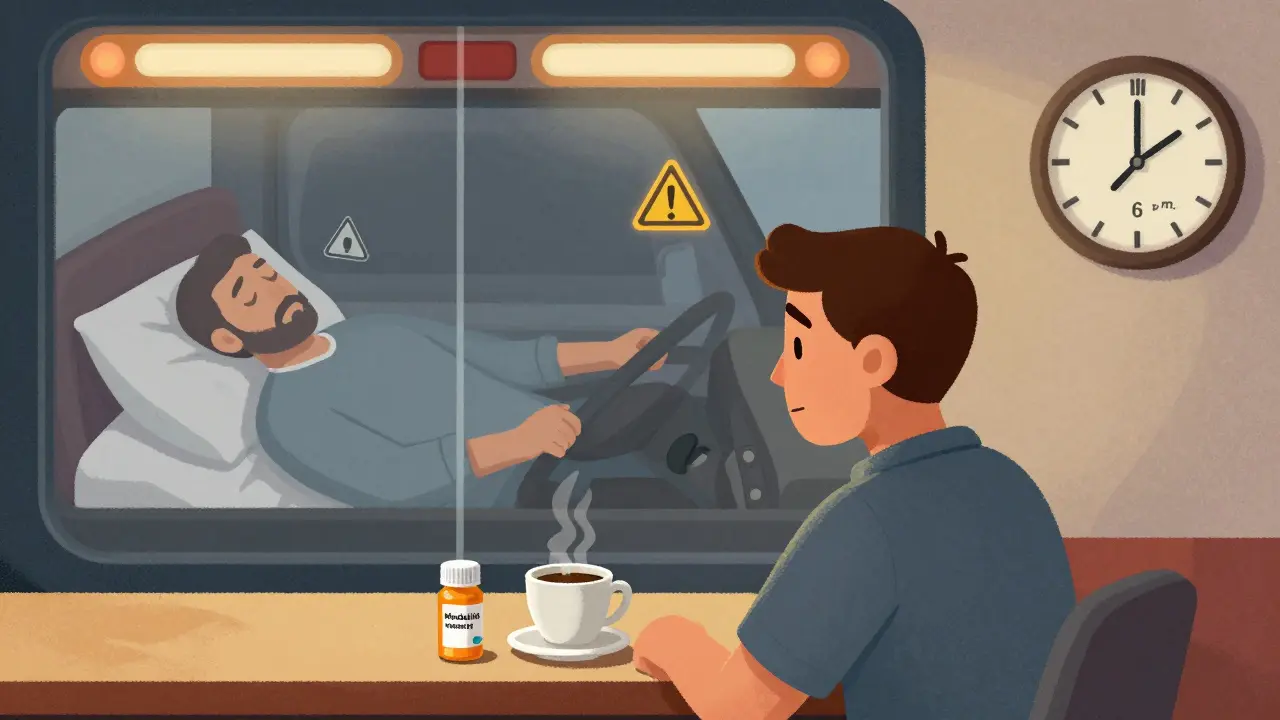
The Hidden Dangers: Residual Drowsiness and Dependency
Most people think: "I take my pill, sleep for 6 hours, and I’m fine." But research says otherwise.One in three night shift workers report feeling drowsy on their next shift-even after a full night’s sleep. Why? Because many sleep meds leave traces in your system. Zolpidem, for example, affects 40% of users even 8 hours after taking it. That means if you work 11 p.m. to 7 a.m., take Ambien at 8 a.m., and sleep until 3 p.m., you’re still impaired when you start your next shift at 11 p.m.
And dependency? It sneaks up. A 2021 study of medical residents found 63% prescribed benzodiazepines even when they knew the risks. Why? Time pressure. Burnout. Lack of training. One nurse on Reddit said: "I’ve been on Ambien for 9 months and now can’t sleep without it." That’s not rare.
Combine these meds with alcohol? The FDA warns it can cause severe breathing problems, coma, or death. Yet 15% of night workers still mix them. That’s like driving with your eyes closed.
What Works Better Than Pills?
Medications treat symptoms. They don’t fix the problem: circadian misalignment.Dr. Charles Czeisler from Harvard says it plainly: "Pharmacological interventions alone cannot overcome the fundamental biology of circadian misalignment." So what does work?
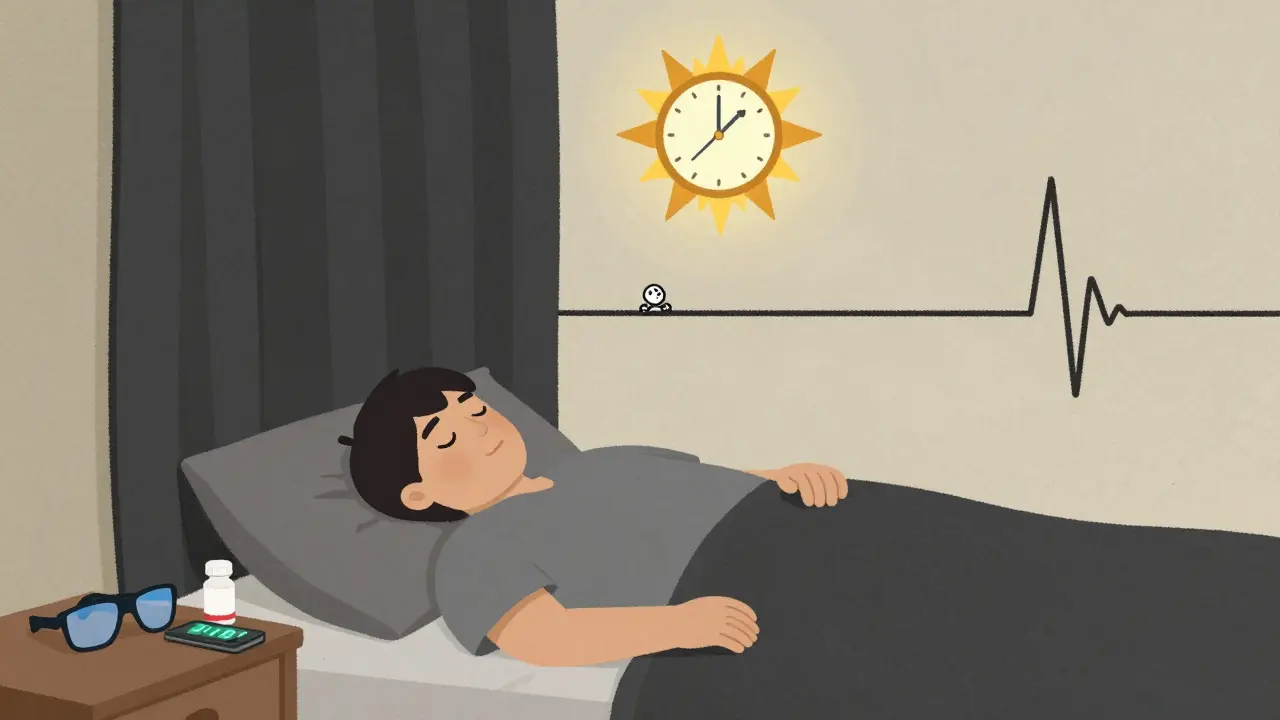
- Light exposure: Wear blue-light-blocking glasses on your way home. Use bright light at work. It tells your brain it’s daytime.
- Sleep hygiene: Dark, quiet, cool room. No screens. Same sleep time every day-even on days off.
- Napping: A 20-30 minute nap before your shift boosts alertness more than caffeine.
- Consistent schedule: Try to work the same nights every week. Your body adapts better to routine than to rotation.
Large employers are catching on. 73% now offer light therapy devices. Hospitals with 24/7 operations have upped their fatigue management programs from 42% in 2020 to 68% in 2023. That’s progress.
How to Use Medications Safely-If You Must
If you’re going to use sleep or wakefulness drugs, do it right.- Talk to your doctor about your schedule. Don’t assume they know you work nights. Tell them the exact hours.
- Never combine medications. No alcohol. No OTC sleep aids. No benzos with Ambien.
- Time it precisely. Take modafinil 1 hour before your shift. Take melatonin 3-4 hours before you want to sleep.
- Limit use. Don’t use prescription sleep aids for more than 3-4 weeks. They lose effectiveness. Dependence grows.
- Read the Medication Guide every time. The FDA requires it. It’s not a formality-it’s a warning.
And if you’re a healthcare provider? Document patient understanding. Ask: "Do you know how long you need to sleep after this pill?" If they say "I’ll just sleep a little," you’re putting them at risk.
The Bottom Line
There’s no perfect solution. Sleep meds can help short-term. But they’re not a long-term fix. The real answer lies in managing light, sleep, and schedule-not popping pills.If you’re a night worker, your body is under constant stress. Medications can give you a temporary edge-but they also come with hidden costs: dependency, drowsiness, and danger. The safest strategy? Use the least amount possible, for the shortest time, and pair it with behavioral changes.
Because no pill can replace a well-timed nap, a dark room, or a consistent schedule. Your life depends on it-not just your paycheck.
Can I use melatonin every night to sleep during the day?
Melatonin can help you fall asleep faster, but it’s not meant for daily long-term use. Taking it every night may reduce your body’s natural production over time. Use it for short periods-like when you’re adjusting to a new schedule-and always take it 3-4 hours before your planned sleep time. Stick to doses between 0.5 mg and 5 mg. Higher doses don’t help and can cause grogginess.
Is modafinil addictive?
Modafinil has a low risk of addiction compared to stimulants like amphetamines. It doesn’t trigger dopamine surges the same way. But it can become habit-forming if used daily over months. Some users report needing it to function, and stopping abruptly can cause fatigue and brain fog. It’s not a dependency like benzodiazepines, but it’s not harmless either. Use it only as prescribed and avoid daily use beyond 3-4 weeks.
Why do some people still drive after taking Ambien?
Ambien and similar sleep drugs can cause complex sleep behaviors-like sleep-driving, sleep-eating, or even walking-without the person remembering any of it. The FDA confirmed over 60 such cases between 2019 and 2022, some resulting in serious injury or death. This happens because the drug affects brain regions involved in movement and memory differently. If you take Ambien, you must stay in bed for 7-8 hours. No exceptions. Even a 2-hour nap afterward isn’t enough.
Are over-the-counter sleep aids like Benadryl safe for night workers?
No. OTC sleep aids like diphenhydramine (Benadryl) or doxylamine (Unisom) are antihistamines. They cause drowsiness, but they also impair coordination, memory, and reaction time the next day. The FDA says 18% of users feel drowsy for hours after taking them. For someone working nights and then driving home or working another shift, this is dangerous. They’re not designed for shift work and can increase accident risk.
Can I use caffeine instead of wakefulness drugs?
Caffeine helps short-term alertness, but it’s not a substitute for modafinil in high-risk jobs. It wears off quickly, causes jitters, and disrupts sleep if taken too late. For a 12-hour night shift, one cup at the start might help-but by hour 8, you’ll crash. Modafinil provides steady, controlled alertness without the crash. Use caffeine strategically: small doses early in the shift, and avoid it in the last 4 hours before sleep.
Lakisha Sarbah
February 7, 2026 AT 09:11Man I work nights at the hospital and I just take melatonin like 30 mins before I try to sleep. No pills, no fuss. I don't even bother with the fancy stuff anymore. Just dark room, earplugs, and a sleep mask. It ain't perfect but it keeps me alive.
Also no caffeine after 4am. Game changer.
Ashley Hutchins
February 9, 2026 AT 00:37you people are so naive i swear. you think melatonin is safe? it's a hormone you're dumping into your body like it's some kind of herbal tea. what's next? drinking bleach for insomnia? you think your body doesn't notice this? you're training yourself to be dependent on chemicals just to function. and then you wonder why you're tired all the time. wake up. your body wasn't made to sleep in daylight. stop trying to hack biology with supplements. just accept it. your life is broken. maybe you need a new job.
Ariel Edmisten
February 10, 2026 AT 10:20Don't take melatonin every night. Use it only when switching shifts. Same with modafinil. Short term only. Sleep hygiene beats pills every time. Dark room. Quiet. Consistent time. Even on weekends. That's the real fix.
Savannah Edwards
February 11, 2026 AT 18:30I've been a night shift nurse for 12 years and I've tried everything. The truth is no one talks about the emotional toll. It's not just about sleep. It's loneliness. It's missing birthdays. It's watching your kids grow up through FaceTime. I used to rely on Ambien like a crutch. Then I had a moment where I woke up in my car outside the hospital at 3 a.m. with no memory of driving there. That scared me straight. Now I use blue light glasses on my commute. I nap for 20 minutes before my shift. I eat dinner at 7 p.m. even if I'm not hungry. I don't take pills unless I'm absolutely desperate. And I talk to my therapist every week. This isn't just a sleep problem. It's a whole life problem. And you have to treat it like one.
Mayank Dobhal
February 12, 2026 AT 12:24modafinil is the only thing that saved me. I work 12 hour ER shifts. Caffeine? I'm on my 4th cup and still yawning. Modafinil? I'm alert. Focused. No crash. I take it at 4 p.m. and sleep at 10 a.m. I don't care what anyone says. It works. And yeah I've been on it for 8 months. So what? I'm not hurting anyone. I'm saving lives. You don't get it until you've been on the job for 14 hours straight and your eyes are burning.
Gouris Patnaik
February 13, 2026 AT 07:41western medicine is a joke. you think drugs solve everything? in india we have ayurveda. we have yoga. we have breathing. we have sun exposure. we have rhythm. you americans are so addicted to pills you forgot how to live. melatonin? modafinil? you're poisoning your soul. your body knows what to do. you just need to stop fighting it. sit in silence. breathe. walk in nature. let your circadian rhythm find its way. no chemicals. no pills. just discipline. and yes i know this sounds spiritual but you have no idea how many people in my country work night shifts and still sleep like babies. because they respect nature. you? you just want a quick fix.
AMIT JINDAL
February 15, 2026 AT 02:57lol i just took 2 ambien last night and woke up at 5am and made pancakes. no memory of it. then i drove to work. lol. jk. kinda. actually i did this once. i was so scared i quit the job. now i work day shift. best decision ever. you think you're in control? you're not. the drug is. and if you think you're immune? you're the one who's gonna end up in a hospital bed because you drove while sleeping. i'm not being dramatic. i lived it. don't be a statistic. stop with the pills. just quit the night shift. your liver and your kids will thank you. 😅
Paula Sa
February 15, 2026 AT 07:10I just want to say thank you to everyone who shared. This post and the comments are a lifeline. I’ve been struggling for years and felt so alone. I didn’t know melatonin timing mattered so much. I didn’t realize modafinil wasn’t meant for daily use. I thought I was the only one who drove home half-asleep. Hearing others say they’ve been there too? That’s healing. I’m not going to fix this overnight. But I’m going to start with a sleep mask, no screens after shift, and talking to my doctor about a taper plan. You’re not just sharing tips-you’re sharing hope. And that matters more than any pill.