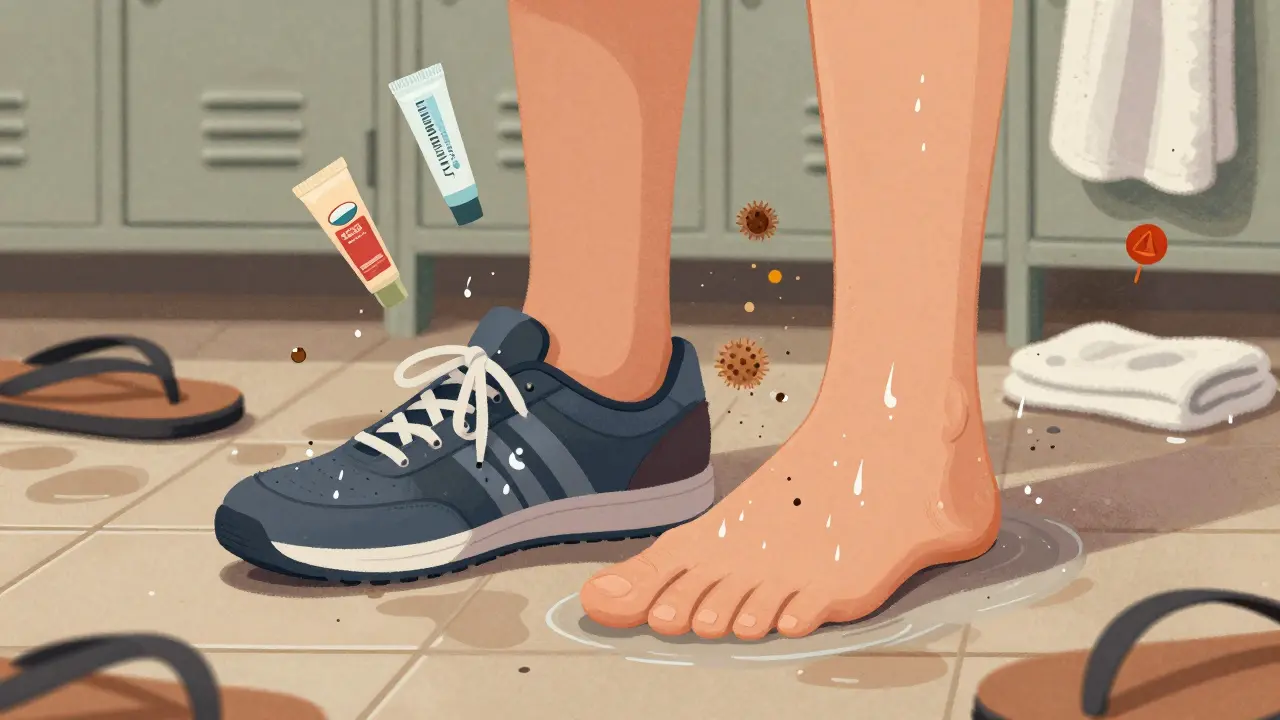
Almost one in four people will deal with athlete’s foot at some point. It’s not glamorous, but it’s common - especially if you wear sneakers all day, hit the gym regularly, or walk barefoot in locker rooms. The itch, the flaking skin, the stinging between your toes - it’s frustrating, and it won’t go away on its own. The good news? You don’t need a prescription. Over-the-counter antifungal treatments work well for most cases - if you use them right.
What’s Actually Causing Your Foot Itch?
Athlete’s foot, or tinea pedis, is caused by fungi called dermatophytes. These bugs thrive in warm, damp places - exactly where your feet spend most of their time: inside sweaty socks and closed shoes. The infection usually starts between your toes, where moisture gets trapped. Left untreated, it can spread to the soles of your feet, toenails, or even your hands if you scratch and then touch other areas. It’s not contagious just by walking on the floor. You need direct contact with infected skin or contaminated surfaces - like gym showers, pool decks, or shared towels. The fungus doesn’t jump. But it lingers. And if your feet stay wet, it grows.OTC Antifungal Options: What’s Actually in the Bottle?
There are five main active ingredients in OTC athlete’s foot treatments. Each works differently, and each has pros and cons.- Terbinafine (Lamisil AT): This is the most effective single-agent treatment. It kills the fungus, not just slows it down. Applied once a day for 1 to 2 weeks, it cures about 83% of mild to moderate cases. It’s faster than most options - many users see relief in 3 to 5 days.
- Clotrimazole (Lotrimin Ultra): Works by disrupting the fungus’s cell membrane. Needs to be applied twice daily for 2 to 4 weeks. Good for mixed infections that involve yeast or mold. Works well for itching and redness, but slower than terbinafine.
- Miconazole (Micatin): Similar to clotrimazole. Often found in powders and sprays. Effective, but requires consistent twice-daily use.
- Tolnaftate (Tinactin): An older option. Works best for interdigital infections. Less effective on the sole of the foot. Often used for prevention because it’s cheap and dries out skin.
- Undecylenic acid: Found mostly in powders. Mildly effective. Often used in combination with other ingredients.
Price-wise, generic tolnaftate runs around $6, while branded terbinafine is closer to $25. But cost doesn’t always mean better value. Terbinafine’s shorter treatment time and higher success rate often make it more cost-effective overall.
Which One Should You Pick?
If you’re just starting out and your infection is mild - peeling skin between the toes, a little redness, occasional itching - go with terbinafine. It’s the gold standard for a reason. One application a day. Two weeks max. You’re done. If you’ve tried terbinafine and it didn’t work, or if your skin is weepy, cracked, or oozing, try clotrimazole. It’s better at handling mixed infections and has more anti-inflammatory effects. You’ll need to be strict about applying it twice a day - morning and night. If you’re prone to recurring infections or you’re an athlete who’s always on the go, use tolnaftate powder daily in your shoes and socks. It’s not a cure, but it’s your best defense against return trips.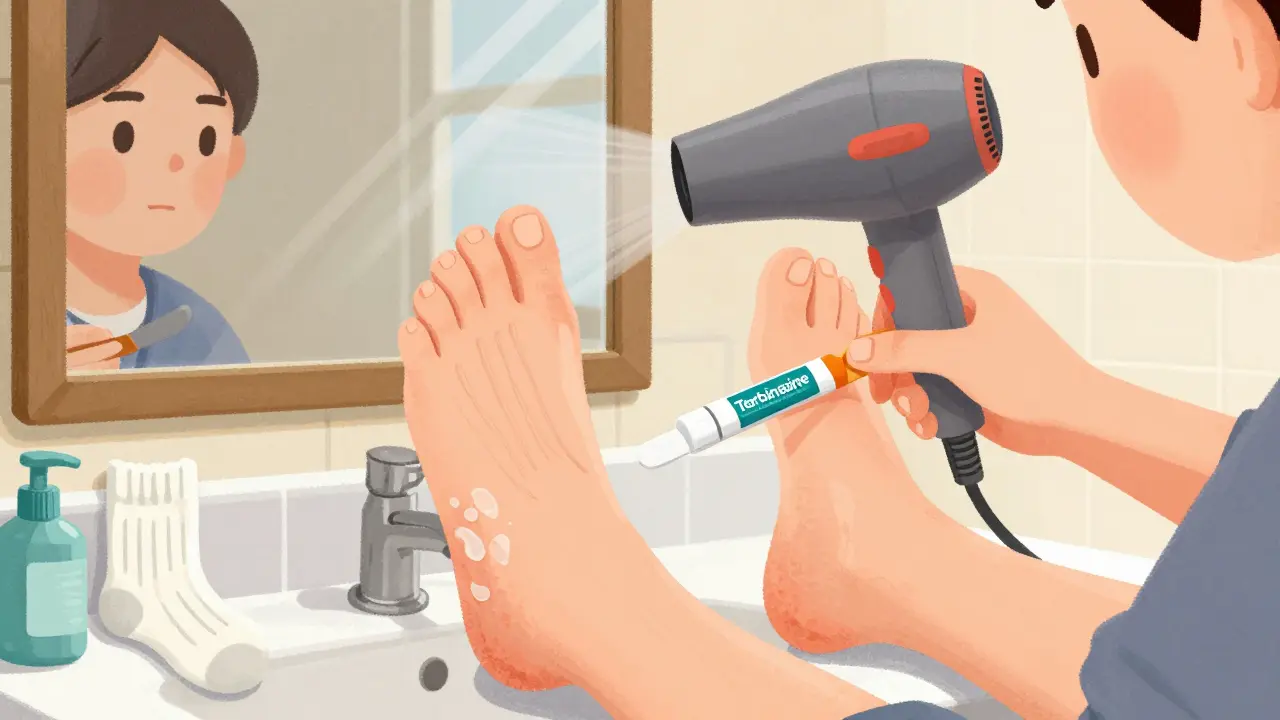
How to Apply It Right (So It Actually Works)
Most people fail not because the medicine doesn’t work - but because they don’t use it correctly. Here’s the real protocol:- Wash your feet with soap and water. Don’t skip the spaces between your toes.
- Dry thoroughly. Use a clean towel - and don’t reuse it for your body. Then, use a hairdryer on cool or low heat for 30 seconds between your toes. Moisture is the enemy.
- Apply a thin layer of cream or gel to the affected area and a 1-inch border of healthy skin around it. Too much doesn’t help - it just makes a mess.
- Apply to both feet. Even if only one foot looks infected, the fungus is probably on both. Treating one side is like fighting a fire with one bucket.
- Keep going. Don’t stop when the itching stops. Terbinafine needs 1-2 weeks total. Clotrimazole needs 2-4 weeks. Stopping early is why 63% of treatments fail.
For powders and sprays: Apply after your feet are completely dry. Dust inside your shoes, especially the insoles. Sprays are great for hard-to-reach spots and for people with arthritis or limited hand mobility.
What Most People Get Wrong
Here are the top mistakes - and how to avoid them:- Applying too thickly: You don’t need a glob. A thin layer is enough. Thick layers trap moisture and irritate skin.
- Not treating both feet: Even if one foot looks fine, treat it. The fungus is already there.
- Skipping socks or wearing the same shoes every day: Fungi live in your shoes. Rotate them. Let them air out for 48 hours between wears.
- Using the same towel for hands and feet: That’s how it spreads to your nails or groin. Use a separate towel - and wash it every 2 days.
- Stopping treatment too soon: Symptoms fade before the fungus is gone. Keep going.
When to Call a Doctor
OTC treatments work for about 85% of cases. But if you’re not better after two weeks - or if things get worse - it’s time to see a professional. See a doctor if:- Your skin is blistering, oozing pus, or turning bright red.
- The infection covers more than half your foot.
- You’re diabetic, have poor circulation, or your immune system is weakened.
- You’ve tried two different OTC products with no results.
Prescription options include oral terbinafine (250mg daily for 2 weeks), itraconazole, or topical ciclopirox. These are stronger and faster - but only needed if the OTC stuff doesn’t cut it.
Prevention: The Real Secret
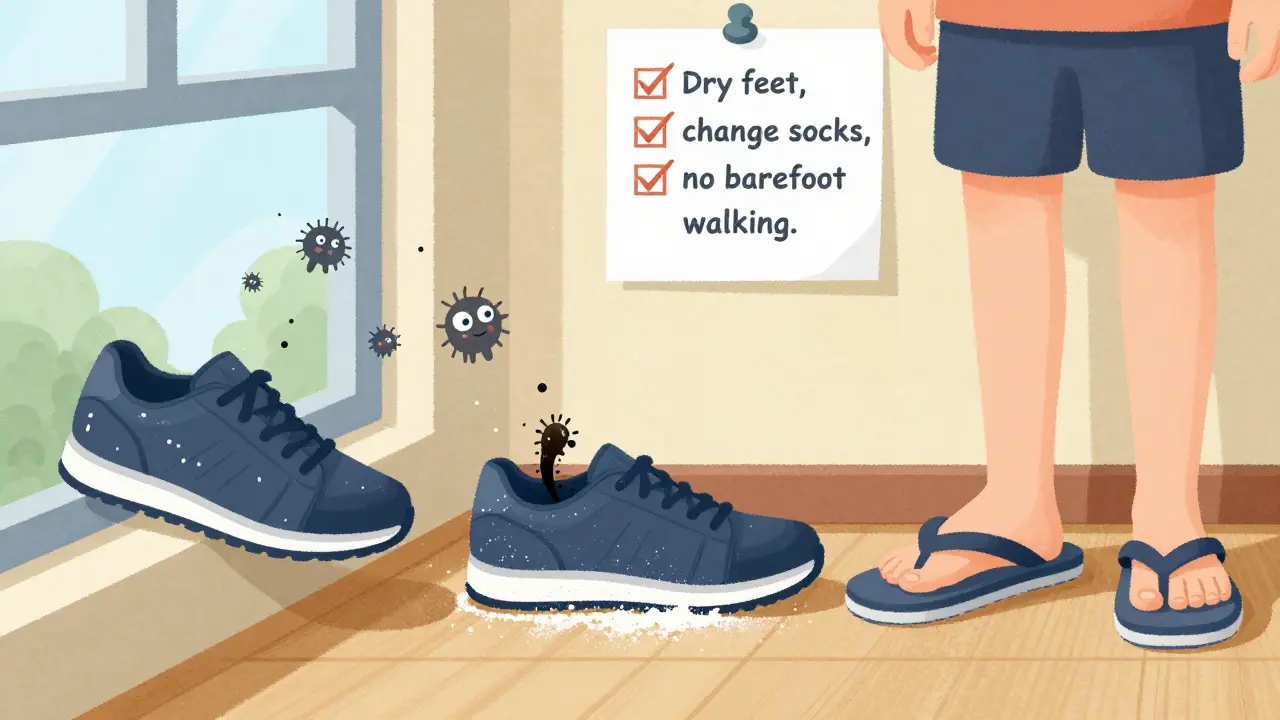
The best treatment is the one you never need. Prevention is 80% of the battle.- Wear flip-flops in showers, pools, and gyms. Reduces transmission risk by 85%.
- Change socks twice a day - especially if you sweat a lot. Cotton or moisture-wicking fabrics only.
- Use antifungal powder daily - even when you’re not infected. Tolnaftate powder in your shoes cuts recurrence by 63%.
- Let your shoes breathe. Don’t wear the same pair two days in a row. Fungi die without moisture.
- Wash your feet daily and dry them like your life depends on it - because your toenails do.
Most people think athlete’s foot is a one-time problem. It’s not. It’s a lifestyle issue. If you stop being careful once the itch is gone, you’ll be back in the same spot in 6 months.
What’s New in the Market?
The OTC antifungal market is evolving. New products now combine antifungals with dimethicone - a silicone that forms a protective barrier on the skin, keeping moisture out. Some sprays now come with cooling agents for instant itch relief. In clinical trials, nanoemulsion formulas are showing promise. These tiny droplets penetrate deeper into the skin, potentially cutting treatment time to just 3-5 days. But they’re not available yet. Meanwhile, resistance is rising. Terbinafine resistance in the most common fungus (Trichophyton rubrum) has tripled since 2010. That’s why sticking to the full course matters more than ever.Can I use OTC athlete’s foot treatments on my nails?
No. OTC creams and sprays don’t penetrate thick toenails well enough to treat fungal nail infections (onychomycosis). If your nails are yellow, thick, or crumbly, you need prescription oral medication or a specialized nail solution. Treating nail fungus with regular athlete’s foot products is a waste of time and money.
Is it safe to use antifungal cream on children?
Yes, most OTC antifungals like clotrimazole and terbinafine are safe for children over 2 years old. Always check the label for age restrictions. Apply the same way - thin layer, dry skin, both feet. If the child has sensitive skin, test a small patch first. If irritation occurs, stop and consult a pediatrician.
Can I wear socks after applying the cream?
Yes - but wait 10 to 15 minutes after applying to let it absorb. Wear clean, dry cotton socks. Avoid synthetic materials that trap sweat. If you’re using a powder, apply it after the cream has dried. Never apply cream and powder at the same time - they can mix and reduce effectiveness.
Why does my athlete’s foot keep coming back?
It’s not that the treatment failed - it’s that prevention stopped. Most recurrences happen because people stop using antifungal powder, wear the same shoes, or go barefoot in damp areas after the itching is gone. Fungal spores can live in shoes for months. If you don’t treat your environment, the infection will return. Use powder daily, rotate shoes, and wear flip-flops in public showers - even when you think you’re "cured."
Are natural remedies like tea tree oil effective?
Some studies show tea tree oil has mild antifungal properties, but it’s not reliable. One 2013 trial found it worked in only 50% of cases - and only when used daily for 6 weeks. It’s not regulated, and concentrations vary. For a fast, guaranteed result, stick with FDA-approved OTC antifungals. Use tea tree oil as a supplement, not a replacement.
pragya mishra
January 19, 2026 AT 22:53Why are we still using chemical creams? I switched to raw apple cider vinegar soaks and my foot fungus vanished in 3 days. No more expensive junk from the drugstore. The pharmaceutical industry doesn’t want you to know this.
Also, why do they always say 'don't walk barefoot in gyms'? Ever heard of the WHO saying public showers are safe if you rinse off? This is fear-mongering.
And why is terbinafine so expensive? It's been around since the 90s. Someone's making bank off our feet.
Also, I used to wear the same shoes for 3 years. No fungus. Coincidence? I think not.
Manoj Kumar Billigunta
January 20, 2026 AT 19:19Great breakdown. I’ve been using terbinafine for years after my first outbreak in college gym locker rooms. The key is consistency - not just applying it, but drying your feet like you’re trying to save a wet phone. I use a hairdryer every night now. No more recurrence in 8 years.
Also, rotating shoes is non-negotiable. I have 4 pairs and I let them sit for 72 hours between wears. It’s a habit now. No big deal.
Andy Thompson
January 21, 2026 AT 04:34EVERYTHING you just read? It’s a scam. The FDA is in bed with Big Pharma. Terbinafine? It’s a neurotoxin disguised as medicine. They’ve been hiding the truth since 2008. Look up the VA studies - they banned it for veterans because of liver damage.
And why are they pushing powders? Because they want you to buy them forever. You’re being manipulated. Tea tree oil is the real solution - and it’s 100% natural. The government doesn’t want you to know that because they can’t patent it.
Also, flip-flops in gyms? That’s a CDC lie. The real danger is the EMF from your phone in your pocket while you shower. Fungi are just a distraction.
sagar sanadi
January 21, 2026 AT 21:31So let me get this straight - you’re telling me I need to dry my toes with a hairdryer... but I’m not allowed to use the same towel for my hands? Who made this rule? The Fungal Overlords?
Also, why is terbinafine the 'gold standard'? Because it’s the most expensive? Or because the guy who wrote this gets kickbacks from Lamisil?
I tried clotrimazole. It didn’t work. Then I stopped caring. My feet are fine. The fungus is probably just vibing in there now. Let it have its moment.
kumar kc
January 23, 2026 AT 11:27Stop using creams. Just wash your feet and don’t be lazy. That’s it.
Thomas Varner
January 23, 2026 AT 22:38Okay, I’ve read this like three times now...
And I still think the hairdryer thing is genius.
Also, I didn’t realize I was supposed to treat BOTH feet...
Wait - I only treated the left one.
Oh no.
I’m gonna have to go back to the drugstore.
And I just bought new shoes yesterday...
Maybe I should’ve waited.
Thanks for the wake-up call, honestly.
Also - I’m now using tea tree oil...
...just in case.
And I’m wearing flip-flops to the fridge.
Just in case.
Carolyn Rose Meszaros
January 24, 2026 AT 22:19Thank you for this! 🙏 I’ve been dealing with this since last summer and I kept stopping the treatment because the itching went away. Now I know I was sabotaging myself. I’m restarting terbinafine today and I’m using the hairdryer trick. Also - I just threw out my old gym towel. 🙌
And yes, I’m buying a second pair of shoes. I’m done being a fungus magnet.
Greg Robertson
January 25, 2026 AT 11:30Really appreciate the breakdown - especially the part about applying it to a 1-inch border of healthy skin. I always just slapped it on the itchy spots. No wonder it kept coming back.
Also, the shoe rotation tip? Game-changer. I used to wear my running shoes every day. Now I have two pairs and I alternate. My feet feel better already, even before the cream has had time to work.
Crystal August
January 25, 2026 AT 19:20Why does this feel like a 10-page ad for Lamisil? I read this and I’m supposed to feel empowered? I feel like I’m being sold a 25-dollar solution to a problem caused by capitalism forcing us to wear sneakers 16 hours a day.
Also - why are we not talking about the fact that gyms are basically fungal zoos? Shouldn’t the government regulate that?
And why is the only natural remedy mentioned is tea tree oil? What about garlic? Or neem? Why is this so Western-centric?
Also - I’m not drying my feet with a hairdryer. That’s ridiculous.
Nadia Watson
January 26, 2026 AT 22:09Thank you for this comprehensive and thoughtful guide. I found the clinical data on terbinafine’s efficacy particularly reassuring, and the emphasis on environmental hygiene - particularly footwear rotation and towel separation - is a crucial point often overlooked in consumer health literature.
That said, I must note a minor typographical error on page three: 'tolnaftate' is misspelled as 'tolnaftae' in the third bullet point under OTC options. Small, but worth correcting for credibility.
Also, I’d like to add that in many South Asian households, neem leaf paste is traditionally used - though I agree with the author that evidence-based treatments should be primary.
Finally - please, for the love of all that is holy - don’t use the same towel. Ever.
Courtney Carra
January 27, 2026 AT 14:22It’s not about the fungus… it’s about control.
We live in a world that tells us to sanitize, to treat, to fix, to prevent - but what if the fungus is just… your foot’s way of saying, 'I’m alive'?
Maybe the real infection is the fear of imperfection.
What if you stopped fighting it - and just let your feet breathe? Not just physically… but spiritually?
Terbinafine might kill the fungus… but will it kill your anxiety?
I’m not saying don’t use it.
I’m saying… ask yourself why you’re so afraid of a little itch.
And maybe… just maybe… you’re the one who needs healing.
Not your feet.
Jacob Cathro
January 27, 2026 AT 20:26Bro. This is peak wellness culture. You're telling me to use a hairdryer on my toes? Like I'm some kind of feng shui ninja? And why is everyone acting like terbinafine is the holy grail? I used it and my foot turned into a science experiment.
Also, the 'rotate your shoes' thing? I have 2 pairs. I wear them every day. I'm not a 70-year-old with 12 pairs of loafers.
And why is no one talking about how the real problem is synthetic socks? That's what's trapping the moisture. Cotton is for losers. I wear compression gear. It's performance.
Also - I think the fungus is just a metaphor for late-stage capitalism. We're all infected. The system is the fungus.
And I'm not drying my feet. I'm drying my soul.