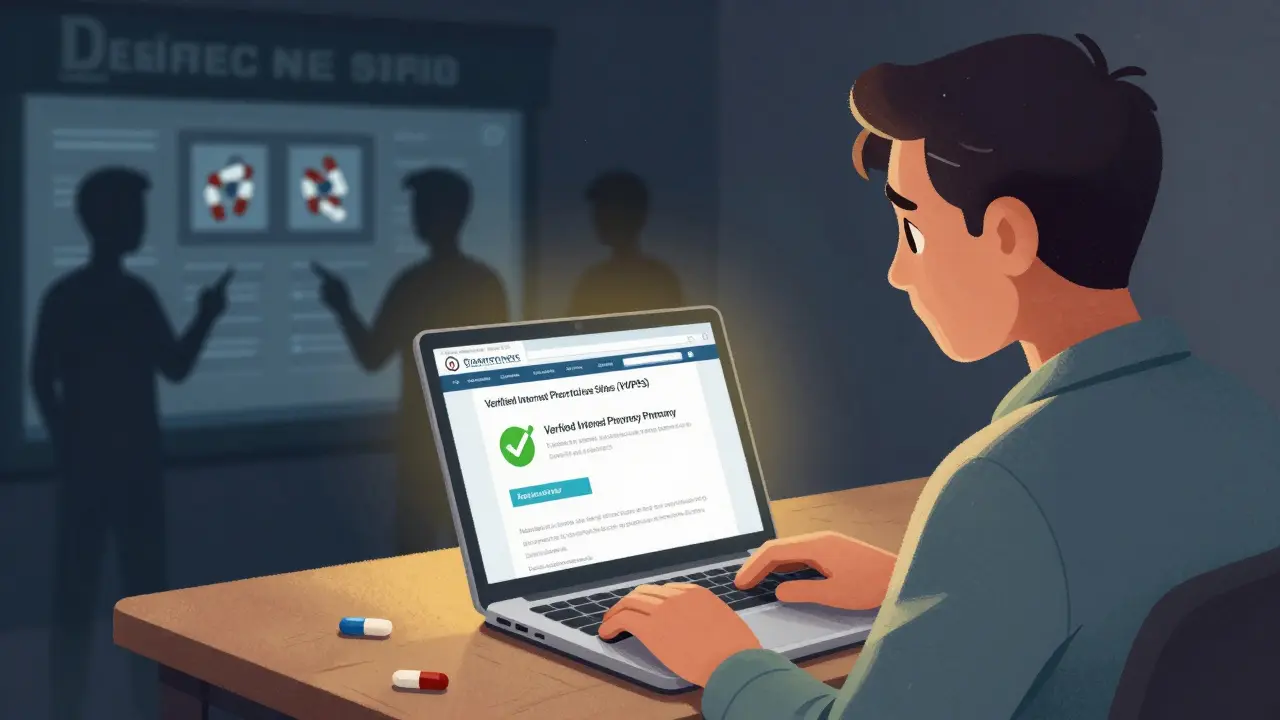
When you buy medication online, you’re trusting that the pharmacy is real, legal, and safe. But not all online pharmacies are legitimate. Some sell counterfeit drugs, expired pills, or even dangerous fake versions of common medications. In 2022, the FDA identified over 1,200 illegal online pharmacies that were operating without proper licenses. How do you know if the pharmacy you’re using is actually licensed? That’s where pharmacy verification services come in.
Why pharmacy verification matters
Pharmacy verification isn’t just a bureaucratic step-it’s a lifeline. A licensed pharmacy has passed inspections, employs properly trained pharmacists, and follows strict safety rules. Unlicensed ones? They don’t. The difference can be the difference between getting your medicine and getting sick.In Washington State alone, over 17,000 pharmacy verifications are done every month. That’s not because people are paranoid-it’s because they’ve learned the hard way. A Chicago hospital once hired a pharmacist whose license had been revoked in Illinois. They didn’t check the state database. Just their internal records. A year later, a patient suffered serious side effects from a misprescribed drug. The hospital paid $250,000 in damages. That kind of mistake is preventable.
The American Pharmacists Association found that states with strong verification systems saw a 37% drop in prescription drug diversion between 2015 and 2022. That means fewer pills ending up on the black market, fewer overdoses, fewer deaths. Verification isn’t just about compliance-it’s about saving lives.
How state verification systems work
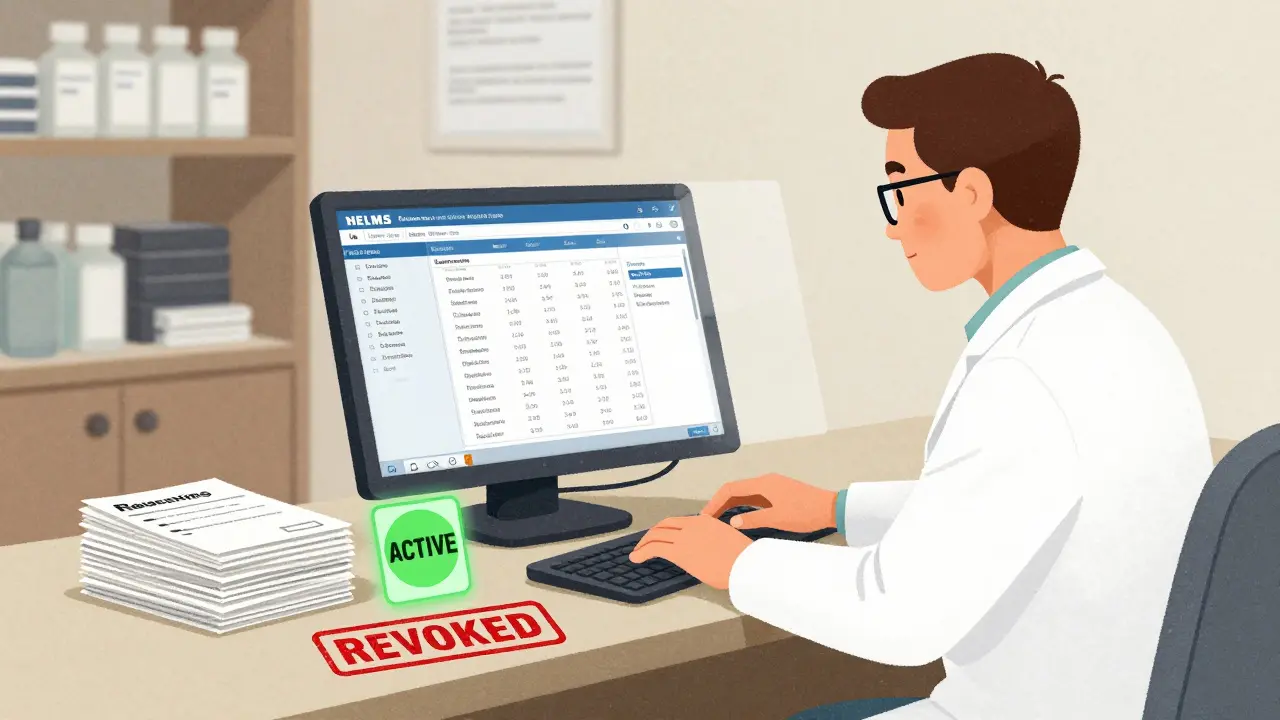
Each U.S. state runs its own pharmacy licensing system. In Washington, it’s called HELMS (Healthcare Enforcement and Licensing Management System). You don’t need special software. Just a browser. Here’s how it works:- Go to the Washington State Department of Health website: doh.wa.gov.
- Find the License Verification section.
- Search by the pharmacy’s exact legal name or its license number.
- Check the status: Active means it’s good. Expired, Suspended, or Revoked means walk away.
- Look for disciplinary actions-those are listed right there.
It takes under 3 seconds to get results. But here’s the catch: you need to know the exact name. If the pharmacy is listed as “Greenway Pharmacy LLC” but you type “Greenway Pharmacy,” the system won’t find it. A 2022 University of Washington study found that 28% of first-time users couldn’t locate the verification tool without help. And 31% of searches failed because of minor typos in the business name.
Washington requires pharmacists to renew their licenses every two years, tied to their birthday. Kentucky? Annual renewals by June 30. That mismatch creates confusion for pharmacists who work across state lines. If you’re verifying a pharmacy in multiple states, you’re doing this process over and over.
NABP Verify: The national solution
If you’re managing a pharmacy that operates in more than one state-or if you’re a patient checking a mail-order pharmacy that ships nationwide-state systems become a nightmare. That’s where the National Association of Boards of Pharmacy (NABP) steps in.NABP Verify is a single platform that checks licensure status across 41 U.S. states and territories in real time. It’s not free. As of January 2024, it costs $79 per year. That’s a barrier for small pharmacies or individual users. But for hospitals, pharmacy chains, or telehealth platforms, it’s worth every penny.
Before NABP Verify, verifying a pharmacist licensed in five states took an average of 22.7 minutes. Now? It takes 3.2 minutes. A 2023 study in the Journal of the American Pharmacists Association found NABP Verify reduced verification errors by 22%. That’s huge. One hospital system reported cutting down credentialing delays by 63% after switching to NABP.
The FDA recommends NABP Verify for healthcare organizations. Why? Because it updates in real time. State systems can take up to 72 hours to reflect a renewal. NABP pulls live data from 41 state boards. If a license gets suspended today, you’ll know today.
What about pharmacy technicians?
If you’re verifying a pharmacy, you also need to know who’s working behind the counter. That’s where the Pharmacy Technician Certification Board (PTCB) comes in. PTCB handles certification for pharmacy techs-not licenses. There’s a difference.A license means the state allows someone to practice. Certification means they passed a national exam. PTCB processed 87,432 verification requests in Q1 2024 with 99.87% accuracy. If a tech claims to be certified, you can check their status at ptcb.org. But remember: PTCB doesn’t verify the pharmacy itself. It only checks the tech. You still need to verify the pharmacy’s license separately.
What’s next? The future of verification
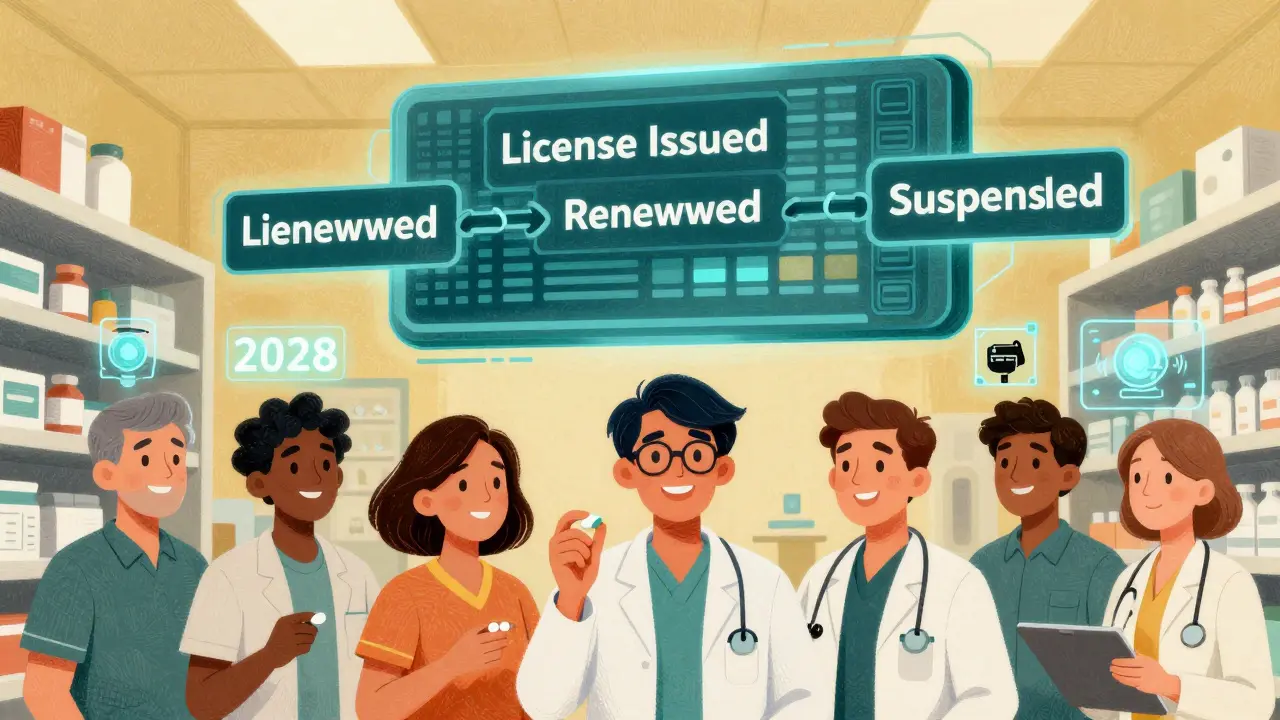
The system isn’t perfect. Twelve states spend less than $50,000 a year to run their verification portals-even though they process over 10,000 checks annually. That’s a recipe for delays and errors. The FDA just awarded $15 million in grants to help states upgrade. Washington got $478,000 to build HELMS 2.0, which will launch in late 2024. It’ll cut search time to under 1.5 seconds and add API integration so electronic health record systems like Epic can verify licenses automatically.Even bigger changes are coming. Amazon Web Services and Washington are piloting a blockchain-based verification system. Think of it like a tamper-proof digital ledger that records every license issuance, renewal, and suspension. No one can fake it. No delays. No typos. By 2028, experts predict most states will move to biometric or blockchain-based systems. But for now, you’ve got to work with what’s here.
What you should do today
If you’re a patient buying online:- Always check the pharmacy’s license. Don’t trust logos, seals, or “verified” badges on the site.
- Use NABP’s Verified Internet Pharmacy Practice Sites (VIPPS) list. It’s free and updated daily.
- If you’re outside the U.S., look for local pharmacy regulatory bodies. Canada has CPhA. The UK has the GPhC. Australia has AHPRA.
If you’re a pharmacy owner or manager:
- Verify every new hire-even if they’ve worked elsewhere.
- Check licenses 30 days before credentialing deadlines. That gives you time to fix errors.
- If you operate in more than one state, subscribe to NABP Verify. The cost is low compared to the risk of hiring someone with a revoked license.
- Train your staff. A 2024 survey found 41% of pharmacy managers had never checked a license themselves.
Common mistakes and how to avoid them
- Mistake: Relying on a pharmacy’s website badge. Solution: Go straight to the state board or NABP. Those badges can be faked.
- Mistake: Assuming a license from one state is valid in another. Solution: Each state has its own rules. Verify each one.
- Mistake: Waiting until the last minute to verify. Solution: Set calendar reminders. Renewals don’t wait.
- Mistake: Not checking disciplinary history. Solution: Look for suspensions, fines, or complaints. They’re public record.
There’s no shortcut. No app that does it all. But with the right tools, you can avoid the risks. And that’s worth the few minutes it takes.
How do I verify an online pharmacy license in Washington State?
Go to the Washington State Department of Health website (doh.wa.gov), navigate to the License Verification section, and search using the pharmacy’s exact legal name or license number. Check that the status says “Active.” If it’s expired, suspended, or revoked, do not do business with them. You’ll need to know the exact name-typos will block your search.
Is NABP Verify worth the $79 annual fee?
Yes-if you’re a pharmacy, hospital, or telehealth provider operating in multiple states. NABP Verify checks licensure across 41 states in real time, cutting verification time from 47 minutes to under 4 minutes. It also reduces errors by 22%. For individual patients, it’s optional. For businesses, it’s a necessary investment to avoid legal and safety risks.
Can I trust a pharmacy that says it’s “FDA approved”?
No. The FDA doesn’t approve online pharmacies. It only approves individual drugs. A pharmacy can claim “FDA approved” even if it’s completely unlicensed. Always verify through the state board or NABP’s VIPPS program. That’s the only reliable way to confirm legitimacy.
What’s the difference between a pharmacy license and a technician certification?
A pharmacy license means the business is legally allowed to dispense medication in a specific state. A pharmacy technician certification (like PTCB) means the individual passed a national exam and is qualified to assist pharmacists. You need both: the pharmacy must be licensed, and the technicians working there should be certified. PTCB doesn’t verify the pharmacy-only the tech.
Why do some states have different renewal dates?
Each state sets its own rules. Washington renews every two years tied to the pharmacist’s birthday. Kentucky requires annual renewals by June 30. This creates confusion for pharmacists who work across borders. There’s no national standard yet. Always check the specific state’s requirements before assuming renewal dates match.
Are there free alternatives to NABP Verify?
Yes-for single-state verification. Every state with a licensed pharmacy has a free public verification portal. But if you need to check multiple states, you’ll have to manually visit each one. NABP Verify is the only paid service that consolidates them all. For one-off checks, use free state portals. For ongoing use across states, pay for NABP.
George Vou
March 7, 2026 AT 19:24so i just bought some viagra from this site that looked legit af with all the badges and stuff... turns out the license was revoked 3 months ago. i almost died. now i check every pharmacy like its my job. dont trust the pretty logos. go straight to the state site. its 3 seconds. dont be lazy.
Ray Foret Jr.
March 8, 2026 AT 04:28thank you for this!!! i was about to order from a site that looked so professional... then i saw your post and checked helms. their license was expired. i almost cried 😭. now i always check. its crazy how easy it is to get scammed. this saved my life. 🙌
Samantha Fierro
March 9, 2026 AT 14:30Thank you for taking the time to lay out such a comprehensive, clear, and vital guide. This is exactly the kind of public service information that should be shared far and wide. The statistics you’ve included - especially around diversion and hospital liability - are chilling, yet they underscore the urgency of verification. For anyone managing healthcare systems or even just filling prescriptions for loved ones, this is non-negotiable. Please keep advocating.
Robert Bliss
March 9, 2026 AT 23:32cool post. i didnt even know you could check this stuff online. i just trusted the website. now im gonna check every time. its like checking if a car is stolen before you buy it. makes sense. thanks for the heads up 😊
APRIL HARRINGTON
March 10, 2026 AT 06:59OMG I JUST REALIZED I’VE BEEN BUYING MEDS FROM A PHARMACY THAT GOT SUSPENDED IN 2021 I’M SO SCARED I’M GOING TO DIE FROM A FAKE PILL I’M CRYING RIGHT NOW I NEED TO GO CHECK MY LAST 5 ORDERS I’M PANICKING
Leon Hallal
March 10, 2026 AT 19:39you think this is bad wait until they start putting microchips in the pills. the government is using these verification systems to track who takes what. they already know your blood type. your dna is in some database. you’re being watched. and the ‘free’ state portals? they’re just front doors. naborp? that’s the real trap. they’re owned by big pharma. you think you’re safe? you’re just another data point.
Judith Manzano
March 12, 2026 AT 19:17This is such an important topic! I love how you broke it down into clear steps. I’ve been helping my mom navigate this since she started ordering her meds online, and honestly, I didn’t realize how much variation there was between states. The fact that Washington ties renewals to birthdays is wild - I never would’ve guessed. I’m going to share this with my book club. Everyone needs to know this.
rafeq khlo
March 14, 2026 AT 15:08It is evident that the current verification infrastructure exhibits profound systemic deficiencies. The fragmentation across state jurisdictions constitutes a regulatory arbitrage opportunity for malevolent actors. The reliance on manual input without standardized identifiers or cryptographic validation renders the entire framework vulnerable to adversarial manipulation. The proposed blockchain initiative, while conceptually sound, remains insufficient without a unified national licensure registry. Until such time as a sovereign digital identity protocol is implemented under federal auspices, all assertions of safety are fundamentally illusory.
Morgan Dodgen
March 15, 2026 AT 04:19lol you guys are so naive. naborp? $79? that’s just the gateway drug. the real money is in the api integrations with epic and cerner. they’re selling your prescription history to data brokers. every time you check a license, you’re feeding a surveillance engine. the ‘verified’ badge? it’s a honeypot. the fda doesn’t approve pharmacies - they approve the verification companies. you think you’re safe? you’re just paying for the illusion of safety. and the blockchain? that’s just the next layer of obfuscation. the real power is in the backend logs no one can access. you’re not verifying a pharmacy - you’re verifying your compliance with the system.
Philip Mattawashish
March 16, 2026 AT 13:43you think this is about safety? this is about control. they want you to think you’re protecting yourself by checking licenses. but the real game is making you dependent on systems they own. the state portals? they’re slow. the naborp? expensive. the blockchain? unproven. why? because they want you to keep coming back. they want you to feel like you’re doing something - so you don’t ask who’s really running the show. and the techs? they’re just pawns. the real criminals are the ones who wrote the rules. and you? you’re just their obedient checker.
Tom Sanders
March 16, 2026 AT 23:40bro this is too much work. i just use the first site that pops up. if i get sick i’ll sue. someone else’s problem.
Jazminn Jones
March 17, 2026 AT 02:10The assertion that verification is a "lifeline" is an emotionally manipulative oversimplification. One must interrogate the institutional power structures that necessitate such verification in the first place. Why are there 41 disparate systems? Why is there no federal standard? Why is NABP Verify proprietary? The real issue is not user negligence - it is the deliberate fragmentation of regulatory oversight to serve corporate interests. The $79 fee is not a cost of safety - it is a tax on compliance. Until structural reform occurs, all individual verification is performative.
Stephen Rudd
March 17, 2026 AT 02:54Interesting. But you Americans think your system is the gold standard. In Australia, we have AHPRA - fully integrated, real-time, and publicly audited. No typos. No 72-hour delays. No $79 fees. We’ve had a national digital registry since 2016. Your "state-by-state" mess is a joke. And your "FDA approved" claim? That’s not even a thing in the real world. You’re not protecting patients - you’re protecting bureaucracy. Fix your system before you lecture the rest of us.
Leon Hallal
March 17, 2026 AT 03:20you think the state portals are safe? they’re just front ends. the real database is in a black vault somewhere. i worked in gov it. they don’t even update the site until the audit is done. and the audit? it’s scheduled for next year. you’re checking a lie. naborp? same thing. they get paid by the states. they’re not your friend. they’re the gatekeepers. you’re not verifying a pharmacy - you’re begging for permission to live.