
Every year, over 90% of prescriptions in the U.S. are filled with generic drugs-cheaper, just as effective, and saved the healthcare system over $2 trillion in the last decade. But sometimes, that’s not enough. When a patient’s life depends on a specific brand, a doctor has the legal power to stop the substitution. This is called a prescriber override.
What Exactly Is a Prescriber Override?
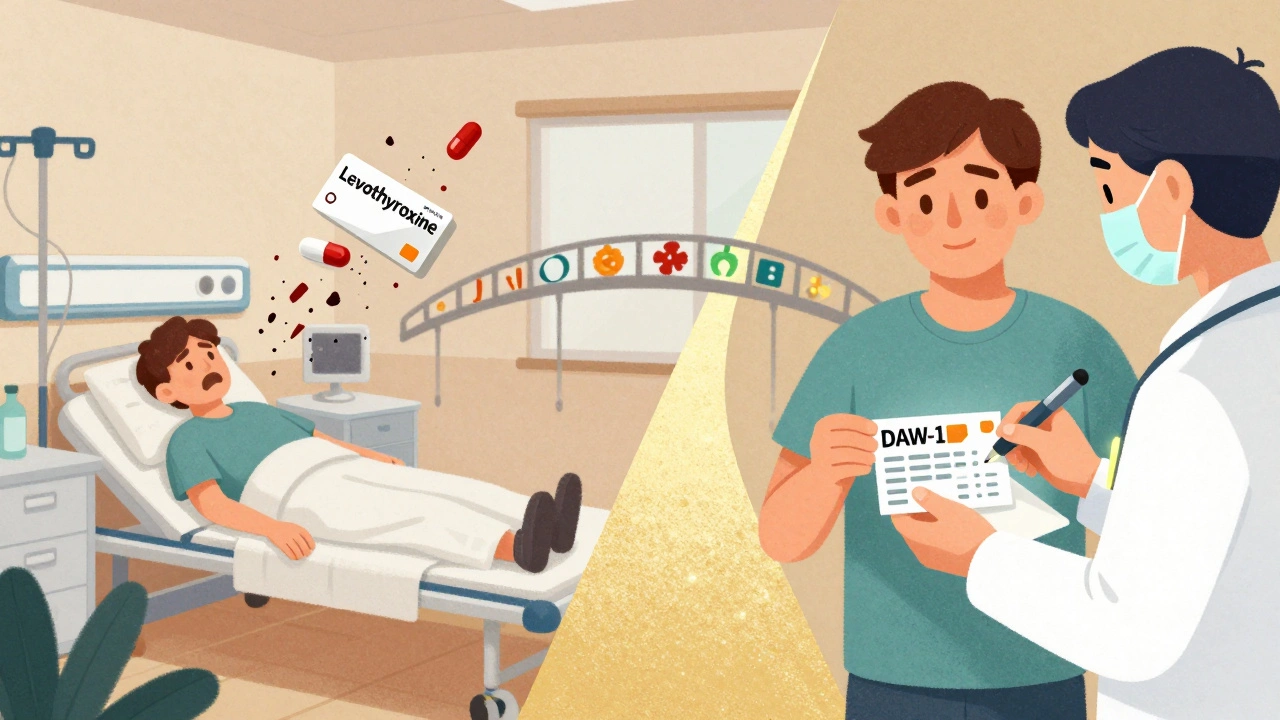
A prescriber override is when a physician writes a prescription that forces the pharmacy to dispense the brand-name drug, even if a generic version exists and is legally allowed to be substituted. It’s not a request. It’s a command. The pharmacist must follow it. This isn’t about preference. It’s not about cost or convenience. It’s about medical necessity. Some drugs don’t play nice with substitutions. Take levothyroxine, for example. It’s used to treat hypothyroidism. Even tiny differences in how the body absorbs the drug-due to different inactive ingredients in generics-can cause serious problems. Too little? Fatigue, weight gain, depression. Too much? Heart palpitations, bone loss, even thyroid storm-a rare but deadly condition. One patient in a Reddit thread described being hospitalized after a pharmacy substituted his brand levothyroxine with a generic, even though his doctor had marked the prescription as ‘Do Not Substitute.’ That’s not a mistake. That’s a failure of the system.How Does It Work Legally?
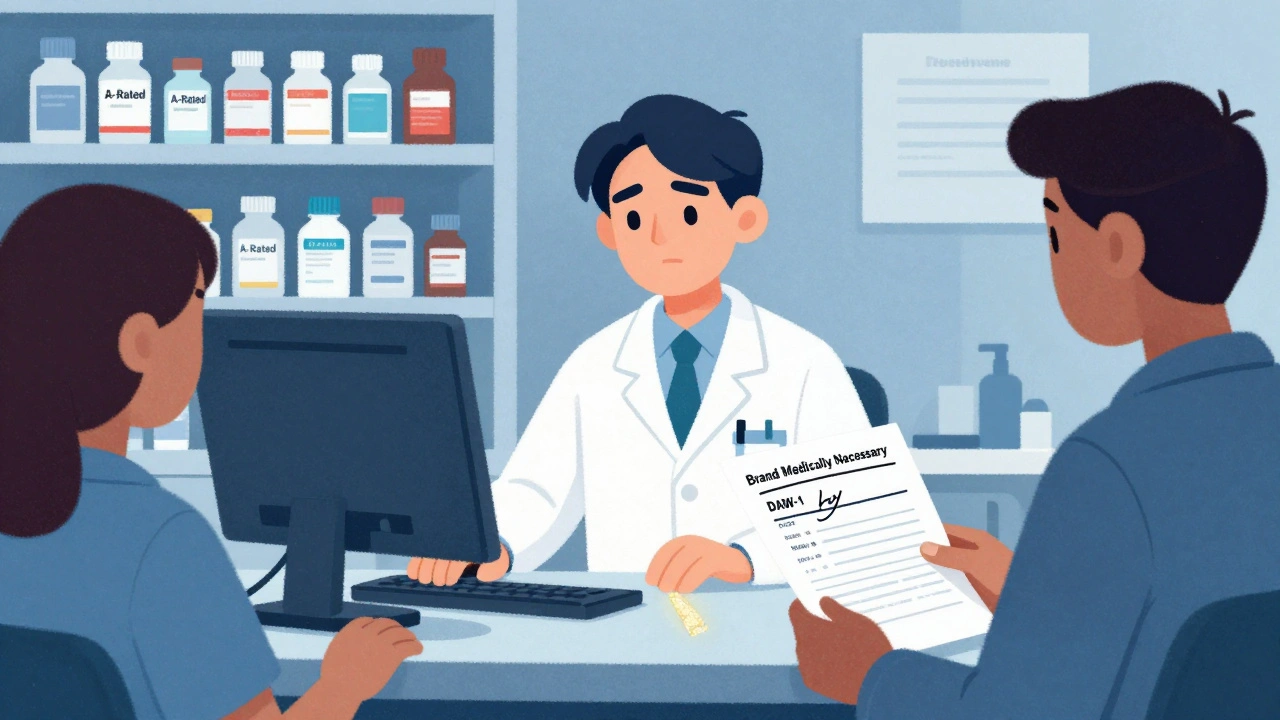
The foundation for all this goes back to 1984, with the Hatch-Waxman Act. It created the modern pathway for generic drugs to enter the market. But it also recognized that not all drugs are interchangeable. So it let each state decide how to handle substitution. Today, every state has its own rules. Thirty-five states require pharmacists to substitute generics unless told otherwise. Fifteen states give pharmacists more flexibility-they can choose whether to substitute unless the doctor says no. The key is the DAW code. This is a two-digit code added to the prescription that tells the pharmacy exactly what to do. DAW-1 means: “Dispense as Written.” That’s the override. It’s the doctor saying, “No generics. Give the brand.” But here’s the catch: states don’t agree on how to write it. In Illinois, you check a box labeled “May Not Substitute.” In Kentucky, you must handwrite “Brand Medically Necessary.” In Michigan, you write “DAW” or “Dispense as Written.” In Oregon, you can say it over the phone. And if you don’t follow the exact format? The pharmacy might still substitute. And then you’ve got a patient on the wrong dose.Which Drugs Need Overrides?
Not every drug needs a brand. But some do. The FDA’s Orange Book lists which generics are considered therapeutically equivalent to their brand-name counterparts. Those get an “A” rating. If it’s a “B,” it’s not interchangeable. But even with an “A” rating, some drugs are too sensitive to change. The top three categories where overrides are most common:- Anticonvulsants (like phenytoin or carbamazepine): Even small changes in blood levels can trigger seizures.
- Psychiatric drugs (like lithium or clozapine): Minor absorption differences can lead to relapse or dangerous side effects.
- Narrow therapeutic index drugs: That’s the technical term for drugs where the difference between a therapeutic dose and a toxic one is razor-thin. Warfarin (a blood thinner), digoxin (for heart failure), and levothyroxine all fall here.
Why Do Doctors Get It Wrong?
You’d think doctors know how to write these overrides. But a national survey found only 58% of physicians correctly understood their own state’s rules. That’s not a typo. It’s 42% of doctors who don’t know how to legally block a substitution. Here’s what goes wrong:- Doctors use phrases like “no generic” or “brand preferred” instead of the legally required wording.
- EHR systems auto-fill the prescription with a default generic, and the doctor doesn’t notice.
- They forget to sign or date the override note.
- They write the override on paper, but the patient e-prescribes the same drug later, and the system ignores the old note.
The Cost of Overrides
Generics are cheaper. That’s why they’re used. A DAW-1 override can cost 32.7% more than a generic. That adds up. The American Pharmacists Association estimates that inappropriate overrides cost the system $7.8 billion a year. Insurance companies hate it. PBMs flag DAW-1 prescriptions for prior authorization. Some plans require doctors to submit clinical justification just to get paid. But here’s the truth: most overrides aren’t inappropriate. They’re necessary. The real problem is when doctors override out of habit, fear, or ignorance-not because the patient needs it. A 2019 study found that physicians often think generic formulations are less reliable, even when there’s no evidence. That’s where education fails.What Doctors Should Do
If you’re prescribing a drug that needs a brand, here’s how to do it right:- Know your state’s rules. Check your pharmacy board’s website. Don’t guess.
- Use the exact language your state requires. No shortcuts.
- Always use DAW-1. Don’t rely on phrases like “brand only.”
- Document the reason: “Patient had seizure after generic switch,” or “Therapeutic failure with two prior generics.”
- Use your EHR’s override template-if it’s set up correctly. If not, push for an update.
- Confirm with the pharmacy. Call them. Don’t assume they got it.
What Pharmacists See
Pharmacists are on the front line. They’re the ones getting rejected claims, denied refills, and angry patients. On AllNurses, pharmacy techs say 68% of override rejections happen because the documentation doesn’t match state rules. A handwritten note on a paper script? Fine. But if that same prescription is e-prescribed and the doctor didn’t select DAW-1 in the system? The pharmacy can’t override the system. They have to dispense the generic. And when that happens? Patients suffer. The Institute for Safe Medication Practices tracked 27 adverse events between 2018 and 2022 from improper substitution of warfarin, phenytoin, or levothyroxine. Four of those were fatal.The Future: Standardization Is Coming
The system is patchwork. It’s confusing. It’s dangerous. That’s why Congress is looking at the Standardized Prescriber Override Protocol Act. It would create one national standard for DAW-1 requests. The NCPDP is already working on integrating override rules directly into the e-prescribing standard by late 2024. The FDA’s Orange Book is getting updates too, including new codes for biosimilars. But until then? The burden is on the prescriber. You can’t rely on the system to catch your mistake. You have to be precise.Bottom Line
Prescriber override is a lifeline-not a loophole. It exists to protect patients when generics aren’t enough. But it’s only as good as the person writing the prescription. If you’re going to override, do it right. Know your state. Use the right code. Document the reason. Confirm with the pharmacy. And never assume the system will protect your patient. It won’t. You have to.Can a pharmacist refuse to follow a prescriber override?
No. If a prescriber properly uses DAW-1 and follows state documentation rules, the pharmacist is legally required to dispense the brand-name drug. Refusing to do so could result in disciplinary action from the state board of pharmacy. However, if the override is improperly documented (e.g., missing signature, wrong wording), the pharmacist may legally substitute the generic and may ask the prescriber to clarify.
What happens if I write “no generics” on a prescription?
It may not be enough. Many states require specific language like “Dispense as Written” or “Brand Medically Necessary.” Phrases like “no generics” or “brand preferred” are often not recognized by pharmacy systems or state law. Always check your state’s exact requirements-don’t rely on common phrases.
Are brand-name drugs always better than generics?
No. For the vast majority of drugs, generics are just as safe and effective. The FDA requires generics to have the same active ingredient, strength, dosage form, and route of administration as the brand. The difference lies in inactive ingredients, which rarely matter-except for drugs with a narrow therapeutic index. For most conditions, generics are the standard of care.
Can patients request a brand-name drug even if the doctor didn’t override?
Yes. That’s called DAW-2. The patient can ask for the brand, and the pharmacy can dispense it-but the patient usually pays the difference in price. This is different from a prescriber override (DAW-1), which is a clinical decision, not a patient preference.
Do insurance plans cover brand drugs if there’s a DAW-1 override?
Not always. Many plans require prior authorization for DAW-1 prescriptions, especially for high-cost drugs. Even with a valid override, the prescriber may need to submit clinical documentation proving medical necessity. If denied, the patient may have to pay out of pocket or switch back to generic.
Michael Robinson
December 9, 2025 AT 05:23It's not about brand vs generic. It's about whether the body can handle the change. Some people aren't made for switches. Their bodies remember the exact formula. Change it, and they break. Simple as that.
Sarah Gray
December 10, 2025 AT 15:15It's astonishing how many physicians still write 'no generics' as if it's a legal incantation. The DAW-1 code isn't a suggestion-it's a statutory requirement. If you're going to practice medicine, learn the regulatory grammar. Or better yet, don't prescribe at all.
Kathy Haverly
December 11, 2025 AT 03:08Let’s be real-this whole ‘medical necessity’ thing is just Big Pharma’s way of keeping the cash flowing. The FDA approves generics for a reason. If your patient had a seizure on levothyroxine, maybe you prescribed it wrong in the first place. Or maybe you just don’t trust science because it doesn’t come with a fancy label.
Andrea Petrov
December 11, 2025 AT 09:08Have you ever wondered why the FDA’s Orange Book changes every year? Why some generics suddenly get an ‘A’ rating one month and a ‘B’ the next? It’s not science-it’s corporate lobbying. The same companies that make the brand also own the generics. They control the data. They control the narrative. And you’re just supposed to trust them?
Graham Abbas
December 11, 2025 AT 12:08I’ve worked in pharmacy across three countries, and this is the first time I’ve seen a system so fragmented it’s almost comical. In the UK, we have a single national guideline. If a doctor needs a brand, they write ‘Do Not Substitute’ and sign it. Done. No state-by-state bingo cards. No EHR glitches. Just clarity. America’s healthcare system doesn’t need more innovation-it needs consistency.
Haley P Law
December 12, 2025 AT 08:41MY DOCTOR JUST SWITCHED ME TO A GENERIC AND I HAD A PANIC ATTACK 😭 I WASN’T EVEN ON THE DRUG FOR LONG BUT I FELT LIKE I WAS DYING. NOW I CRY EVERY TIME I GO TO THE PHARMACY. 🥺
Andrea DeWinter
December 13, 2025 AT 19:07For anyone prescribing anticonvulsants or lithium-just call the pharmacy before you send the script. Seriously. Even if you use DAW-1, systems glitch. A quick call saves lives. And if you’re a patient and you’ve had a bad reaction to a switch? Tell your pharmacist. They’re not just filling bottles-they’re keeping you alive.
Steve Sullivan
December 14, 2025 AT 08:18look i get that generics are cheaper but if your body starts acting weird after a switch, that's not 'you're just paranoid' that's your brain going 'wait this isn't the same'. i had a friend on carbamazepine and the generic made him zone out for hours. like, he forgot his own birthday. his doc had to fight the insurance for 3 months to get the brand back. don't be that guy who thinks 'it's all the same' until it's your kid on a seizure watch.
George Taylor
December 14, 2025 AT 17:02And yet, 42% of doctors don't know how to properly write an override? That's not incompetence-it's negligence. And the fact that insurance companies are now demanding 'clinical justification' for overrides? That's not cost control-it's bureaucratic gaslighting. You're asking a physician to prove that their patient isn't going to die because they switched from one pill to another that looks identical? This system is designed to fail.
Chris Marel
December 16, 2025 AT 06:30Back home in Nigeria, we don’t have generics vs brand debates-we just don’t have enough drugs at all. When I saw this post, I felt a strange mix of envy and sorrow. You’re arguing over paperwork and codes, but we’re just hoping someone gets the medicine at all. Still, what you’re describing? That precision? That’s what we dream of.
precious amzy
December 18, 2025 AT 00:26It is an incontrovertible fact that the pharmaceutical-industrial complex has engineered this regulatory maelstrom to perpetuate the illusion of therapeutic distinction where none exists. The DAW-1 protocol is not a medical safeguard-it is a fiscal artifact of rent-seeking behavior masquerading as patient advocacy. One must question the epistemological legitimacy of prescribing practices predicated upon placebo-driven pharmacological fidelity.
Carina M
December 19, 2025 AT 03:46It is morally reprehensible that physicians are permitted to override generic substitution without standardized, auditable documentation. The financial burden placed upon the public healthcare system is unconscionable. If a patient requires a brand-name agent, then they should be required to pay the full differential-without insurance subsidies. This is not a medical issue. It is a moral one.
William Umstattd
December 20, 2025 AT 15:59Let me tell you something-when I saw the first patient die because a pharmacist substituted her warfarin, I stopped trusting the system. I stopped trusting the FDA. I stopped trusting the EHR vendors. I now hand-write every override on paper, scan it, email it, and call the pharmacy. Twice. Because if I don’t, someone else’s mother dies. And no algorithm, no DAW code, no ‘standardized protocol’ will bring her back.
Tejas Bubane
December 22, 2025 AT 15:57bro this whole thing is a scam. generics are 99% the same. if your body can’t handle it, you’re just weak. i’ve switched my meds 5 times and never had an issue. stop crying about it and take the cheap pill like everyone else. also your doctor probably just doesn’t know what he’s doing.
Ajit Kumar Singh
December 24, 2025 AT 06:47India has over 100 generic makers for levothyroxine. No one dies here because of substitution. Why? Because we test. We regulate. We train. But in USA, you have 50 different rules in 50 states? That’s not healthcare-that’s chaos. And you wonder why people lose trust? You built this mess yourselves.