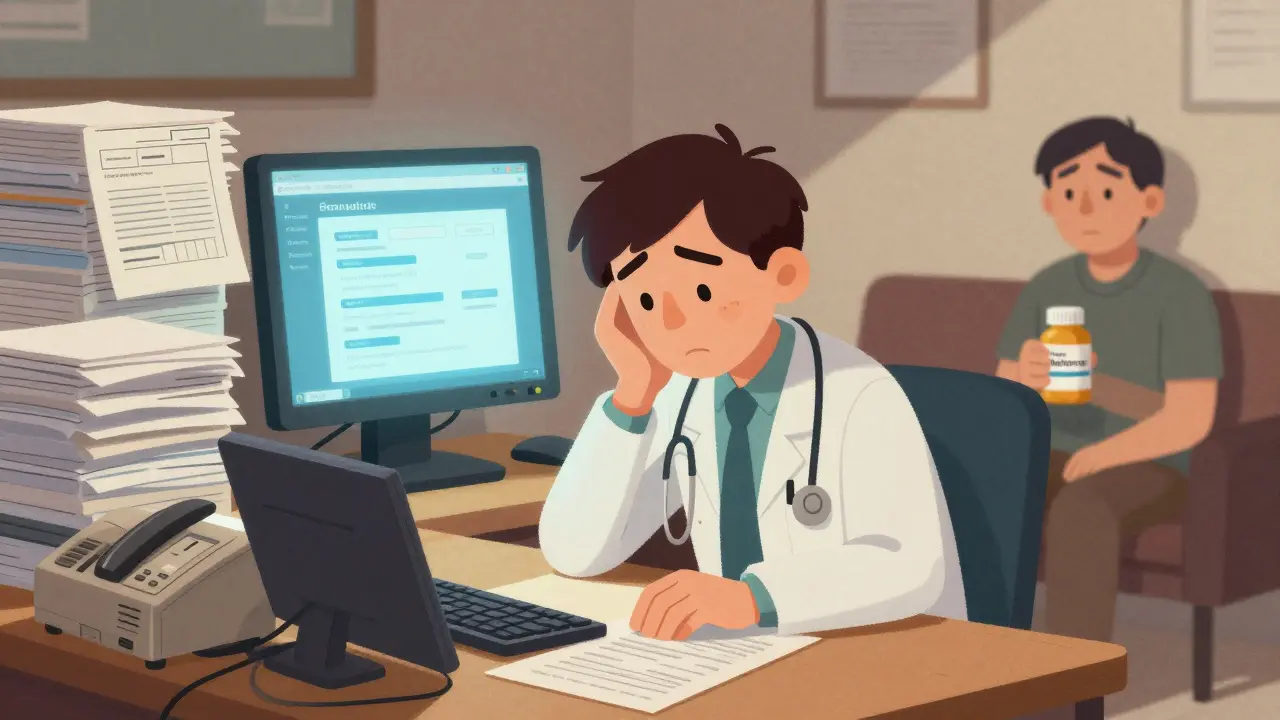
Getting a generic medication approved through prior authorization isn’t just paperwork-it’s a daily hurdle for providers trying to get patients the right drugs at the right time. Even though generics are cheaper, safer, and just as effective as brand-name drugs, insurance companies still require providers to jump through hoops before they’ll pay. In 2025, nearly 93% of commercial health plans still demand prior authorization for at least some generic medications. That means doctors, nurses, and medical assistants spend hours each week filling out forms, calling insurers, and chasing approvals instead of seeing patients.
Why Do Insurers Require Prior Authorization for Generics?
It’s not about safety. It’s about money. Insurance companies and pharmacy benefit managers (PBMs) use prior authorization to control costs by steering patients toward the cheapest version of a drug-often the one they’ve negotiated the best price on. But here’s the catch: sometimes, the cheapest option isn’t the best for the patient.
For example, a patient might have had a bad reaction to the insurer’s preferred generic version of metformin. The doctor prescribes a different generic, equally effective but not on the preferred list. Without prior authorization, the patient walks out with a $150 co-pay instead of $5. That’s why providers must prove medical necessity-not just that the drug is needed, but why this specific generic is necessary.
The most common reasons insurers require prior authorization for generics are:
- Quantity limits (e.g., requesting 90 days’ supply when the plan allows only 30)
- Duration limits (e.g., proton pump inhibitors capped at 8 weeks unless documented as chronic)
- Therapeutic interchange rules (e.g., forcing a switch to a preferred generic even if the patient tolerates another)
- Off-label use (e.g., using a generic for a condition not listed on the FDA label)
According to the American Medical Association, 28% of all prior authorization requests are for generic drugs. That’s more than 1 in 4 approvals doctors fight for-despite generics being the default choice in most cases.
How Providers Actually Get Approval
The process sounds simple: submit a request. But in reality, it’s a maze of portals, fax machines, and inconsistent rules.
Here’s how it works in practice:
- Identify the requirement - Check the payer’s formulary. Is the requested generic on the preferred list? Is there a quantity or duration limit?
- Gather documentation - This isn’t optional. You need clinical proof: lab results, diagnostic reports, progress notes, or even prior treatment failures. For example, if a patient can’t tolerate metformin, you need a note documenting GI side effects.
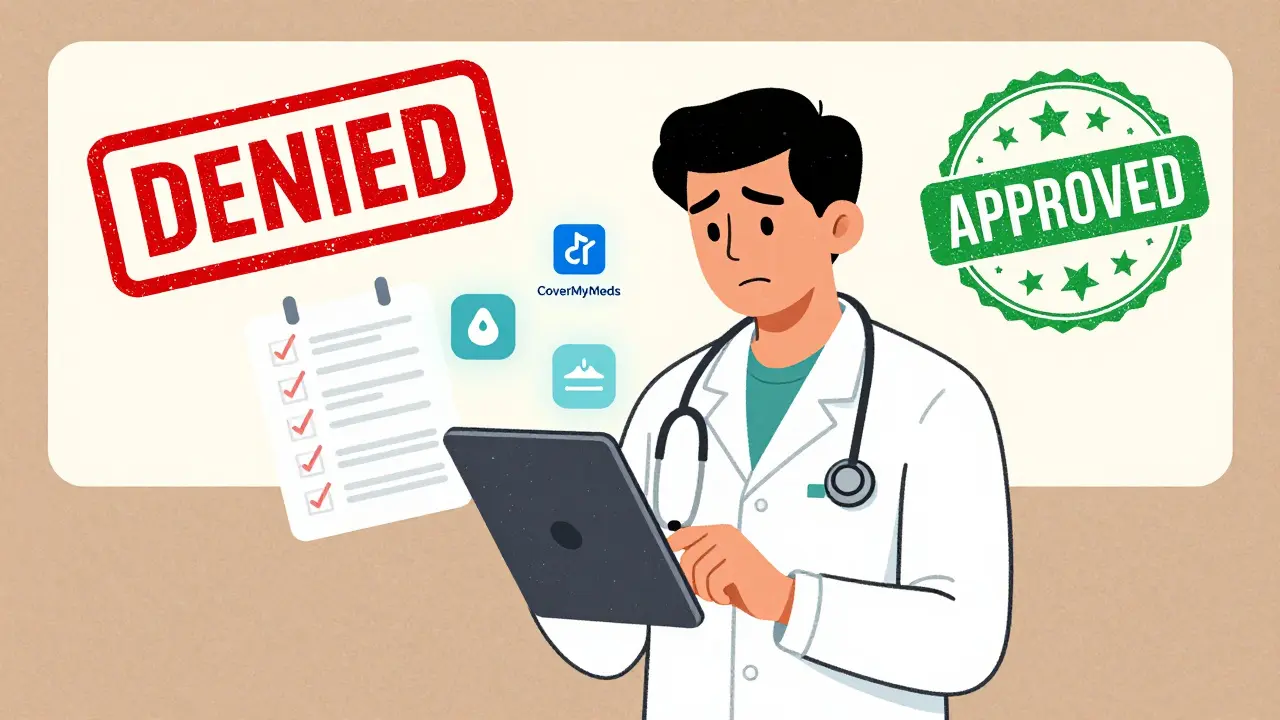
- Choose the submission method - 78% of commercial insurers now require electronic submission through platforms like CoverMyMeds or Surescripts. Only 5% still accept phone requests. Fax is fading but still used by 22% of plans, especially Medicaid and smaller insurers.
- Submit and track - Use automated tracking tools. Many practices now assign medical assistants to monitor submission status. Auto-approval kicks in 41% of the time when quantity limits aren’t exceeded and documentation is complete.
- Follow up - If denied, appeal immediately. Denial rates for generics average 18.7%, with 42% of denials due to missing documentation.
One provider in Ohio shared a win: They secured approval for omeprazole 40mg daily for 12 weeks for a patient with Barrett’s esophagus by attaching the endoscopy report showing intestinal metaplasia. Approval came in two business days via electronic submission. That’s the ideal scenario.
What Happens When Approval Is Delayed or Denied
Delays aren’t just inconvenient-they’re dangerous.
56% of physicians report having to issue bridge prescriptions-short-term, out-of-pocket solutions-while waiting for approval. Patients often skip doses, stop treatment, or pay hundreds of dollars out of pocket. A 2023 survey of 1,200 pharmacists found that 83% have seen patients unable to afford generics while waiting for approval.
Denials happen for reasons that make no clinical sense. One doctor on Sermo described a denial for generic sitagliptin after the patient had GI issues with metformin. The insurer demanded proof of three failed medications, even though ADA guidelines say metformin intolerance alone is enough to switch. That’s not medical necessity-it’s bureaucracy.
And the timeline? Medicaid must approve urgent requests within 24 hours and standard ones within 14 days. Commercial insurers? 5 to 10 business days. But if they ask for more info? That clock resets. Approval can stretch to 7-14 days, sometimes longer.
Electronic Systems Are Changing the Game
Remember fax machines? They’re still out there. But the tide is turning.
As of mid-2024, 87% of major PBMs offer electronic prior authorization (ePA). Systems like CoverMyMeds, Surescripts, and Epic-integrated tools have cut processing times by 35-50%. Some insurers now auto-approve generic requests if the quantity is within limits and the patient has a history of prior approval.
Express Scripts reported a 40% increase in auto-approvals for generics in 2023. And starting January 1, 2024, Medicare Advantage plans must respond to 90% of standard prior authorization requests within 72 hours-down from 14 days. That’s a big win.
But here’s the problem: not all systems talk to each other. A provider using Epic might have trouble submitting to a payer that uses a different platform. That’s why 89% of providers say documentation requirements vary wildly between payers.
What Works: Strategies That Save Time
Successful practices don’t wait for approval-they build systems to get it faster.
- Create templates - Have pre-filled templates for common scenarios: diabetes meds, PPIs, antidepressants. Capital Rx found providers using templates saw 32% faster approvals.
- Assign roles - Medical assistants handle 78% of routine prior auth requests under physician supervision. Train them on payer-specific rules.
- Build payer relationships - Call the insurer’s provider relations line. Get names. Know who to ask for when things stall.
- Use checklists - Keep a binder or digital doc with each payer’s requirements. What lab values do they need? What forms? What’s the turnaround time?
- Track denials - If a payer denies the same generic twice, document it. Use that data to push back or switch plans.
One clinic in Texas reduced their average approval time from 6 days to 2 days by assigning a dedicated staff member to manage prior authorization full-time. They didn’t hire a new doctor-they hired a medical assistant and gave them the right tools.
The Bigger Picture: Why This System Is Broken
Prior authorization for generics was meant to prevent overuse. But today, it often blocks access.
The Centers for Medicare & Medicaid Services estimates prior authorization saves $23.8 billion a year in inappropriate spending-$4.2 billion of that from generic misuse. Sounds good, right? But the Congressional Budget Office warns that provider administrative costs will hit $1.2 billion by 2026 if nothing changes.
Doctors spend 16.1 hours per week on prior authorization. That’s nearly two full workdays. And 78% say that time could be better spent with patients.
Worse, some PBMs are now restricting which manufacturer of a generic they’ll cover. Even if two generics are bioequivalent, one might be cheaper to the insurer. So now, if a patient switches from one generic manufacturer to another, you need prior authorization again. That’s not clinical-it’s corporate.
The American Medical Association is pushing state laws to eliminate prior authorization for generics that have been on the market for over five years and have multiple manufacturers. That’s smart. If a drug has been safely used for years by thousands, why block it?
What’s Next? AI and Reform
By 2026, McKinsey predicts 75% of generic prior authorization decisions will be handled by AI. Systems will analyze clinical notes, lab results, and prior history to auto-approve or flag cases needing review. Processing times could drop below 24 hours.
But AI isn’t magic. It only works if it’s trained on clean, consistent data. And right now, payer rules are messy. What one insurer calls “medical necessity,” another calls “unapproved use.”
Meanwhile, the Improving Seniors’ Timely Access to Care Act of 2023 is forcing Medicare plans to speed up decisions. Medicaid is moving to standardized electronic transactions. These are steps forward.
Still, until insurers stop treating all generics the same-until they trust the science and stop micromanaging prescriptions-providers will keep fighting the same battles.
Bottom Line: What Providers Need to Know
Generic medications are not the problem. The system is.
If you’re a provider:
- Know your payer’s rules inside and out.
- Document everything-especially why the patient needs this generic.
- Use electronic systems. Avoid fax if you can.
- Train your team. Don’t let the doctor do all the paperwork.
- Track denials. Use them to negotiate or change plans.
Patients don’t care about formularies or PBMs. They care about getting their medicine on time, at a price they can afford. That’s your job. And until the system changes, you’re the one holding it together.
Do all insurance plans require prior authorization for generic medications?
No, but most do. As of 2025, 93% of commercial health plans require prior authorization for at least some generic drugs. Medicaid requires it for 67% of plans, and Medicare Part D for 89%. Plans with strict formularies and pharmacy benefit managers (PBMs) are most likely to require it-especially for drugs with multiple generic options.
How long does prior authorization for generics typically take?
With electronic submission and complete documentation, approval usually takes 1-3 business days. Medicaid must respond within 24 hours for urgent cases and 14 days for standard requests. Commercial insurers typically take 5-10 business days. If additional information is requested, the clock resets, and delays can stretch to 7-14 days.
Can I appeal a denied prior authorization for a generic drug?
Yes, and you should. Denial rates for generics average 18.7%, with the most common reasons being missing documentation (42%) or failure to demonstrate medical necessity (38%). Appeals are more likely to succeed if you include supporting clinical evidence-like lab results, specialist notes, or prior treatment failures. Many insurers have a two-tier appeal process, and persistence often pays off.
Why do insurers require prior authorization for generics when they’re cheaper?
Because not all generics are priced the same. Insurers negotiate deals with specific manufacturers, so they want patients on the version they’ve locked in at the lowest price. Even if two generics are bioequivalent, one might cost $2 and another $8. Prior authorization steers patients toward the cheapest option, even if the patient has tolerated a different one for years.
What documentation is required to get approval for a generic medication?
You need clinical proof that the requested generic is medically necessary. This includes: patient chart notes, lab results, diagnostic reports (like MRIs or endoscopies), and records of prior medication failures or adverse reactions. For example, if a patient had vomiting with one generic metformin, you need documentation of that reaction. Some payers also require proof that alternatives were tried or that the condition requires long-term use.
Brady K.
January 2, 2026 AT 07:28Let’s be real - prior auth for generics is corporate extortion dressed up as ‘cost control.’ You’re telling me a $5 metformin needs a 12-page dossier because some PBM broker got a kickback from the $2 version? This isn’t medicine, it’s a rigged casino where the house always wins - and the patient pays with their health.
Doctors aren’t bureaucrats. They’re clinicians. And yet we’ve turned them into insurance clerks with stethoscopes. The AMA’s 16.1 hours/week stat? That’s 80 hours a month of patient care lost to paperwork. That’s malpractice by system design.
And don’t get me started on the ‘therapeutic interchange’ nonsense. If my patient’s been stable on one generic for three years, why the hell should I fight to keep them on it? Because the insurer’s contract with Manufacturer B says so? That’s not clinical decision-making - that’s supply chain arbitrage with a side of suffering.
Kayla Kliphardt
January 2, 2026 AT 23:38I’ve seen patients skip doses because they couldn’t afford the co-pay while waiting for approval. One woman with hypertension waited 11 days for her amlodipine - she ended up in the ER. I didn’t need data to know this was wrong. I just needed to see her hands shaking.
I don’t know how to fix the system, but I know we’re treating people like line items in a spreadsheet. And that’s not healthcare. It’s accounting with a white coat.
John Chapman
January 4, 2026 AT 16:50YESSSS this is the exact reason I became a PA 😤💪
My clinic started using CoverMyMeds + templates and our approval time dropped from 7 days to 48 HOURS. We even trained our MAs to handle the bulk of it - now the docs can actually see patients instead of staring at fax machines like it’s 1998.
Also - if your insurer still uses fax, send them a thank you card… with a middle finger drawn on it 🖕😂
Let’s get this system fixed. Patients aren’t data points. They’re people. And we owe them better.
Urvi Patel
January 6, 2026 AT 03:42Anyone who thinks prior auth is broken hasn't studied healthcare economics properly. The system is working exactly as intended - to prevent waste and overutilization. The real issue is that clinicians refuse to adapt to market realities. Generics are commodities. Why should a provider be allowed to cherry-pick based on anecdotal preference when the cheapest option is bioequivalent?
It’s not bureaucracy - it’s fiscal responsibility. The problem is your emotional attachment to autonomy. Medicine isn’t a democracy. It’s an industry. Get over it.
Bennett Ryynanen
January 6, 2026 AT 16:57I’ve been in this game 18 years. I’ve seen this crap evolve from handwritten forms to AI bots that still can’t tell the difference between a patient who had diarrhea on one generic and one who’s allergic.
But here’s what I tell my team - don’t fight the system. Outsmart it. Templates. Checklists. Assign the MA to handle the portal like it’s a full-time job. And if you get denied? Appeal. Then appeal again. Then call the rep by name. They’re people too.
And yeah - it’s exhausting. But if we don’t push back, nothing changes. So keep fighting. Your patients are worth it.
Chandreson Chandreas
January 7, 2026 AT 06:56It’s funny how we call it ‘prior authorization’ like it’s some kind of permission slip from the gods of insurance.
But really - it’s just capitalism with a clipboard. We’ve turned healing into a negotiation. The patient needs medicine. The insurer needs to control spend. The doctor? They’re stuck in the middle like a referee in a game where the rules keep changing every round.
Maybe the real question isn’t how to fix the system - but why we still think this is medicine at all.
🫂
Darren Pearson
January 8, 2026 AT 18:58While the anecdotal evidence presented is compelling, one must consider the broader macroeconomic implications of unfettered prescribing. The administrative burden, though regrettably substantial, serves as a necessary friction mechanism to prevent moral hazard in pharmaceutical utilization. Without prior authorization protocols, the incentive structure for both providers and patients would deteriorate, leading to systemic cost inflation.
That said, the inefficiencies in interoperability between electronic systems are indeed suboptimal and warrant targeted reform. Standardization, not elimination, is the path forward.
Paul Huppert
January 10, 2026 AT 12:09I used to hate prior auth. Now I just submit and move on. But I noticed something - the more documentation I include, the faster it goes. Even if it’s extra. Lab results. Notes. Even a screenshot of the patient’s old prescription.
One time I attached a photo of the patient’s pill bottle with the generic name circled. Approved in 3 hours.
Turns out, sometimes you just have to make it stupidly easy for them to say yes.
Hanna Spittel
January 11, 2026 AT 17:1393% of plans do this… but who owns them? 😏
Ever notice how every PBM is secretly owned by the same 3 mega-corporations that also own the brand-name drug companies? 🤔
Generics are cheaper… unless they’re NOT the one the parent company owns. Then suddenly you need 17 forms and a blood sample.
It’s not about cost. It’s about control. And the FDA doesn’t even regulate the ‘preferred’ generics - just the active ingredient.
Wake up. This isn’t broken. It’s designed.
anggit marga
January 12, 2026 AT 20:07Why are you even talking about American healthcare like it matters? In Nigeria we just go to the pharmacy and buy what we need. No forms. No fax. No drama. Your system is a joke. You pay for insurance but you can't even get a $3 pill? That’s not healthcare. That’s colonialism with a co-pay.
Stop begging for permission. Just go get the medicine. End of story.
Joy Nickles
January 12, 2026 AT 21:08Okay so I just looked at my EHR and I think I found the root cause: the insurance company’s portal uses a deprecated version of jQuery that doesn’t render the dropdowns correctly on Safari... which means the MA has to use Internet Explorer on a VM that only works on Windows 7... which is why 42% of denials are 'missing documentation' because the form never submitted... and now I’m crying in the supply closet... 😭
Also I think my printer is haunted. It keeps jamming on the 3rd page of the prior auth form. I swear it’s sentient. And it hates me.
Emma Hooper
January 13, 2026 AT 09:17Y’all are acting like this is new. Nah. This is just capitalism with a stethoscope. We turned doctors into clerks, patients into risk profiles, and pills into profit margins.
But here’s the real tea: the people who designed this system? They don’t take generics. They get the brand-name stuff. No prior auth. No hassle. Just ‘here’s your $200 pill, sweetie.’
So yeah. It’s not broken. It’s working perfectly for someone.
And guess who’s not on the list?
Us.