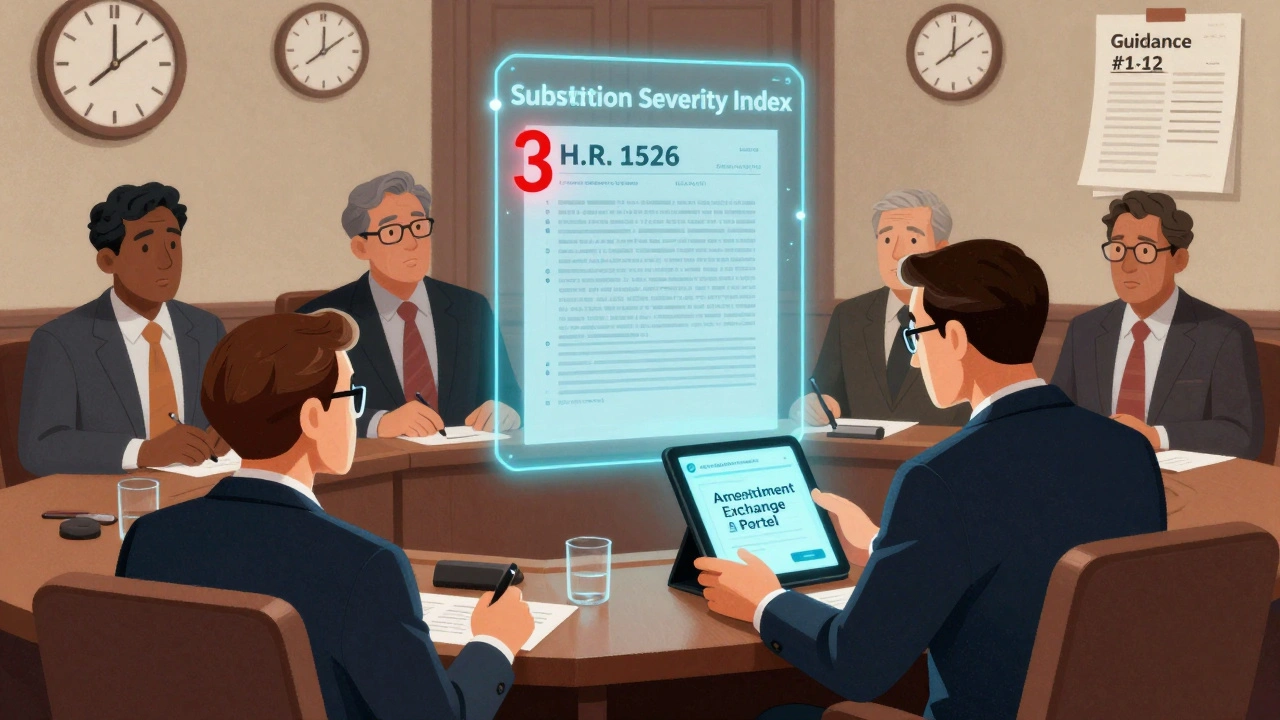
The way amendments are swapped out in Congress has changed dramatically since 2023. If you’ve ever wondered why some bills seem to move quickly while others stall for weeks, the answer often lies in the new rules around substitution. These aren’t just technical tweaks-they’ve reshaped how laws get made, who gets heard, and what gets passed.
What Exactly Is Amendment Substitution?
Amendment substitution is when a lawmaker replaces the full text of one proposed change to a bill with a different version. Think of it like editing a draft document: instead of adding notes in the margin, you delete the whole paragraph and paste in a new one. Before 2023, any member could swap an amendment on the floor with minimal notice. Now, it’s a tightly controlled process.
The shift began with the 118th Congress in January 2023, when Republicans took control of the House and pushed for faster, more predictable votes. But the real overhaul came in January 2025, with the adoption of H.Res. 5-the official rulebook for the 119th Congress. This isn’t just a minor update. It’s a complete redesign of how substitutions work.
The New Rules: How Substitution Works in 2025
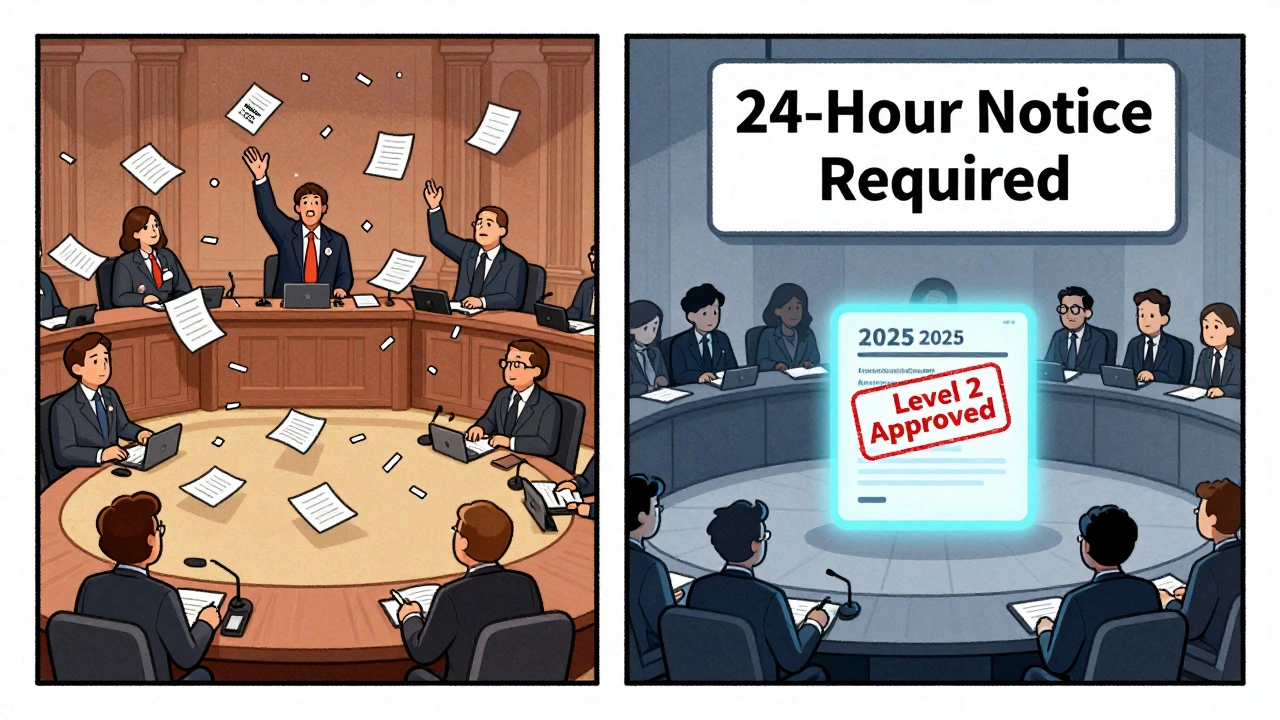
Under the current system, any lawmaker who wants to substitute an amendment must file it at least 24 hours before a committee meeting. That’s not optional. It’s enforced through a digital tool called the Amendment Exchange Portal, which launched in mid-January 2025. You can’t just email a draft or hand in a printed copy. Everything must be uploaded with specific metadata.
That metadata includes:
- Exact line numbers being replaced in the original text
- A written justification for the change
- Whether the substitution counts as a “germane modification”-meaning it’s directly related to the bill’s subject
Once filed, the request goes to a new Substitution Review Committee inside each standing committee. This group has five members: three from the majority party, two from the minority. They have just 12 hours to approve or reject the substitution.
Not all substitutions are treated the same. The system now uses a Substitution Severity Index with three levels:
- Level 1: Minor wording changes-like fixing a typo or clarifying a phrase.
- Level 2: Procedural changes-adjusting how something is enforced, not what it does.
- Level 3: Substantive policy changes-rewriting the core intent of the bill.
Level 1 and 2 substitutions only need a simple majority vote in the review committee. Level 3? That requires 75% approval. That’s a huge jump from the old 50% threshold.
What Changed From the Old System?
Before 2023, any member could submit a substitution without committee approval. It was called the “automatic substitution right,” and it had been in place since 2007. That meant a single member could drop a last-minute amendment that completely changed a bill’s meaning-sometimes to kill it outright. These were called “poison pill” amendments.
The new rules shut that down. According to the Congressional Research Service, the number of disruptive amendments dropped by 44% in the first quarter of 2025. Committees passed 28% more bills out of markup than they did in the same period in 2024.
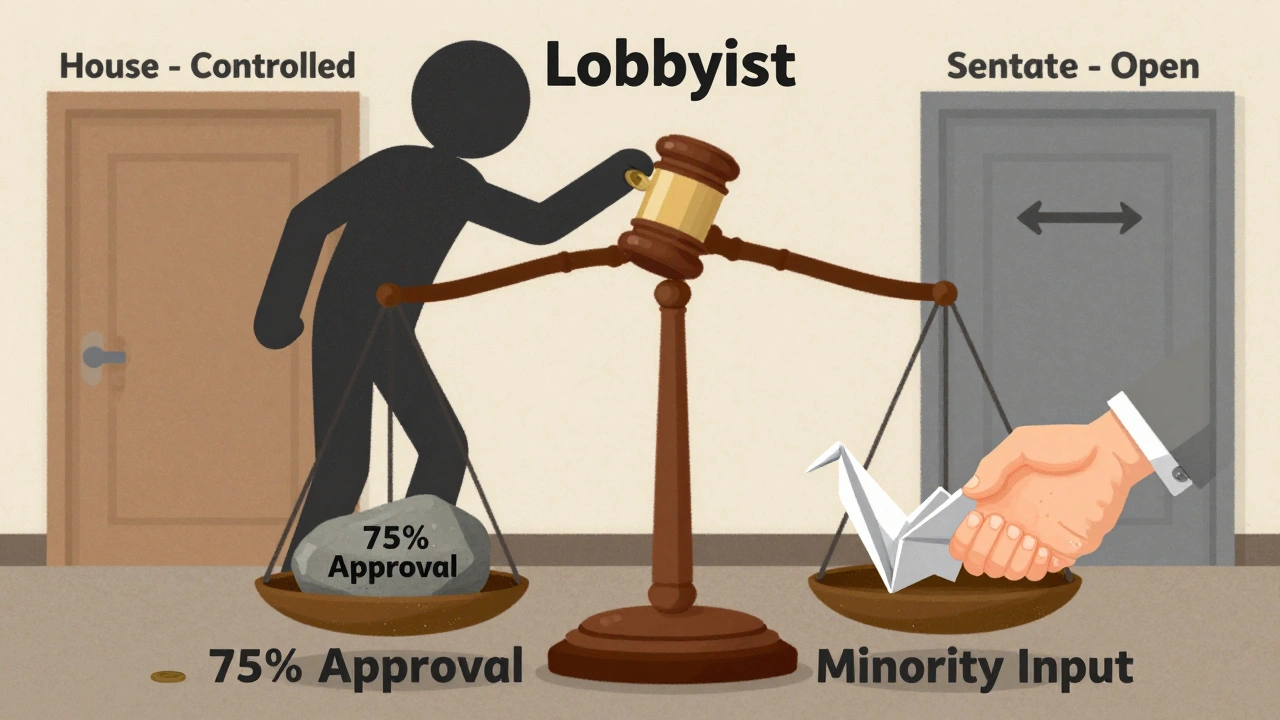
But there’s a trade-off. The Senate still lets members substitute amendments with just a 24-hour notice and no committee review. That means the House is now slower and more restrictive than the Senate on this issue. In fact, Senate substitution processes are 43% faster, according to the Congressional Management Foundation.
Who Benefits? Who Gets Left Out?
Majority party staff overwhelmingly say the new system works better. A May 2025 survey of 127 committee staff found that 68% of majority-party employees rated the system as “more efficient,” giving it an average score of 4.2 out of 5. They say they can plan better, avoid surprises, and get bills passed without last-minute chaos.
Minority staff? Not so much. Eighty-three percent of them called the system “restrictive of legitimate input,” with an average score of just 2.1 out of 5. Why? Because even well-intentioned changes can get blocked.
Representative Pramila Jayapal (D-WA) ran into this in March 2025. She submitted a substitution to H.R. 1526, a bill aimed at stopping rogue judicial rulings. Her changes were clearly Level 2-procedural tweaks to clarify enforcement. But the automated portal flagged them as Level 3. The review committee rejected it. She had to resubmit manually and wait another day.
Meanwhile, Representative Tony Gonzales (R-TX) praised the system during a May hearing, saying it stopped “last-minute sabotage amendments” during the defense bill markup. His point? The old system let the minority party hold the majority hostage. The new one gives the majority control.
Implementation Problems and Fixes
It wasn’t smooth at first. In January 2025, 43% of first-time filers messed up their submissions-mostly because they didn’t know how to use the portal or misunderstood the metadata rules. The House Rules Committee responded by releasing 12 detailed guidance memos and running mandatory training sessions. By May, the error rate dropped to 17%.
Still, confusion lingers. The Minority Staff Association pointed out that “Level 3” determinations still feel arbitrary. One change might be labeled Level 2 in one committee and Level 3 in another. That inconsistency fuels accusations of partisan bias.
And then there’s the training burden. Committee staff now report spending an average of 14 hours learning the new rules. That’s time taken away from drafting bills, talking to constituents, or even sleeping.
The Bigger Picture: Why This Matters
These changes didn’t happen in a vacuum. Between 2023 and 2025, 78% of state legislatures adopted similar substitution restrictions. Lobbying firms had to restructure their teams. Instead of targeting floor votes, they now focus on committee staff-the people who actually review substitutions.
Lobbying spending shifted too. In the first half of 2025, committee-specific lobbying rose 29%, while floor lobbying dropped. That means influence is now concentrated in fewer hands.
Legal experts are watching closely. The Constitutional Accountability Center filed an amicus brief in May 2025 arguing the rules may violate the First Amendment by restricting lawmakers’ ability to speak freely on the floor. A court challenge could come.
There’s also a looming legislative battle. In June 2025, H.R. 4492-the Substitution Transparency Act-was introduced. It would force the review committees to publish their deliberations within 72 hours. Right now, those meetings are private. If this bill passes, it could bring more accountability-or more political drama.
What’s Next?
The Senate is considering a bill that would standardize substitution rules across both chambers. But the parliamentarian ruled key parts of it noncompliant with the Byrd Rule-meaning it can’t be passed with a simple majority. That’s a dead end for now.
The Congressional Budget Office predicts that by 2026, the average time to consider each amendment will drop from 22 minutes to 14 minutes. That’s faster. But faster doesn’t always mean fairer.
Groups like the Heritage Foundation believe these rules are here to stay. They see them as necessary efficiency gains. The Brennan Center, however, warns of a backlash. They predict that after the 2026 elections, if control shifts in the House, the entire system could be ripped up and rewritten.
For now, the rules are in place. They favor control over chaos. They favor predictability over spontaneity. And they’ve made it harder for the minority to change the course of a bill-not by voting it down, but by making it nearly impossible to even propose a meaningful alternative.
Frequently Asked Questions
What is the Amendment Exchange Portal?
The Amendment Exchange Portal is the official digital system used by the U.S. House of Representatives to submit and review amendment substitutions. It requires users to upload metadata, including exact line numbers, justification, and classification of change severity. It became mandatory on January 15, 2025.
Can minority members still influence legislation under the new rules?
Yes, but it’s harder. Minority members can still propose amendments and request substitutions, but they now need approval from a review committee dominated by the majority party. Level 3 substitutions require 75% approval, which makes major policy changes nearly impossible without majority support. Their influence has shifted from floor maneuvering to behind-the-scenes negotiation.
Why are Level 3 substitutions so hard to pass?
Level 3 substitutions involve substantive policy changes-like rewriting the core purpose of a bill. The 75% approval threshold was raised from 50% to prevent last-minute, high-stakes amendments that could derail bills. This gives the majority party more control over the legislative agenda and reduces the risk of surprise amendments that lack public scrutiny.
How has the new system affected bill passage rates?
In the first quarter of 2025, 28% more bills passed committee markup compared to the same period in 2024. This is largely attributed to fewer disruptive amendments and more predictable scheduling. However, this efficiency comes at the cost of reduced minority input, which critics argue undermines democratic deliberation.
Are there any legal challenges to the new substitution rules?
Yes. The Constitutional Accountability Center filed an amicus brief in May 2025 arguing that the rules restrict lawmakers’ First Amendment rights by limiting their ability to offer meaningful amendments. A formal lawsuit hasn’t been filed yet, but legal experts say it’s likely if the rules remain unchanged after the 2026 elections.
What’s the difference between House and Senate substitution rules?
The House requires 24-hour notice, electronic submission, committee review, and severity classification. The Senate only requires 24-hour notice and no formal review. As a result, substitution in the Senate is 43% faster. This creates a two-track system where the House is more controlled and the Senate remains more open.
How do lobbyists adapt to the new substitution rules?
Lobbying firms have shifted resources from floor lobbying to committee staff. Since substitutions now require committee approval, lobbyists focus on building relationships with members of the Substitution Review Committee and understanding the Level 1-3 classification system. A Quinn Gillespie & Associates memo from February 2025 confirmed that 63% of major firms restructured their amendment tracking teams in early 2025.
Michael Dioso
December 5, 2025 AT 23:18This whole substitution system is just majority party theater. They call it 'efficiency' but it's really just shutting down debate. Remember when the minority could actually influence bills? Now they're reduced to begging for Level 1 tweaks. This isn't reform-it's authoritarianism in a suit.
Rupa DasGupta
December 7, 2025 AT 12:39Ugh I hate this so much 😩 the portal glitches every time I try to submit and then they say 'you didn't follow metadata rules' like I'm supposed to be a tech wizard?? I just want my amendment to be heard!! 💔
Marvin Gordon
December 9, 2025 AT 11:45Look, I get the frustration-but let’s be real. Before 2023, half the bills got derailed by some guy in the back row dropping a 20-page amendment that rewrote the whole thing at 2 AM. This system isn’t perfect, but it stopped the chaos. We need structure, not anarchy on the floor.
ashlie perry
December 10, 2025 AT 14:54Did you know the Amendment Exchange Portal is secretly linked to a DARPA AI that predicts which amendments will 'threaten the stability of the legislative ecosystem'? That’s why Jayapal’s Level 2 got flagged as Level 3. They don’t want change. They want control. And the training sessions? They’re brainwashing staff to fear dissent.
Ali Bradshaw
December 11, 2025 AT 11:07It’s a trade-off, no doubt. Faster passage means more laws get made, which is good. But the cost is legitimacy. When the minority feels silenced, even if they’re technically allowed to speak, the whole system loses trust. Maybe the answer isn’t more rules-it’s more transparency.
an mo
December 12, 2025 AT 09:49Let’s cut the crap. The Senate’s 43% faster because they’re still operating in the 1990s. The House is the only chamber with the guts to modernize. If you can’t handle metadata, maybe you shouldn’t be drafting amendments. This isn’t about oppression-it’s about accountability. Stop whining and learn the system.
aditya dixit
December 13, 2025 AT 22:29There’s a philosophical tension here between procedural efficiency and democratic participation. The old system prioritized the latter, often at the cost of coherence. The new one prioritizes the former, risking alienation. But is a law that passes quickly but lacks broad legitimacy truly a law? Or just a temporary administrative directive?
William Chin
December 14, 2025 AT 13:14While I appreciate the intent behind the Substitution Review Committee, I must respectfully submit that the implementation of the Amendment Exchange Portal constitutes a non-trivial administrative burden inconsistent with the principles of parliamentary privilege as codified in Clause 1, Section 5 of the U.S. Constitution. The requirement for metadata submission infringes upon the legislative independence guaranteed to Members of the House.
Ada Maklagina
December 16, 2025 AT 04:33They say it’s faster but I’ve seen the same people get the same amendments approved every time. It’s not about rules-it’s about who you know. The portal’s just a fancy filter for the old boys’ club.
Deborah Jacobs
December 17, 2025 AT 03:09I just want to say how sad it is that we’ve turned lawmaking into a video game where you need a perfect score on metadata to even get a level 2 unlock. People aren’t just fighting for policy anymore-they’re fighting just to be heard. And the people who get crushed in this system? They’re not lobbyists. They’re nurses, teachers, veterans-regular folks trying to fix something broken. The system doesn’t just favor the majority. It favors the quiet ones who know how to play the game.