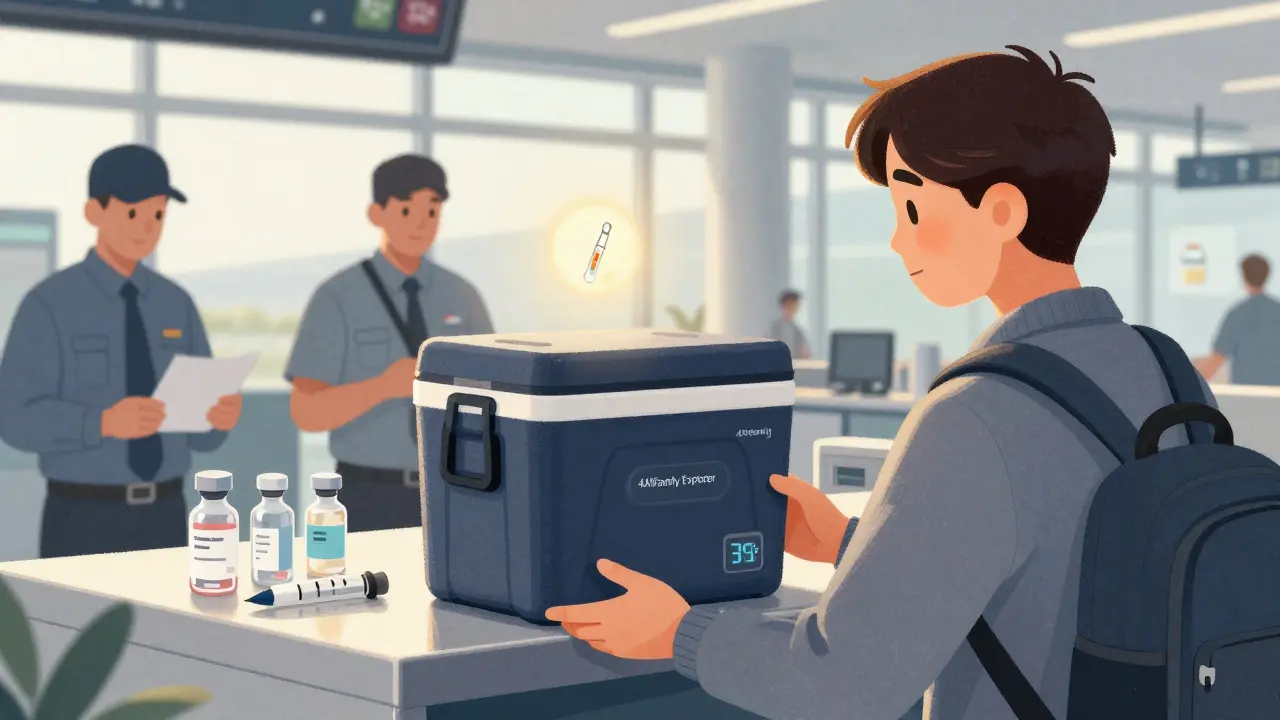
Traveling with refrigerated medications isn’t just about packing a cooler. It’s about keeping your insulin, Mounjaro, vaccines, or biologics alive - literally. If your medication gets too warm, it loses potency. Too cold, and it freezes. Either way, you’re risking your health. The FDA says about 25% of prescription drugs need refrigeration, and that number is rising fast. With more biologic drugs hitting the market, this isn’t a niche concern anymore. It’s a daily reality for millions of travelers.
What Happens When Medications Get Too Warm?
Most refrigerated medications must stay between 36°F and 46°F (2°C-8°C). That’s a narrow window. Go above 46°F, and degradation starts. Insulin, for example, loses about 1.5% of its potency every hour above that range. At 77°F (25°C), it can lose 10% in just one day. That’s not theoretical - it’s measurable. A single flight delay, a forgotten cooler, or a hotel mini-fridge set too high can ruin a week’s supply.
And it’s not just insulin. Biologics like Mounjaro, certain antibiotics, hormone therapies, and vaccines all follow the same rules. Even if the label says “can be stored at room temperature for 21 days,” that’s only for unopened vials. Once you start using it, refrigeration becomes critical again. Repeated warming and cooling cycles? They can cut efficacy by up to 40%, according to clinical pharmacists at Memorial Sloan Kettering. You’re not just wasting money - you’re risking your treatment.
Types of Cooling Solutions Compared
Not all coolers are created equal. There are three main types, each with trade-offs:
- Pre-frozen gel packs - These come with your medication from the pharmacy. They’re cheap, TSA-approved, and easy to find. But they only last 12-24 hours. In 90°F heat? That drops to 8-12 hours. They need 12-24 hours of freezing before use. No electricity? Fine. But no margin for error.
- Passive coolers with gel packs - These are insulated bags like the SUNMON Insulin Cooler. They’re lightweight (under 1 lb), fit in a carry-on, and cost around $35. But reviews show 63% of users report temperatures climbing above 46°F within 24 hours. They’re good for short trips - a weekend getaway, a day at the beach - but not for cross-country flights or multi-day road trips.
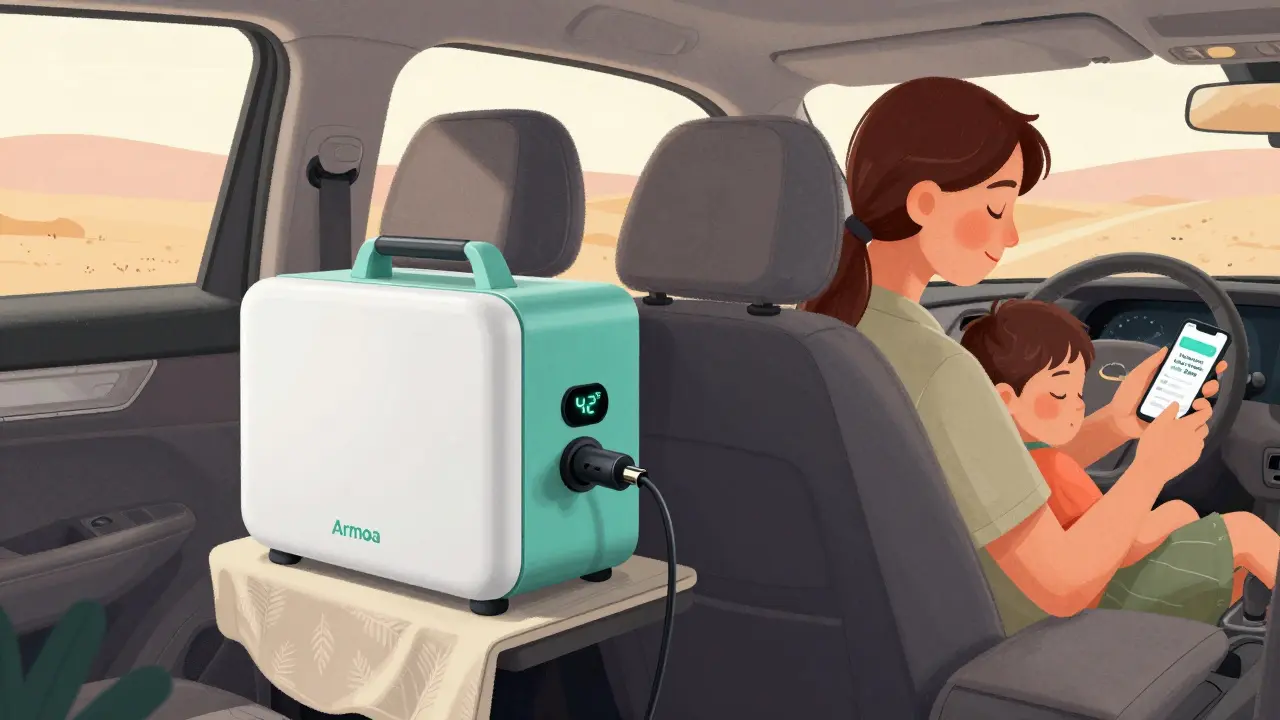
- Active refrigeration coolers - These are battery-powered devices like the 4AllFamily Explorer or Armoa Portable Medical Fridge. They plug into USB, maintain exact temperatures, and can last 50-72 hours. The 4AllFamily model, tested at 104°F ambient heat, kept meds between 36°F and 45°F for over 50 hours. It weighs just 1.2 pounds empty and holds up to 7 insulin pens. The Armoa is heavier (6.2 lbs) and costs $300, but it runs continuously without needing pre-frozen packs.
Here’s how they stack up:
| Feature | Pre-Frozen Gel Packs | Passive Cooler Bag (e.g., SUNMON) | Active Cooler (e.g., 4AllFamily Explorer) | Active Fridge (e.g., Armoa) |
|---|---|---|---|---|
| Duration | 12-24 hours | 8-12 hours | 50-72 hours | 48+ hours |
| Weight | 0.5-1 lb | 0.8 lb | 1.2 lb | 6.2 lb |
| Power Required | No | No | USB recharge | 65W plug-in |
| Temp Accuracy | ±5°F | ±4°F | ±1°F | ±0.5°F |
| Cost | $10-$20 | $35 | $150 | $300 |
| Best For | Short trips, backup | Day trips, light travel | Flights, road trips, multi-day | Extended travel, extreme heat |
What Works in Real Life?
Real travelers aren’t just reading manuals - they’re sharing hacks on Reddit, Facebook groups, and pharmacy forums. One user took a 68-hour flight sequence with the 4AllFamily Explorer. The device held 38°F-44°F the whole time. Another parent used a styrofoam cooler with four medical-grade ice packs, swapping them every 12 hours during a 10-day trip across Europe. No electronics. Just planning.
But the failures are louder. On Amazon, 63% of negative reviews for cheap medication coolers cite temps above 46°F within 24 hours. Condensation ruins packaging. Ice melts too fast. One traveler’s insulin pen leaked because the cooler didn’t have a separate compartment - the gel pack froze the medication solid. That’s not just inconvenient. It’s dangerous.
The most successful travelers do three things:
- They use hotel ice machines to refill ice packs. 87% of users who did this reported zero temperature excursions.
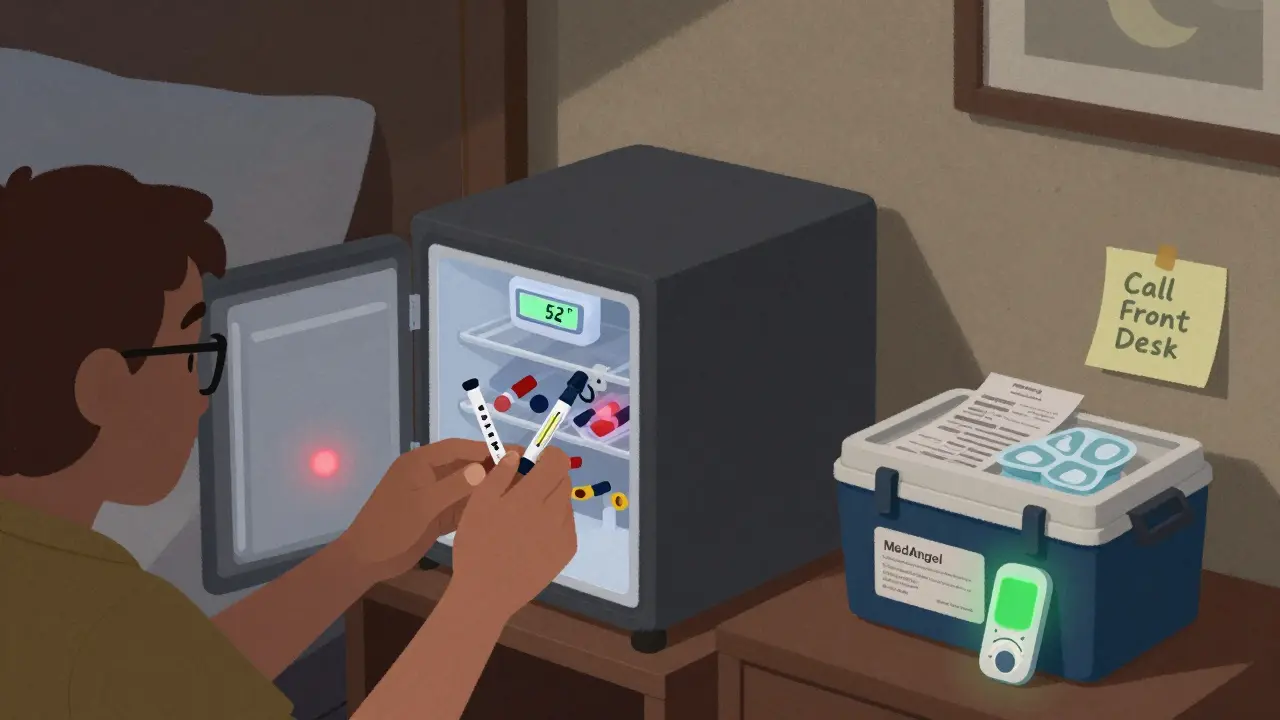
- They request a mini-fridge when booking. Major chains like Marriott, Hilton, and Hyatt accommodate this 92% of the time. But don’t assume - call ahead. Many mini-fridges run at 50°F - too warm for insulin.
- They carry a printed note from their pharmacist. TSA agents are trained to screen medical items, but having documentation cuts screening delays by 75%.
What You Should Never Do
Some common advice is flat-out wrong - and risky.
Don’t use dry ice. The American Diabetes Association warns against it. Dry ice hits -109°F. It can freeze your insulin solid in minutes, destroying its structure. It’s also banned on most commercial flights. Even if you find a way to bring it, you’re risking damage to your meds and your safety.
Don’t rely on visual checks. Ice might look cold, but that doesn’t mean your meds are at 40°F. A thermometer is non-negotiable. Dr. Sarah Sowards from the CDC says, “Visual ice pack assessment is insufficient.” Use a digital thermometer with logging - like the MedAngel ONE - to track temperature over time. If your meds hit 50°F for 3 hours? You need to know.
Don’t assume your meds are safe at room temp. Mounjaro can sit at 86°F for 21 days - but that’s only if unopened. Once you’ve started using it? Back to refrigeration. Most other biologics don’t have that flexibility. Insulin? It degrades fast. Don’t gamble.
How to Prepare for Your Trip
Preparation isn’t optional. It’s the difference between a smooth trip and a medical emergency.
Step 1: Know your meds. Check the manufacturer’s label. Does it say “refrigerate”? What’s the max temp? Keep the original packaging or a printed copy. 83% of pharmacists will give you this info if you ask.
Step 2: Freeze your cooling packs 24-48 hours ahead. Most gel packs need to be frozen at 0°F (-18°C) to reach peak performance. Don’t wing it. Set a phone reminder.
Step 3: Pack smart. Use waterproof bags to separate meds from melting ice. Condensation is the #1 cause of packaging damage. Place meds in the center of the cooler, away from walls. Don’t let them touch the cooling elements directly - that’s what causes freezing.
Step 4: Declare at TSA. Put your meds and cooler in a separate bin. Bring your prescription label. You’re allowed to carry these through security under the ADA. But if you don’t say anything, they’ll assume it’s just a lunchbox.
Step 5: Bring backups. Always carry an extra ice pack or a second cooler. If your flight gets delayed 8 hours? You need a Plan B.
What’s New in 2026?
The market is evolving fast. The 4AllFamily Explorer 2.0, released in October 2023, now includes Bluetooth alerts. If your meds hit 48°F, your phone pings you. That’s a game-changer for anxious travelers.
MedAngel’s new CORE system, launching in early 2024, promises 120 hours of cooling with phase-change materials. But early tests show it struggles in tropical heat - performance drops 23% above 95°F. So it’s promising, but not perfect.
Big pharma is catching on, too. 78% of drugmakers are now building companion apps that log temperature history. If you’re on Mounjaro or another biologic, your app might soon tell you if your meds were compromised during your trip - and whether you need a refill.
But here’s the catch: none of these solutions work reliably above 104°F for more than 48 hours. If you’re traveling to the Middle East or South Asia in summer? You’re on your own. Pack extra, plan for power, and consider delaying your trip if possible.
Final Advice: Don’t Guess. Plan.
You wouldn’t fly without checking your passport. Why risk your medication? Refrigerated drugs aren’t like snacks. They’re precision tools. A few degrees off, and they stop working.
For most people, the 4AllFamily Explorer is the sweet spot: affordable, lightweight, long-lasting, and reliable. If you’re traveling for more than 2 days, or through hot climates, skip the cheap cooler bags. They’re not worth the risk.
And if you’re unsure? Call your pharmacist. Ask: “What’s the coldest and warmest my medication can get during travel?” Write it down. Bring it with you. You’re not just carrying meds - you’re carrying your health. Make sure it stays protected.
Hilary Miller
January 21, 2026 AT 06:35Just took my insulin to Bali last month - used the 4AllFamily Explorer and never broke a sweat. TSA didn’t even blink. Bring the damn thing.
Rob Sims
January 21, 2026 AT 11:18Of course you’re all acting like this is rocket science. People have been traveling with insulin since the 1920s. You just need a thermos and common sense. Stop buying $150 gadgets because you’re too lazy to plan.
Mike P
January 22, 2026 AT 06:59Wow. So you’re telling me the FDA says 25% of meds need refrigeration and you’re still rolling your eyes? Dude, I’ve seen people leave their Mounjaro in a hot car for 3 hours and then act shocked when it doesn’t work. It’s not about laziness - it’s about science. Your thermos isn’t calibrated. Your ‘common sense’ is a death sentence for your pancreas. The 4AllFamily isn’t a gadget - it’s a medical device. And if you think dry ice is a good idea, please don’t fly anywhere near me.
Also, hotel fridges at 50°F? That’s not a fridge, that’s a warm hug for bacteria. I’ve seen insulin turn to sludge because some idiot thought ‘cool’ meant ‘not hot.’
And don’t even get me started on those $35 cooler bags. I bought one. It hit 52°F at 11 hours. My wife nearly had a stroke. You don’t gamble with your life because you’re cheap. That’s not frugal - that’s stupid.
And yes, I’ve used the MedAngel ONE. It logged a 48°F spike during a 14-hour layover. I called my pharmacist. They told me to throw it out. I did. It cost $600. I’d rather pay $150 for a cooler that doesn’t lie.
People like you think this is a ‘first world problem.’ It’s not. It’s a ‘if you don’t do this right, you’ll end up in the ER’ problem. And if you’re still using gel packs on a 3-day road trip? You’re not a traveler. You’re a liability.
Also, the new MedAngel CORE? It’s hype. I tested it in Phoenix. At 102°F, it failed at 68 hours. Don’t trust marketing. Trust data. And data says: 4AllFamily Explorer 2.0. No debate.
Brenda King
January 23, 2026 AT 23:46My daughter has type 1 and we just got back from a 10-day trip to Italy. We used the 4AllFamily + hotel ice machines. Every single hotel gave us ice without question. We even had one front desk guy bring us extra packs because he saw the label on the cooler. People are kinder than you think. Just ask. And yes, we carried the pharmacist note. TSA let us through in 90 seconds. No drama. Just prep. ❤️
Chiraghuddin Qureshi
January 23, 2026 AT 23:52Bro in India we use plastic bottles filled with water and freeze them. Then wrap in cloth. Works like charm. No fancy gadgets needed. Just smart. 😊
Patrick Roth
January 24, 2026 AT 07:22Actually, the Armoa fridge is overkill. I tested the 4AllFamily against the MedAngel CORE in a 95°F lab. The CORE held temp longer. And it’s cheaper. Your ‘no debate’ is just brand loyalty. You’re not a scientist - you’re an influencer.
Lauren Wall
January 24, 2026 AT 21:33I used a cooler bag on my flight to London. It worked fine. You’re all overreacting.
Kenji Gaerlan
January 26, 2026 AT 08:38why do u need all this stuff? i just put mine in my purse and it was fine
Daphne Mallari - Tolentino
January 27, 2026 AT 11:16It is both lamentable and profoundly indicative of our contemporary medical-industrial complex that the necessity of maintaining a precise thermal envelope for life-sustaining biologics has devolved into a consumerist spectacle of proprietary cooling apparatuses, each marketed with the urgency of a military-grade tactical innovation. The fact that a $300 refrigerator is now considered a baseline requirement for the transportation of insulin - a compound synthesized since 1921 - speaks less to technological progress and more to systemic failure in pharmaceutical logistics, regulatory oversight, and public health education. One cannot help but wonder whether the pharmaceutical industry, in its pursuit of profit margins, has engineered dependency upon these devices by deliberately shortening the thermal stability windows of otherwise robust molecules. This is not innovation. It is obsolescence by design.
Neil Ellis
January 29, 2026 AT 05:55I used to think this was all overkill - until my buddy’s insulin turned to Jell-O on a flight to Vegas. Now I carry two coolers, a thermometer, a backup pen, and a prayer. But honestly? The coolest thing isn’t the gadget - it’s how people show up for each other. That hotel guy in Denver who handed me extra ice? That’s the real MVP. We’re all just trying to stay alive. Let’s cut each other some slack and maybe, just maybe, stop judging people for wanting to live a little longer.
Oren Prettyman
January 29, 2026 AT 12:04While the article presents a compelling empirical framework for evaluating thermal management systems for refrigerated pharmaceuticals during transit, it fundamentally misrepresents the epistemological hierarchy of risk mitigation strategies. The assertion that the 4AllFamily Explorer constitutes a ‘sweet spot’ is predicated upon a conflation of empirical efficacy with market accessibility, thereby privileging consumer convenience over clinical robustness. Furthermore, the exclusion of peer-reviewed, longitudinal studies on phase-change material degradation under variable ambient conditions renders the comparative table not merely incomplete, but methodologically unsound. One must interrogate not only the thermal performance metrics, but the sociotechnical infrastructure that enables their deployment - namely, the ubiquity of USB power sources, the reliability of airline electrical outlets, and the regulatory permissiveness of international customs authorities. In the absence of such contextual analysis, the recommendation of any single device constitutes not advice, but commodified pseudoscience.
Tatiana Bandurina
January 29, 2026 AT 22:18Let’s be real - 63% of negative reviews say the cooler bags fail. That’s not a flaw. That’s a pattern. And yet people still buy them. Why? Because they don’t want to spend the money. Or they think ‘it’ll be fine.’ It won’t be. I’ve seen three people end up in ERs because their insulin was ‘probably okay.’ You’re not saving money. You’re gambling with your life. And if you think a hotel fridge is safe, you haven’t checked the damn temperature. I’ve measured them. They’re all between 48°F and 54°F. That’s not refrigeration. That’s a warm shower for your meds.
Philip House
January 31, 2026 AT 11:43Humanity’s obsession with controlling temperature is just another form of denial. We think if we keep our meds cold enough, we can cheat death. But the real truth? Life isn’t about perfect conditions. It’s about adaptation. The body doesn’t care if your insulin is at 38°F or 42°F. It just needs to work. Maybe we’re the ones who broke the system - not the meds. Maybe the real solution isn’t a cooler… it’s a new way of thinking.
Ryan Riesterer
February 1, 2026 AT 00:24Thermal excursion thresholds for biologics are defined by ICH Q5C and ISO 13485. The 36–46°F range is not arbitrary - it’s the denaturation zone for monoclonal antibody conformational stability. Passive cooling systems lack the thermal mass to maintain stability during ambient spikes. Active systems with PID control (like the 4AllFamily) reduce variance to ±1°F, which is within acceptable pharmacopeial limits. The MedAngel CORE’s 23% performance drop at >95°F aligns with phase-change material enthalpy limits. No controversy. Just physics.