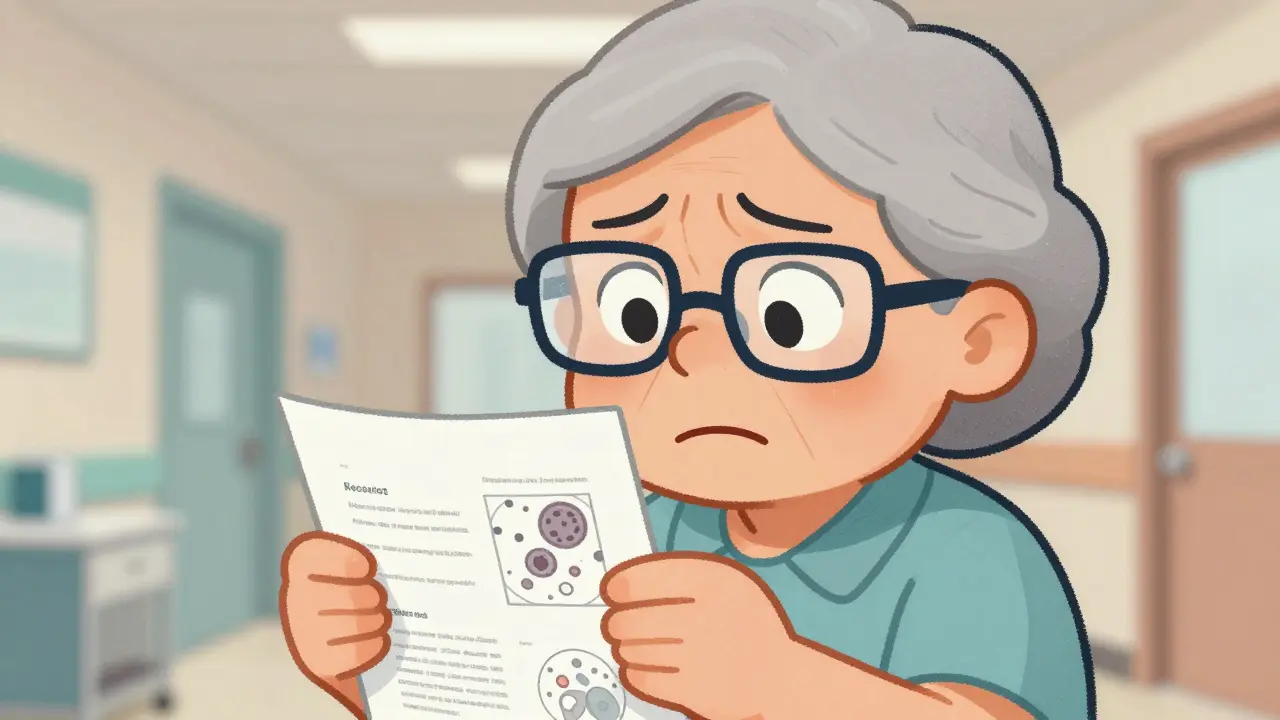
Imagine handing a discharge instruction sheet to a patient who is 78 years old. The text is dense, the font is tiny, and the medical jargon is thick. Now imagine that same patient trying to read it with failing eyesight, while processing new information about a complex medication regimen. This scenario plays out in hospitals and clinics every single day. It isn't just an inconvenience; it’s a safety risk.
Senior patient education is the specialized practice of creating and delivering health information designed specifically for adults aged 65 and older. It addresses the unique barriers older adults face, including declining vision, hearing loss, cognitive changes, and lower health literacy. When we get this right, we reduce medical errors, improve treatment adherence, and keep people out of the hospital. When we get it wrong, the costs are staggering-both financially and in terms of human suffering.
The Reality of Health Literacy in Older Adults
We often assume that because someone is older, they are more educated or better at understanding health information. The data says otherwise. According to the CDC’s analysis of the National Assessment of Adult Literacy, 71% of adults over age 60 had difficulty using print materials. Even worse, 80% struggled with documents like forms or charts, and 68% found interpreting numbers and calculations challenging.
This isn't about intelligence. It's about the intersection of aging physiology and complex system design. As we age, our visual acuity drops, our working memory capacity shrinks, and our ability to process conflicting information slows down. Add to this the fact that many older adults grew up in eras where patients were told what to do, not how to participate in their care, and you have a recipe for confusion.
The financial impact is real. The Agency for Healthcare Research and Quality (AHRQ) estimates that limited health literacy costs the U.S. healthcare system between $106 billion and $238 billion annually. Older adults bear a disproportionate share of this burden. They are 2.3 times more likely to report poor health status and 1.7 times more likely to have diabetes if they struggle with health literacy. These aren't just statistics; they represent preventable complications and avoidable emergency room visits.
Design Principles for Senior-Friendly Materials
If you are creating or selecting materials for older adults, generic "plain language" guidelines aren't enough. You need specific, evidence-based design choices. The National Institute on Aging (NIA) and the CDC provide clear standards that go beyond common sense.
First, look at the physical format. The NIA guidelines specify a minimum 14-point font size using easy-to-read typefaces like Arial or Helvetica. Avoid italics and underlining, which can be hard to distinguish from other letters. Use high-contrast colors-black text on white or cream paper is best. Blue or gray ink can disappear for someone with cataracts.
Second, simplify the content structure. Write at a 3rd to 5th grade reading level. Yes, even if your audience has college degrees. Stress, illness, and anxiety lower everyone's reading comprehension temporarily. A study published in the Journal of General Internal Medicine in 2021 showed that materials written at this level improved comprehension by 42% among adults over 65 compared to standard medical texts.
- Use short sentences: Keep them under 20 words whenever possible.
- Avoid jargon: Say "high blood pressure" instead of "hypertension." Say "sugar in the blood" instead of "glucose levels" unless you define it clearly first.
- Use visuals: Illustrations, diagrams, and photos should support the text, not decorate it. A picture of a pill bottle with a label pointing to the dosage time is worth a paragraph of instructions.
- Provide context: When mentioning similar-sounding letters or numbers, use phonetic cues (e.g., "m as in Mary").
The Power of Multimodal Communication
Relying solely on printed handouts is outdated. Dr. Lynda Anderson, former Director of the CDC’s Healthy Aging Program, emphasizes that addressing health literacy requires a supportive communication environment that acknowledges sensory and cognitive changes. This means using multiple channels simultaneously.
Effective senior patient education combines print, audio, video, and interpersonal interaction. For example, when explaining a new medication, provide a printed card with large fonts, show a video demonstration of how to take it, and then engage in a conversation to confirm understanding. The American Geriatrics Society’s HealthinAging.org portal exemplifies this approach, offering resources in various formats and reporting 2.3 million annual accesses since 2020.
Technology also plays a growing role. Telehealth utilization among older adults jumped from 17% in 2019 to 68% in 2023. This shift demands that digital platforms be accessible too. Voice-activated tools, simplified navigation, and larger touch targets are no longer luxuries-they are necessities. The NIA’s updated Go4Life exercise program, launched in January 2024, incorporates voice-activated technology and simplified video demonstrations to meet this need.
The Teach-Back Method: Your Best Tool
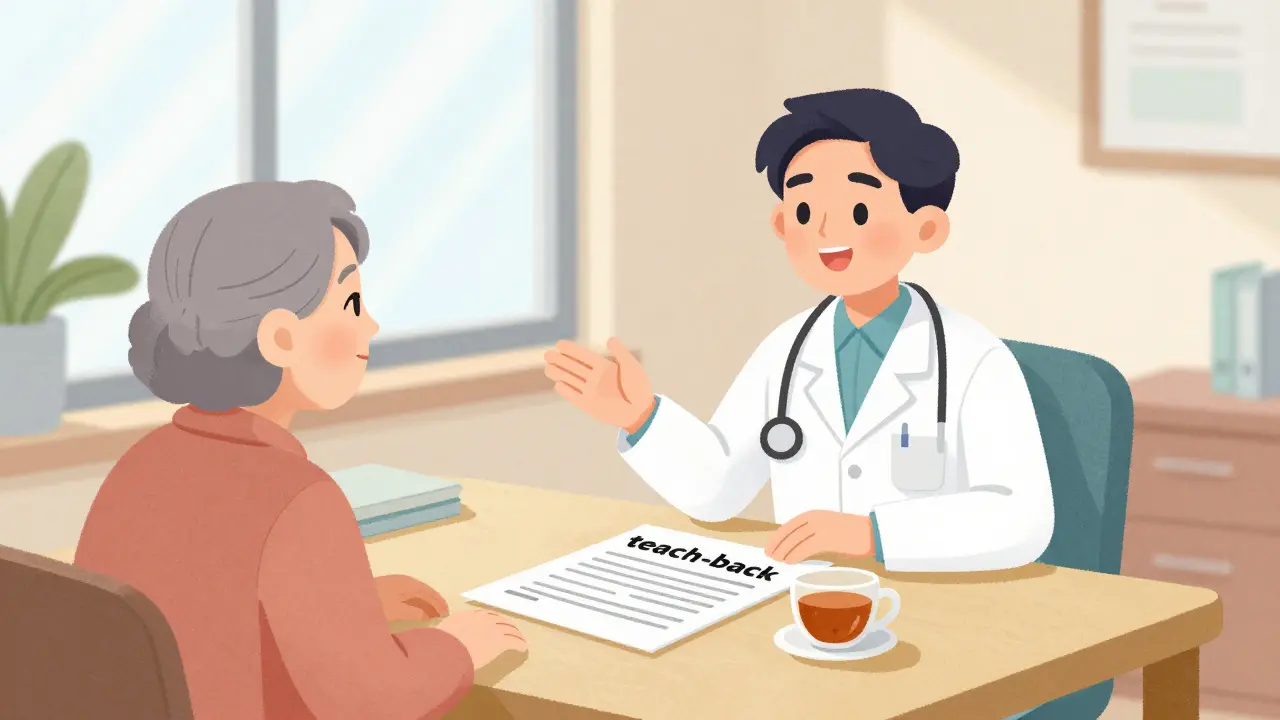
You can have the most beautifully designed pamphlet in the world, but if the patient doesn't understand it, it’s useless. The gold standard for confirming understanding is the teach-back method. This involves asking the patient to repeat the information back to you in their own words.
It’s not about testing the patient; it’s about testing your communication. If they can’t explain it simply, you haven’t explained it clearly yet. Research in Patient Education and Counseling (2022) found that providers who used health literacy techniques, including teach-back, spent only 2.7 additional minutes per visit but achieved 31% better comprehension outcomes.
Here’s how to do it effectively:
- Ask open-ended questions: "What questions do you have about taking this medicine?"
- Request confirmation: "To make sure I explained this well, could you tell me how you plan to take this pill?"
- Correct misunderstandings gently: "Let me try saying that another way..."
- Repeat until understood: Don’t move on until the patient demonstrates accurate recall.
Barriers exist here too. A 2022 survey by the National Council on Aging found that 51% of older adults admitted to not asking for clarification when confused due to embarrassment or fear of appearing unintelligent. This makes the provider’s proactive use of teach-back critical. You must create a safe space where confusion is normalized, not stigmatized.
| Feature | Standard Material | Senior-Optimized Material |
|---|---|---|
| Font Size | 10-12 point | Minimum 14 point |
| Reading Level | 8th-10th grade | 3rd-5th grade |
| Language Style | Medical terminology common | Plain language, defined terms |
| Visual Support | Minimal or decorative | Integrated instructional graphics |
| Verification | Assumed understanding | Mandatory teach-back component |

Implementation Challenges and Solutions
Knowing what to do is different from doing it. Healthcare systems face significant hurdles in implementing these changes. A 2023 American Medical Association survey cited limited staff time as the primary barrier, mentioned by 78% of providers. Another 65% of community health centers reported insufficient funding for specialized material development.
However, the return on investment is compelling. Medicare’s 2023 Annual Report to Congress highlighted that hospitals with comprehensive senior patient education programs saw 14.3% fewer readmissions among beneficiaries. That translates to approximately $1,842 in savings per patient. Furthermore, the AHRQ documented a 22% reduction in emergency department visits among older adults within 18 months of implementing universal health literacy precautions.
To overcome resource constraints, organizations can leverage existing high-quality resources rather than building from scratch. The HealthPartners Institute maintains a database of over 1,300 customized materials. MedlinePlus offers an "Easy-to-Read Health Information" section with 217 vetted resources. Using these established tools saves time and ensures quality.
Training is equally important. The American Medical Association’s 2024 policy update recommends 8 hours of health literacy instruction for all medical students by 2026. Current providers need ongoing training to shift from a paternalistic model to a partnership model. This includes learning how to listen actively, recognize non-verbal cues of confusion, and adapt communication styles on the fly.
Future Trends in Senior Health Communication
The field is evolving rapidly. We are moving toward greater personalization. The National Institutes of Health is currently funding a $4.2 million study (R01AG078952) through 2026 to develop AI-driven patient education tools. These tools will adapt content based on individual cognitive and sensory capabilities in real-time.
Digital literacy is becoming intertwined with health literacy. As telehealth becomes the norm, older adults need support not just in understanding their health conditions, but in navigating the technology used to manage them. Future materials will likely include hybrid approaches-combining simple app interfaces with phone-based support lines.
Finally, there is a growing recognition of the role of caregivers. Amanda C., a caregiver from San Diego, noted on HealthinAging.org that the site helped her distill technical information into understandable formats for her family. Educating the support network around the patient is as crucial as educating the patient themselves. The next generation of senior patient education will treat the patient-caregiver unit as the primary target for communication strategies.
What is the recommended font size for senior patient education materials?
The National Institute on Aging recommends a minimum font size of 14 points. Using clear, sans-serif typefaces like Arial or Helvetica enhances readability further. High contrast between text and background is also essential.
Why is the teach-back method important for older adults?
The teach-back method confirms understanding by having patients repeat information in their own words. Studies show it improves comprehension outcomes by 31% and helps identify misunderstandings early, reducing medical errors and improving adherence to treatment plans.
At what reading level should senior health materials be written?
Materials should be written at a 3rd to 5th grade reading level. This accommodates the estimated 20% of U.S. adults who read at or below this level and accounts for the temporary decline in comprehension caused by stress, illness, or aging-related cognitive changes.
How much does limited health literacy cost the healthcare system?
The Agency for Healthcare Research and Quality estimates that limited health literacy costs the U.S. healthcare system between $106 billion and $238 billion annually. Older adults are disproportionately affected, leading to higher rates of hospital readmissions and emergency department visits.
Where can I find pre-made senior-friendly patient education materials?
Reputable sources include the National Institute on Aging (NIA), the CDC’s Healthy Aging Program, HealthinAging.org (American Geriatrics Society), and MedlinePlus. These organizations offer vetted, plain-language resources covering a wide range of health topics.