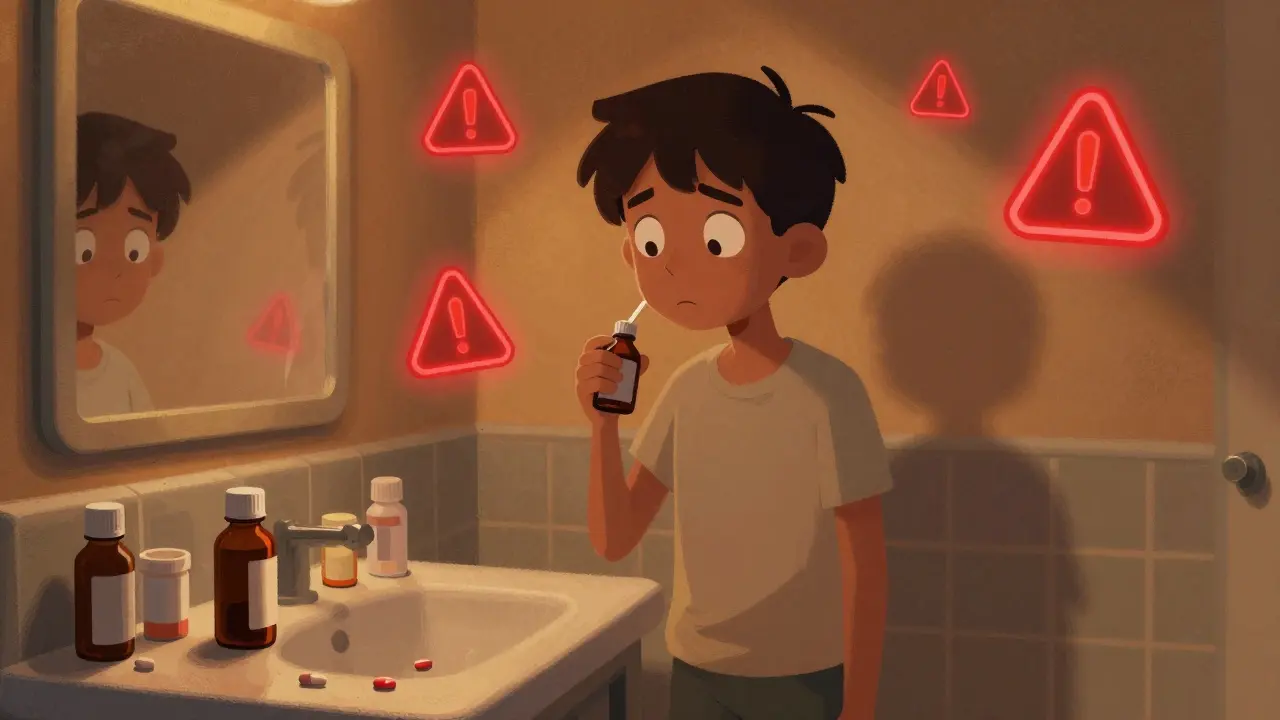
Most people think over-the-counter (OTC) drugs are safe because you don’t need a prescription. But that’s a dangerous assumption. Every year, thousands of people-especially teens and young adults-take way more than the label says, not to feel better, but to get high. It’s called OTC drug misuse, and it’s not harmless experimentation. It’s a slow-burning crisis with real, measurable damage.
What OTC Drug Misuse Actually Looks Like
It’s not just taking two pills instead of one. Misuse means using a medicine in a way it was never meant to be used. For example, swallowing 10 cough syrup doses at once to chase a hallucination. Or crushing loperamide pills to mimic opioid effects. This isn’t rare. In 2020, over 3 million Americans aged 12 and up misused OTC cough and cold meds. And it’s getting worse.
The most common target? Dextromethorphan, or DXM. It’s in hundreds of cough syrups, tablets, and gels. At normal doses (15-30 mg), it’s a safe cough suppressant. At 200-400 mg? It starts acting like ketamine-detaching you from your body, warping your senses. At 500-1,500 mg? You’re at risk of paralysis, seizures, and organ failure.
Physical Signs You Can’t Ignore
If someone’s misusing OTC drugs, their body gives away clues. These aren’t vague symptoms. They’re specific, documented changes:
- Dilated or pinpoint pupils-78% of DXM abusers show this, per Mayo Clinic data.
- Slurred speech-articulation errors jump from 2% at normal doses to 68% at abusive levels.
- Unexplained weight loss-chronic users lose an average of 12.7 pounds in just three months.
- High body temperature-fevers spike to 103-105°F, sometimes leading to heatstroke.
- Heart racing-heart rate jumps from 70 bpm to over 180 bpm. Blood pressure can hit 160/100.
- Liver damage-many cough syrups contain acetaminophen. Taking more than 4,000 mg a day can cause sudden, fatal liver failure.
One Reddit user, ‘CoughSyrupSurvivor,’ described a 1,200 mg DXM trip: “I couldn’t move for 8 hours. My heart was pounding at 147 bpm. The visual snow lasted three weeks.” That’s not a bad trip. That’s brain and heart trauma.
Behavioral Red Flags
The physical signs are scary, but the behavioral changes are often the first thing you notice.
- Sudden drop in grades-GPA falls from 3.4 to 2.1 in one semester, according to Tennessee Department of Health data.
- Secretive behavior-locked doors, password-protected phones, hiding pills in vitamin bottles. One rehab study found 100% of teens did this.
- Financial oddities-$127 a month vanishes without explanation. That’s often spent on multiple OTC products from different pharmacies.
- Isolation-social interactions drop from 5.2 per day to 1.7. Friends, family, sports-all gone.
- Risk-taking-driving while high, stealing, skipping school. They’re 3.2 times more likely to get pulled over or in a crash.
These aren’t teenage mood swings. They’re signs of a brain chemically rewired by repeated abuse.
Psychological Damage Is Real-and Lasting
OTC drugs don’t just mess with your body. They mess with your mind.
- Mood swings-5.7 times more frequent than in non-users.
- Paranoia-episodes lasting 2-4 hours after the high fades, reported in 44% of DXM users.
- Emotional numbness-feeling nothing for 12-24 hours after the drug wears off.
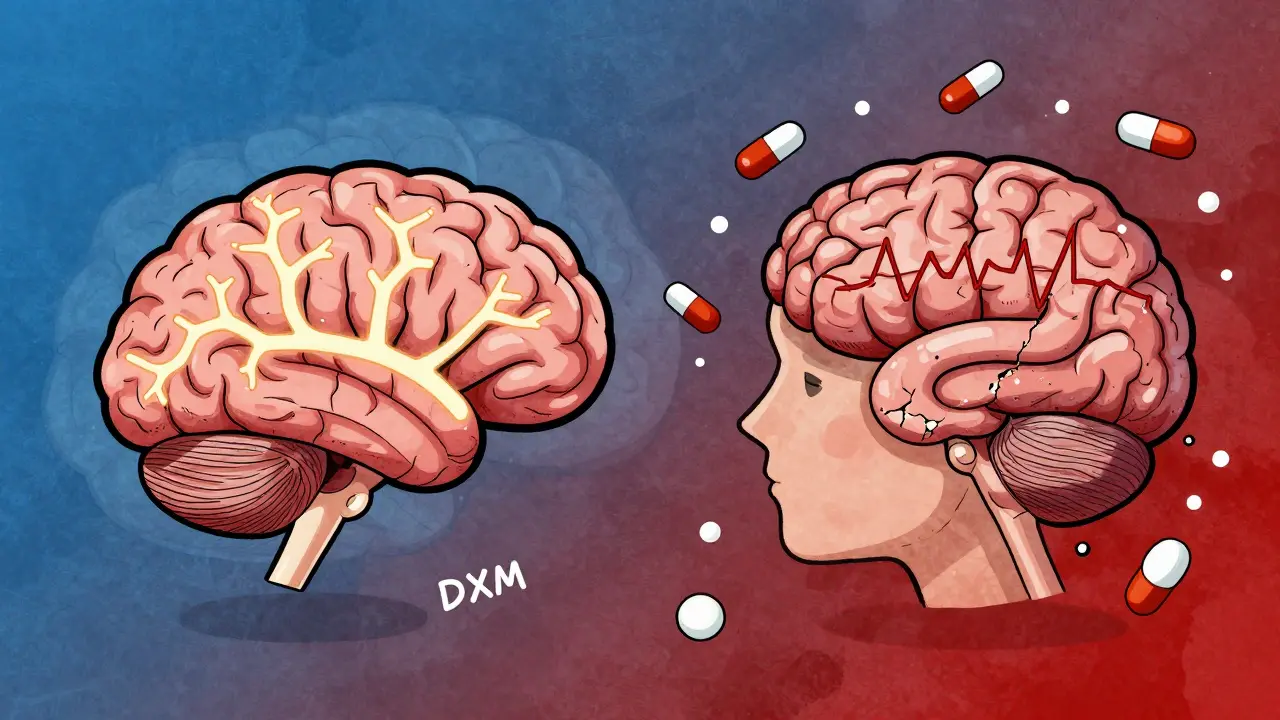
- Persistent psychosis-31% of chronic users develop hallucinations and delusions that don’t go away, even after stopping. Some need antipsychotic meds for life.
- Memory loss-NIDA found 8.3% reduction in hippocampal volume after six months of heavy DXM use. That’s the part of your brain that stores memories.
Dr. Nora Volkow, head of the National Institute on Drug Abuse, put it plainly: “High-dose DXM abuse produces dissociative states comparable to ketamine.” And ketamine is a controlled substance for a reason.
Why Loperamide Is Just as Dangerous
Most people don’t know about loperamide misuse. It’s the active ingredient in Imodium-used for diarrhea. But some people take 100 pills a day (5,000 mg) to get a cheap opioid high. The recommended dose? 16 mg.
At those doses, loperamide causes dangerous heart rhythm problems. It can stretch the QT interval past 500 milliseconds. Normal is 350-440. When it hits 500+, you’re at risk of sudden cardiac arrest. Since 2011, misuse has jumped 278%. The FDA had to issue a safety alert in 2023. This isn’t a myth. It’s a killer.
How Fast Does It Turn Into Addiction?
People think OTC drugs are “soft.” They’re not.
Within 4-6 weeks of regular misuse, 63% of users develop tolerance. That means they need 3 to 5 times the original dose to feel the same effect. That’s addiction. And it doesn’t stop there.
Research from American Addiction Centers shows 67% of people who start with OTC drugs move on to prescription pills or heroin within 18 months. 41% switch to opioids in just 14 months. 29% are using heroin by month 22.
It’s not a coincidence. The brain’s reward system gets hijacked the same way, whether the drug came from a pharmacy shelf or a dealer’s pocket.
What to Do If You or Someone Else Is Misusing OTC Drugs
It’s not too late. But waiting makes it harder.
If you see three or more physical signs-like slurred speech, dilated pupils, and high fever-act immediately. Tennessee’s health department found that early intervention works 92% of the time.
Start with a calm, non-judgmental talk. Don’t accuse. Ask: “I’ve noticed you’ve been acting different. Are you okay?”
Don’t try to handle it alone. Contact a professional. SAMHSA’s National Helpline (1-800-662-HELP) gets over 14,000 calls a year about OTC drug abuse. They’ll connect you with local help.
For teens, family therapy combined with cognitive behavioral therapy (CBT) has a 68% success rate at keeping them drug-free after six months. Individual therapy alone? Only 42%.
Detox isn’t quick. DXM withdrawal can last 5-7 days, with depression, anxiety, and insomnia common. Many need antidepressants to recover. Loperamide withdrawal requires medical monitoring due to heart risks.
How to Prevent It
Prevention starts at home.
- Lock up meds. 72% of households keep OTC drugs in unlocked cabinets. Homes with lockboxes see 3.2 times less misuse.
- Know what’s in your medicine cabinet. Check labels for DXM and acetaminophen. If you see “dextromethorphan,” treat it like a controlled drug.
- Talk to teens early. Schools in 32 states now run “Know the Dose” programs. Since 2021, first-time DXM misuse among 8th graders has dropped 29%.
- Dispose of old meds. Expired or unused OTC drugs are often the first ones taken. Use pharmacy drop boxes.
The FDA now requires all DXM products to have a bold warning: “Misuse may cause serious injury.” That simple change cut adolescent misuse by 14.3%.
It’s Not About Willpower
People who misuse OTC drugs aren’t “weak.” They’re often self-medicating for anxiety, trauma, or depression. The drug isn’t the problem-it’s the symptom.
Recovery isn’t about punishment. It’s about support. Treatment works. People get better. But only if someone speaks up.
If you’re reading this and recognize yourself in these signs-you’re not alone. And you don’t have to keep going this way. Help is out there. You just have to reach for it.
Alvin Bregman
January 14, 2026 AT 12:01ive seen this happen to my cousin he was taking cough syrup like it was soda now he cant remember his own birthday
Robert Way
January 15, 2026 AT 19:04why do people think its safe just cause its over the counter lol i once took 10 advils cause i was bored and ended up in the er
Sarah Triphahn
January 15, 2026 AT 19:21so its not just teens its adults too right? my neighbor takes imodium like candy and says its the only thing that makes him feel normal. hes 42. this is a mess.
Vicky Zhang
January 16, 2026 AT 15:39i know someone who went from cough syrup to oxycodone in less than a year. she was a straight-A student. now shes in rehab. its not a phase. its a death sentence waiting to happen. please talk to your kids before its too late. i beg you.
Allison Deming
January 17, 2026 AT 14:12It is profoundly concerning that society has normalized the casual misuse of pharmacological substances under the guise of accessibility. The normalization of such behavior reflects a systemic failure in public health education and parental oversight. The data presented here is not anecdotal-it is clinical, empirical, and damning.
Susie Deer
January 18, 2026 AT 13:54usa is weak. kids these days dont have discipline. lock up the meds and stop coddling them
says haze
January 20, 2026 AT 12:05the real tragedy isn't the drugs-it's that we treat chemical dissociation like a rite of passage. we're not raising kids, we're raising experimenters with access to a pharmacy. the brain doesn't care if you took it from a shelf or a dealer-it just remembers the damage.
TooAfraid ToSay
January 21, 2026 AT 13:53you guys are overreacting. in nigeria we use tramadol like candy and no one dies. this is just american paranoia
Dylan Livingston
January 21, 2026 AT 15:28oh so now we're blaming parents? how about the fact that every single pharmacy sells this stuff like candy? and no one checks IDs? and the FDA only added a warning after people started dying? this is capitalism, not care.
Andrew Freeman
January 22, 2026 AT 06:53dxm isnt even that bad i did 800mg once and just slept for 10 hours. people are drama queens
Sarah -Jane Vincent
January 22, 2026 AT 09:52theyre using this to self medicate because the system failed them. the real villain is the mental health system that makes therapy cost 200 an hour and takes 6 months to get an appointment. this isnt rebellion its survival
Henry Sy
January 23, 2026 AT 20:45my buddy took a whole bottle of drixoral last year. woke up in a hospital with his heart doing the tango. now he runs a support group. if you're reading this and you're doing this-stop. you're not cool. you're just broken. and you dont have to be.
Anna Hunger
January 25, 2026 AT 19:41As a licensed clinical social worker, I can confirm that early intervention with family-based CBT yields statistically significant outcomes. The data presented here aligns with peer-reviewed literature from the Journal of Adolescent Health. Please do not delay seeking professional support.
Jason Yan
January 25, 2026 AT 23:55we treat pain like its a moral failure. if you're taking dextromethorphan to escape your thoughts, you're not weak-you're hurting. the real question isn't why they're doing it, it's why no one asked them if they were okay first. maybe we need more listening and less judging.