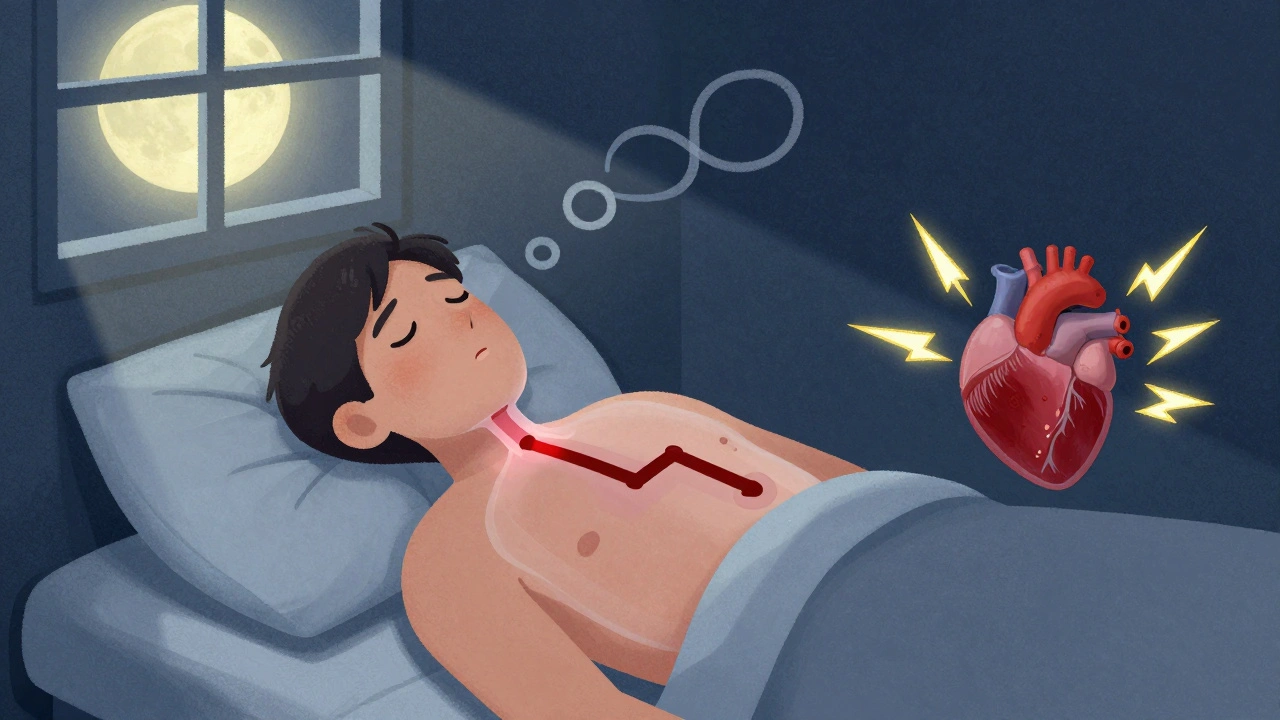
Imagine waking up exhausted every morning, even after eight hours in bed. Your partner says you snore loudly, then stop breathing for seconds at a time. You feel foggy all day, and your blood pressure won’t drop no matter how many pills you take. What if this isn’t just bad sleep-it’s a silent alarm for your heart?
Sleep Apnea Isn’t Just Snoring
Sleep apnea isn’t just noisy breathing. It’s when your airway collapses or your brain stops telling your body to breathe during sleep. Obstructive sleep apnea (OSA), the most common type, happens when throat muscles relax too much and block airflow. About 80-90% of cases are OSA. Central sleep apnea is rarer and comes from the brain failing to send the right signals. Together, they affect nearly 1 billion people worldwide-that’s one in every seven adults.
What makes this dangerous isn’t just the snoring. It’s what happens inside your body every time you stop breathing. Your oxygen drops. Your heart races. Your blood pressure spikes. And this repeats dozens, sometimes hundreds, of times a night. Over years, this pattern doesn’t just tire you out-it damages your heart and blood vessels.
Why Your Blood Pressure Won’t Go Down
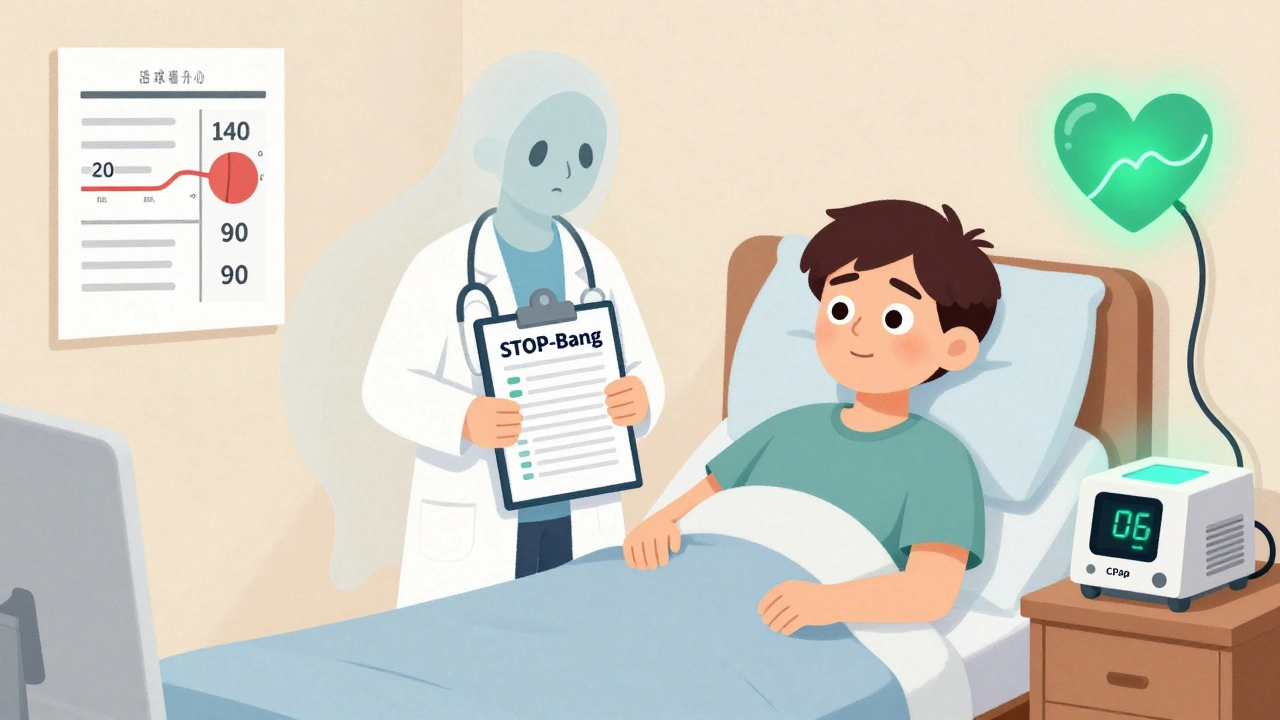
If you’ve been told you have resistant hypertension-meaning your blood pressure stays above 140/90 even after taking three different medications-sleep apnea might be the missing piece. Up to 80% of people with resistant hypertension also have undiagnosed sleep apnea.
Here’s why: each time your breathing stops, your body panics. Stress hormones like adrenaline surge 2-4 times higher than normal. Your blood vessels tighten. Your heart works harder. This doesn’t just happen during the night. Over time, your body learns to keep blood pressure elevated even when you’re awake.
And it’s not just the numbers. Normal blood pressure drops 10-20% at night. But in people with sleep apnea, 70-80% show no drop at all-or even a rise. This "non-dipping" pattern is a major red flag. Studies show it’s linked to a 2-3 times higher risk of heart attack and stroke compared to those whose blood pressure dips normally.
Heart Disease and Sleep Apnea: A Dangerous Duo
Having moderate to severe sleep apnea doesn’t just raise your blood pressure-it triples your risk of coronary artery disease. People with an Apnea-Hypopnea Index (AHI) of 15 or higher are 30% more likely to develop heart disease and 60% more likely to have a fatal heart event than those without it.
The timing of heart attacks tells a chilling story. In people with untreated sleep apnea, 26.5% of heart attacks happen between midnight and 6 a.m. That’s nearly double the rate in people without sleep apnea. Why? Because that’s when breathing pauses are most frequent, oxygen levels are lowest, and stress on the heart is highest.
Heart failure is even more tightly linked. Up to 60% of heart failure patients also have sleep apnea. And the reverse is true: people with OSA are 140% more likely to develop heart failure. The reason? Constant strain on the heart from repeated oxygen drops and pressure spikes weakens the muscle over time.
Stroke Risk Skyrockets
If you’ve had a stroke-or are worried about having one-sleep apnea is a silent partner. People with OSA are 2.5 times more likely to have a first stroke and 3.2 times more likely to have another. The worse the oxygen drop during sleep, the higher the risk. When oxygen saturation falls below 90% for more than 12% of the night, stroke death risk jumps by 4.3 times.
It’s not just about the stroke itself. Stroke recovery is harder if sleep apnea goes untreated. Oxygen deprivation slows brain healing. High blood pressure during sleep increases the chance of bleeding or clotting again. Treating sleep apnea isn’t optional-it’s part of stroke prevention and recovery.
Arrhythmias Don’t Wait for Morning
Irregular heartbeats, especially atrial fibrillation (AFib), are common in people with sleep apnea. In fact, 49% of people with paroxysmal AFib-the kind that comes and goes-also have sleep apnea. Compare that to just 21% of people without AFib. That’s more than double.
And here’s the kicker: if you’re getting catheter ablation for AFib, your success rate drops by 30% if sleep apnea is untreated. The same goes for cardiac resynchronization therapy-response rates fall by 15%. Sleep apnea doesn’t just cause arrhythmias; it makes treatments less effective.
Younger People Are at Higher Risk Than You Think
Most people assume sleep apnea is an older adult problem. But new data shows it’s accelerating heart disease in younger people too. A 2024 study of nearly 10,000 adults found that those aged 20-40 with sleep apnea symptoms had a 45% higher chance of high blood pressure, 33% higher risk of diabetes, and 25% higher risk of metabolic syndrome than their peers without symptoms.
In older adults over 41, the increase was much smaller-only 10-12%. That means sleep apnea isn’t just a consequence of aging. In younger people, it’s actively speeding up cardiovascular damage. If you’re under 40, snoring loudly, waking up gasping, and feeling tired all day, don’t wait. Get checked.
CPAP Isn’t a Magic Bullet-But It Helps
Continuous Positive Airway Pressure (CPAP) is the most common treatment. It uses a mask to keep your airway open. Many expect it to drop blood pressure dramatically. But here’s the truth: CPAP typically lowers systolic pressure by only 2-3 mmHg. That’s not huge-but it’s not nothing.
Where CPAP shines is in preventing disasters. It reduces stroke recurrence by 37%. It improves heart failure outcomes. It makes AFib treatments work better. And it reduces inflammation, oxidative stress, and endothelial damage-all of which drive heart disease.
The problem? Only 46% of people use CPAP enough to get real benefit-meaning at least 4 hours a night, 70% of nights. Many quit because the mask feels uncomfortable, the machine is noisy, or they don’t feel better right away. But if you stick with it, the long-term benefits for your heart are real.
What Cardiologists Are Starting to Do
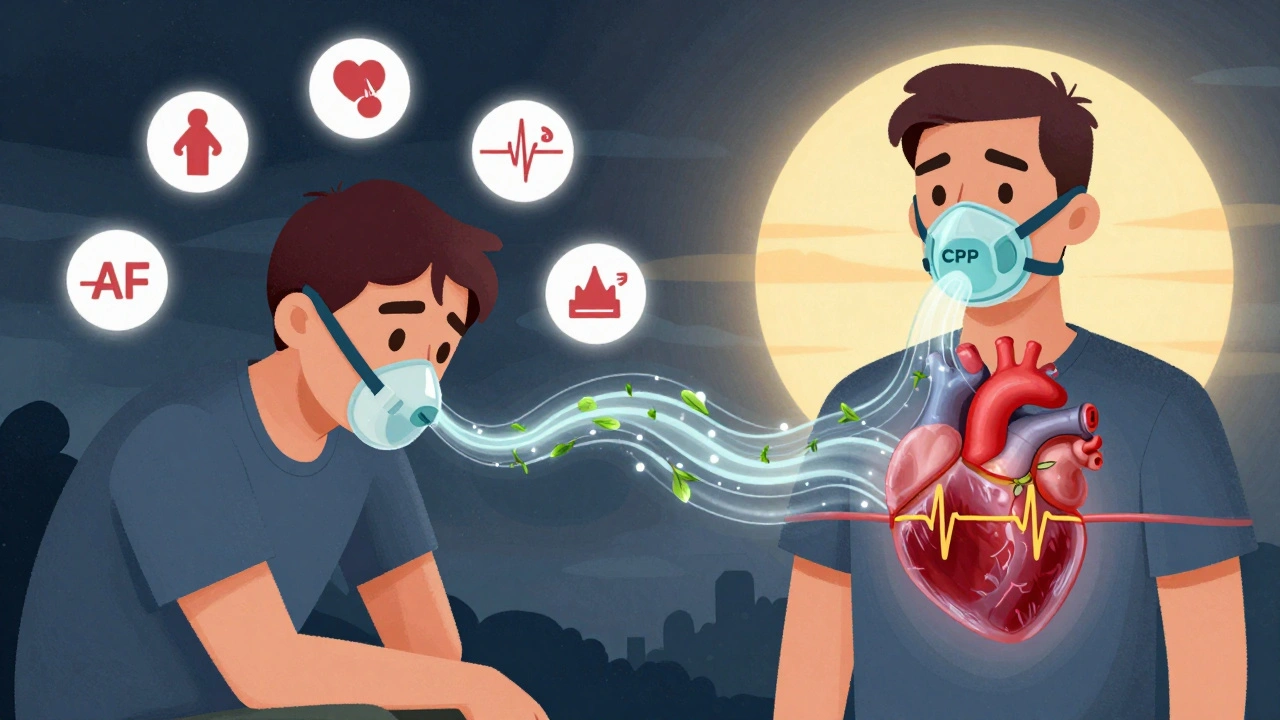
Doctors are catching on. The American Heart Association now says: if you have high blood pressure, heart failure, stroke, AFib, or coronary disease-especially if treatment isn’t working-screen for sleep apnea.
Simple tools like the STOP-Bang questionnaire (which asks about snoring, tiredness, observed apneas, blood pressure, BMI, age, neck size, and gender) can identify moderate to severe cases with 84% sensitivity. No expensive test needed. If you score high, a sleep study is the next step.
Cardiologists are starting to work with sleep specialists. Why? Because treating sleep apnea isn’t a side note-it’s part of heart care. Ignoring it is like treating high cholesterol without addressing smoking.
What You Can Do Today
If you’re tired all the time, snore loudly, wake up choking, or have high blood pressure that won’t budge:
- Ask your doctor about sleep apnea. Don’t wait for them to bring it up.
- Get a home sleep test if you’re a candidate. It’s accurate for moderate to severe cases.
- If diagnosed, try CPAP for at least 30 days. It takes time to feel better.
- If CPAP doesn’t work, ask about oral appliances or weight loss programs. Losing 10% of body weight can cut apnea events in half.
- Track your blood pressure at home. If it doesn’t dip at night, that’s a sign.
Sleep apnea isn’t a lifestyle flaw. It’s a medical condition that’s silently wrecking hearts. The science is clear. The tools exist. The only thing missing is action.
Can sleep apnea cause high blood pressure even if I’m not overweight?
Yes. While obesity is the biggest risk factor-accounting for 70% of cases-sleep apnea can happen in thin people too. Structural issues like a narrow airway, large tonsils, or jaw position can cause obstruction. Even without extra weight, the breathing pauses trigger the same stress responses that raise blood pressure. Anyone with unexplained hypertension, especially if it’s resistant to medication, should be screened.
If I use CPAP, will my blood pressure go back to normal?
CPAP usually lowers systolic blood pressure by just 2-3 mmHg on average. That’s modest, but it’s not the whole story. The real benefit is reducing nighttime spikes and restoring normal blood pressure patterns. Over time, this reduces strain on your heart and arteries. Many people also find their other blood pressure medications work better once sleep apnea is treated. It’s not a cure, but it removes a major obstacle to control.
Is sleep apnea only a problem if I snore?
No. While loud snoring is common, some people with sleep apnea don’t snore at all-especially those with central sleep apnea. Other signs include waking up gasping, chronic fatigue, morning headaches, dry mouth, and difficulty concentrating. If you’re tired despite sleeping enough, and you have heart disease or high blood pressure, sleep apnea should be ruled out-even without snoring.
Can losing weight cure sleep apnea?
For many people, yes-especially if obesity is the main cause. Losing just 10% of body weight can reduce apnea events by 50% or more. In some cases, significant weight loss can eliminate the need for CPAP entirely. But weight loss alone isn’t always enough. If your airway is structurally narrow, you may still need treatment. Still, weight loss improves outcomes no matter what treatment you use.
How do I know if my sleep study result is accurate?
Home sleep tests are 85-90% accurate for moderate to severe sleep apnea (AHI ≥15). But they miss up to 40% of mild cases. If your home test is negative but you still have symptoms-especially if you have heart disease or high blood pressure-ask for a full overnight polysomnography in a sleep lab. It’s the gold standard and can detect subtle breathing disruptions, oxygen drops, and heart rhythm changes that home tests miss.
Why does my doctor care if I have sleep apnea if I already take heart meds?
Because untreated sleep apnea makes your heart meds less effective. It raises your blood pressure at night, triggers arrhythmias, increases inflammation, and stresses your heart. Even if your pills are working during the day, nighttime breathing problems undo that progress. Treating sleep apnea isn’t extra-it’s essential to make sure your heart treatment actually works.
What’s Next?
If you’ve been ignoring your snoring or brushing off your fatigue, it’s time to listen. Sleep apnea isn’t a nuisance-it’s a major cardiovascular threat. The good news? It’s one of the few heart risk factors you can treat effectively. You don’t need a miracle. You need a diagnosis. And then, consistent care.
Start by asking your doctor: "Could my sleep be hurting my heart?" Then take the next step. Your heart will thank you years from now.
Brooke Evers
December 8, 2025 AT 07:24I used to think my constant fatigue was just part of being a mom juggling three kids and a full-time job. Then I started waking up gasping, and my husband said I sounded like a chainsaw with a hiccup. I got tested and found out I had severe OSA. I was skeptical about CPAP, but after two weeks, I felt like I’d been sleepwalking through life and finally woke up. My blood pressure dropped, my brain fog lifted, and I cried the first time I didn’t need caffeine by 10 a.m. It’s not glamorous, but it’s life-changing. If you’re tired and it’s not getting better-get checked. You don’t have to live like this.
Also, if you’re worried about the mask, try different types. I hated the full face at first, switched to nasal pillows, and now I forget I’m even wearing it. It’s not perfect, but it’s the best thing I’ve ever done for myself.
And yes, I lost 15 pounds too. But even before that, CPAP made a difference. Your body isn’t broken-it’s just been starved of oxygen at night. Fix that, and everything else starts to heal.
I know it feels overwhelming. But I promise you, this one step can undo years of damage. You’re not lazy. You’re not broken. You just need help breathing.
I’m so glad I didn’t ignore it. You shouldn’t either.
Love you all. Keep going.
Chris Park
December 9, 2025 AT 05:24Let’s be brutally honest: the entire sleep apnea-cardiovascular link is a corporate-funded narrative designed to sell CPAP machines and sleep studies. The AHA’s guidelines are written by consultants with ties to ResMed. The 1 billion figure? Extrapolated from flawed surveys. The ‘80% of resistant hypertension has OSA’ stat? Retrospective bias. You don’t need a machine-you need to stop eating processed carbs and sleep on your side. I’ve measured my own oxygen saturation with a consumer pulse oximeter-no apneas, no drop, no ‘silent killer.’ Just a medical-industrial complex turning tired people into profit centers. If your BP is high, fix your diet. Not your mask.
Also, the claim that CPAP reduces stroke recurrence by 37%? That’s from a single industry-sponsored RCT with a 6-month follow-up. Where’s the 10-year data? Where’s the control group that did yoga and magnesium? The science is thin. The marketing is loud. Wake up.
Inna Borovik
December 9, 2025 AT 08:31Chris, your skepticism is statistically valid, but emotionally reckless. Yes, industry influence exists. But dismissing 17 meta-analyses and 30+ prospective cohort studies because of potential bias is like rejecting antibiotics because Big Pharma profits from them. The pathophysiology is irrefutable: intermittent hypoxia → sympathetic overdrive → endothelial dysfunction → hypertension → atherosclerosis. It’s not theory-it’s molecular biology. CPAP doesn’t ‘cure’ anything, but it interrupts the cascade. And the fact that 46% adherence rate is the norm? That’s a behavioral problem, not a scientific one. The data isn’t flawed-it’s underutilized.
Also, the STOP-Bang questionnaire has a 92% NPV for moderate-severe OSA in hypertensive patients. That’s not marketing. That’s clinical utility. If you’re going to be contrarian, at least cite the actual papers. Not the conspiracy forums.
Rashmi Gupta
December 9, 2025 AT 20:03I used to think snoring was normal. Then my cousin died of a heart attack at 38. No history. No cholesterol issues. Just snored like a freight train and never got tested. I went to the doctor after that. Got a home test. Found out I had AHI of 28. Started CPAP. Didn’t feel better for weeks. Thought it was a waste. But then one morning-I woke up and didn’t immediately want to cry. That’s when I knew. It’s not about feeling better right away. It’s about not dying before your time. If you’re young and tired? Get tested. Don’t wait for a funeral to make you listen.
brenda olvera
December 11, 2025 AT 19:35I just want to say thank you to everyone who shared their stories. I’ve been ignoring my snoring for years because I thought it was just me being a bad sleeper. But reading this made me realize I’m not alone. My BP has been up for two years and my doctor just shrugged. I’m going to ask again this week. I’m scared but I’m doing it. You all gave me courage. I love you strangers on the internet. You’re the real heroes.
Also I bought a humidifier for my CPAP and it’s like a little bedtime spa. weirdly comforting. who knew
Myles White
December 11, 2025 AT 23:08I’ve been using CPAP for five years now and I can tell you the biggest myth is that you need to use it perfectly. I miss nights. I travel. I forget to clean the mask. I’ve had it fall off during a nightmare. But I’ve used it enough-maybe 60-70% of nights-that my blood pressure is stable, my energy is consistent, and my wife hasn’t complained about snoring in over two years. You don’t need perfection. You need consistency. Even 3 hours a night, 5 days a week, is better than nothing. The body remembers oxygen. It’s not magic. It’s biology. Just keep showing up.
Also, if you’re thinking about weight loss, don’t wait. Start small. Walk after dinner. Drink more water. Sleep better. The weight will follow. But don’t make it a condition for treatment. Treat the apnea now. The rest will come.
Nigel ntini
December 13, 2025 AT 17:42For anyone feeling overwhelmed by CPAP-just know you’re not failing. The machine is the tool, not the test. I used to hate mine. I’d take it off after 20 minutes. Then I realized: it’s not about how long I wear it-it’s about what it’s doing to my body while I’m wearing it. I started tracking my morning blood pressure on my phone. After 3 weeks, it dropped 5 points. That was my ‘aha’ moment. I didn’t feel different. But my numbers did. So I kept going.
Now I sleep like a baby. And I’ve stopped waking up with a headache. I didn’t know those were connected until I fixed the breathing. This isn’t a lifestyle upgrade. It’s a physiological reset. And it’s worth every awkward night.
Mansi Bansal
December 15, 2025 AT 06:22It is an incontrovertible fact that the modern medical establishment has pathologized normal human variation under the guise of cardiovascular risk mitigation. The notion that nocturnal hypoxemia constitutes a disease entity requiring lifelong mechanical intervention is not only scientifically dubious, but ethically suspect. One must interrogate the epistemological foundations of sleep medicine: Is the AHI truly a valid metric for systemic pathology? Or is it merely a proxy for social anxiety about snoring? The data is conflated with behavioral norms. The silent killer is not apnea-it is the commodification of sleep. I shall not be coerced into submission by a plastic tube. I shall sleep as nature intended-awake, alert, and unmediated by corporate engineering.
pallavi khushwani
December 16, 2025 AT 21:26you know what’s wild? i used to think sleep was just something you did when you were tired. like a reset button. but now i think it’s more like a conversation your body has with itself every night. and if you’re stopping breathing? you’re basically screaming in your sleep and nobody’s listening. and then your heart gets tired of being yelled at. it just starts keeping its blood pressure high all the time because it thinks you’re still in danger.
it’s not about being lazy. it’s about your body being terrified and nobody telling it it’s safe.
cpap isn’t a cage. it’s a lullaby.
Dan Cole
December 17, 2025 AT 09:39Let me break this down with surgical precision: The AHA’s endorsement of CPAP is not based on outcome data-it’s based on consensus. There is no RCT proving CPAP reduces mortality in OSA patients. None. Zero. The ‘37% reduction in stroke recurrence’? That’s from a single-center, non-blinded study with selection bias. The 80% hypertension correlation? Confounded by obesity, age, and sedentary lifestyle. And yet, we’re told to strap a mask to our faces for life because ‘the science is clear.’ The science is not clear. It’s convenient. It’s profitable. And it’s being sold to the vulnerable as salvation. Wake up. You’re being manipulated by a $12 billion industry that profits from your fear.
Also, if you’re under 40 and snoring, you’re probably just sleeping on your back. Flip over. Done. No machine needed. Stop buying into the myth.
Billy Schimmel
December 18, 2025 AT 16:29My dad had sleep apnea. Didn’t want to use CPAP. Said it was ‘for old people.’ Died of a heart attack at 52. I got tested last year. AHI of 22. Started CPAP. Still hate it. But I wear it. Because I don’t want to be the guy who knew and didn’t do anything. So yeah. I’m tired. I’m annoyed. But I’m alive. And that’s enough.
Shayne Smith
December 19, 2025 AT 10:01just got my home sleep test results. AHI 18. honestly thought i was just bad at sleeping. now i’m ordering a CPAP. also my dog started sleeping next to me at night and i swear he’s trying to help. he paws at my mask if it slips. weirdly cute.
Max Manoles
December 21, 2025 AT 06:09For those saying CPAP doesn’t work-have you tried it for longer than a week? I tried for 3 days, gave up, thought it was useless. Then I read a paper on endothelial recovery timelines. Turns out, it takes 4-6 weeks for vascular inflammation to reduce. I kept going. At week 5, I woke up and realized I hadn’t had a headache in 10 days. My wife said I stopped talking in my sleep. My boss said I stopped making stupid mistakes. It wasn’t magic. It was biology catching up. Don’t quit before the healing starts. The machine doesn’t fix you. It gives you the oxygen to fix yourself.