Recall Checker Tool
Check Your Device Recall Status
Find this on your implant card or prescription label
Safe to Use
Your device is not currently recalled. Keep your records safe and check again quarterly.
Recommended Action:
- Store your medical records securely
- Register your device with the manufacturer
- Check for recalls at FDA Recall Database quarterly
Recall Detected
Class I Recall
Critical Safety Alert
Your device has been recalled. This recall is Class I, meaning it could cause serious injury or death.
Do not remove or stop using your device without consulting your doctor.
Next Steps:
- Call your doctor immediately
- Write down the lot number and recall reason
- Do not self-treat or remove the device
- Keep all documentation for insurance claims
Recall Classifications
I
Class I
Most serious. Could cause serious injury or death.
II
Class II
Might cause temporary or reversible problems.
III
Class III
Unlikely to cause harm—usually labeling or packaging errors.
When you get a medical implant or take a prescription drug, you’re trusting that it’s safe. But sometimes, things go wrong. A batch of heart valves fails. A batch of insulin becomes contaminated. A hip implant breaks earlier than it should. When that happens, manufacturers issue a recall-and your lot number is the key to knowing if you’re affected.
What Is a Lot Number, and Why Does It Matter?
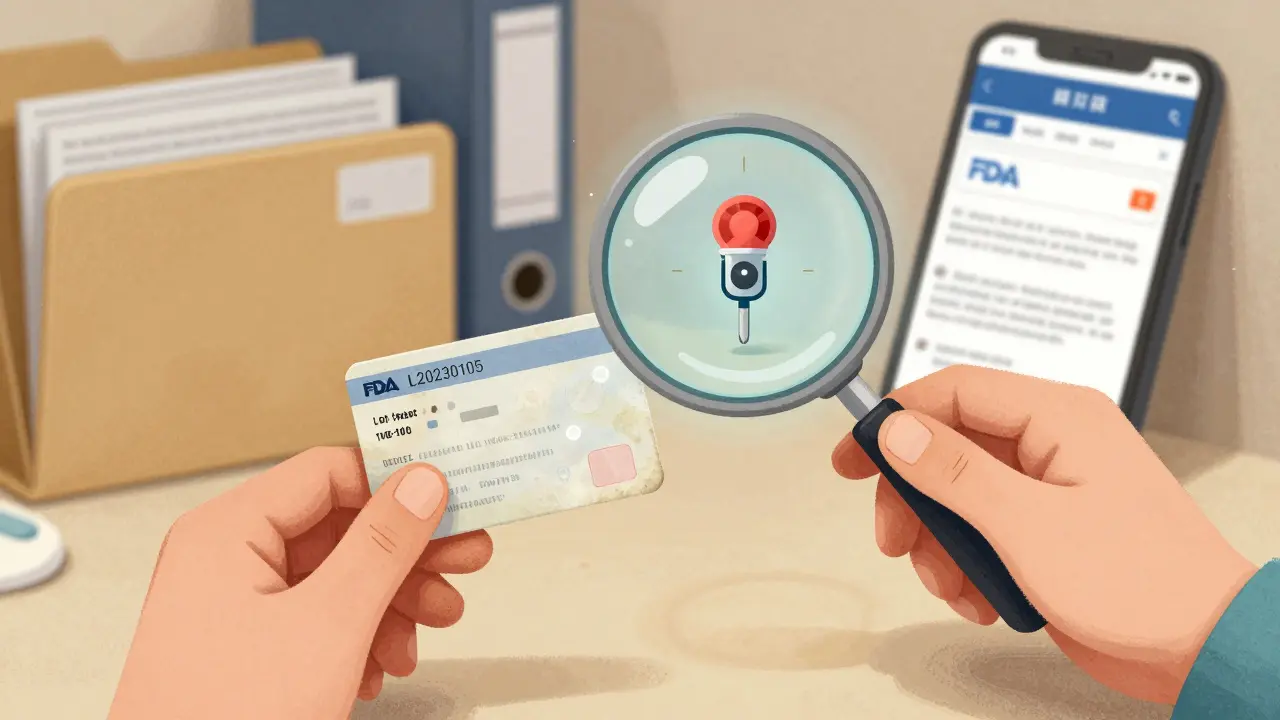
A lot number isn’t just a random code. It’s a unique identifier printed on the packaging of your medicine or implanted device. It tells manufacturers exactly which batch you received-and when it was made. For example, a lot number like L20230105 means the product was made on January 5, 2023. That’s critical because if a problem shows up in a specific batch, regulators can pull only that batch, not every single unit ever made. Without lot numbers, recalls would be chaotic. Imagine being told to replace every pacemaker ever implanted because one batch had a defect. That’s not how it works. Thanks to lot tracking, recalls are precise. In 2021, Edwards Lifesciences recalled only 2,807 specific TAVR heart valves out of hundreds of thousands-because they knew exactly which lot numbers were faulty.Why Most Patients Miss Recalls (And How to Avoid It)
The FDA found that 68% of patients with implants can’t find their implant card when asked. Another 42% don’t know how to check for recalls. That’s not laziness-it’s confusion. Most people don’t realize how important that little card is. Here’s the reality: manufacturers don’t always know where you live. Hospitals don’t always keep your records forever. Your surgeon’s office might close. If you don’t have your own copy of your lot number, you’re relying on luck. A 2023 study showed patients who kept their implant cards and surgical records were 3.2 times more likely to get timely recall notices. That’s not a small difference. It’s the difference between catching a problem before it hurts you-and finding out only after you’re in pain.What You Need to Do Right Now
You don’t need a degree in medicine to protect yourself. Just three simple steps:- Find your implant card or prescription label. This should have the device name, model, serial number, and lot number. If you don’t have it, call your surgeon’s office or pharmacy. Ask for a copy of your surgical report-it usually includes the lot number.
- Create a medical file. Put the card, prescription bottle photos, and any manuals in one place. Use a folder, a phone app, or even a cloud drive. Label it clearly: “Medical Devices & Lot Numbers.”
- Register your device. Most manufacturers let you register implants online. Do it. You’ll get direct emails if your lot is recalled. The FDA says registered users get notified 14 days faster than those who don’t.

How to Check for Active Recalls
The FDA updates its Medical Device Recalls database every day. It’s free, public, and easy to use. Go to fda.gov/medical-device-recalls. You can search by device name, manufacturer, or lot number. There are three types of recalls:- Class I: Most serious. Could cause serious injury or death. (About 12% of all recalls in 2023.)
- Class II: Might cause temporary or reversible problems.
- Class III: Unlikely to cause harm-usually labeling or packaging errors.
What If You Don’t Know Your Lot Number?
If you lost your card and can’t get records, here’s what to do:- Call your surgeon’s office or the hospital where you had the procedure. Ask for your operative report.
- If you had a drug, check your pharmacy’s online portal. Many now store lot numbers for prescriptions.
- Ask your primary care doctor to request your records from the specialist.
What’s Changing in 2026?
Things are getting better. In January 2024, the FDA launched a pilot program where you can text your lot number to 311-FDA and get an instant recall status. By 2026, AI systems will automatically match your electronic health record with recall databases-and flag you if your device is at risk. Epic and Cerner, the two biggest electronic health record systems, now include lot numbers in patient portals. If your doctor uses one of these, log in and check your device list. You might already have the info without even knowing it. Still, not everyone is covered. Only 67% of orthopedic implants have full tracking. Cardiac devices? Nearly 98%. That gap matters. If you have a knee or hip replacement, be extra careful. Don’t assume someone else is watching out for you.
What to Do If You Get a Recall Notice
If you get an email, letter, or call about a recall:- Don’t remove or stop using your device unless your doctor says so.
- Write down the lot number and recall reason.
- Contact your doctor or specialist immediately.
- Keep all packaging and documentation-you may need it for insurance or replacement.
Elen Pihlap
January 7, 2026 AT 12:07OMG I just found my old hip implant card in a drawer and my lot number was L20210812. I had no idea this stuff mattered. I almost threw it away. I’m so scared now.
Sai Ganesh
January 9, 2026 AT 01:34In India, we rarely get detailed implant information. Hospitals often don’t even give you a card. I had a knee replacement in 2020 and only learned about lot numbers last year. This post is a wake-up call for many of us.
steve rumsford
January 9, 2026 AT 08:19Bro. I just took a pic of my insulin pump’s lot number and saved it to my phone. I’ve had this thing for 3 years and never thought to do that. I’m gonna screenshot the FDA page too. This is the most useful thing I’ve read all month.
Andrew N
January 9, 2026 AT 20:13Actually, the FDA’s recall database isn’t reliable. I checked it last month for a pacemaker recall and it was missing three Class I incidents reported by hospitals. The system is outdated. Registering with manufacturers is good, but don’t trust the FDA as your only source.
Poppy Newman
January 10, 2026 AT 12:50Just registered my pacemaker!! 🙌 I used the manufacturer’s portal and it took 90 seconds. I also uploaded my surgical report to Google Drive under ‘Medical Stuff’. If I die tomorrow, at least my family won’t be clueless 😅
Anthony Capunong
January 11, 2026 AT 14:29Why are we trusting foreign companies with our lives? American-made devices are safer. If this was a U.S. company, we wouldn’t need to worry about lot numbers. The FDA should ban imports unless they meet stricter tracking standards.
Ayodeji Williams
January 13, 2026 AT 11:26Wait so you mean I gotta keep track of my damn insulin pump lot number? Bro I barely remember my own birthday. This is too much. I’m just gonna wait till I feel weird and then go to ER. That’s how we do it in Nigeria 😎
Kamlesh Chauhan
January 15, 2026 AT 05:53why do they even make us do this its not like we have time to be medical detectives also i lost my card and my doctor is gone and now i have to call some random hospital what a mess
Christine Joy Chicano
January 16, 2026 AT 02:10This is one of the most meticulously researched and urgently necessary pieces of public health guidance I’ve read in years. The 3.2x statistic alone should be mandatory reading for every patient with an implant. The structural failure of healthcare systems to proactively notify patients is a scandal - and your three-step solution is elegant, actionable, and profoundly human. Thank you for not talking down to us.
Adam Gainski
January 16, 2026 AT 17:49Just a quick tip: if your hospital uses Epic or Cerner, log into your patient portal and look under ‘Devices’ or ‘Procedures’. I found my knee implant lot number there without calling anyone. Took me 2 minutes. Also, save your pharmacy receipts - they often list lot numbers for meds like insulin.
Anastasia Novak
January 18, 2026 AT 07:10Ugh. Another ‘just take 15 minutes’ post from someone who clearly doesn’t work 60-hour weeks, has no kids, and doesn’t live in a state where the DMV takes 3 hours just to renew a license. My ‘medical file’ is a pile of papers in my car. I don’t have time for this.
Alex Danner
January 19, 2026 AT 09:03I’m a nurse and I see this every day. Patients panic when they get a recall notice because they don’t know what to do. But if they’ve already got their lot number saved? They stay calm. They call their doctor. They don’t Google ‘can a hip implant kill me?’ at 2am. This isn’t just about safety - it’s about reducing anxiety. Do the 15 minutes. Your future self will thank you.
Paul Mason
January 19, 2026 AT 22:32Look I’ve been doing this for 15 years. If you don’t have a copy of your surgical report, you’re already behind. And if you didn’t register your device? You’re basically gambling. I told my mom to do this after her knee replacement. She’s 78. She did it. She’s alive. Simple.
Katrina Morris
January 20, 2026 AT 13:14i just took a pic of my insulin box and saved it in my phone photos under 'medical stuff' lol i hope that's enough i'm not great with files but i'm trying
LALITA KUDIYA
January 21, 2026 AT 08:02thank you for this. i had a stent in 2022 and never thought about lot numbers. now i saved everything on my phone. i feel safer already 💙