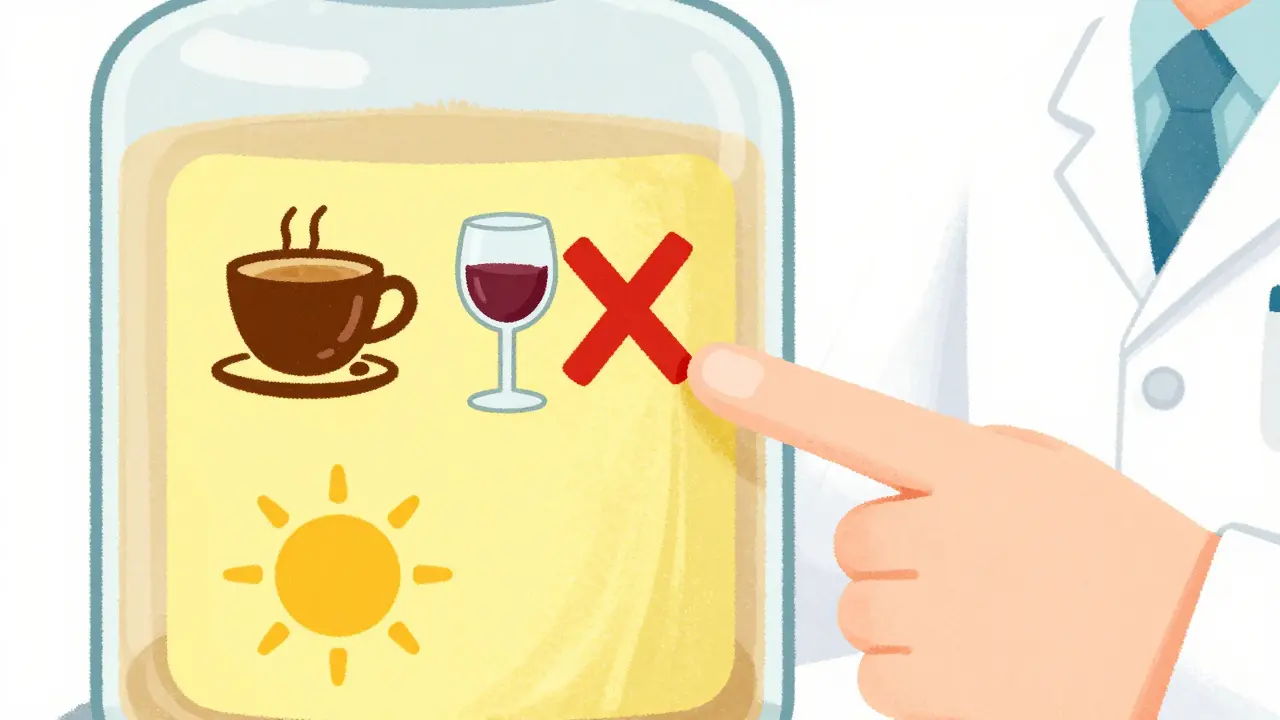
When you pick up your prescription, you might notice small yellow stickers on the bottle. They look simple-just a symbol and a few words. But these aren’t just decorations. These are pharmacy warning icons, and they’re designed to keep you safe. If you’ve ever been confused by a symbol like a coffee cup with a slash through it, or a car with a warning triangle, you’re not alone. Millions of people misinterpret these labels every year, sometimes with serious consequences.
What Do These Icons Actually Mean?
Pharmacy warning icons are visual shortcuts that tell you how to take your medicine safely. They’re not random. Each one has a specific meaning backed by research. In New Zealand, these are called Cautionary and Advisory Labels (CALs), and they’re standardized across all pharmacies. You’ll usually see them as small yellow stickers with black text. Common ones include:- May cause drowsiness - This means you shouldn’t drive, operate machinery, or make important decisions after taking the medicine.
- Take with food - Some drugs irritate your stomach if taken on an empty stomach.
- Do not drink alcohol - Mixing alcohol with certain medications can cause dangerous side effects like dizziness, liver damage, or even breathing problems.
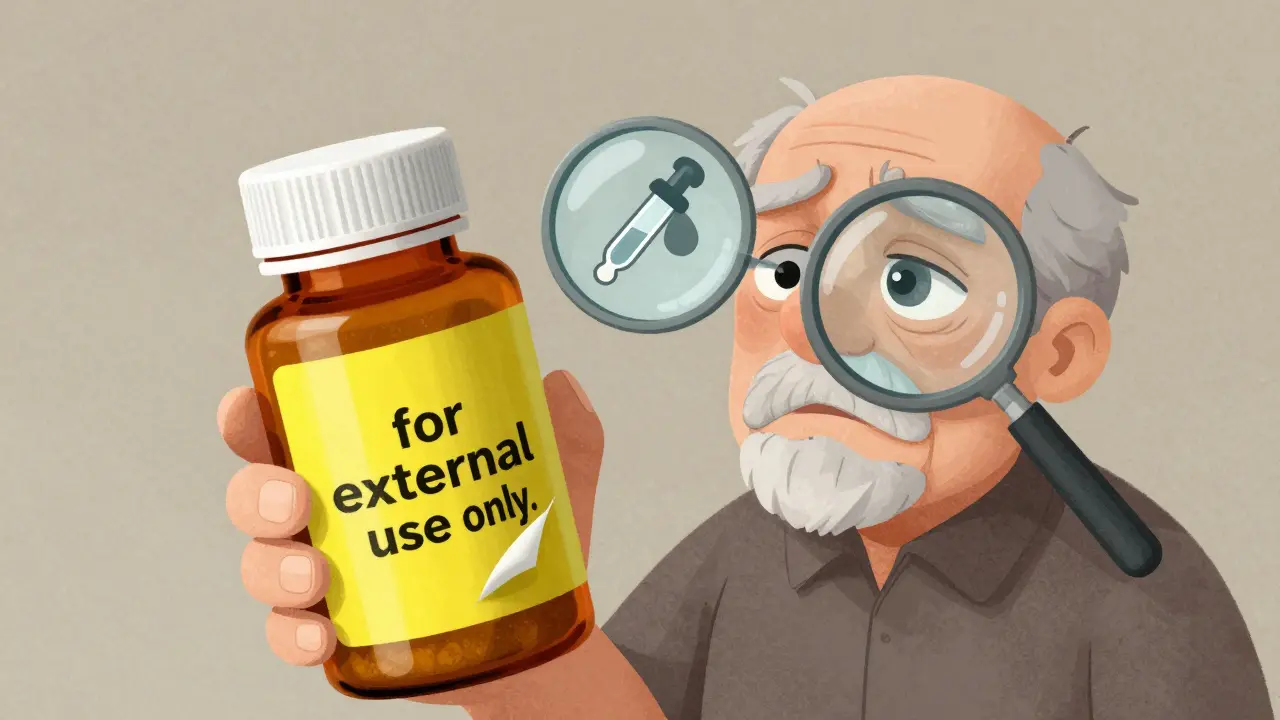
- For external use only - This one’s tricky. It doesn’t mean you can’t swallow it-it means you should only apply it to your skin, eyes, or ears, not take it by mouth.
- May cause sun sensitivity - Some medicines make your skin burn more easily in sunlight.
Color matters too. Yellow usually means "caution." Red means "danger"-but you rarely see red on prescription labels in New Zealand. In the U.S., color use is inconsistent. Some pharmacies use red for life-threatening risks, others use it for allergies. That’s part of the problem.
Why Do These Icons Exist?
Medication errors kill about 7,000 people in the U.S. every year, according to the FDA. Many of those errors happen because people don’t understand how to take their medicine. A 2021 study found that over half of Americans misread at least one common warning label. One woman took her eye drops orally because she thought the dropper symbol meant to swallow them. Another patient crushed a capsule labeled "swallow whole," thinking it would work faster. It didn’t-it caused serious internal burns.These icons were created to fix that. Before standardized labels, pharmacists wrote warnings by hand. Some wrote in tiny script. Others used different wording. A warning like "take with food" could appear as "take after eating," "avoid empty stomach," or "with meals." That confusion led to mistakes. In the 1990s, the Institute for Safe Medication Practices (ISMP) pushed for uniform symbols. By 2005, major U.S. chains started adopting them. New Zealand followed with its national CAL system in 2018.
Why Do People Still Get It Wrong?
Even with standardization, people still misunderstand. Why?First, symbols aren’t universal. The "radioactive" symbol (a three-bladed fan) is used in some places to mean "external use only." But most people associate that with radiation danger. A 2020 study found 68% of patients with low health literacy thought it meant the medicine was radioactive.
Second, too many labels create noise. If a bottle has 10 different stickers, people start ignoring them. A 2021 study showed that when pharmacists applied more than three warnings per prescription, patients remembered fewer than half. The fix? Use only the most critical ones. Large pharmacy chains now use software to pick the top 1-3 warnings based on the drug and patient history.
Third, literacy matters. The phrase "do not chew or crush" is written at a first-grade reading level. But 90% of people in one study misunderstood it. Some thought it meant "don’t swallow it." Others thought "crush" meant "break the tablet into pieces"-which is exactly what you shouldn’t do.
How Do Other Countries Do It?
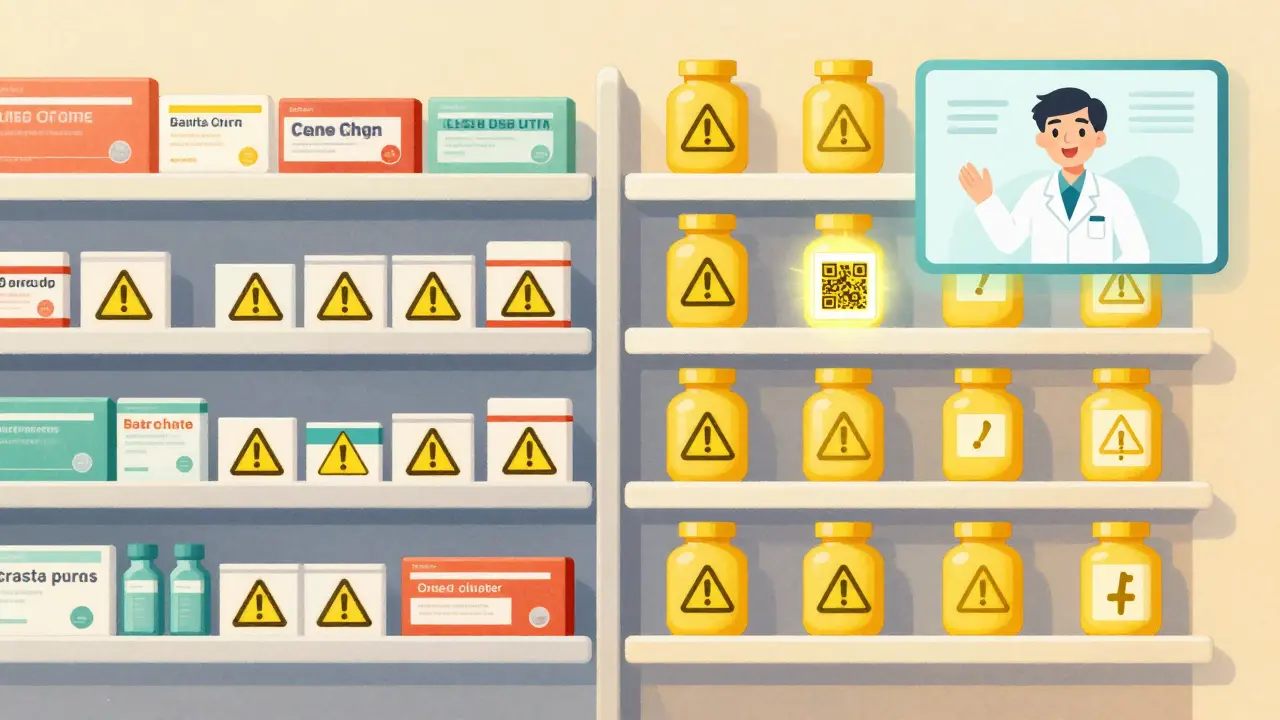
New Zealand’s system is simpler than the U.S.’s. The U.S. has no national standard. CVS uses 14 warning icons. Walgreens uses 17. Independent pharmacies use up to 23. That’s chaos. If you move from one pharmacy to another, the same drug might have different labels.The U.K. solved this by creating just nine standardized icons. After rolling them out in 2015, misinterpretation rates dropped from 39% to 17%. New Zealand’s CAL system, with its 12 core warnings, showed 22% better comprehension than the U.S. system in a 2022 Commonwealth Fund study.
Canada and Australia use similar systems to New Zealand. They focus on clarity, consistency, and fewer labels. The lesson? Less is more.
What’s Changing Right Now?
The FDA is pushing for national standardization. In September 2022, they released draft rules proposing 12 core warning icons to be used across all U.S. pharmacies by 2026. CVS and Walgreens have already agreed to reduce their systems to match. By late 2023, CVS cut its 14 labels down to 12. Walgreens plans to follow by mid-2024.Technology is also helping. Some pharmacies now include QR codes on labels that link to short video explanations. Kaiser Permanente tested this in 2022-2023. Patients who scanned the code understood the warnings 89% of the time-up from 58% with just text and symbols.
But here’s the catch: 24% of seniors don’t use smartphones regularly. So QR codes can’t replace physical labels-they can only help.
What Should You Do?
Don’t assume you know what a label means. Even if you’ve taken the medicine before, check the sticker every time. Warnings can change based on dosage, other medications you’re taking, or your age.Ask your pharmacist:
- "What does this symbol mean?"
- "What happens if I ignore this warning?"
- "Is there a simpler way to remember this?"
Pharmacists are trained to explain these. In fact, combining verbal advice with the visual label improves understanding by 63%, according to the ISMP. Don’t be shy-ask. It’s your safety.
Also, keep your labels visible. Don’t toss the bottle right after you fill it. Keep it where you can see the warning. If the sticker peels off, go back to the pharmacy and ask for a new one. They’re required to replace it.
What’s Next for Warning Labels?
The future is personalized. Researchers at the University of Pittsburgh tested an AI system that adjusts warning labels based on your age, literacy level, and medical history. For someone over 70 with low vision, it might show larger text and simpler language. For someone with kidney disease, it might add a warning about fluid intake. In trials, this boosted medication adherence by 32%.By 2030, experts estimate standardized warning icons could prevent 12,000 to 18,000 serious drug reactions each year in the U.S. alone-and save over $1 billion in hospital costs.
But none of that matters if you don’t understand the label. Symbols are tools. They only work if you know how to read them.
What does the yellow sticker on my medicine mean?
The yellow sticker is a Cautionary and Advisory Label (CAL). It’s a standardized warning that tells you about important risks like drowsiness, alcohol interactions, or sun sensitivity. In New Zealand, these are required by law and use consistent symbols across all pharmacies.
Why do some warning labels look different at different pharmacies?
In the U.S., there’s no national standard, so each pharmacy chain uses its own set of icons. CVS, Walgreens, and independent pharmacies all have different systems. New Zealand and the U.K. fixed this by using one national set of 12-9 labels. The U.S. is moving toward standardization, but it’s not complete yet.
Can I ignore a warning if I’ve taken the medicine before without problems?
No. Warnings are based on the drug’s properties, not your personal experience. A warning like "do not drink alcohol" applies every time, even if you drank last week and felt fine. Your body changes. Other medications you take might interact differently now. Always follow the label.
What should I do if I don’t understand a warning?
Ask your pharmacist. Don’t guess. Pharmacists are trained to explain these warnings in plain language. You can also ask for a printed handout or a video explanation if your pharmacy offers it. Your safety is more important than feeling embarrassed.
Are there apps or tools to help me understand these labels?
Yes. The ISMP offers a free "Medication Safety Self-Assessment" tool online. The CDC’s "Every Dose Counts" campaign has printable guides and videos. Some pharmacies now include QR codes on labels that link to short videos explaining the warning. But always double-check with your pharmacist-technology doesn’t replace human advice.
Do warning icons work for non-English speakers?
Yes, when they’re designed well. The FDA found that combining clear symbols with simple text reduces errors by 40% among non-English speakers. But symbols must be universally understood. For example, a "no alcohol" symbol (a wine glass with a slash) works better than text alone. That’s why standardization matters-consistent symbols are easier to learn across languages.
Kim Hines
December 16, 2025 AT 17:51Been taking meds for years and never paid attention to those yellow stickers until my aunt ended up in the ER because she thought 'do not crush' meant to break it in half to swallow easier. Turns out that’s how you get internal burns. Now I read every single one. Scary how easy it is to assume you know what it means.
Joanna Ebizie
December 18, 2025 AT 02:33Ugh, I hate when pharmacists act like I’m dumb for asking what the symbols mean. Like I should just magically know that a coffee cup with a slash means ‘don’t drink caffeine’ and not ‘this drug is brewed from beans.’
Mike Smith
December 19, 2025 AT 03:47It’s imperative to recognize that standardized medication labeling is not merely a logistical improvement-it is a public health imperative. The fragmentation of warning systems across pharmacy chains in the United States has created a preventable crisis. The adoption of a unified national framework, as proposed by the FDA, aligns with evidence-based practice and demonstrates a commitment to patient safety. Furthermore, the integration of technology, such as QR-linked educational videos, represents a progressive step toward equitable comprehension-though it must remain supplementary to human interaction, not a replacement.
Ron Williams
December 19, 2025 AT 11:38I’ve worked in community pharmacies for 18 years. The biggest issue isn’t the symbols-it’s overload. I’ve seen patients with six or seven stickers on one bottle. They just stop looking. We’ve started using software to cut it down to the top three based on the patient’s history. The difference? People actually remember what they’re supposed to do. Less is more. Always has been.
Kitty Price
December 20, 2025 AT 21:44That radioactivity symbol for 'external use only' is wild 😳 I thought my eye drops were going to give me cancer. So glad they're fixing this. Also-QR codes are genius. My grandma uses them now. She says it’s like having a mini pharmacist in her pocket 🙌
Aditya Kumar
December 22, 2025 AT 16:04Why are we even talking about this? Just read the damn bottle. If you can’t, don’t take it.
Colleen Bigelow
December 23, 2025 AT 13:20They’re pushing QR codes now? What’s next? Will Big Pharma start embedding microchips in pills so they can track when you take them? This isn’t safety-it’s control. And why are we copying New Zealand? They’re basically a suburb of Canada with better sheep. The U.S. doesn’t need to follow foreign systems. We’re supposed to be the leader in medicine, not a copycat.
Billy Poling
December 25, 2025 AT 05:22While I acknowledge the utility of standardized cautionary and advisory labels, I must express my profound concern regarding the potential for systemic over-reliance on visual symbols at the expense of linguistic clarity. The assumption that a universally understood iconography exists is, in fact, a fallacy. Cultural, cognitive, and linguistic diversity among the U.S. population renders such an approach inherently flawed. Moreover, the integration of digital technology, such as QR codes, introduces a new layer of exclusion for elderly, low-income, and technologically disengaged demographics. One must question whether the pursuit of efficiency has supplanted the fundamental ethical obligation to ensure universal accessibility. The FDA’s proposed standardization, while well-intentioned, may inadvertently exacerbate disparities rather than mitigate them.
Randolph Rickman
December 26, 2025 AT 03:22Hey everyone-this is actually one of the most important things you’ll read all year. Seriously. I used to ignore those stickers too. Then my dad had a bad reaction because he mixed his blood pressure med with grapefruit juice. He didn’t even know it was a thing. Now I keep a printed cheat sheet on my fridge with all the common icons and what they mean. I even made my mom a laminated version. If you’re reading this, take five minutes and look up the symbols for your meds. It could save your life. You’re worth it.
sue spark
December 27, 2025 AT 08:33I always thought 'take with food' meant eat a big meal right after but my pharmacist said just eat something small like a cracker. That changed everything. Also why do they use the same symbol for 'do not crush' and 'do not chew'? They mean different things right
SHAMSHEER SHAIKH
December 27, 2025 AT 14:45As a pharmacist in India, I can confirm that standardized visual warnings are a game-changer. In our country, we adopted a similar system in 2020, and patient adherence improved dramatically. The challenge here is not the symbols themselves, but the cultural perception of authority: many patients believe the pharmacist is merely a dispenser, not an educator. We now train our staff to say, 'This symbol is your safety net,' not 'This is the rule.' We also use color-coded icons for low-literacy patients: green for 'safe to do,' yellow for 'caution,' red for 'never.' The results? Over 80% of patients now correctly recall their warnings after one visit. Standardization is not about copying New Zealand-it is about respecting human dignity. Every patient deserves to understand their medicine.