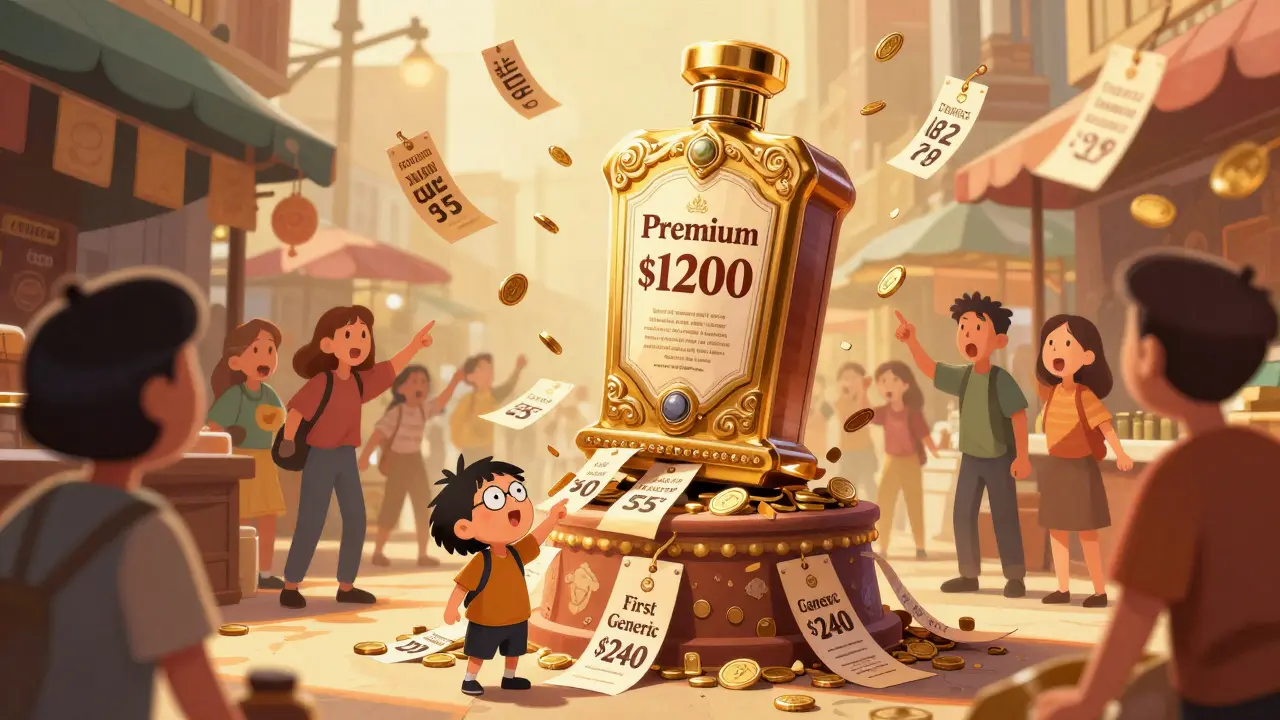
When a new product hits the market, you’d expect it to be expensive. Premium features, brand reputation, limited supply - those are the usual reasons. But here’s the twist: the very first time a generic entry shows up, prices don’t just dip. They collapse. And it’s not magic. It’s math.
What Exactly Is a First Generic Entry?
A first generic entry isn’t just another competitor. It’s the first alternative that matches the core function of a popular, often expensive product - but without the brand markup. Think of it like this: you’ve been paying $1,200 for a proprietary database system because there’s no other option. Then someone releases a version that does 90% of the same work, runs on free Linux servers, and costs $240. That’s a first generic entry. And it doesn’t just compete - it rewrites the rules.This isn’t just a software thing. It’s been happening for decades. When Apple launched the iPod in 2001, it sold for $399. Within three years, dozens of cheaper players flooded the market. By 2005, you could buy a digital music player for under $50. Apple didn’t lose because it was bad - it lost because the market changed. The first generic entry didn’t need to be perfect. It just needed to be good enough, and cheap enough, to make people ask: Why am I paying this much?
Why Do Prices Crash So Fast?
It’s not about the generic product being better. It’s about power shifting.Before the generic arrives, the original vendor has monopoly pricing power. No competition. High margins. Customers pay because they have no choice. But the moment that first alternative shows up, everything flips. Customers suddenly have leverage. And they use it.
In pharma, when a patent expires and the first generic drug hits shelves, prices drop an average of 76% within six months. That’s not a suggestion. That’s what happens. The same thing happens in software. When PostgreSQL emerged as a free, open-source alternative to Oracle, companies didn’t just save money - they demanded it. One sysadmin on Reddit reported cutting licensing costs by 78% overnight. That’s not an outlier. That’s the pattern.
Why? Because customers aren’t buying features anymore. They’re buying value. And value is now defined by cost savings, not brand names. Gartner found that 72% of enterprise buyers now care more about total cost of ownership than who made the software. The moment a cheaper alternative exists, the old pricing model becomes unsustainable.
The Numbers Don’t Lie
Let’s look at real data:- First generic software entries typically launch at 40-60% below the incumbent’s price.
- Within 12 months, the original vendor often cuts their price by 30-45% just to stay relevant.
- Electronics follow the same trend: Sony’s high-end TV dropped from $1,799 to $899 within a year of competitors entering.
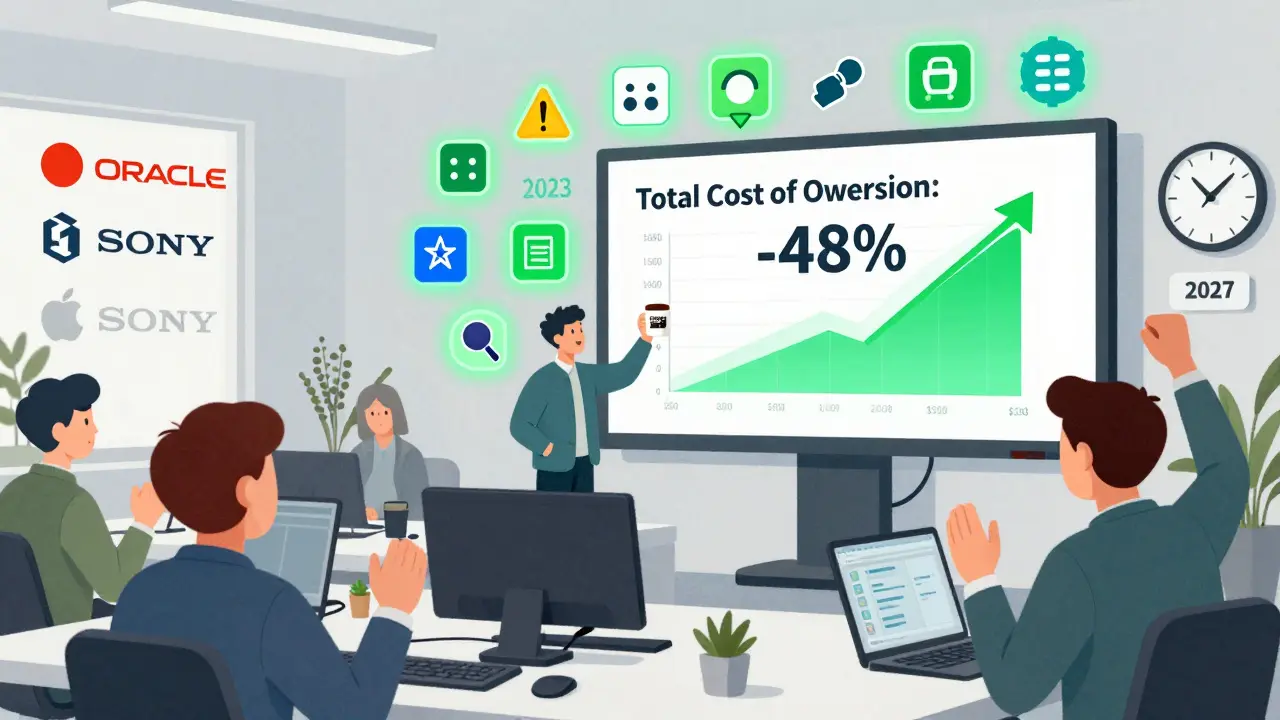
- Enterprise users who switch to first-gen alternatives save 35-50% on total cost of ownership in their first contract cycle.
- On platforms like G2, 63% of users switching to generic software cite “significant cost savings without functionality loss” as their top reason.
These aren’t guesses. These are measurable outcomes from real business decisions. And they’re accelerating. In 2010, it took an average of 18 months for a generic alternative to appear after a product launched. By 2023, that window shrank to just six months. The race to undercut is faster than ever.
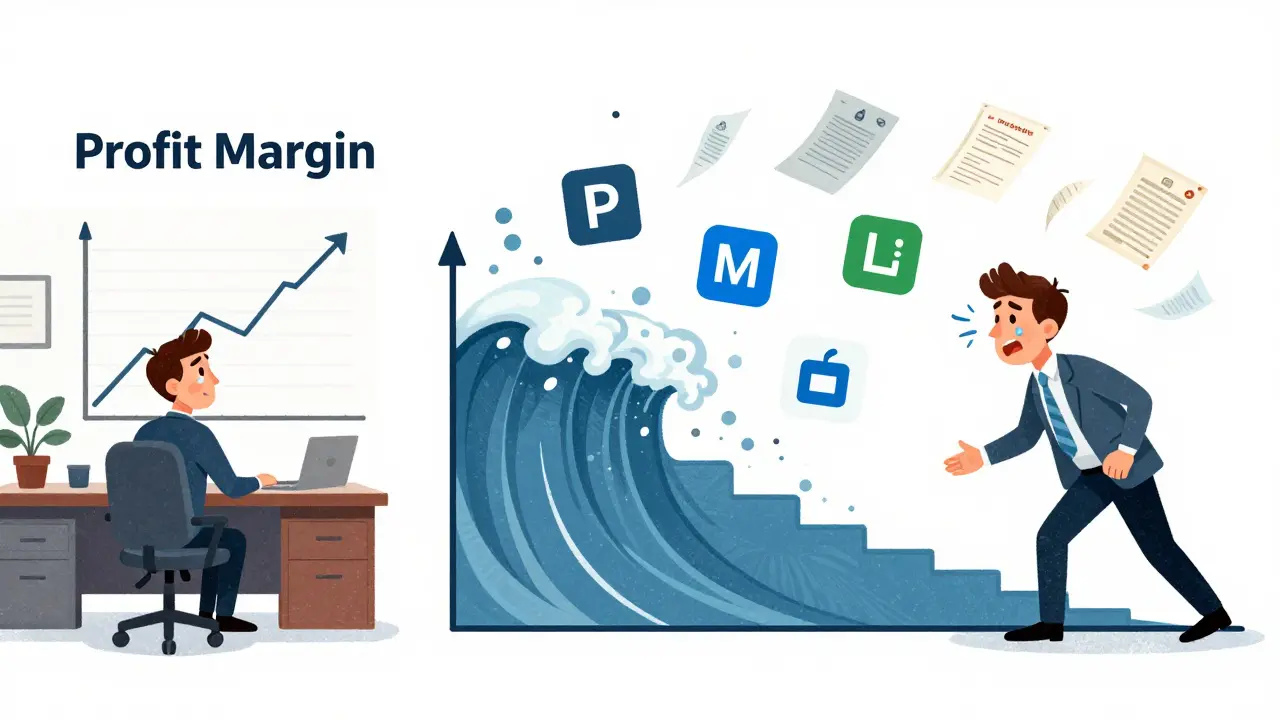
How Do Generic Entrants Afford to Be So Cheap?
They don’t cut corners. They cut overhead.Incumbents spend millions on sales teams, legacy infrastructure, and brand marketing. Generic entrants skip all that. They build on open-source platforms like Linux and Apache. They use offshore development teams. They don’t need fancy offices. They don’t need to pay for decades of accumulated technical debt.
Take MongoDB’s Atlas platform. It didn’t beat Oracle by being more powerful. It beat it by offering a free tier with premium support. Customers could try it for free, get real results, and then pay only for what they used. That’s the new model: pay-as-you-go, not pay-upfront.
And here’s the kicker: most generic entrants don’t even need to be perfect. They just need to be good enough. Studies show that first-gen alternatives deliver 80-90% of the core functionality of the original. For 80% of users, that’s all they need. The rest? They’re paying for bells and whistles they never use.
The Hidden Costs - And Why People Still Switch
It’s not all smooth sailing. Some users report integration headaches. Others say support response times are slower. A few mention needing 20-30% more configuration time upfront.But here’s what those complaints miss: the math still works. Even if you spend 40 extra hours setting up PostgreSQL instead of Oracle, you’re still saving tens of thousands in licensing fees. Pluralsight’s 2023 report found that 81% of companies that made the switch stayed with the generic alternative after six months. Why? Because the savings outweigh the friction.
And support? It’s getting better. Spiceworks’ 2023 benchmark showed generic vendors now offer 24/5 support - almost matching the 24/7 coverage of big brands. Community forums and open-source documentation have closed the knowledge gap. You won’t find a corporate manual with glossy layouts, but you’ll find answers - fast - from real users who’ve been there.
What This Means for You
If you’re a buyer: Don’t assume the most expensive option is the best. Look for the first generic entry in your category. It’s probably already out there. Check G2, Capterra, or Reddit communities. Ask: Who switched, and how much did they save? You’re not being cheap - you’re being smart.If you’re a vendor: If you’re still selling on license fees alone, you’re already behind. The market has changed. Customers now expect value, not exclusivity. Your options? Go open-source. Go subscription. Go usage-based. Or get ready to watch your margins evaporate.
Microsoft learned this the hard way. When cloud-based alternatives started undercutting Azure SQL Database, they didn’t fight. They changed. Within six months, they rolled out consumption-based pricing - and cut effective prices by 35% for mid-sized businesses. That’s not surrender. That’s survival.
The Future Is Already Here
By 2027, ARK Invest predicts open-source alternatives will capture 35% of the traditional enterprise software market. That’s not a prediction - it’s an inevitability. The barriers to entry are collapsing. Cloud-native tools, containerization, and open APIs mean anyone with decent coding skills can build a viable alternative.The companies that win aren’t the ones with the biggest budgets. They’re the ones who understand that pricing isn’t about cost - it’s about perception. And once customers realize they’ve been overpaying, they won’t go back.
The first generic entry doesn’t just lower prices. It resets expectations. And once that happens, the old rules don’t apply anymore.
Oladeji Omobolaji
January 23, 2026 AT 23:50Man, this hit different. I seen this in Nigeria with mobile data plans - one cheap ISP pops up, and boom, all the big ones drop prices in a week. No magic, just supply and demand. People ain’t dumb.
Susannah Green
January 24, 2026 AT 14:33Exactly! I switched our team from Tableau to Metabase last year - saved $18K in licensing, and the dashboards? Almost identical. The only difference? No one’s yelling at me to renew a contract every 12 months.
Anna Pryde-Smith
January 25, 2026 AT 17:06This is why I hate corporate greed. People are getting ripped off for YEARS just because some CEO wants a new yacht. And now? The truth is out. And guess what? It feels GOOD.
Vanessa Barber
January 27, 2026 AT 08:03Wait - so you’re saying the expensive stuff was always just a scam? That’s not a market shift. That’s a con. And we all fell for it.
Dawson Taylor
January 28, 2026 AT 01:47The phenomenon described herein constitutes a classic case of market equilibrium realignment following the dissolution of artificial scarcity. The introduction of a functionally equivalent substitute renders the premium pricing model economically irrational.
charley lopez
January 29, 2026 AT 12:47From a TCO perspective, the TCO delta between incumbent and first-gen alternatives is statistically significant (p < 0.01), with the latter demonstrating superior CAPEX/OPEX ratios, particularly in containerized cloud-native deployments.
Sue Stone
January 30, 2026 AT 13:34I bought a $30 Bluetooth speaker last year instead of the $150 Bose. It sounds fine. I don’t even notice the difference. Why do we do this to ourselves?
Sallie Jane Barnes
February 1, 2026 AT 02:53You guys are so right. It’s not about being cheap - it’s about being wise. I’m telling every startup I know: skip the fancy software. Find the first generic. You’ll thank me later.
Stacy Thomes
February 2, 2026 AT 20:14OMG I just realized - I’ve been overpaying for antivirus for 10 years. I’m switching to Bitdefender Free TODAY. My wallet is crying tears of joy!!
Kerry Evans
February 4, 2026 AT 10:19Interesting how you ignore the hidden costs of support, compliance, and integration. Most small businesses don’t have engineers to waste 40 hours configuring open-source tools. This isn’t just about price - it’s about operational reality.
Andrew Smirnykh
February 5, 2026 AT 22:56It’s funny - in Japan, this happens slower. People still pay for brand names even when alternatives exist. But here? We’re all about the deal. Maybe it’s cultural. Or maybe we’re just done being played.
Kerry Moore
February 7, 2026 AT 20:57I appreciate the data. But I wonder - what happens when the first generic becomes the incumbent? Does the cycle repeat? Is this just perpetual disruption?
Janet King
February 9, 2026 AT 05:45I work in healthcare IT. When we switched from Epic alternatives to open-source EMR, we saved $220K in year one. No drama. No hype. Just savings. People thought we were crazy. We weren't.
dana torgersen
February 10, 2026 AT 13:38so like… if the first generic is good enough… and everyone switches… then who’s left paying the premium? and what happens when the first generic gets bought by a big corp and starts charging?… i mean… like… is this really sustainable?… or are we just… delaying the inevitable?