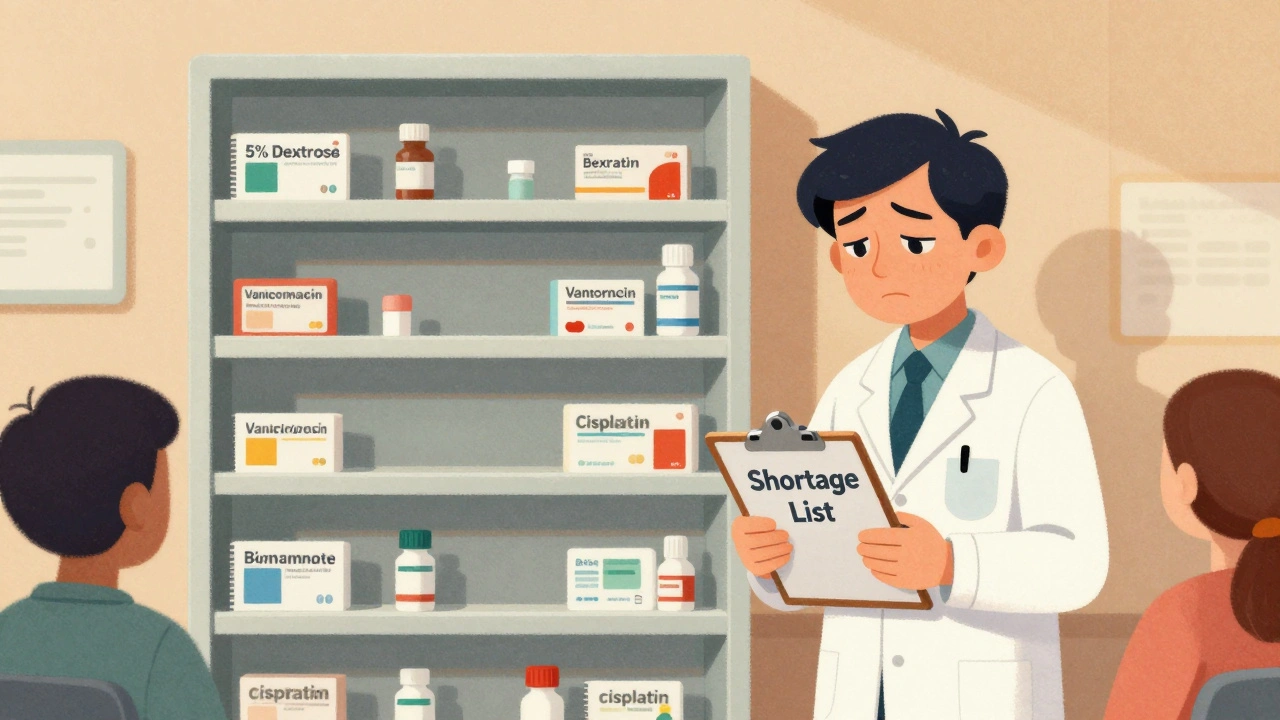
Right now, hundreds of essential medications are hard to find in U.S. hospitals and pharmacies. It’s not a glitch. It’s a systemic breakdown. If you or someone you know relies on insulin, chemotherapy, IV fluids, or even basic antibiotics, you’re likely feeling the pinch. As of April 2025, there were 270 active drug shortages - a number that’s barely budged from last year’s crisis levels. These aren’t rare, obscure drugs. They’re the ones you count on when your life depends on them.
What’s Actually in Shortage?
The most critical shortages hit the most vulnerable patients. Sterile injectables - drugs given directly into the bloodstream - are taking the hardest hit. Why? Because making them is expensive, complex, and low-profit. A single contaminated batch can shut down a whole factory for months. Here’s what’s running out:- 5% Dextrose Injection (small bags) - Used to deliver fluids and medications, this has been scarce since February 2022. Expected to improve by August 2025, but many hospitals are still rationing.
- 50% Dextrose Injection - Critical for treating low blood sugar in diabetics and emergency cases. Shortage began in December 2021. No clear end date yet.
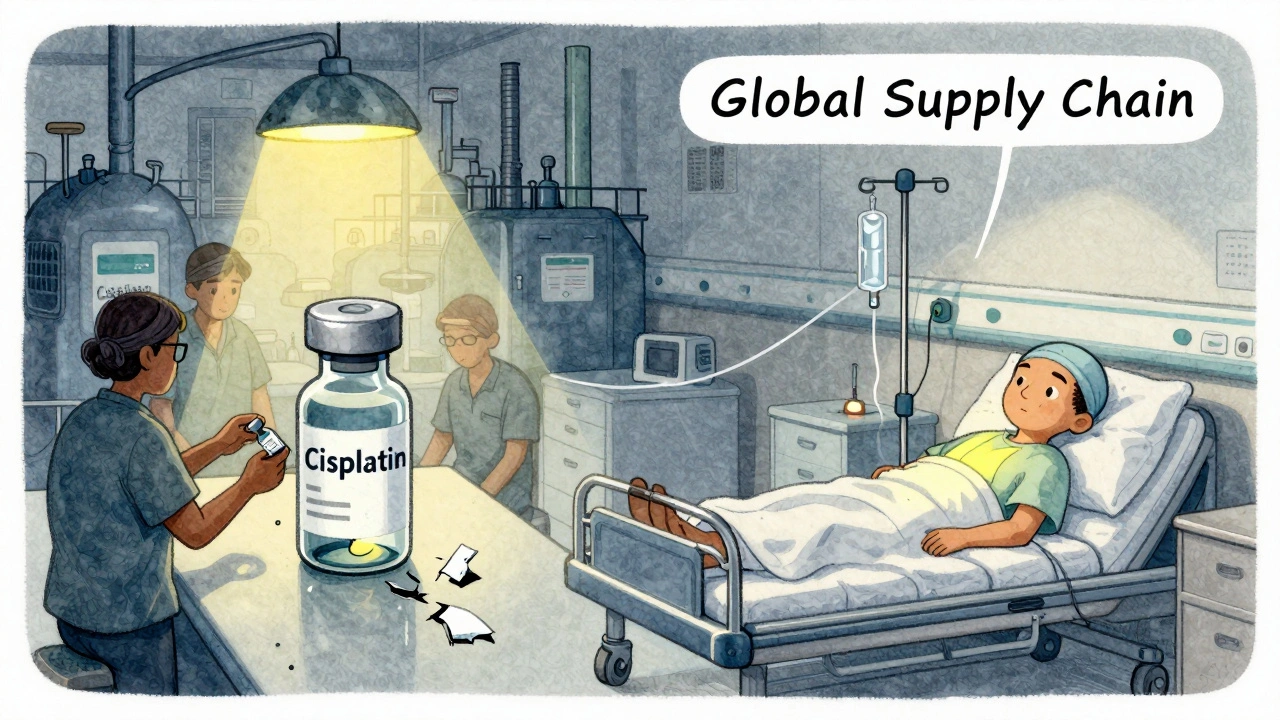
- Cisplatin - A frontline chemotherapy drug for testicular, ovarian, and lung cancers. One Indian manufacturer, which supplied half of the U.S. supply, failed FDA inspections in 2022. Production hasn’t fully resumed.
- Vancomycin - A last-resort antibiotic for resistant infections. Shortages have stretched into 2025, forcing doctors to use older, more toxic alternatives.
- Levothyroxine - The go-to treatment for hypothyroidism. Demand surged 20% since 2022, and supply couldn’t keep up. Patients report switching brands or missing doses.
- GLP-1 agonists (e.g., semaglutide, tirzepatide) - Originally for diabetes, now widely used for weight loss. Demand has grown 35% yearly since 2020. Manufacturers can’t produce fast enough.
- Normal Saline (0.9% sodium chloride) - The most common IV fluid. Used in nearly every hospital procedure. Shortages have become routine, especially in rural areas.
These aren’t random. They’re clustered. Over half of all current shortages are in three categories: central nervous system drugs (like ADHD meds), antimicrobials, and fluids and electrolytes. If you’re getting cancer treatment, managing diabetes, or fighting an infection - you’re in the crosshairs.
Why Is This Happening?
It’s not just bad luck. It’s a broken system.Most of the raw ingredients for U.S. drugs - called active pharmaceutical ingredients (APIs) - come from just two countries: India (45%) and China (25%). That’s not a coincidence. These countries produce APIs cheaply. But cheap comes with risk. Quality control failures are common. In 2022, an FDA inspection of a major Indian plant found unsanitary conditions and falsified test results. That plant made cisplatin. Production stopped. Patients waited.
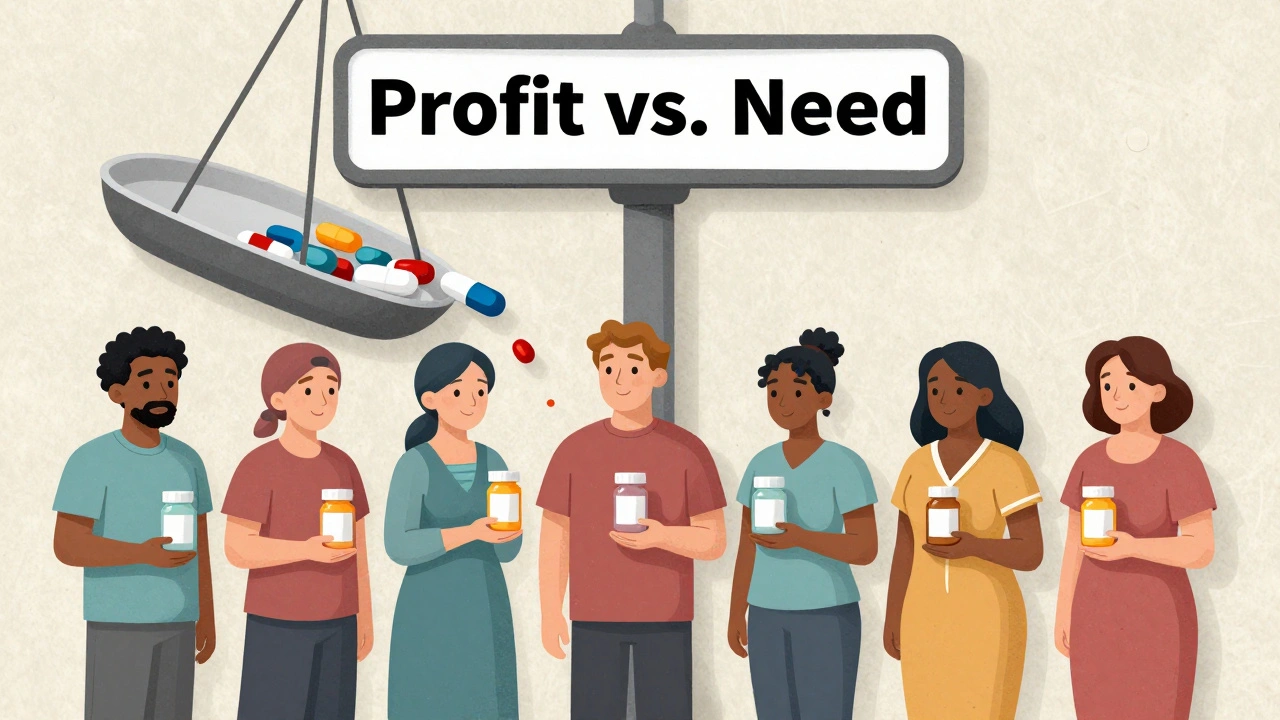
Then there’s the profit problem. Generic drugs make up 90% of prescriptions but only 20% of drug revenue. Manufacturers make 5-8% profit on generics. On brand-name drugs? 30-40%. So when a generic drug’s price drops a few cents, companies stop making it. Why invest in a low-margin product when you can make more money elsewhere?
And when demand spikes - like with weight-loss drugs - supply chains can’t adjust fast enough. Factories aren’t built to ramp up overnight. It takes 18-24 months to build a new sterile injectable line. By then, the shortage is already hurting people.
The FDA tries to help. They’ve prevented about 200 potential shortages this year by warning manufacturers early. But they can’t force anyone to produce more. They can’t demand transparency. They can’t punish companies that quietly stop making a drug without telling anyone.
How Are Doctors and Pharmacies Coping?
It’s chaos on the ground.Pharmacists spend over 10 hours a week just tracking down drugs. One hospital in Ohio had to ration cisplatin - giving it only to patients with testicular cancer, where it’s most effective. Others got alternatives that were less effective and more toxic.
Doctors are forced to substitute. A 2024 AMA survey found 43% of physicians had to switch patients to a different drug because the original wasn’t available. Sometimes it works. Sometimes it doesn’t. One patient on levothyroxine switched brands and developed heart palpitations. Another got a different antibiotic and had a severe allergic reaction.
Medication errors are rising. A 2025 ASHP study found 67% of hospital pharmacists reported errors directly tied to substitutions. A nurse gives Drug A because Drug B is out. But Drug A looks similar. The wrong dose gets given. A patient gets sick. No one’s to blame - just a system that’s stretched too thin.
Patients aren’t spared either. A 2024 survey by Patients for Affordable Drugs found 31% of cancer patients had treatment delayed because of shortages. The average delay? Nearly two weeks. That’s not just inconvenient. It’s life-threatening.
What’s Being Done?
Some fixes are starting to show up.In January 2025, the FDA launched a new portal where doctors and pharmacists can report shortages that aren’t on the official list. In three months, they got over 1,200 reports - and acted on 87% of them. That’s progress.
Forty-seven states now let pharmacists swap in a similar drug without calling the doctor first. Only 19 states allow that without any approval. That’s a big help when every hour counts.
New York is working on a public online database that shows exactly which pharmacies have which drugs in stock. Hawaii’s Medicaid program now allows drugs approved in Canada or the EU during shortages. That’s bold. And it works.
The U.S. Pharmacopeia is pushing for three big changes: financial incentives to make APIs in the U.S., mandatory stockpiles of critical drugs, and a national early warning system that connects manufacturers, distributors, and hospitals. No one’s implemented it yet - but the need is clear.
What Can You Do?
If you’re on a medication that’s in short supply:- Don’t wait until your last pill to call your pharmacy. Check availability early. Ask if they’ve received a new shipment.
- Ask your doctor about alternatives. Not all substitutions are equal, but some are safe and effective. Don’t assume there’s no option.
- Keep a list of your meds. Include the generic name, brand name, and dosage. This helps pharmacists find substitutes faster.
- Don’t skip doses. If you’re out, call your doctor immediately. Skipping insulin, thyroid meds, or chemo can have serious consequences.
- Join patient advocacy groups. Organizations like Patients for Affordable Drugs track shortages and push for policy change. Your voice matters.
There’s no magic fix. The problem is structural. But awareness helps. If enough people speak up - to their doctors, their lawmakers, their pharmacies - change becomes possible.
What’s Next?
The Congressional Budget Office predicts drug shortages will stay above 250 through 2027. If new tariffs on Chinese and Indian pharmaceuticals go through, that number could jump to 350. That’s not speculation. That’s projection.Until manufacturers are financially rewarded for making generic drugs reliably, until the U.S. stops outsourcing half its medicine to countries with weak oversight, until hospitals can stockpile without going bankrupt - this won’t get better.
But it doesn’t have to stay this way. Solutions exist. They just need political will. And public pressure.
What are the most common drugs in shortage right now?
The most common shortages are sterile injectables like 5% and 50% Dextrose, normal saline, cisplatin, vancomycin, and levothyroxine. GLP-1 weight-loss drugs are also in high demand and short supply. These are not obscure medications - they’re used daily in hospitals and clinics across the country.
Why are generic drugs more likely to be in shortage than brand-name drugs?
Generic drugs make up 90% of prescriptions but only 20% of pharmaceutical revenue. Manufacturers make only 5-8% profit on generics, compared to 30-40% on brand-name drugs. When prices drop or costs rise, companies stop making generics because it’s not worth it. Brand-name drugs have higher margins, better supply chains, and often more domestic production.
Can pharmacists substitute a different drug if mine is out of stock?
In 47 states, pharmacists can substitute a therapeutically equivalent drug during a shortage. But only 19 states allow them to do so without first contacting your doctor. Always ask your pharmacist if a substitution is safe and approved. Never assume it’s automatic.
How long do drug shortages usually last?
Some shortages resolve in weeks. Others last years. The average resolution time improved by 15% in 2024 due to better FDA coordination, but many shortages from 2022 are still ongoing. The FDA tracks expected resolution dates, but delays are common - especially for complex sterile injectables.
Is it safe to use a drug from another country during a shortage?
In most cases, no - unless approved by the FDA or your state’s health department. But Hawaii’s Medicaid program now allows foreign-approved drugs during shortages, and other states are considering similar rules. These drugs must meet strict safety standards. Never import medications on your own. Talk to your doctor or pharmacist about legal alternatives.
Rebecca Dong
December 9, 2025 AT 20:28Of course it’s a conspiracy-Big Pharma’s working with the FDA to keep drugs scarce so they can jack up prices on the alternatives. You think they don’t know exactly when to let a batch fail? They plan this. They wait. They watch. And then-bam-your insulin is gone, and their stock price is up 20%. Wake up.
Jack Appleby
December 11, 2025 AT 19:45Let’s be precise: the issue isn’t ‘shortages’-it’s structural disincentivization of generic manufacturing within a profit-driven, deregulated oligopoly. The FDA’s warnings are performative; they lack enforcement teeth because Congress refuses to appropriate funding for inspectional capacity. Meanwhile, API outsourcing to India and China-both of which have endemic regulatory corruption-isn’t ‘globalization,’ it’s strategic surrender.
And don’t get me started on GLP-1s. These aren’t ‘medications’-they’re lifestyle luxuries masquerading as therapeutics. The real crisis is that we’re diverting finite manufacturing capacity from life-saving chemotherapies to weight-loss drugs for the affluent. Moral hazard on a national scale.
Neelam Kumari
December 12, 2025 AT 15:13Oh please. You think Americans are the only ones suffering? We in India make half the world’s generics-and we’re getting blamed for it? Your hospitals are bankrupt because your insurance system is a joke, not because we can’t produce cisplatin. You want drugs? Pay more. Or stop treating diabetes like a hobby and start taking your meds.
And don’t even mention levothyroxine. Half the people taking it don’t even need it. Your doctors prescribe it like candy. Then you cry when it’s gone. Pathetic.
Doris Lee
December 13, 2025 AT 08:13Hey-just wanted to say if you’re struggling to find your meds, you’re not alone. I’ve been there with my dad’s chemo. Call your pharmacy early, keep a list, and don’t be afraid to ask your doc about alternatives. There’s always a path forward-even if it’s messy. You’ve got this.
Raj Rsvpraj
December 13, 2025 AT 11:02Why are you all crying? India produces 45% of the world’s APIs-and you think we’re the problem? You Americans can’t even make a sterile bag without contaminating it! We follow WHO standards. You follow profit margins. And now you blame us? Hah! Go make your own drugs. Try building a plant in Ohio with your union wages and OSHA compliance. You’d fold in six months.
Also, GLP-1s? You’re wasting medicine on people who just want to look good. Let them pay extra. Save the cisplatin for real patients. That’s logic. Not emotion.
Kaitlynn nail
December 14, 2025 AT 12:11It’s not about drugs. It’s about who we value.
When a life-saving med is harder to get than a new iPhone, we’ve already lost.
Ben Greening
December 14, 2025 AT 17:34While the systemic issues are indeed profound, it is worth noting that the FDA’s recent proactive reporting portal has demonstrated tangible efficacy, resolving 87% of unreported shortages within three months. This suggests that transparency, even in a fractured system, can yield measurable improvements. Further, state-level pharmacist substitution authority-now operative in 47 jurisdictions-has mitigated patient harm significantly, particularly in rural and underserved regions.
One should not overlook the role of patient advocacy in amplifying these incremental reforms. Collective action, however modest, remains a critical lever for change.
Aileen Ferris
December 15, 2025 AT 22:50wait so like… the saline bags are gone?? but like… why?? i mean… i get the profit thing but… like… its just salt water?? how is this even possible??
Frank Nouwens
December 16, 2025 AT 19:14It is my understanding that the manufacturing of sterile injectables requires an extraordinary degree of environmental control, including HEPA-filtered cleanrooms, validated sterilization processes, and continuous microbiological monitoring. A single breach-whether due to inadequate sanitation, personnel error, or equipment failure-can result in the contamination of an entire batch, necessitating the shutdown of the facility for months while investigations and remediation occur. This is not a matter of negligence alone; it is a matter of technical complexity compounded by economic fragility.
Moreover, the supply chain for such products is not merely logistical-it is biological. The raw materials, packaging, and even the water used must meet pharmaceutical-grade standards. The cost of compliance is immense, and when profit margins are 5–8%, rational actors withdraw.
Stephanie Maillet
December 17, 2025 AT 19:08There’s something deeply human here, isn’t there? We’ve outsourced not just our pills, but our trust-in institutions, in safety, in each other.
When a child with leukemia waits for cisplatin, and the only available alternative is more toxic than the disease itself… we’re not just facing a supply chain failure.
We’re facing a moral one.
And yet, in the same breath, we see pharmacists working 10-hour days to find substitutes, doctors refusing to let patients go without, and states like Hawaii saying, ‘We’ll bring in safe drugs from Canada.’
Maybe the system is broken-but the people? They’re still showing up.
That’s where hope lives.
Queenie Chan
December 19, 2025 AT 08:03Have you ever thought about how weird it is that we treat medicine like a commodity? Like, we don’t do this with fire engines or police. If your town’s only ambulance breaks down, you don’t say ‘well, it’s just not profitable to fix it.’ You fix it. Or you rebuild it. But with medicine? We shrug and say ‘market forces.’
What if we treated insulin like clean water? What if we treated chemo like a public utility?
Would we still be here? Or would we finally be… human?