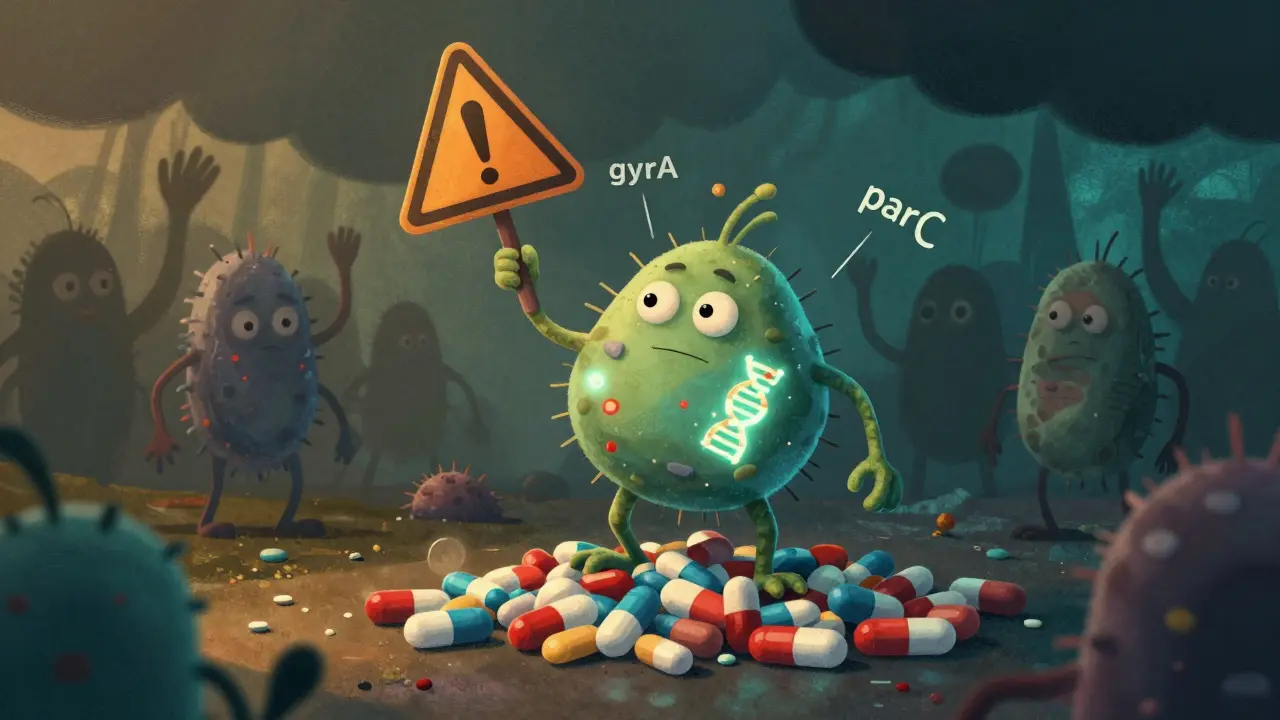
Every time you take an antibiotic when you don’t need it, you’re not just helping yourself-you’re helping bacteria become stronger. This isn’t science fiction. It’s happening right now, in hospitals, farms, and homes around the world. By 2025, antibiotic resistance is expected to cause more deaths than cancer. And the root cause? Simple: we’ve been using these drugs like candy.
How Bacteria Learn to Survive Antibiotics
Bacteria don’t sit around waiting to die. When exposed to antibiotics, they adapt. Fast. The process starts with random genetic mutations-tiny changes in their DNA that accidentally give them a survival edge. One mutation might change the shape of a protein so the antibiotic can’t latch on. Another might turn on a pump that shoots the drug right back out. These changes aren’t planned. They’re accidents. But in the presence of antibiotics, those accidents become superpowers.
Studies tracking bacteria under lab conditions show resistance doesn’t happen all at once. It builds in stages. First, bacteria use quick, reversible tricks-like turning on genes that temporarily block the drug. This is called epigenetic switching. It’s like putting up a temporary shield. Then, over time, they lock in the change with permanent mutations. One 2025 study found that in dynamic antibiotic environments-where doses varied like real-world use-bacteria developed stable resistance in as few as 150 generations. In static, predictable doses? It took over 500 generations. That means inconsistent or low-dose use actually speeds up resistance.
Some mutations are common across species. Changes in the gyrA and parC genes make bacteria resistant to fluoroquinolones like ciprofloxacin. Mutations in ampC break down amoxicillin. For cefepime, it’s usually pbp genes. And when it comes to tetracycline, the story gets weirder: resistance often starts with a transposon-a piece of jumping DNA-that inserts itself near a pump gene and flips it on permanently. The bacteria didn’t evolve the pump for tetracycline. They just hijacked one that was already there.
It’s Not Just About Mutations
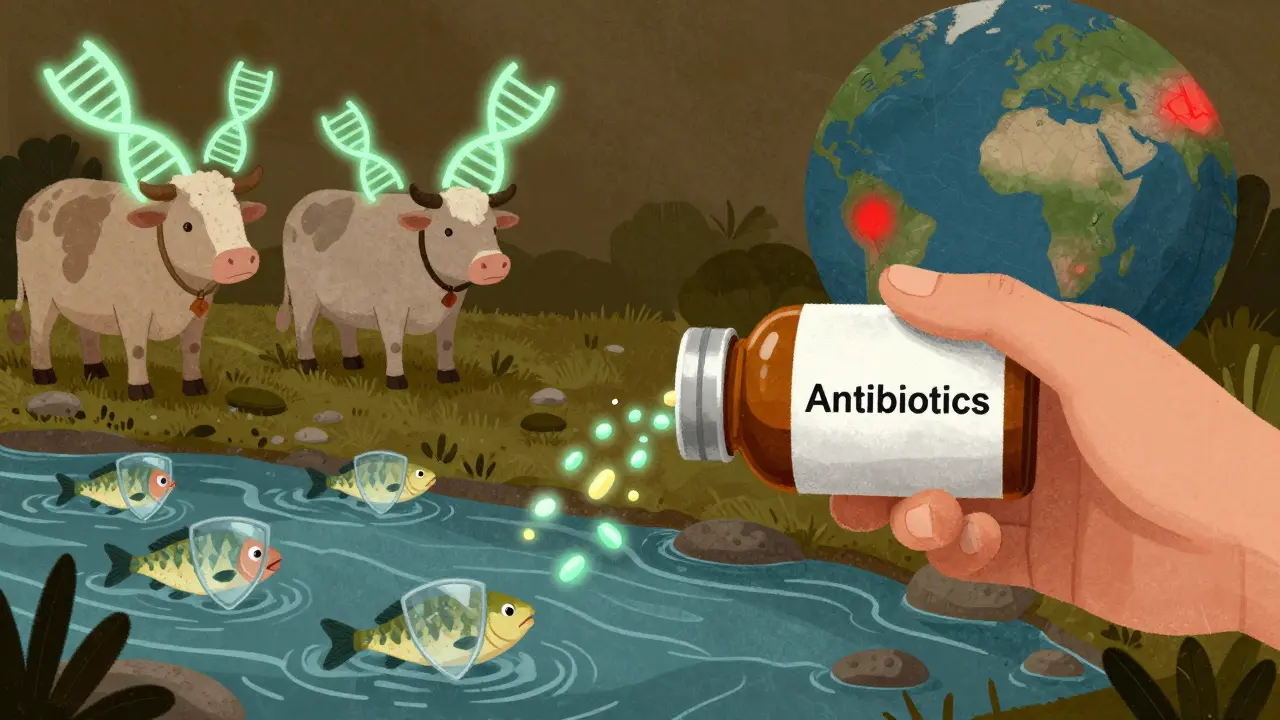
Mutations are only half the story. Bacteria also steal resistance genes from each other. This is called horizontal gene transfer. One bacterium can pass a resistance gene to another through direct contact, or even release it into the environment for others to pick up. Think of it like sharing a cheat code. In hospitals, this happens constantly. In rivers near farms, it’s even worse. Antibiotics used in livestock end up in manure, which washes into waterways. There, resistant bacteria mix with wild microbes-and pass along their defenses.
And here’s the twist: you don’t even need antibiotics to make this worse. Recent studies show that common painkillers, antihistamines, and even antidepressants can trigger bacteria to absorb resistance genes from their surroundings. That means pollution from everyday medicines is helping superbugs spread-even when no one’s taking antibiotics.
Why We’re Overusing Antibiotics
In the U.S., about 30% of outpatient antibiotic prescriptions are unnecessary. That’s 47 million courses a year given for colds, flu, and sore throats-most of which are viral. Antibiotics don’t kill viruses. But patients ask for them. Doctors give them. It’s easier than explaining why they won’t help.
In other countries, the problem is even worse. In some places, antibiotics are sold over the counter without a prescription. People take them for fevers, coughs, or even to prevent illness. In agriculture, they’re fed to pigs, chickens, and cows not to treat disease-but to make them grow faster. That’s a massive, ongoing selection pressure. Every dose, every drop, every bit of manure that ends up in soil or water is training bacteria to survive.
The result? We’re running out of options. The WHO’s 2024 report on new antibiotics found that out of 67 drugs in development, only 17 target the most dangerous resistant bacteria. And only three of those are truly new-meaning they can bypass existing resistance mechanisms. The rest are tweaks on old drugs. They’ll work for a while. Then bacteria will adapt again.
What ‘Appropriate Use’ Actually Means
Appropriate antibiotic use isn’t just about not taking them when you don’t need them. It’s about using them right when you do.
- Take the full course-even if you feel better. Stopping early leaves behind the toughest bacteria. They survive, multiply, and pass on their resistance.
- Don’t save leftovers for next time. The dose, duration, and type are specific to the infection you had. Using them for something else can be dangerous and ineffective.
- Never share antibiotics. What works for one person might harm another-or fuel resistance in someone else’s body.
- Ask before you take. If your doctor prescribes an antibiotic, ask: ‘Is this definitely needed?’ ‘What’s the evidence?’ ‘Are there alternatives?’
Doctors are getting better at this. Antimicrobial stewardship programs-where pharmacists and infectious disease specialists review prescriptions-have cut unnecessary use by 20-30% in hospitals. But these programs take time. It takes 12 to 18 months to see real drops in resistance rates. And they’re still rare in low-income countries.
The Bigger Picture: One Health
You can’t fix antibiotic resistance by just changing how humans use drugs. It’s a web. Humans, animals, plants, soil, water-they’re all connected. That’s the idea behind One Health.
When a farmer gives antibiotics to chickens, resistant bacteria show up in their meat. When you eat it, those bacteria can colonize your gut. When you flush pills down the toilet, they enter wastewater. Treatment plants can’t fully remove them. They end up in rivers. Fish absorb them. Algae grow around them. And the cycle continues.
Over 150 countries have national plans to fight resistance. But only 35% of low-income nations have fully implemented theirs. High-income countries are doing better-75% on average. But even then, enforcement is patchy. Farming regulations are weak. Pharmacy oversight is lax. Public awareness is low.
What’s Being Done-and What’s Not
Scientists are exploring wild new ideas. CRISPR tools are being designed to target and destroy resistance genes inside bacteria. Metabolomics is helping identify hidden metabolic pathways that bacteria use to survive drugs. Bioinformatics models now predict how resistance will evolve in specific strains-letting doctors choose drugs before the infection even starts.
But these are long-term fixes. We’re not waiting for them. We’re already in crisis mode.
The FDA recently updated testing standards for cefiderocol, a last-resort drug for carbapenem-resistant infections. That’s progress. But it’s reactive. We’re playing catch-up.
Meanwhile, the World Bank warns that if nothing changes, antimicrobial resistance could push 24 million people into extreme poverty by 2050. The global cost? Over $1 trillion a year. That’s not just healthcare bills. It’s lost workdays, failed surgeries, longer hospital stays, and children who can’t recover from simple infections.
Your Role in Stopping the Spread
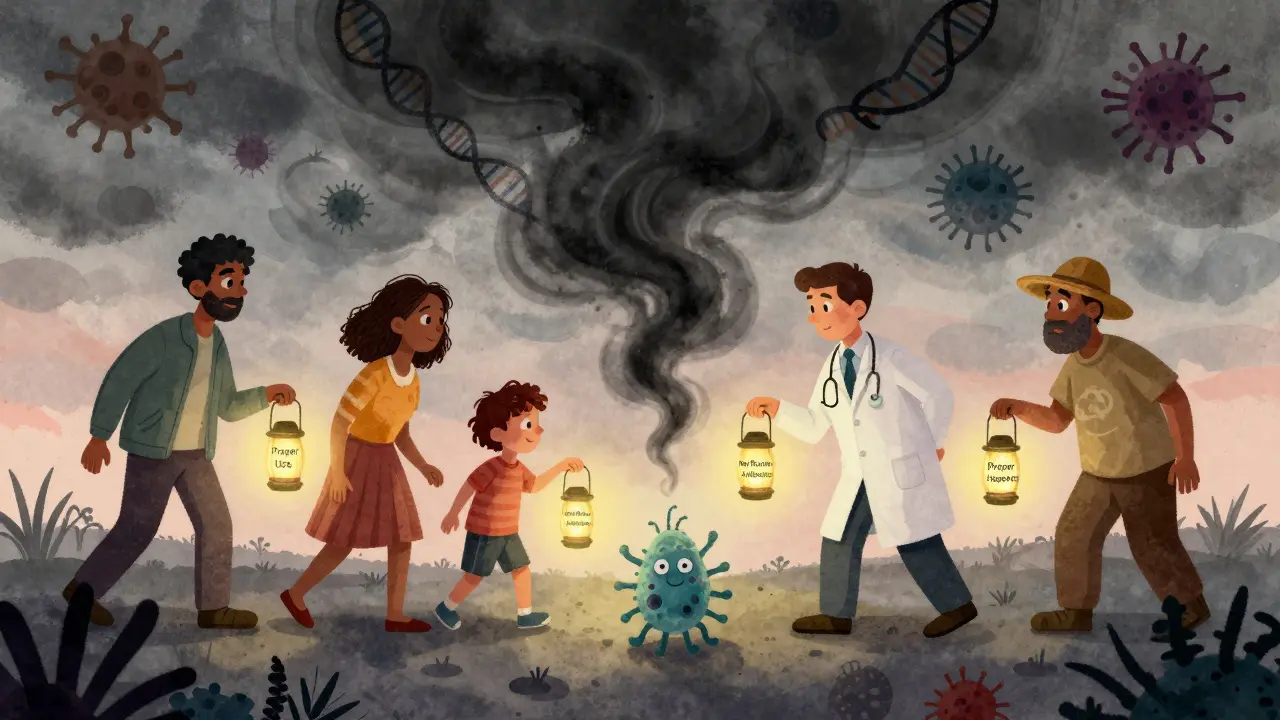
You don’t need to be a scientist to make a difference. Here’s what you can do:
- Never pressure your doctor for antibiotics. If they say no, thank them.
- Dispose of old antibiotics properly. Don’t flush them. Take them to a pharmacy drop-off.
- Choose meat from animals raised without routine antibiotics. Look for labels like ‘no antibiotics ever’ or ‘organic’.
- Wash your hands. Simple hygiene stops infections before they start-and reduces the need for antibiotics.
- Spread the word. Talk to friends, family, teachers. Most people don’t realize how serious this is.
Antibiotics saved millions in the 20th century. But they’re not magic. They’re tools. And like any tool, misuse breaks them. We’re not running out of antibiotics because science failed. We’re running out because we didn’t treat them with the respect they deserve.
The next time you’re offered an antibiotic, pause. Ask. Think. You’re not just protecting yourself. You’re protecting the next generation’s ability to survive a simple infection.
Can antibiotic resistance be reversed?
In some cases, yes-but it’s slow. If antibiotic use drops significantly, resistant bacteria may lose their advantage and become less common over time. But the genes don’t disappear. They stay hidden in bacterial populations, ready to resurface if antibiotics are used again. Complete reversal is unlikely. The goal is to slow spread and preserve what’s left.
Are natural remedies effective against resistant infections?
No. Honey, garlic, and essential oils might have mild antibacterial properties in lab settings, but they cannot replace antibiotics for serious infections like pneumonia, sepsis, or urinary tract infections. Relying on them delays proper treatment and increases the risk of complications or death.
Why don’t we just make new antibiotics?
Developing new antibiotics is expensive, slow, and not very profitable for drug companies. Most new drugs are modifications of old ones, and bacteria quickly adapt. Only 3 of the 67 antibiotics currently in development are truly novel. Without better incentives and global coordination, the pipeline will stay dry.
Does taking antibiotics weaken my immune system?
Not directly. But antibiotics kill off good bacteria in your gut, which play a role in immune function. This can make you more susceptible to other infections, like C. diff, and may affect long-term immunity, especially in children. That’s another reason to avoid unnecessary use.
Is antibiotic resistance only a problem in hospitals?
No. In fact, most resistance starts outside hospitals-in farms, households, and the environment. Community-acquired resistant infections are rising fast. You don’t need to be sick in a hospital to pick up a superbug.
What Comes Next
The next decade will decide whether we live in a world where a scraped knee can kill-or where antibiotics still work. It’s not about finding one miracle cure. It’s about changing how we think, act, and regulate. Every pill you refuse, every label you read, every conversation you start, adds up.
We’ve had warnings since 1945. We’ve had data since 2019. We’ve had plans since 2017. What’s missing? Action. Real, daily, personal action. Not from governments alone-from you.
Shawn Peck
January 30, 2026 AT 20:54Look, I don't care how many studies say this. I took amoxicillin for a cold last winter and felt better. That's all I need to know. If it works, it works. Stop scaring people with science jargon.
Sarah Blevins
February 1, 2026 AT 00:41The data presented in this post is methodologically sound, though it lacks a meta-analysis of longitudinal resistance prevalence across low- and high-income regions. The assumption that individual behavioral changes can meaningfully alter population-level resistance trajectories is statistically tenuous without structural intervention data.
Jason Xin
February 1, 2026 AT 02:13Yeah, I get it. We're all guilty of asking for antibiotics like they're free candy. But here's the thing - most people don't know the difference between a virus and a bacteria. And doctors? They're rushed, overworked, and tired of arguing. So they hand out prescriptions just to make the patient go away. It's not malice. It's systemic burnout. We need better tools for docs - not just guilt trips for patients.
Also, that part about antidepressants triggering gene transfer? That blew my mind. I didn't realize my Zoloft might be helping superbugs. That’s wild.
Kathleen Riley
February 1, 2026 AT 09:15The ontological framework underlying the discourse on antimicrobial resistance presupposes a Cartesian dichotomy between human agency and microbial autonomy, thereby obscuring the symbiotic entanglement of pharmaceutical capitalism with biological evolution. To posit individual behavioral modification as a panacea is to engage in epistemic narcissism - as if the microbe, in its primordial indifference, cares for our moral posturing.
Resistance is not a failure of ethics; it is the inevitable expression of evolutionary logic under anthropogenic pressure. Our moralizing is merely the echo of a dying paradigm.
Beth Cooper
February 1, 2026 AT 12:31Okay but have you ever heard of the truth about antibiotics? The government and Big Pharma are totally hiding the real cure - it's all in the Himalayan salt and magnetic water therapy. They don't want you to know because antibiotics are a multi-billion dollar racket. They even make you think you need them by lying about viruses. I read a guy on YouTube who cured his MRSA with apple cider vinegar and chanting. He's now living in a yurt in Oregon. Coincidence? I think not.
Rohit Kumar
February 2, 2026 AT 19:30In India, we’ve lived with this for decades. Antibiotics are sold at every corner shop. People take them for fever, for cough, for even a headache. No one knows what a prescription is. But here’s what no one talks about - we also have the strongest natural immunity on earth. Our bodies have been fighting bad bacteria since birth. We don’t need fancy labs to fix this. We need education. Not fear. Not guilt. Just knowledge.
And yes, I’ve seen kids recover from pneumonia with just rest, garlic, and clean water. But I’ve also seen them die because someone waited too long to get real medicine. It’s not either/or. It’s both/and.
Carolyn Whitehead
February 2, 2026 AT 22:45Love this post. Seriously. I used to ask for antibiotics for everything. Now I just drink tea and sleep. And guess what? I’m still alive. Also, I started buying chicken with 'no antibiotics ever' on the label. Feels good to do something small that actually matters. Keep sharing stuff like this ❤️
Beth Beltway
February 4, 2026 AT 19:54Oh please. 'Ask your doctor' - like they’re not just profit-driven sales reps for Big Pharma. You think they care about your gut biome? They care about their bonus. And don’t get me started on 'organic' meat - that’s just a marketing scam. The real problem? The FDA and WHO are controlled by pharmaceutical lobbies. They want you dependent. They want you scared. They want you buying the next 'miracle drug' every time the last one fails. This whole post is a distraction. The truth? We’re all lab rats in a drug company’s experiment.