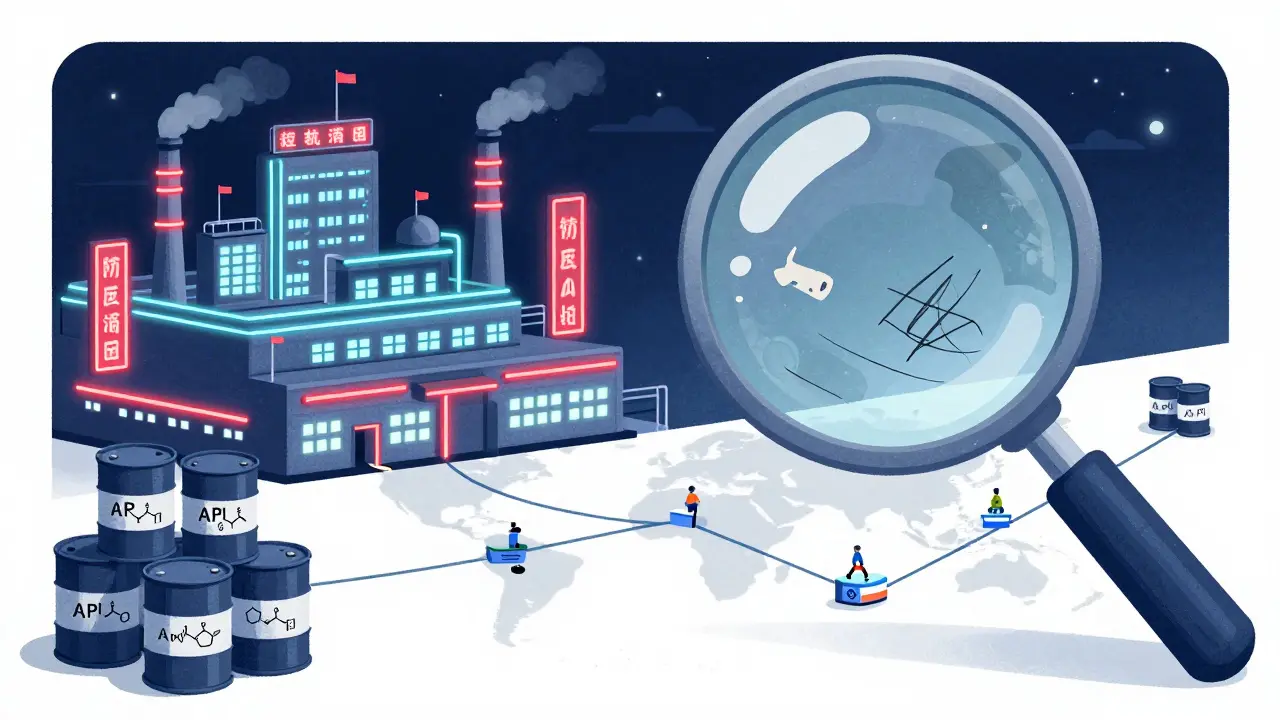
When you take a generic pill for high blood pressure, antibiotics, or diabetes, there’s a better than 70% chance the active ingredient inside came from a factory in China. That’s not speculation-it’s fact. As of 2023, China supplies 80% of the world’s active pharmaceutical ingredients (APIs), the raw chemical building blocks of nearly every generic medicine sold globally. But behind that staggering scale lies a quiet crisis: quality control that often falls short of international standards, supply chains that are dangerously concentrated, and a regulatory system still catching up to global expectations.
How China Dominates the Global API Market
China didn’t become the world’s API powerhouse overnight. After joining the World Trade Organization in 2001, the government poured billions into pharmaceutical manufacturing. State-backed policies, cheap labor, lax environmental rules, and vertical integration-controlling everything from raw chemicals to finished APIs-gave Chinese producers a massive cost advantage. Today, companies like Sinopharm and Shijiazhuang Pharma Group can produce 500 to 2,000 metric tons of a single API per year, at costs 30-40% lower than U.S. or European rivals. The result? A global market where Chinese APIs cost $50-$150 per kilogram, while the same substance made in Germany or the U.S. runs $200-$400. For generic drug makers in India, the U.S., and Europe, buying Chinese APIs isn’t a choice-it’s a necessity. India imports 65% of its APIs from China, then turns them into finished pills. The U.S. gets 88% of its API manufacturing overseas, and China alone accounts for nearly 28% of those facilities. But here’s the catch: China makes the raw ingredients, not the final pills. It controls 80% of the API market but only 5-7% of the finished drug export market. That means the world depends on China for the foundation of its medicines, but not the finished product. That dependency creates a single point of failure-and it’s already causing alarms.Quality Problems That Won’t Go Away
Cost savings don’t mean quality improvements. The U.S. Food and Drug Administration (FDA) has been sounding the alarm for years. Between 2022 and 2023, inspections of Chinese API facilities found:- 78% had inadequate laboratory controls
- 65% failed to properly validate their manufacturing processes
- 52% showed data integrity issues-like deleted records, altered results, or falsified logs
The Gap Between Production Scale and Quality Systems
China’s factories are big. Really big. But many still use outdated batch processing methods-where chemicals are mixed in large vats, one batch at a time. That’s the old way. In the U.S. and Europe, 35% of API production now uses continuous manufacturing: a smoother, more controlled, real-time monitored process that reduces contamination and variability. In China? Only 35% of production uses continuous methods. The rest? Batch processing. That means more room for error. The Chinese government knows this. Since 2016, it launched the Generic Consistency Evaluation (GCE) program, requiring generics to prove they work the same as the original branded drug. So far, only 35% of approved generics have completed the evaluation. That leaves thousands of drugs on the market without verified bioequivalence. Meanwhile, China has shut down 4,500 non-compliant factories since 2018. That sounds good-until you realize it cut the number of generic manufacturers from 7,000 to 2,500. The survivors? Many are still cutting corners to survive. After China’s National Volume-Based Procurement (NVBP) program slashed generic drug prices by over 50% between 2018 and 2023, margins dropped from 40-50% to just 15-20%. Profit pressure means quality often becomes the first thing to shrink.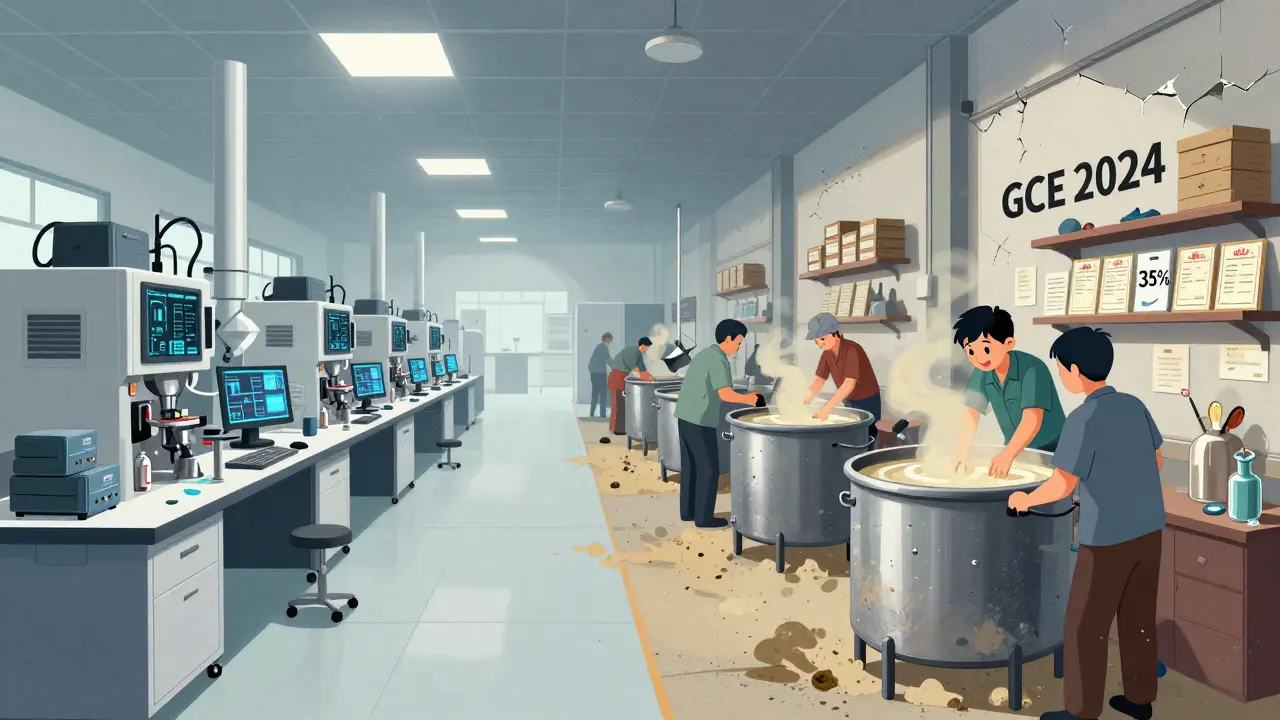
Why the FDA Can’t Keep Up
You’d think the FDA would be inspecting Chinese facilities constantly. But here’s the reality: the FDA inspects Chinese plants at one-tenth the rate of U.S. facilities. Why? Access. China doesn’t always allow unannounced inspections. Travel restrictions, political tensions, and bureaucratic delays mean inspectors often get scheduled visits with advance notice-giving factories time to clean up, hide problems, or temporarily hire extra staff. Dr. Margaret Hamburg, former FDA Commissioner, told Congress in March 2024: “We’re flying blind in half the world.” And she’s right. With over 187 FDA-inspected facilities in China as of 2023, and over 2,000 total API plants, the gap is enormous. The FDA simply doesn’t have the manpower-or the access-to keep up. Even when inspections happen, results are troubling. A 2024 analysis of FDA warning letters showed that Chinese facilities consistently rank worst in data integrity, process validation, and environmental controls. Meanwhile, companies trying to build compliant factories in China face steep costs: building an FDA-grade API plant costs $85-$120 million. Non-compliant? Just $50-$75 million. Many choose the cheaper route.Who’s Trying to Fix This-and Can They?
China isn’t ignoring the problem. In 2024, it launched “Pharma 2035,” a $22 billion plan to upgrade technology, adopt continuous manufacturing, and increase FDA-inspected facilities from 187 to 500 by 2027. The National Medical Products Administration (NMPA) now requires electronic submissions and mandates that 30% of high-volume APIs use continuous manufacturing by 2026. Some progress is real. China’s NMPA says 95% of its GMP-certified plants now follow ICH Q7 guidelines-the global standard for API quality. It claims 80% of non-compliant facilities have been closed. But numbers don’t always match reality. A 2024 Gartner survey of 150 pharmaceutical companies found Chinese API suppliers scored just 3.2 out of 5 for quality consistency. European suppliers scored 4.1. Meanwhile, the rest of the world is pulling away. The U.S. CHIPS and Science Act allocated $500 million to bring API production home. The EU’s 2024 Pharmaceutical Strategy aims to cut China’s API share from 80% to 40% by 2030. India, Vietnam, and Mexico are expanding their own manufacturing. McKinsey forecasts China’s API market share will drop from 78% in 2023 to 65% by 2030.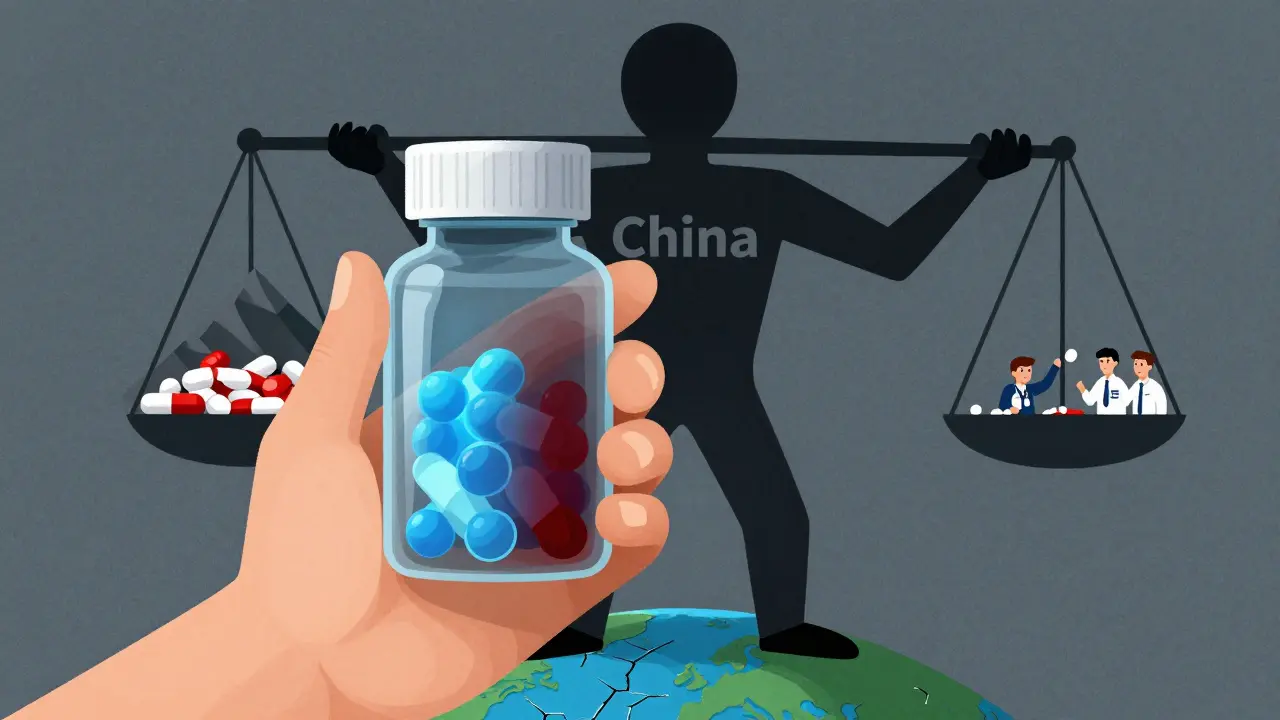
What This Means for You
If you’re a patient, you might wonder: “Should I be worried?” The answer isn’t simple. Most generic drugs from China are safe. Millions of people take them every day without issue. But the risk isn’t zero. When a batch fails purity tests, or when a lab falsifies data, the consequences can be deadly-especially for chronic conditions like heart disease or diabetes. If you’re a pharmacist, distributor, or generic drug manufacturer, the message is clear: source wisely. Don’t assume Chinese APIs are all the same. Ask for certificates of analysis. Demand third-party testing. Track your suppliers’ inspection history. The cost savings are real-but so are the risks. The truth is, the world needs China’s scale. No other country can produce APIs at this volume or price. But the world also needs quality. Right now, China is stuck in the middle: too big to ignore, too risky to trust completely.What’s Next for Chinese Generic Production?
The next five years will decide China’s future in global pharma. If it invests $30-$40 billion in quality infrastructure and achieves 95%+ compliance with FDA and EMA standards, it can keep its lead. If it doesn’t, the world will keep moving on. India is already building its own API capacity. The U.S. is starting to make some essentials at home. Europe is funding alternatives. China’s advantage isn’t gone-but it’s eroding. The question isn’t whether China will lose its dominance. It’s whether it will fix its quality problems fast enough to stay in the game. For now, the system works-barely. But it’s a house built on cheap labor, weak oversight, and global dependence. One supply chain disruption. One major recall. One pandemic. And the cracks could turn into a collapse.Are generic drugs from China safe to take?
Most are. Millions of people worldwide take generic medications with Chinese-sourced APIs without any issues. But safety isn’t guaranteed. The FDA has found that 12.7% of Chinese API samples fail purity tests, compared to under 2% from the U.S. or Europe. Quality varies by manufacturer. Always trust FDA-approved brands and avoid unregulated suppliers.
Why does the U.S. rely so heavily on China for drug ingredients?
Cost and scale. Chinese manufacturers produce APIs at 30-40% lower cost than Western companies, and they can produce massive volumes-up to 2,000 metric tons per year for a single ingredient. Building equivalent facilities in the U.S. or Europe would cost billions and take years. For generic drug makers, the price advantage is too big to ignore.
Has China improved its drug quality standards?
Yes, but slowly and unevenly. Since 2016, China shut down 4,500 non-compliant factories and launched the Generic Consistency Evaluation program. But as of 2024, only 35% of generics have passed it. While top-tier manufacturers now meet international standards, many smaller plants still cut corners. The gap between the best and worst is still wide.
What’s the difference between APIs and finished drugs?
APIs are the active chemicals that make the drug work-like metformin for diabetes or lisinopril for blood pressure. Finished drugs are the pills, capsules, or injections you swallow, which include the API plus fillers, coatings, and binders. China makes most APIs but very few finished drugs for export. India and the U.S. turn those APIs into pills.
Should I avoid generic drugs made with Chinese ingredients?
No-but be informed. Avoid unbranded or unregulated generics. Stick to FDA-approved or EMA-certified products, even if they use Chinese APIs. The issue isn’t the country-it’s the manufacturer. Reputable companies like Teva, Mylan, or Zydus have strict quality controls, even when sourcing from China. Don’t assume all Chinese-made drugs are risky. But do ask your pharmacist where the API comes from.
Amy Ehinger
January 16, 2026 AT 00:49It's wild to think that the pill I take every morning for my blood pressure could've been made in a factory thousands of miles away, and I probably never even thought about it until now. I mean, I trust my pharmacist, I trust the FDA label, but reading this makes me realize how little I actually know about what's inside those little capsules. It's not that I'm scared-I'm just... curious now. Like, who's checking the checkers? And why does it feel like we've outsourced our health to a system we can't fully see or understand?
Still, I don't think we should panic. Most of these drugs work fine. But maybe we need more transparency-not fear. Like, if a batch fails, why can't that be public? Not to scare people, but so we can all make smarter choices.
Also, props to China for scaling like that. No other country could've pulled off that kind of volume at that price. It's just... the quality gap is real, and we're all holding our breath hoping the next batch doesn't break.
Crystel Ann
January 17, 2026 AT 20:54I’ve been a nurse for 22 years and I’ve never seen a patient harmed by a generic from China. That doesn’t mean the risks aren’t there, but the system-flawed as it is-has worked for millions. We don’t throw out the baby with the bathwater. We fix the leaks.
Maybe the answer isn’t bringing everything back home-it’s holding the top manufacturers to higher standards, and rewarding the ones who do it right. The ones who invest in continuous manufacturing, who audit their own labs, who publish their data. Those companies exist. We just need to find them and support them.
ellen adamina
January 18, 2026 AT 15:29China makes 80 of the APIs but only 5 of the finished drugs so the real issue is the gap between raw material and final product and why no one is testing the final pills more rigorously
Annie Choi
January 18, 2026 AT 20:08Let’s be real-this isn’t about China. It’s about capitalism. We wanted cheap drugs so we outsourced the dirty work. Now we’re shocked the system has corners? Of course it does. The real scandal isn’t the factory-it’s that we let the cost of medicine become more important than the safety of patients.
And now we’re acting like we didn’t see this coming. We did. We just didn’t care enough to act. Time to stop blaming the manufacturer and start holding the regulators accountable. The FDA’s got 187 inspected plants out of 2000? That’s not negligence-it’s policy.
Arjun Seth
January 20, 2026 AT 02:18India is the real villain here. They import 65 of their APIs from China, then slap their own label on it and sell it as 'Made in India'-it's a scam. And then they export it to Africa and Latin America like it's safe. What kind of moral compass lets you profit off someone else's half-baked chemistry? Shame on India. Shame on the entire supply chain. The U.S. is just a lazy consumer. China is the supplier. But India? India is the con artist.
Mike Berrange
January 20, 2026 AT 12:14It’s not that China is bad. It’s that we’ve built an entire global infrastructure on the assumption that cost equals quality. And now we’re shocked when that assumption fails. We didn’t fail China. We failed ourselves. We chose price over safety. We didn’t fund inspections. We didn’t invest in alternatives. We just kept buying. And now we’re surprised when the house of cards collapses? Pathetic.
Dan Mack
January 22, 2026 AT 07:49They’re poisoning us. It’s not a coincidence that chronic illness rates have gone up since China took over API production. This is a bio-warfare operation disguised as free trade. The FDA is in on it. The WHO is in on it. They don’t want you to know that your insulin might be laced with heavy metals because it’s cheaper to skip the purification step. They’re letting you die slowly so the stock market stays up. Wake up.
Amy Vickberg
January 22, 2026 AT 15:32I get why people are scared, but I also think we’re missing the bigger picture. China isn’t the enemy here. The system is. And we helped build it. Instead of demonizing one country, let’s push for global standards. Let’s fund independent testing labs. Let’s reward transparency. We can fix this without turning it into a geopolitical war. We just need to want to fix it more than we want to save a few dollars.
Nat Young
January 23, 2026 AT 14:44Wait-so you’re telling me the 12.7 failure rate is from FDA inspections, but they only inspect 10 of the plants? That means the real failure rate could be 30, 40, 50? You’re not even testing the majority. So why are you quoting 12.7 like it’s a reassuring number? That’s not data. That’s propaganda. And if you’re buying into it, you’re the problem.
Niki Van den Bossche
January 23, 2026 AT 22:30It’s not about APIs. It’s about epistemology. We’ve outsourced not just manufacturing, but the very ontology of trust. We no longer believe in the integrity of the object-we believe in the brand. The pill is no longer a chemical compound-it’s a symbol of corporate assurance. And when that symbol cracks, we don’t know how to grieve. We just blame the manufacturer. But the manufacturer was just doing what we asked: make it cheap. We wanted a miracle. We got a metaphor.
Jan Hess
January 24, 2026 AT 12:31Look I get the fear but here’s the thing we need more factories everywhere not less. If India can make 30 of its own APIs and Vietnam is stepping up and Mexico is building labs then we need to fund all of it. Not just the US. Not just Europe. Everywhere. Competition drives quality. Monopoly drives corner-cutting. China’s not going away but we can make sure it’s not the only game in town. That’s the real solution.
Jaspreet Kaur Chana
January 24, 2026 AT 23:42As someone from India who works in pharma logistics, I see this every day. Chinese APIs come in, we test them, we make the pills, we ship them to Africa, to Latin America, to the US. And yes, sometimes we get batches that are off. But we don’t just ship them. We quarantine. We retest. We trace. We throw out the bad ones. Most companies here are trying. It’s not perfect. But we’re not the villains. We’re the middlemen trying to keep the lights on while the West points fingers. The real question is: why don’t you invest in your own supply chain instead of blaming everyone else?
Haley Graves
January 26, 2026 AT 11:06If you’re worried about your meds, talk to your pharmacist. Ask for the COA-the Certificate of Analysis. If they can’t give it to you, that’s a red flag. Don’t just assume. Don’t panic. But don’t be passive. You have more power than you think. Demand transparency. Support brands that audit their suppliers. Vote with your wallet. This isn’t about fear. It’s about agency.
Gloria Montero Puertas
January 28, 2026 AT 05:28Let’s be honest: the FDA’s inspection rate is laughable. 187 out of 2,000? That’s not oversight-that’s theater. And the fact that they allow scheduled visits? Pathetic. This isn’t a quality issue. It’s a corruption issue. China doesn’t need to be evil. All it needs is a system that doesn’t care enough to stop it. And the West? The West is happy to keep buying.